Who is the Most Profitable Man in the Crypto World? Trump Rakes in Over $1.427 Billion in 2025

Foresight NewsPublished on 2026-07-01Last updated on 2026-07-01

Abstract

Who is the most profitable man in crypto? President Trump's 2025 financial disclosure, filed with the Office of Government Ethics, reveals crypto-related earnings exceeding $1.427 billion, starkly contrasting the broader market downturn. The bulk of this wealth stems not from passive investment but from his entities' roles as issuers and licensors. CIC Digital LLC, his memecoin operation, generated approximately $636 million in 2025, primarily from "Celebration Coins" royalty fees. DT Marks Defi LLC, a stakeholder in World Liberty Financial, earned about $594 million from asset sales and token distribution proceeds. Other entities held significant Bitcoin, Ethereum, and various altcoin wallets, along with substantial income from stablecoin ventures and his wife's NFT sales. This "issuer model" shields him from market downturns. While his namesake memecoin plummeted from ~$74 to ~$1.68, leaving many retail investors at a loss, his royalty income remained unaffected. The disclosure emerges as the U.S. Senate debates the CLARITY Act, which includes contentious ethics provisions aimed at preventing officials from profiting from the crypto sector they regulate. Critics argue Trump's earnings exemplify a critical conflict of interest, fueling demands for stricter rules to separate regulatory power from personal financial gain in the industry.


Author: Sanqing, Foresight News


On July 1, the U.S. Office of Government Ethics (OGE) released President Trump's 2025 annual financial disclosure report (OGE Form 278e), his first annual filing since his second term, spanning 927 pages. The OGE is a federal agency within the executive branch established by the Ethics in Government Act of 1978. It oversees the conduct of over 4 million federal officials and employees, preventing conflicts of interest, with annual financial disclosures being a core regulatory tool. Foresight News has tallied all identifiable cryptocurrency holdings and cash flow items from the original disclosure, with the total accountable income amounting to approximately $1.427 billion.


This report was released against the backdrop of a downturn in the crypto market—Bitcoin prices have fallen over 50% from last autumn's all-time high, putting widespread pressure on the industry. The President's personal crypto wealth expanded against the trend, forming a stark contrast with the industry's overall contraction. Vice President Vance's (JD Vance) concurrently disclosed personal assets also included, for the first time, a Bitcoin holding, with a disclosed value range of $250,000 to $500,000.


The Crypto Ledger in the Disclosure


Trump's crypto assets are scattered across four related entities, with each holding and cash flow recorded down to the single digit in the original report. All details below are from the original OGE Form 278e.


CIC Digital LLC (the operating entity for the memecoin business, 100% held by the "Donald J. Trump Revocable Trust"): The books show holdings include a USDC cold wallet valued between $5 million and $25 million, an Ethereum cold wallet valued between $5 million and $25 million, and a Bitcoin cold wallet valued at over $50 million. In 2025, this entity received $635,068,835 in royalties through the "Celebration Coins" token licensing agreement, $493,846 through a sub-licensing agreement with JBCZ Group LLC, $510,808 from Ethereum staking rewards, and $45,932 in USDC cold wallet interest, totaling approximately $636 million.


DT Marks Defi LLC (formerly DT Tower II LLC, holds a 38.25% stake in WLF Holdco LLC, the controlling entity of World Liberty Financial, with the Trump family collectively holding 30%): The books show holdings include an Ethereum cold wallet valued at over $50 million, a Bitcoin cold wallet valued at over $50 million, and multi-currency cold wallets including Chainlink (LINK) valued between $500,000 and $1 million, Aave (AAVE) valued between $1 million and $5 million, among others.


In 2025, this entity received a net gain of $65,625,000 from the sale of WLF Holdco equity and received cash and various token proceeds from World Liberty Financial's token sales: the Ethereum wallet received $150,606,931, the USDC wallet received $56,036,445, USD cash received $42,250,000, the Bitcoin wallet received $33,462,160, and long-tail tokens like LINK, AAVE, ENA, MOVE, ONDO collectively received $8,204,785, with an additional $1,821,628 from Ethereum staking rewards and $6,995 in USDC interest. This entity's total annual income reached approximately $594 million.


DTTM Operations LLC: Directly holds 15.75 billion World Liberty Financial governance tokens, recorded under the Ethereum wallet item, with a disclosed value range of "over $50 million".


DT Marks SC LLC: Holds a 38.25% stake in Stablecoin Holdco LLC, receiving $196,875,000 in dividends in 2025. Investors in this stablecoin company include Abu Dhabi's Sheikh Tahnoon bin Zayed Al Nahyan.


Beyond directly held tokens and tokenized income, Trump also holds Coinbase (COIN) Class A shares through multiple personal investment accounts, with purchase frequency noticeably higher than sales in 2025, with a single highest purchase amount reaching the $250,000 to $500,000 range; he also holds shares in Coreweave, a Bitcoin miner transitioning into an AI company.


He also holds shares in other crypto-involved enterprises like CME, Block Inc., Intercontinental Exchange (parent company of NYSE), Robinhood, Strategy, and Bitcoin miner CleanSpark. Among these, the Robinhood holding is the largest, reaching the $250,000 to $500,000 range in a single account.


Additionally, associated with Trump is an NFT income under First Lady Melania's name. Her MKT World LLC, through a licensing agreement with Designers Manager selling NFTs and other collectibles, had a net income of $6,011,259 in 2025; this income is registered under "Part 5: Spouse's Assets" on the disclosure form, separate from the crypto assets held by Trump himself.


In contrast, Vance's disclosure is much simpler. His personal asset list includes only one crypto holding—a Coinbase account holding Bitcoin, with a disclosed value range of $250,000 to $500,000, generating no other crypto-related income for the year.


Issuers Reap Profits in All Conditions, Retail Investors Bear the Losses Alone


Trump's crypto wealth does not come from passive holding but from his direct position as an issuer. CIC Digital LLC is both the licensor of the memecoin and the direct recipient of royalties; DT Marks Defi LLC is both a shareholder in World Liberty Financial's controlling entity and the direct beneficiary of token sale cash flows.


He is not "investing" in cryptocurrency; he is "issuing" cryptocurrency.


This issuer-position revenue model bears almost no downside risk. The Trump-named token was issued on the Solana blockchain just days before his January 2025 inauguration, once surging to around $74 before falling continuously, currently trading around $1.68.


According to data cited by the X platform account MeidasTouch, approximately 764,000 wallet addresses have incurred losses on this token. Trump himself, from royalty income alone, received $635 million.
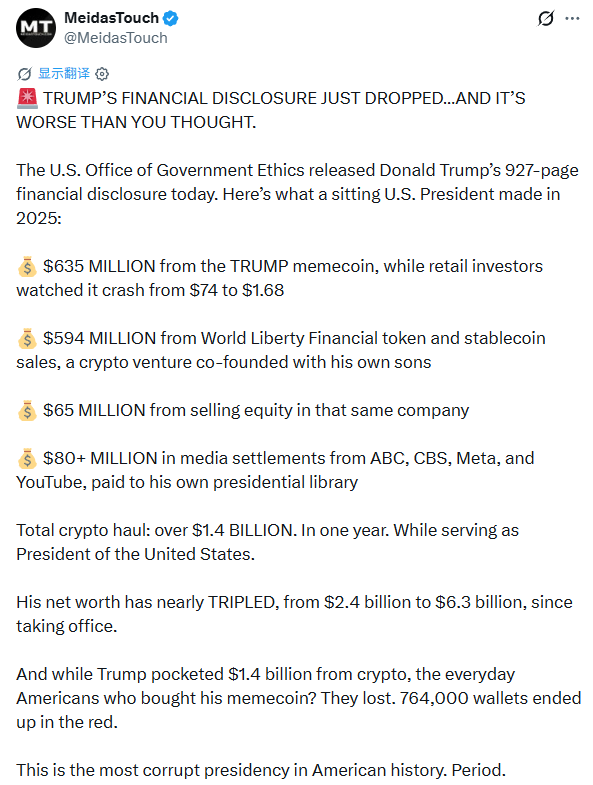


MeidasTouch called it "the most corrupt presidential term in American history," a statement carrying strong political bias, but it points to a real issue. When the issuer's income comes from the trading activity itself rather than the project's long-term value, retail investors are naturally at a disadvantage.


Regulator and Beneficiary as One


The timing of this disclosure coincides with a critical phase of negotiations in the Senate for the most important legislative process in the U.S. crypto industry, the "CLARITY Act." This bill aims to clarify the standards for determining the security status of assets like Bitcoin and Ethereum, but the ethics provision prohibiting the President, Vice President, members of Congress, and their families from holding or benefiting from crypto businesses has yet to be resolved in the negotiations.


Democratic lawmakers have been pushing to include this clause in the final text, citing the issues exposed by this disclosure. Incumbent high-ranking officials should not simultaneously be the biggest beneficiaries of the industry they regulate.


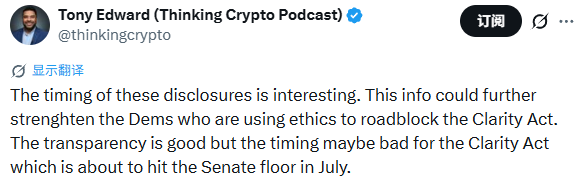
According to comments by Thinking Crypto podcast host Tony Edward on X, the timing of this disclosure's release is "rather delicate," potentially further strengthening the Democrats' leverage to block the bill's progress on ethical grounds; organizations like Transparency International have also consistently criticized the bill for lacking conflict-of-interest provisions.


In contrast, Vance's disclosed $250,000 to $500,000 Bitcoin holding is closer to the level of an ordinary high-net-worth individual investor. The controversy illustrates that the core issue is not "whether officials can hold crypto assets," but "whether the President's family directly operates, issues, and extracts fees from the entities under regulation."


Whether the "CLARITY Act" can incorporate conflict-of-interest provisions within the remaining window will directly determine whether the model of "regulator and beneficiary as one" is merely a unique case of the Trump administration or will become the norm for the long-term coexistence of the crypto industry and power structures in the future.


Related Questions

QAccording to the financial disclosure report, what is the total approximate crypto-related income for President Trump in 2025?

AAccording to the report, the total identifiable crypto-related income for President Trump in 2025 is approximately $1.427 billion.

QWhich entity is the primary operator of Trump's memecoin business and generated significant royalties?

ACIC Digital LLC is the primary operator of the memecoin business. It generated around $635 million in 2025, primarily from royalties for the 'Celebration Coins' token license agreement.

QWhat is the core ethical issue highlighted in the article regarding Trump's crypto wealth and the CLARITY Act?

AThe core ethical issue is the conflict of interest where the President, as a key regulator, is also the largest beneficiary of the industry being regulated through his direct control and income from issuing cryptocurrencies. The article questions the lack of strong ethics clauses in the CLARITY Act to prevent this.

QHow does the article describe the financial outcome for retail investors who bought the Trump-themed memecoin compared to Trump's own earnings?

AThe article states that while President Trump earned approximately $635 million in royalties from the memecoin, around 764,000 wallet addresses are reportedly at a loss as the token's price fell from a high of about $74 to around $1.68.

QWhat is the main difference between the crypto holdings disclosed by Vice President Vance and those of President Trump?

AVice President Vance's disclosure shows a single Bitcoin holding valued between $250,000 and $500,000 with no other crypto income, resembling a typical high-net-worth investor. In contrast, President Trump's wealth stems from operating and issuing cryptocurrencies through controlled entities, generating billions in income from royalties, token sales, and dividends.

Related Reads

Confirmed: Claude Code Secretly Inspects Users, Time Zone and Chinese AI Labs Are Key Factors

Today was a significant day for Anthropic. The company announced the launch of Claude Sonnet 5, described as its most agentic model yet, and separately confirmed that the U.S. Department of Commerce has lifted export controls on its Claude Fable 5 and Mythos 5 models, allowing their distribution to resume. However, a separate controversy has emerged regarding its coding assistant, Claude Code. Developers have exposed that certain versions of the tool allegedly contain hidden code designed to detect specific user data. This code reportedly checks for the use of Chinese time zones (like Asia/Shanghai), the presence of custom API proxy URLs, and connections to domains associated with Chinese tech companies and AI labs. If triggered, this information is said to be encoded into the system prompt sent to the AI cloud, using subtle, nearly indistinguishable variations in characters (like different Unicode apostrophes in the "Today's date" line) as a form of steganography. The core issue is the covert nature of this data collection. While telemetry for security and abuse prevention is common, implementing it through hidden channels within the prompt—without user awareness or documented disclosure—fundamentally breaches trust. This is particularly sensitive for a coding assistant that operates with access to source code and system commands. Following the exposure, an Anthropic engineer acknowledged the code's existence and stated it would be removed in an upcoming release. The incident raises serious questions about transparency and the boundaries of data collection in AI developer tools.

marsbit12m ago

Confirmed: Claude Code Secretly Inspects Users, Time Zone and Chinese AI Labs Are Key Factors

marsbit12m ago

Grayscale: After Halving, BTC is Nearing the Bottom of This Cycle

Grayscale Research suggests Bitcoin's recent decline below $60,000, a >50% drop from its October peak, represents a cyclical correction within a long-term uptrend rather than a trend reversal. Key factors behind the pullback include a shift in market expectations toward Federal Reserve rate hikes under new Chair Kevin Warsh, uncertainty around the CLARITY Act's Senate passage, pressure on leveraged entities like Strategy, and concerns over quantum computing risks. The path out of the current bear market hinges on upcoming catalysts. An optimistic scenario, where the CLARITY Act passes, leverage is contained, and the Fed refrains from hiking, could mean Bitcoin is nearing its cycle bottom. A pessimistic scenario, featuring legislative failure, further deleveraging, and Fed rate hikes, could lead to additional moderate downside. Grayscale does not expect a historically deep ~80% drawdown due to a more measured prior bull run and stickier institutional demand. Despite short-term headwinds, Grayscale remains highly optimistic about crypto's long-term structural prospects, driven by institutional adoption of public blockchains, unsustainable government debt, declining trust in intermediaries, and AI's potential demand for alternative systems. The report concludes that while the exact cycle low depends on near-term catalysts, current valuations present an attractive entry point for long-term investors betting on the decade-ahead growth of digital assets.

marsbit34m ago

Grayscale: After Halving, BTC is Nearing the Bottom of This Cycle

marsbit34m ago

Web3 Bear Market Survival Guide: Ten Great Books to Help You Navigate the Cycles

"Web3 Bear Market Survival Guide: Ten Books to Help You Navigate the Cycle" This article presents a curated book list aimed at helping Web3 enthusiasts and professionals endure and grow during crypto market downturns. It argues that bear markets are not just periods of waiting but crucial times for deepening one's foundational understanding beyond technical whitepapers and price charts. The ten recommended books offer perspectives on technology, economics, philosophy, and strategy to build resilience and long-term vision. The list includes: 1. **"The Inevitable" by Kevin Kelly:** For using a long-term technological lens to combat uncertainty about the future, including the role of crypto and AI. 2. **"Human Action" by Ludwig von Mises:** To upgrade one's economic and philosophical framework, understanding action, speculation, and calculation in a bear market context. 3. **"The Nature of Technology" by W. Brian Arthur:** For viewing blockchain and crypto as combinatorial evolutions of existing technologies, understanding their modular and economic development. 4. **"The Distant Savior" (Chinese novel):** Explores the cultural attributes of self-reliance ("strong culture") versus dependency ("weak culture"), crucial for surviving industry cycles. 5. **"The Sovereign Individual" by James Dale Davidson & Lord William Rees-Mogg:** A prophetic 1997 work on how technology empowers individuals and challenges nation-states, foreshadowing Bitcoin's emergence. 6. **"Japanization: What the World Can Learn from Japan's Lost Decades" (Adapted title):** Uses Japan's economic history as a case study to identify structural opportunities that persist even during broader recessions. 7. **"Denationalisation of Money" by F.A. Hayek:** The ideological blueprint for Bitcoin, arguing for competitive currency issuance beyond state monopoly. 8. **"Duan Yongping Investment Q&A" (Chinese compilation):** Emphasizes the simple discipline of "doing the right things and doing things right," focusing on fundamentals and maintaining a "stop doing list." 9. **"The Network State: How To Start a New Country" by Balaji Srinivasan:** A visionary text from a crypto insider outlining bold predictions and concrete ideas for a blockchain-based future across media, governance, and identity. 10. **"Selected Works of Mao Zedong" (Vol. 1):** Analyzed as a strategic playbook for a weak force challenging a powerful establishment, offering lessons on strategy, alliance-building, and perseverance for the crypto movement. The conclusion states that bear markets filter out those with weak conviction, not weak skills. Survival depends on cognitive depth and mental fortitude, which these books aim to provide.

Foresight News56m ago

Web3 Bear Market Survival Guide: Ten Great Books to Help You Navigate the Cycles

Foresight News56m ago

Trump's 25-Year Financial Report: Family Earns Over $1 Billion Annually from Crypto, While Retail Investors Lose Money on $TRUMP

Former President Donald Trump's family earned approximately $1.2 billion from cryptocurrency ventures in 2025, according to a financial disclosure report. This revenue stream, outlined in a 927-page filing, now surpasses income from most of his long-established real estate holdings. The crypto earnings originated from two main sources: over $500 million from the sale of products like "governance tokens" by World Liberty Financial, a DeFi project co-owned by the Trump family, and roughly $635 million in royalties from the Trump-themed meme coin $TRUMP, issued by CIC Digital LLC. While Trump's entities profited, retail investors faced significant losses. The $TRUMP token, which peaked above $74 shortly after its January 2025 launch, has plummeted to around $1.68. World Liberty Financial's token has also fallen roughly 80% since its debut. Reports indicate that the majority of meme coin buyers have lost money, with Trump-linked entities still holding about 80% of $TRUMP's supply under vesting plans. The disclosure highlights a stark contrast: Trump's crypto and real estate businesses flourished—with new international property deals bringing in tens of millions—even as his administration shifted to crypto-friendly policies, relaxing the stringent regulatory stance of the previous Biden administration. The White House maintains that Trump acts only in the public interest, with his businesses placed in a trust managed by his sons, denying any conflict of interest. However, the report notes the difficulty of assessing such conflicts, particularly regarding foreign business dealings with countries that later received favorable U.S. policy decisions.

marsbit1h ago

Trump's 25-Year Financial Report: Family Earns Over $1 Billion Annually from Crypto, While Retail Investors Lose Money on $TRUMP

marsbit1h ago

From 'Address Clustering' to 'Evidence Standards': Why is Chainalysis Redefining Blockchain Tracing?

**Summary:** In June 2026, Chainalysis introduced the **Blockchain Tracing Ontology (BTO)**, a proposed data framework aiming to establish standardized, transparent, and verifiable models for blockchain analysis. This initiative addresses a core industry issue: despite public blockchain data, different firms often produce inconsistent results (e.g., differing entity labels for the same address) due to non-uniform methodologies, particularly in **address clustering**. This lack of standardization poses challenges for judicial investigations, AML, and enforcement. The BTO is not a new clustering algorithm but a **common "language" or conceptual framework**. It moves beyond the simplistic "cluster" model by introducing a hierarchical structure: **Entity → Wallet → Wallet Segment → Address**, which better reflects complex organizational wallet management. A key shift is from presenting mere results to ensuring **process trust and explainability**. The framework emphasizes documenting the **Evidence** and **Confidence** behind each analytical claim—specifying the on-chain/off-chain data, rules applied, and certainty levels—enabling third-party verification. This focus is partly informed by legal precedents like the **Bitcoin Fog** case, where Chainalysis's methods underwent rigorous judicial scrutiny (Daubert hearing), highlighting the need for reproducible, scientifically sound analysis. The proposal clarifies that on-chain analysis identifies address relationships and flow patterns, not real-world identities, which still require off-chain evidence (e.g., KYC data). Ultimately, Chainalysis envisions steering the industry from an "experience-driven" to a **"standards-driven"** future, where competition centers on **data quality, analytical transparency, and judicial admissibility** rather than just label coverage. Widespread adoption could facilitate cross-agency collaboration, reduce disputes, and provide a more reliable foundation for global compliance and enforcement.

marsbit1h ago

From 'Address Clustering' to 'Evidence Standards': Why is Chainalysis Redefining Blockchain Tracing?

marsbit1h ago

Trading

Spot
活动图片