Is the Plunge Just Beginning? Three 'Macro Bombs' for BTC About to Detonate

Odaily星球日报Published on 2025-12-16Last updated on 2025-12-16

Abstract

Bitcoin experienced a sharp drop on December 15, falling from $89,000 to around $85,000, nearing its December 1 low. The market fear and greed index has fallen to 21, indicating extreme fear. Three major macroeconomic events are expected to further impact Bitcoin's price: First, the U.S. November non-farm payroll data will be released on December 16. Due to the previous government shutdown, October data was incomplete, which may lead to market volatility. Weak data could reinforce expectations of a Fed rate cut in January 2026, but could also increase selling pressure on Bitcoin. Second, the Bank of Japan is widely expected to raise interest rates by 25 basis points on December 19, marking its highest rate in 30 years. This could end the long-standing yen carry trade, reducing liquidity in risk assets like Bitcoin. Historical data shows Bitcoin often drops over 20% following BoJ rate hikes. Third, uncertainty over the next Fed Chair is growing. Kevin Warsh, considered more hawkish, has gained traction as a potential nominee over Kevin Hassett. A Warsh appointment could mean tighter monetary policy, further suppressing Bitcoin’s upward momentum. These factors materialize, Bitcoin may face continued downward pressure, with some analysts predicting a fall toward $70,000.

Original | Odaily Planet Daily (@OdailyChina)

Author | Golem (@web 3_golem)

On the evening of December 15th, Bitcoin experienced another flash crash, plummeting from $89,000 to around $85,000, approaching the low of December 1st ($83,822). Accompanying the sharp drop, the market fear and greed index fell to 21 (extreme fear).

"Be fearful when others are greedy"? The temptation to buy the dip or engage in swing trading is immense right now, but it's also extremely easy to step on a landmine. Monday's flash crash was not an isolated incident. The "three hidden macro risks" planted in December are severely suppressing Bitcoin's upward momentum. A larger storm of decline may have just begun.

Tuesday's Non-Farm Payrolls Night

On Tuesday, December 16th, at 21:30 (UTC+8), the U.S. Department of Labor will release the November Non-Farm Payrolls (NFP) data. Due to the previous U.S. government shutdown, the household survey data for October was not collected, resulting in a blank unemployment rate for October. Consequently, the standalone October NFP data was canceled, but the Labor Department will incorporate the October establishment survey (NFP) data into the November release.

While the NFP data based on the establishment survey remains useful, the lack of contrasting household survey data for October might amplify the contradictions between the non-farm payroll numbers and the unemployment rate, leading to an incomplete and potentially misleading market interpretation. This combined report, missing some key indicators, could increase speculative trading or market volatility, putting pressure on Bitcoin's price. Institutions will also treat this report as an "important but require caution" information.

Citigroup economists also pointed out that the latest employment report to be released on the evening of December 16th might release more conflicting signals. The bank expects October job losses of about 45,000, but an increase of 80,000 jobs in November. They also predict the unemployment rate will rise from 4.4% to 4.52%, while a Reuters survey of economists shows an unemployment rate of 4.4%. The Fed's own quarterly projections indicate a median unemployment rate of about 4.5% by the end of this year.

Coupled with this being the first NFP report since the Fed announced a 25 basis point rate cut on December 10th, market reactions to wages, sector changes, and total employment numbers might be amplified due to expectations for the Fed's January 2026 rate decision.

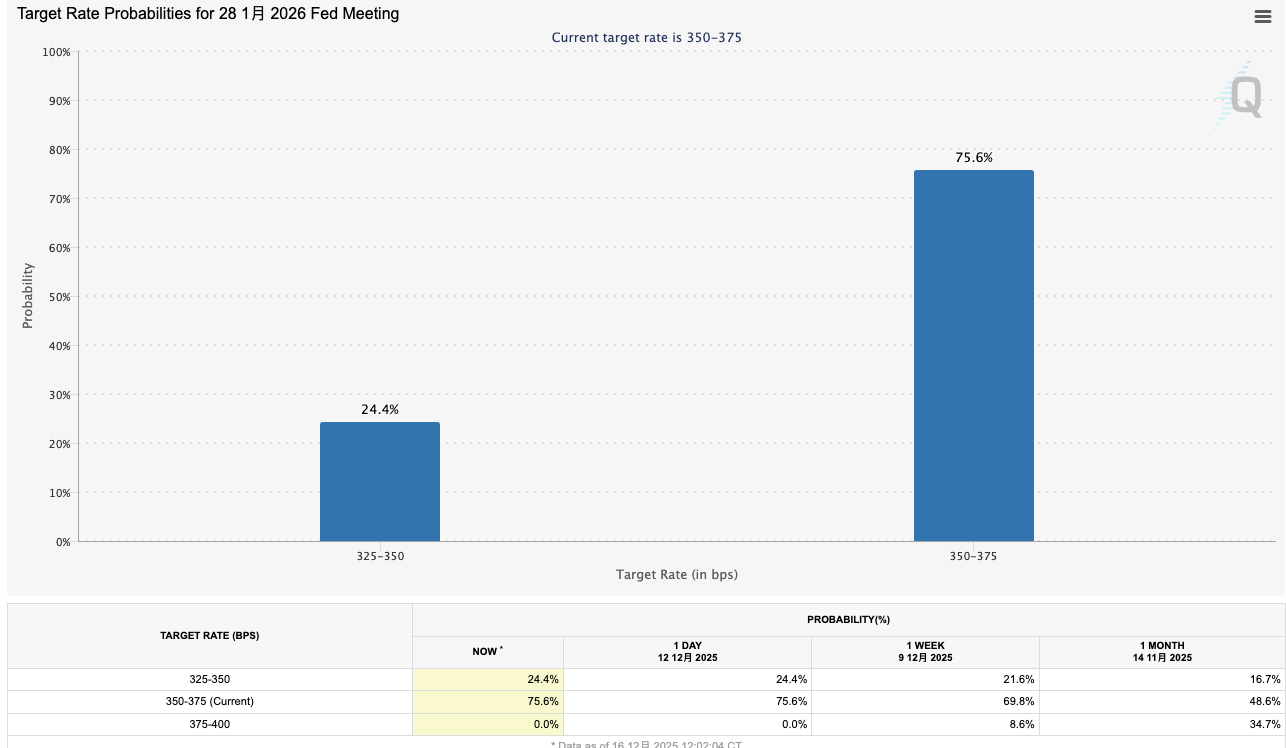
The NFP report's biggest impact is on market expectations for a Fed rate cut in January 2026. According to CME's "FedWatch Tool," the probability of a 25 basis point rate cut in January 2026 is only 24.4%, while the probability of maintaining the current rate is 75.6%.
Morgan Stanley strategist Michael Wilson analyzed that if tonight's NFP report shows moderate weakness, it could intensify market expectations for the Fed to cut rates again at least in the first quarter of next year.

However, the Financial Times believes that tonight's U.S. NFP report will provide policymakers and investors with a more complete picture of the U.S. labor market, ending months of partial "flying blind." Although the Fed cut rates to a three-year low on December 10th amid serious divisions, the current debate still centers on whether to prioritize fighting high inflation or a weakening labor market.

Therefore, in an already消极 (bearish) market, if the NFP data fails to provide a positive signal again, Bitcoin will likely face another downward crisis.

Friday's Bank of Japan Interest Rate Decision

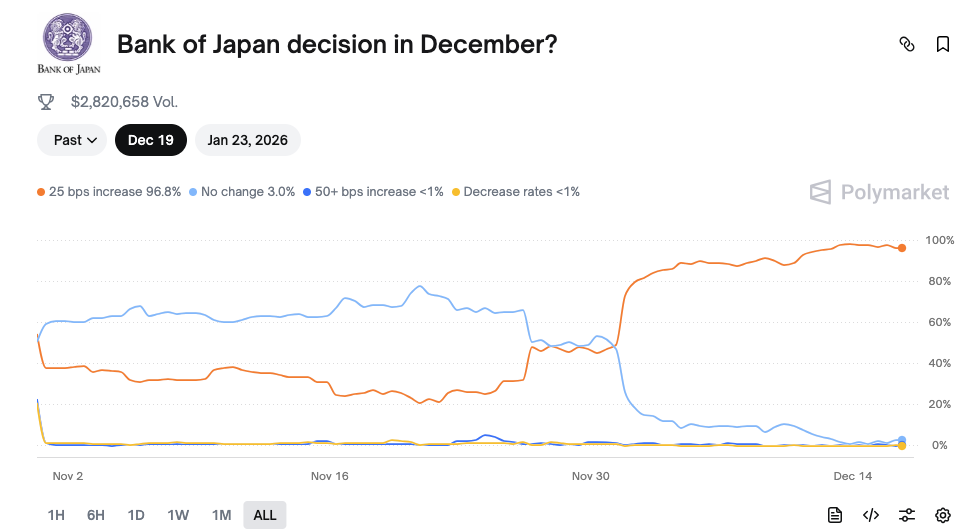
On Friday, December 19th, the Bank of Japan (BOJ) will announce its interest rate decision. The market widely believes a 25 basis point rate hike (to 0.75%) is a "done deal." According to Polymarket data, the probability of a 25 basis point hike on December 19th has reached 97%, which would bring Japanese interest rates to their highest level in 30 years since 1995.
Investors are closely watching the BOJ's rate hike because the Yen carry trade has injected massive amounts of funds into global financial markets over the past decade, including the crypto market. For over a decade, the BOJ's interest rates have basically remained in an ultra-loose range of "close to 0% or slightly negative," allowing numerous institutions and investors to borrow ultra-low-interest Yen and invest in U.S. Treasuries, U.S. stocks, or Bitcoin, "easily earning" the interest rate differential or risk premium.

But a BOJ rate hike will shatter this illusion. Investors will no longer get "free Yen" to conduct carry trades in global financial markets. Stock and crypto markets will face pressure, while the Yen strengthens, and yields on Japanese 10-year and 30-year government bonds rise successively.

Some macro analysts believe that if the BOJ hikes rates as expected on December 19th, Bitcoin could correct further to the $70,000 level. Analyst AndrewBTC tracked historical data, stating that every BOJ rate hike since 2024 has been accompanied by a Bitcoin price drop of over 20%: approximately 23% in March 2024, ~26% in July 2024, and ~31% in January 2025. If the BOJ hikes rates next week, similar downside risks could reappear.

In fact, the market has been shrouded in the shadow of a BOJ rate hike throughout December. To some extent, the market has almost priced in the possibility of Japan raising rates from 0.5% to 0.75% in December. But the key issue is that a December hike by the BOJ is not a one-off action; it's the start of a new rate hike cycle.

Multiple sources透露 (revealed) that after Friday's hike, Japan could see more rate hikes. These sources stated that Japanese officials believe even after hiking to 0.75%, the BOJ仍未达到 (has still not reached) the neutral interest rate level. Some officials already consider 1% to be below the neutral rate. Informed sources indicated that even if the BOJ updates its neutral rate estimate based on the latest data, the range is not expected to narrow significantly at present. The BOJ's current estimate for the nominal neutral rate range is approximately 1% to 2.5%.

In this scenario, not only will Bitcoin's price be under pressure this week, but it also has the potential to continue trending lower for some time. Crypto investors need to prepare themselves psychologically in advance.

Uncertainty Over Next Fed Chair Nomination Intensifies

Hassett has long been a frontrunner to succeed Powell as the next Fed Chair. Even as the candidate list narrowed to 5 people in early December, Hassett's winning probability on Polymarket remained far ahead (Related reading:Fed "Changing of the Guard" Countdown: 5 Major Candidates Revealed, Who is the Final Winner?). The reason is that Hassett is inherently a "Trump-aligned figure" and agrees with Trump on interest rate cut policy (Trump has consistently advocated for rapid rate cuts).

But on December 13th, the situation began to change. Trump said in an Oval Office interview that day: "Both Kevins (Warsh and Hassett) are excellent, and the other candidates are outstanding too."

Simultaneously, according to informed sources, Trump previously met with Warsh in the Oval Office for 45 minutes, during which he pressured Warsh, asking if he could guarantee support for rate cuts if elected Fed Chair. Trump confirmed this in the interview: "He thinks rates must be cut, everyone I've spoken to thinks so too." Trump said he believes the next Fed Chair should seek his opinion when setting interest rate policy.

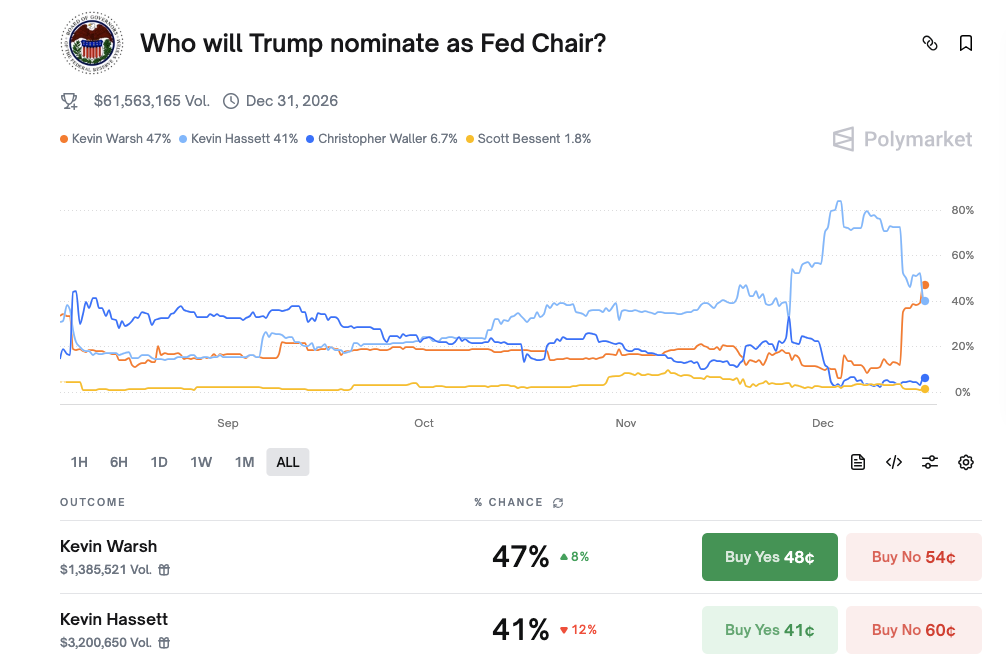
After the news broke, the probability of Warsh being nominated as the next Fed Chair on Polymarket rose to 38%, while Hassett's probability dropped from 75% to 50%.

On December 15th, according to informed sources, some senior figures close to Trump are opposing Hassett becoming the next Fed Chair due to concerns that Hassett is too close to the president. Since then, Hassett's advantage on Polymarket has disappeared. As of now, the probability of Warsh being nominated is 47%, while Hassett is at 41%, slightly behind Warsh.
This is not good news for crypto investors. Crypto investors, of course, are not interested in U.S. political struggles, but rather because Warsh is not part of the "rate cut camp." Warsh has long been considered a "hawk," with policies leaning towards tightening interest rates and combating inflation, and advocating for reducing the central bank's balance sheet. If he takes office, it would clearly suppress the crypto market from a macro perspective.

The Bitcoin plunge on the evening of December 15th was also influenced, in the short term, by the sentiment surrounding Warsh's potential nomination. But if Trump ultimately confirms Warsh's nomination by the end of December, then the Christmas rally anticipated by crypto investors might also fail to materialize.


Related Questions

QWhat are the three major macroeconomic events mentioned in the article that could trigger a further decline in Bitcoin's price?

AThe three major macroeconomic events are: 1) The release of the November U.S. Non-Farm Payrolls (NFP) data on December 16th, which could create market volatility and uncertainty. 2) The Bank of Japan's (BoJ) interest rate decision on December 19th, which is widely expected to result in a 25 basis point hike. 3) The uncertainty surrounding the nomination of the next Federal Reserve Chair, with potential candidates' differing stances on monetary policy affecting market.

QHow did the market's 'Fear and Greed Index' react to Bitcoin's drop to near $85,000 on December 15th?

AThe market's 'Fear and Greed Index' dropped to 21, indicating a state of 'Extreme Fear' among investors following the price decline.

QWhy is the Bank of Japan's potential interest rate hike significant for the Bitcoin and global financial markets?

AA BoJ rate hike is significant because it would end over a decade of ultra-low interest rates that fueled the 'yen carry trade.' Investors borrowed cheap yen to invest in higher-yielding assets like U.S. stocks, bonds, and Bitcoin. Higher Japanese rates would make this trade less profitable, potentially leading to capital outflows from these markets and putting downward pressure on assets like Bitcoin.

QAccording to the article, what impact could the nomination of Kevin Warsh as Fed Chair have on the crypto market?

AThe nomination of Kevin Warsh, who is perceived as a 'hawkish' candidate favoring tighter monetary policy and inflation control, could be negative for the crypto market. His potential policies would be less supportive of lower interest rates, creating a macro environment that could suppress the crypto market's growth and potentially eliminate any expected 'Santa rally'.

QWhat does the article suggest about the nature of the potential Bank of Japan rate hike on December 19th? Is it seen as a one-time event?

AThe article suggests that the potential rate hike is not seen as a one-time event but rather as the beginning of a new cycle of interest rate increases. Sources indicate that Japanese officials believe even a hike to 0.75% has not reached the neutral rate level, implying that further hikes could follow, creating sustained downward pressure on Bitcoin.

Related Reads

Trading

Spot
Futures

Hot Articles

What is $BITCOIN

DIGITAL GOLD ($BITCOIN): A Comprehensive Analysis Introduction to DIGITAL GOLD ($BITCOIN) DIGITAL GOLD ($BITCOIN) is a blockchain-based project operating on the Solana network, which aims to combine the characteristics of traditional precious metals with the innovation of decentralized technologies. While it shares a name with Bitcoin, often referred to as “digital gold” due to its perception as a store of value, DIGITAL GOLD is a separate token designed to create a unique ecosystem within the Web3 landscape. Its goal is to position itself as a viable alternative digital asset, although specifics regarding its applications and functionalities are still developing. What is DIGITAL GOLD ($BITCOIN)? DIGITAL GOLD ($BITCOIN) is a cryptocurrency token explicitly designed for use on the Solana blockchain. In contrast to Bitcoin, which provides a widely recognized value storage role, this token appears to focus on broader applications and characteristics. Notable aspects include: Blockchain Infrastructure: The token is built on the Solana blockchain, known for its capacity to handle high-speed and low-cost transactions. Supply Dynamics: DIGITAL GOLD has a maximum supply capped at 100 quadrillion tokens (100P $BITCOIN), although details regarding its circulating supply are currently undisclosed. Utility: While precise functionalities are not explicitly outlined, there are indications that the token could be utilized for various applications, potentially involving decentralized applications (dApps) or asset tokenization strategies. Who is the Creator of DIGITAL GOLD ($BITCOIN)? At present, the identity of the creators and development team behind DIGITAL GOLD ($BITCOIN) remains unknown. This situation is typical among many innovative projects within the blockchain space, particularly those aligning with decentralized finance and meme coin phenomena. While such anonymity may foster a community-driven culture, it intensifies concerns about governance and accountability. Who are the Investors of DIGITAL GOLD ($BITCOIN)? The available information indicates that DIGITAL GOLD ($BITCOIN) does not have any known institutional backers or prominent venture capital investments. The project seems to operate on a peer-to-peer model focused on community support and adoption rather than traditional funding routes. Its activity and liquidity are primarily situated on decentralized exchanges (DEXs), such as PumpSwap, rather than established centralized trading platforms, further highlighting its grassroots approach. How DIGITAL GOLD ($BITCOIN) Works The operational mechanics of DIGITAL GOLD ($BITCOIN) can be elaborated on based on its blockchain design and network attributes: Consensus Mechanism: By leveraging Solana’s unique proof-of-history (PoH) combined with a proof-of-stake (PoS) model, the project ensures efficient transaction validation contributing to the network's high performance. Tokenomics: While specific deflationary mechanisms have not been extensively detailed, the vast maximum token supply implies that it may cater to microtransactions or niche use cases that are still to be defined. Interoperability: There exists the potential for integration with Solana’s broader ecosystem, including various decentralized finance (DeFi) platforms. However, the details regarding specific integrations remain unspecified. Timeline of Key Events Here is a timeline that highlights significant milestones concerning DIGITAL GOLD ($BITCOIN): 2023: The initial deployment of the token occurs on the Solana blockchain, marked by its contract address. 2024: DIGITAL GOLD gains visibility as it becomes available for trading on decentralized exchanges like PumpSwap, allowing users to trade it against SOL. 2025: The project witnesses sporadic trading activity and potential interest in community-led engagements, although no noteworthy partnerships or technical advancements have been documented as of yet. Critical Analysis Strengths Scalability: The underlying Solana infrastructure supports high transaction volumes, which could enhance the utility of $BITCOIN in various transaction scenarios. Accessibility: The potential low trading price per token could attract retail investors, facilitating wider participation due to fractional ownership opportunities. Risks Lack of Transparency: The absence of publicly known backers, developers, or an audit process may yield skepticism regarding the project's sustainability and trustworthiness. Market Volatility: The trading activity is heavily reliant on speculative behavior, which can result in significant price volatility and uncertainty for investors. Conclusion DIGITAL GOLD ($BITCOIN) emerges as an intriguing yet ambiguous project within the rapidly evolving Solana ecosystem. While it attempts to leverage the “digital gold” narrative, its departure from Bitcoin's established role as a store of value underscores the need for a clearer differentiation of its intended utility and governance structure. Future acceptance and adoption will likely depend on addressing the current opacity and defining its operational and economic strategies more explicitly. Note: This report encompasses synthesised information available as of October 2023, and developments may have transpired beyond the research period.

363 Total ViewsPublished 2025.05.13Updated 2025.05.13

What is $BITCOIN

Discussions

Welcome to the HTX Community. Here, you can stay informed about the latest platform developments and gain access to professional market insights. Users' opinions on the price of BTC (BTC) are presented below.

活动图片