# Research Related Articles

HTX News Center provides the latest articles and in-depth analysis on "Research", covering market trends, project updates, tech developments, and regulatory policies in the crypto industry.

Biology's Paradigm Shift: Zuckerberg's New Open-Source Model Completely Overturns Google's AlphaFold Throne

The AlphaFold era faces a major challenge. A new open-source AI model, ESMFold2, from Meta CEO Mark Zuckerberg's Biohub, has been released alongside a massive database of 11 billion predicted protein structures—surpassing the AlphaFold database by 8 billion entries. Published in Nature, the model is reported to outperform AlphaFold3 in key areas, particularly in predicting protein complexes. Crucially, it is fully open-source with no commercial restrictions. ESMFold2 takes a different technical approach, building on a protein language model trained on billions of sequences, including microbial data from diverse environments like soil and ocean—areas less covered by AlphaFold. The team validated its utility by designing and successfully synthesizing novel functional proteins in the lab. The decision to open-source everything is seen as a strategic move, similar to Meta's approach with its Llama models, aiming to build an ecosystem and accelerate global research. While scientists welcome the resource, some urge caution, noting the need for independent validation of predictions and questioning its performance on entirely novel protein folds. The development signals intensified competition in protein AI, rapidly evolving much like the large language model field, and represents a significant step forward in using AI to decode and engineer the machinery of life.

marsbit05/29 12:31

Biology's Paradigm Shift: Zuckerberg's New Open-Source Model Completely Overturns Google's AlphaFold Throne

marsbit05/29 12:31

Deconstructing Mysterious Researcher Serenity's Chokepoint Algorithm and the Global Revaluation of Equity Assets

Unmasking Serenity's "Chokepoint Theory": A Framework for AI-Era Investment This article deconstructs the investment methodology of the pseudonymous online researcher Serenity (formerly AleaBito on Reddit), who claims extraordinary returns by identifying critical bottlenecks in AI and robotics supply chains. Rejecting Wall Street's typical top-down analysis, Serenity employs a bottom-up, reverse-engineering approach. Starting with an end product like an Nvidia GPU cluster, he meticulously maps the global supply chain down to its most essential, irreplaceable physical components—the "choke points." These are low-profile, often monopolized sub-sectors where a disruption could paralyze entire downstream industries, analogous to a strategic strait controlling global oil flow. His primary focus is the physical evolution of AI data centers, specifically the shift from copper interconnects to silicon photonics and Co-Packaged Optics (CPO). He identifies five critical, monopolized technical barriers within CPO: high-precision fiber alignment components (e.g., FOCI), external light sources and high-power lasers (e.g., SIVE), molecular beam epitaxy equipment (ALRIB/Riber), ultra-high-purity red phosphorus raw materials, and Silicon-on-Insulator (SOI) wafers (Soitec). Serenity extends this framework to humanoid robotics, arguing that while the AI "brain" resides in the US, the physical "body" hardware (actuators, gears, motors) is dominated by Asian manufacturers. He highlights a looming "demand tsunami" for specific rare earth elements essential for robot motors, presenting a severe future supply chain and geopolitical challenge. The article cites several of his investment targets (RPI, SIVE, Soitec, VLN, NBIS) where identifying such choke points, coupled with correcting market mispricings (e.g., ticker code confusion for VLN), allegedly led to significant re-ratings. Ultimately, the article posits that Serenity's core value is not in providing stock picks, but in demonstrating a paradigm: using deep technical analysis to find the silent, indispensable "physical switches" within complex systems, thereby exploiting institutional research blind spots. However, it warns of major risks, including illiquidity in micro-cap stocks, potential "pump-and-dump" accusations, and the foundational gamble that his identified technological paths (like CPO) are the correct and inevitable ones.

marsbit05/28 07:26
Deconstructing Mysterious Researcher Serenity's Chokepoint Algorithm and the Global Revaluation of Equity Assets

marsbit05/28 07:26

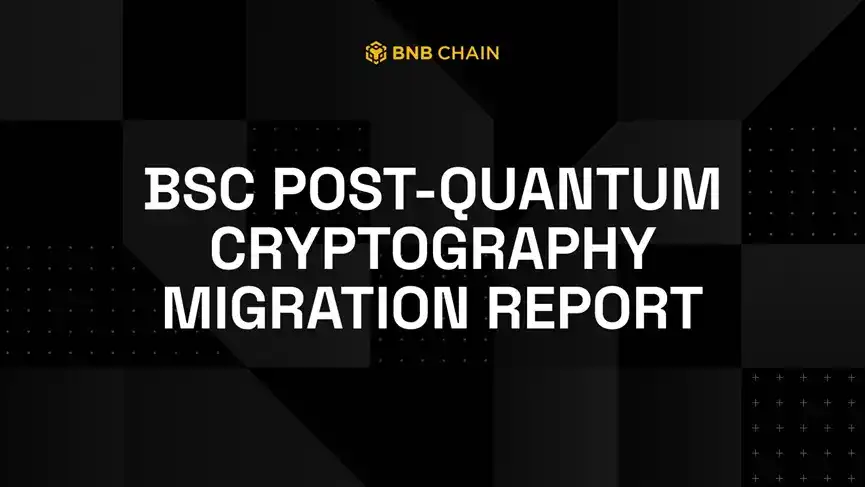
BNB Chain Releases Research Report, Exploring Post-Quantum Cryptography Migration Path for BSC

BNB Chain, a leading Layer-1 blockchain ecosystem, has released a research report exploring the potential migration path for BNB Smart Chain (BSC) to post-quantum cryptography. The study evaluates replacing traditional cryptographic systems with quantum-resistant alternatives, specifically examining the use of ML-DSA-44 for transaction signing and pqSTARK for aggregating validator consensus signatures. While quantum computers are not currently a practical threat to existing blockchain cryptography, the research represents a proactive effort to ensure long-term network security and infrastructure resilience. The report assessed several core areas of the BSC tech stack, including post-quantum transaction signing, validator signature aggregation, transaction validation, public key storage, and network performance under increased data loads. A key finding is that achieving post-quantum readiness is technically feasible today but requires significant trade-offs in scalability. Test data indicates: • Transaction size would increase from ~110 bytes to ~2.5 kilobytes. • Block size would grow from ~110 kilobytes to ~2 megabytes. • Native transfer TPS would decrease from 4,973 to 2,997. The primary performance bottleneck is not signature verification itself, but the increased network transmission overhead caused by larger transaction and block sizes. Conversely, the pqSTARK aggregation technology proved highly efficient, compressing validator signatures by an approximately 43:1 ratio, which helps manage consensus-layer overhead. The report notes that post-quantum alternatives for areas like P2P handshakes and KZG commitments were not within the scope of this evaluation and require further research and broader ecosystem coordination. BNB Chain emphasizes this work is a research-oriented exploration and not a response to any imminent security threat.

marsbit05/18 13:51

BNB Chain Releases Research Report, Exploring Post-Quantum Cryptography Migration Path for BSC

marsbit05/18 13:51

活动图片