# Prediction Related Articles

HTX News Center provides the latest articles and in-depth analysis on "Prediction", covering market trends, project updates, tech developments, and regulatory policies in the crypto industry.


Why Do You Always Lose Money on Polymarket? Because You're Betting on News, While the Pros Read the Rules

Why do you always lose money on Polymarket? Because you bet on news, while the pros study the rules. This article explains how top traders ("che tou") profit by meticulously analyzing market rules, not just predicting events. Polymarket, a prediction market platform, often sees disputes over event outcomes due to ambiguous rule wording. For instance, a market asking "Who will be the leader of Venezuela by the end of 2026?" was misinterpreted by many who bet on Delcy Rodríguez, assuming she held power. However, the rules specified "officially holds" as the formally appointed, sworn-in individual. Since Nicolás Maduro was still recognized as president officially, he won the market—even being in prison. To resolve such disputes, Polymarket uses a decentralized arbitration system via UMA protocol. The process involves: 1. Proposal: Anyone can propose a market outcome by staking 750 USDC, earning 5 USDC if unchallenged. 2. Dispute: A 2-hour window allows challenges with a 750 USDC stake; successful challengers earn 250 USDC. 3. Discussion: A 48-hour period on UMA Discord for evidence and debate. 4. Voting: UMA token holders vote in two 24-hour phases (blind then public). Outcomes require >65% consensus and 5M tokens voted; otherwise, four re-votes occur before Polymarket intervention. 5. Settlement: Results are final and automatic. Unlike traditional courts, Polymarket’s system lacks separation between arbitrators and stakeholders—voters often hold market positions, creating conflicts of interest. This leads to herd mentality in discussions and non-transparent outcomes without explanatory rulings, preventing precedent formation. Thus, success on Polymarket hinges on deep rule interpretation, not just event prediction, exploiting gaps between reality and contractual wording.

marsbit04/20 11:58

Why Do You Always Lose Money on Polymarket? Because You're Betting on News, While the Pros Read the Rules

marsbit04/20 11:58

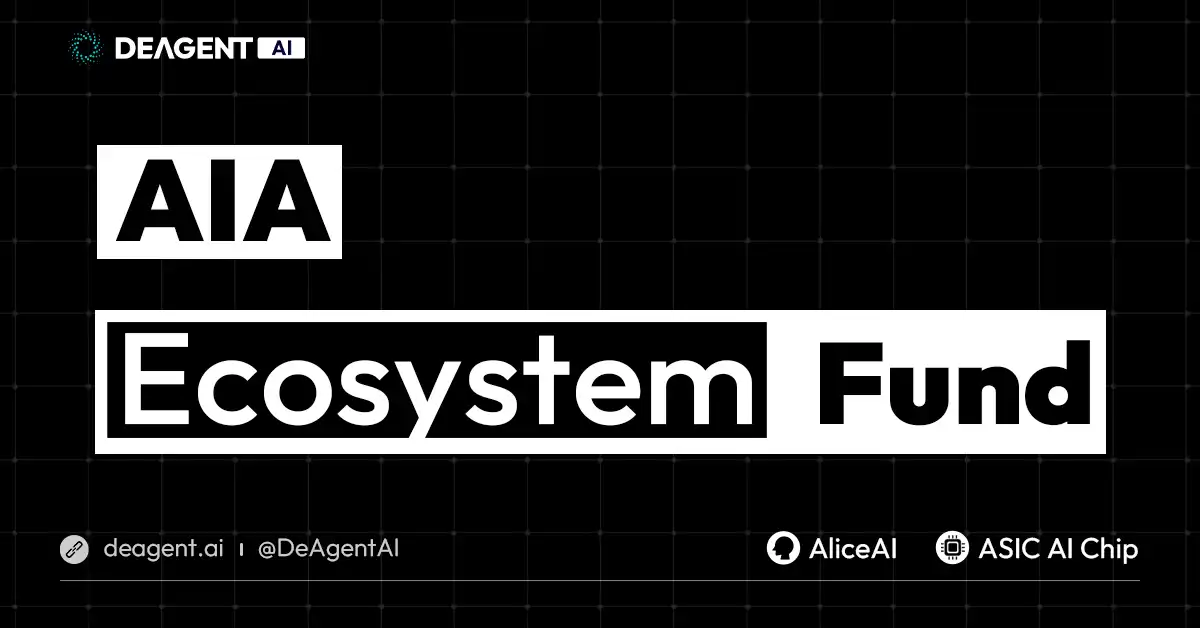
DeAgentAI Announces Establishment of AIA Ecosystem Fund, Focusing on 'AI Agent + Physical AI' Track

DeAgentAI, a leading decentralized AI infrastructure project on SUI and BNB Chain, has announced the establishment of the AIA Ecosystem Fund. The fund will focus on the integrated track of "AI Agent + Physical AI," aiming to incubate and accelerate the next generation of AI applications with autonomous decision-making capabilities and extend AI technology from on-chain intelligence to the real world. The fund will provide comprehensive support in technology, user traffic, and ecosystem resources. Its core investment directions include AI Agent applications with autonomous on-chain execution and multi-agent collaboration capabilities, and Physical AI projects that extend AI inference into the physical world through hardware and computing efficiency. The fund has already made seed-round investments in two projects: - AliceAI: An AI-driven prediction market decision system that compresses fragmented information into verifiable, tamper-proof decision signals, offering a full-cycle solution from signal generation to automated execution via Telegram Bot. - An ASIC AI chip project: A custom hardware solution designed specifically for Transformer-based inference, aiming to reduce token processing costs to less than one-tenth of current GPU solutions while significantly improving energy efficiency and lowering latency. According to DeAgentAI’s founder, the goal is to bridge the gap between on-chain intelligence and the physical world, supporting key protocols that connect users to the future of Physical AI.

marsbit04/14 10:21

DeAgentAI Announces Establishment of AIA Ecosystem Fund, Focusing on 'AI Agent + Physical AI' Track

marsbit04/14 10:21

Tsinghua's Prediction 2 Years Ago Is Becoming Global Consensus: Meta and Two Other Major AI Institutions Have Reached the Same Conclusion

Summary: In a remarkable validation of Chinese AI research, Meta and METR have independently reached conclusions that align perfectly with the "Density Law" proposed by a Tsinghua University and FaceWall Intelligent team two years ago. Published in Nature Machine Intelligence in late 2025, the law states that the computational power required to achieve a specific level of AI performance halves every 3.5 months. This convergence was starkly evident in April 2026. METR reported that AI capabilities are doubling every 88.6 days, while Meta's new model, Muse Spark, demonstrated it could match the performance of a model from the previous year using less than one-tenth of the training compute. When plotted, the growth curves from all three sources—using different metrics (parameters, compute, task length)—show an almost identical exponential slope. The findings have profound implications: AI inference costs are collapsing faster than anticipated, powerful edge-computing AI is becoming rapidly feasible, and the industry's strategy of simply scaling model size is becoming economically inefficient. The Chinese team, which has been building its "MiniCPM" model series based on this law since 2024, is seen as having a significant two-year lead in practical engineering experience, marking a rare instance where Chinese researchers pioneered a fundamental predictive trend in AI.

marsbit04/13 12:14

Tsinghua's Prediction 2 Years Ago Is Becoming Global Consensus: Meta and Two Other Major AI Institutions Have Reached the Same Conclusion

marsbit04/13 12:14

活动图片