# Hedging Related Articles

HTX News Center provides the latest articles and in-depth analysis on "Hedging", covering market trends, project updates, tech developments, and regulatory policies in the crypto industry.

Can IBIT Really Trigger a Market-Wide Liquidation?

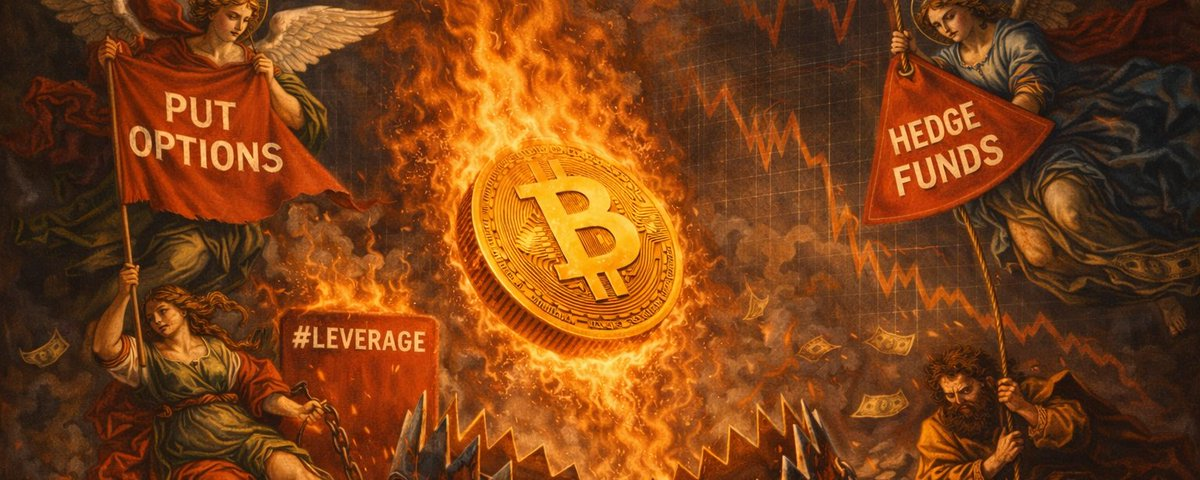
Market discussions have recently focused on the sharp Bitcoin decline and subsequent rebound in early February, with attention turning to the role of BlackRock’s iShares Bitcoin Trust (IBIT). Jeff Park, an advisor at Bitwise, suggests the volatility was closely tied to IBIT’s record-high trading volume and put-heavy options activity on February 5. Contrary to expectations, IBIT saw net creation—not redemption—amid the sell-off, indicating the drop may not have been driven by ETF investor panic. Instead, the pressure likely originated from institutional deleveraging and risk reduction within traditional finance structures. Market makers and multi-asset portfolios adjusted derivatives and hedging positions, transmitting stress through IBIT’s secondary market and options activity, ultimately affecting Bitcoin's price. A common narrative attributes sell-offs to ETF redemptions forcing BTC liquidations. However, only authorized participants (APs) can create or redeem shares. Secondary market trading—no matter how large—only changes share ownership, not the underlying BTC held in custody. On the day of the drop, net BTC outflows from all U.S. spot Bitcoin ETFs amounted to only 5,952 BTC, a small fraction of total holdings. When IBIT sells off in the secondary market, APs may arbitrage discounts by buying shares and hedging with BTC spot sales or futures shorts. This hedging can transmit selling pressure to Bitcoin markets even without significant net redemptions. Thus, IBIT’s influence operates through complex, layered mechanisms rather than direct BTC liquidation.

marsbit02/09 07:39

Can IBIT Really Trigger a Market-Wide Liquidation?

marsbit02/09 07:39

The Real Reason for the "February 5th Crash": A Case of Collateral Damage from Wall Street Deleveraging

On February 5th, the crypto market experienced a sharp crash, with Bitcoin briefly plummeting to $60,000 and over $2.6 billion in liquidations. The article argues that the sell-off was not driven by crypto-native factors but by a broader Wall Street deleveraging event, likely originating from multi-strategy hedge funds facing extreme losses in software stocks and other risk assets. Key evidence includes record-high trading volumes in Bitcoin ETFs like IBIT, dominated by put options, and unusually high correlation between Bitcoin and software stocks. Forced deleveraging triggered the unwinding of delta-neutral strategies (such as basis trades), causing a violent, cascade-like sell-off. This was exacerbated by negative gamma dynamics in the options market, where dealers were forced to aggressively sell underlying assets as volatility spiked. Despite the steep decline, Bitcoin ETFs saw net inflows—not outflows—suggesting the selling pressure came from paper/financial system positioning (e.g., hedge fund liquidations and dealer hedging), not long-term investor redemptions. The rebound on February 6th further indicated that traditional market-neutral capital re-entered to capture renewed basis trade opportunities. The author concludes that the crash was a result of accidental contagion from traditional finance deleveraging, not a crypto-specific crisis, and expects a strong rebound given Bitcoin’s deeper integration into global capital markets.

marsbit02/09 03:00

The Real Reason for the "February 5th Crash": A Case of Collateral Damage from Wall Street Deleveraging

marsbit02/09 03:00

Finally, Aave Founder Also Buys a $30 Million Mansion

Aave founder Stani Kulechov has purchased a $30 million Victorian-style mansion in London's Notting Hill, as crypto wealth increasingly flows into real estate. The deal, completed in November 2025 amid Bitcoin's surge past $120,000, reflects a broader trend of crypto entrepreneurs diversifying digital gains into tangible assets during market peaks. Other notable transactions include Block.one CEO Brendan Blumer’s $170 million Italian villa, Coinbase CEO Brian Armstrong’s $133 million Los Angeles property, and multiple high-profile acquisitions by Stake.com founders and NFT collectors. Some purchases, like FTX’s Sam Bankman-Fried’s $240 million property spree, were later exposed as misappropriated funds. The shift isn’t limited to real estate. Tether, issuer of USDT, has accumulated approximately 140 tons of physical gold—worth about $24 billion—making it one of the largest non-governmental gold holders globally. The company continues buying 1-2 tons weekly, backing its gold-pegged token XAUT and signaling a strategic move toward stable, physical reserves. According to Sotheby’s 2026 Luxury Outlook Report, cryptocurrency is increasingly influencing luxury purchases in markets like Dubai, New York, and California. Regulatory developments may soon allow crypto assets to qualify for mortgage collateral, further integrating digital wealth into traditional finance. This trend underscores a lasting convergence between crypto wealth and conventional asset classes.

marsbit02/04 08:12

Finally, Aave Founder Also Buys a $30 Million Mansion

marsbit02/04 08:12

The World of Gold, the Dollar, and Debt: A Revaluation of the Balance Sheet

The article "The World of Gold, the Dollar, and Debt: A Revaluation of the Balance Sheet" argues that the fundamental, often hidden mechanism organizing modern society is not money itself, but the continuous extension of debtor-creditor relationships. Nations, communities, and individuals essentially trade the future for the present. Economic growth and consumption are fueled by an institutionalized consensus that the future can be allocated in advance, with debt being the technical instrument of this system. From this perspective, the core question becomes: who has the power to discount the future into the present and define that future? Money creation and contraction are merely expressions of this debt-based world. The true "magic" of finance is the intertemporal exchange of resources. The roles of the US dollar and gold are clarified through this lens. The dollar is not merely currency; it is the primary tool for coordinating and denominating global debt. The system functions as a massive intertemporal trade: the US provides future promises, while the world provides present productive capacity to承接 (undertake) that debt. Gold is unique as the only major financial asset with no corresponding liability; it is the ultimate settlement that requires no counterparty's promise. It is therefore often seen as inefficient in a healthy debt system but gains value when the future兑现 (fulfillment) of promises is doubted. The author posits that true避险 (risk aversion) is not about finding a permanently safe asset but about identifying healthy, sustainable balance sheets at different times. The fundamental risk is not volatility but structural debt imbalance. The rise of AI is identified as the key variable reshaping global balance sheets. AI creates a paradox: it drastically reduces the price of digital efficiency (software, information processing) while creating unprecedented rigid demand for physical capital (compute power, electricity, land, energy, minerals). This forces a recalibration of the debt system, as growth becomes tethered to physical constraints rather than financial engineering. Markets are thus pricing future production constraints, seen in the rise of silver and other commodities. The article concludes that while the dollar's network effect and its role as the deepest global asset pool (e.g., for settling trades and collateralizing loans) make it currently irreplaceable, its supremacy is not guaranteed. Its ability to discount the future is challenged by physical constraints. For the dollar to maintain its status, the US must lead in building AI infrastructure, making the dollar the essential token for purchasing the world's most powerful compute and efficient productivity. Failure to do so could lead to a slow, irreversible relative decline of the dollar system, until a new monetary anchor, better aligned with real productive capacity and technological leadership, emerges. Gold, while a temporary haven, is not a permanent solution as it generates no cash flow and cannot enhance productivity.

marsbit02/02 13:42

The World of Gold, the Dollar, and Debt: A Revaluation of the Balance Sheet

marsbit02/02 13:42

活动图片