# Hedging Related Articles

HTX News Center provides the latest articles and in-depth analysis on "Hedging", covering market trends, project updates, tech developments, and regulatory policies in the crypto industry.

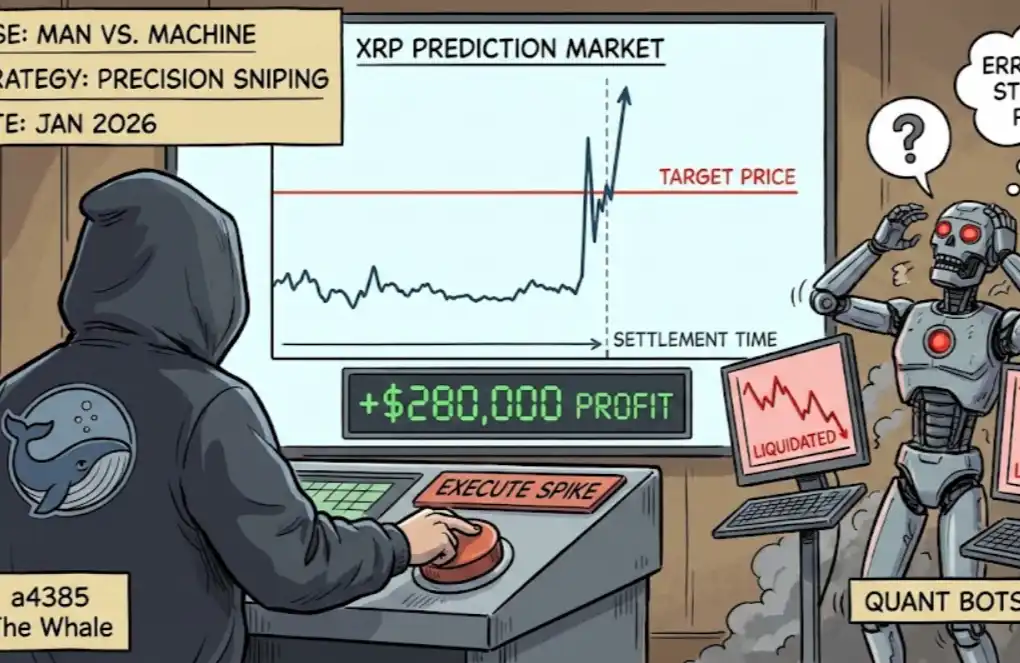
1-Minute Breakdown of Quantitative Models: High Rollers Hunt Down Trading Bots

In the emerging prediction markets, a mysterious trader known as a4385 executed a sophisticated attack against quantitative trading bots, netting $280,000 in 48 hours. These markets allow users to bet on short-term price movements of assets like XRP—for example, predicting whether the price will rise or fall within 15 minutes. Quant algorithms typically profit by exploiting散户情绪 and market inefficiencies with毫秒级 precision. On January 17, 2026, a4385 placed a "rise" bet in an XRP market when the price was below the starting price and the probability of success was only 36%. In the final minute before settlement, a4385 executed large market buy orders, artificially pumping XRP’s price just above the starting threshold at the exact moment of settlement—ensuring his bet paid out. The strategy relied on shallow order book depth (due to weekend trading and XRP’s lower liquidity), allowing a4385 to move the market with relatively modest volume (~$569,000 in the final minute. Each operation cost about $6,200 in fees, but yielded returns as high as $40,218 per round. To hedge against post-settlement price drops, a4385 held short positions of equivalent size, ensuring overall portfolio stability. This required significant capital—over a million dollars—highlighting that this was not luck or a散户 victory, but a calculated exploit of market structure, liquidity conditions, and quantitative model behavior.

marsbit01/21 04:45

1-Minute Breakdown of Quantitative Models: High Rollers Hunt Down Trading Bots

marsbit01/21 04:45

The Era of 'Passive Income' Ends: How Will Crypto Options Carry the Banner of Returns in 2026?

The "lazy yield" era in crypto is ending as traditional DeFi yields compress. Crypto options are poised to become a key financial instrument by 2026, driven by three trends: the decline of easy yields, the emergence of simplified "entry-level products" that abstract options into one-click interfaces, and institutional validation from acquisitions like Coinbase's $2.9 billion purchase of Deribit. While on-chain options currently represent a small fraction of crypto derivatives volume, the success of platforms like Polymarket—which processed $9 billion in 2024—shows strong retail demand for probabilistic betting. New protocols like Euphoria are radically simplifying options into intuitive, gamified experiences, hiding complexity behind sleek UIs. Simultaneously, advanced DeFi options protocols (e.g., Rysk, Derive, GammaSwap, Panoptic) are evolving to serve institutional needs—offering structured products, hedging tools, and capital-efficient strategies for DAOs, funds, and LPs. These platforms provide transparent, composable, and non-custodial options infrastructure. The market will likely bifurcate: a retail layer focused on abstracted, dopamine-driven applications and an institutional layer offering sophisticated risk management and yield strategies. As passive yields diminish, options are emerging as the next frontier for both speculative and defensive crypto finance.

marsbit01/02 00:05
The Era of 'Passive Income' Ends: How Will Crypto Options Carry the Banner of Returns in 2026?

marsbit01/02 00:05

活动图片