# Data Center Related Articles

HTX News Center provides the latest articles and in-depth analysis on "Data Center", covering market trends, project updates, tech developments, and regulatory policies in the crypto industry.

Analog Chip Giants TI and ADI Are Stepping Up

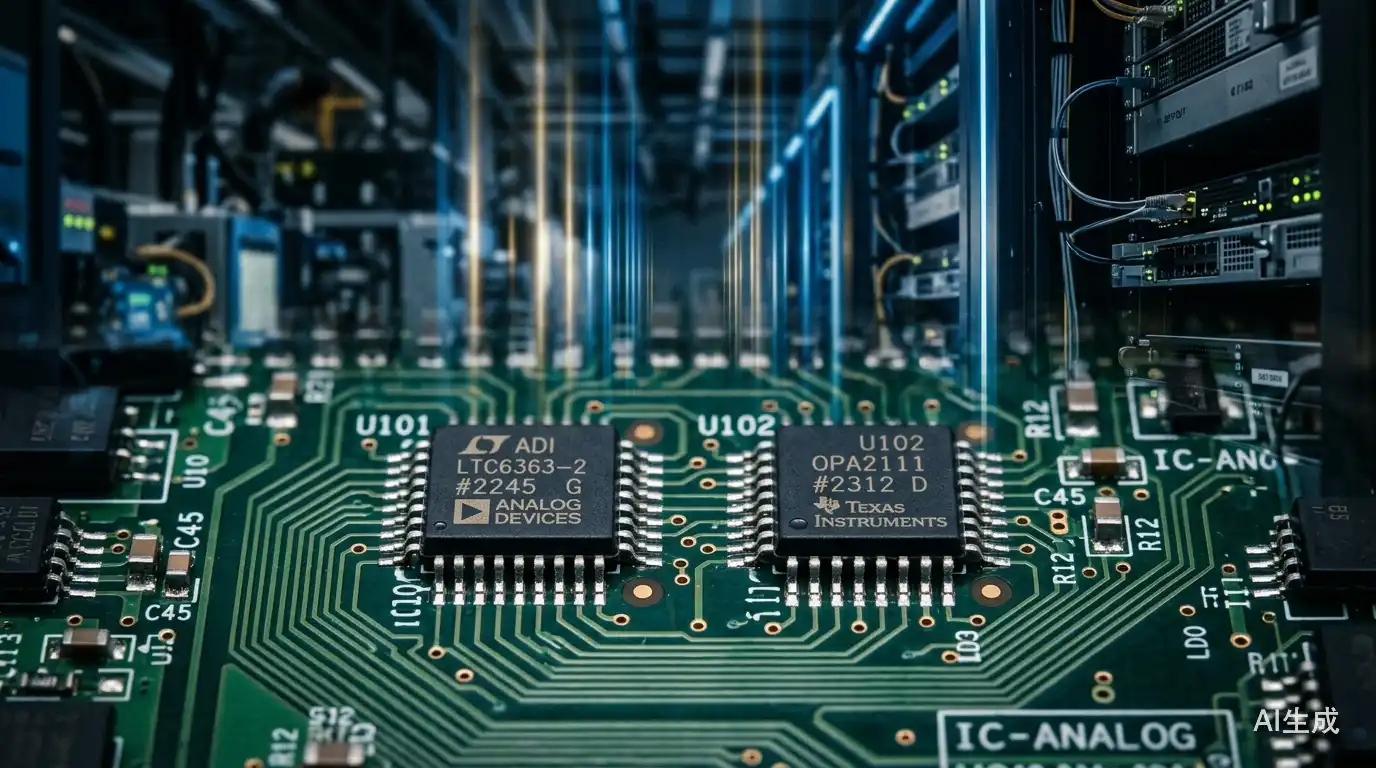
Analog chip giants Texas Instruments (TI) and Analog Devices (ADI) have both reported strong quarterly results, signaling an industry recovery. TI's Q2 2026 revenue reached $5.463 billion, a 23% year-over-year (YoY) increase. ADI's Q3 FY2026 revenue hit $4.022 billion, up 40% YoY, marking a new quarterly record. Both companies benefited from rising demand in industrial and data center markets, though their growth paths differed. TI experienced broad-based strength across its segments. Industrial revenue (33% of total) grew approximately 30% YoY, while data center revenue (9%) doubled. The automotive segment (33%) also showed a strong rebound, attributed to demand from China's EV/hybrid market and low inventory levels at automakers. ADI's growth was led by its industrial (49% of revenue, +53% YoY) and communications (16%, +84% YoY) segments, with data center products constituting 80% of the latter. Management highlighted a significant "AI exposure," with data center and ATE-related businesses now accounting for 20% of total revenue. Key differences emerged in their strategies and supply chain dynamics. ADI attributed a larger portion of its growth to AI infrastructure demand and has built "strategic inventory" to a record high of ~$1.93 billion to support future growth, despite channel inventory being below target levels. Its product lead times have extended to up to six months, and price increases are contributing to margin expansion. TI's inventory remained high at $4.6 billion but saw improved turnover. The company emphasized that its growth is primarily volume-driven, with minimal contribution from recent price hikes. TI maintains a competitive lead time below 13 weeks and expressed confidence in its capacity sufficiency for the next three years. In summary, both companies are riding a recovery wave fueled by industrial and AI/data center demand. TI's approach leverages its broad market presence and prepared capacity, while ADI is more focused on AI-driven growth and strategic inventory buildup. Their differing paths highlight the evolving structure of demand within the analog semiconductor market's rebound.

marsbit1h ago

Analog Chip Giants TI and ADI Are Stepping Up

marsbit1h ago

The New Rules of the AI Race: Nvidia Shifts from Chips to Energy Resources and Construction Sites

Nvidia is providing a $105 billion financial guarantee for the construction of OpenAI's data center campus in Ohio, signaling a strategic shift in the AI industry from competing on chips to battling for physical infrastructure and energy resources. The guarantee, detailed in an SEC filing, acts as insurance against tenant default rather than direct construction funding. OpenAI must repay any sums drawn. Nvidia will also invest $1.5 billion in SB Energy for the project's power component. The planned campus has a capacity of 4.25 GW, with OpenAI's current commitments to Nvidia reaching 12 GW. This move underscores that leading AI development now requires securing space, power, and financial backing for massive, long-term projects. Tech giants are taking on roles akin to developers and financial institutions. Concurrently, AI firms are diversifying suppliers: OpenAI and Anthropic have signed major deals with AMD for GPU deployments. Nvidia is also scaling its financial model through partnerships with investment firms to mobilize over $500 billion in external capital. The paradigm in AI is shifting from hardware supremacy to building comprehensive ecosystems. Future industry growth will depend on balancing innovation with real-world infrastructure capabilities, turning abstract computations into tangible industrial projects. An AI analysis notes the deal's resemblance to vendor financing schemes from the telecom bubble of the late 1990s and questions the long-term viability of gas-dependent energy infrastructure for AI, should market growth slow.

cryptonews.ru08/21 09:16

The New Rules of the AI Race: Nvidia Shifts from Chips to Energy Resources and Construction Sites

cryptonews.ru08/21 09:16

Bitcoin Miners Invest Billions in AI as Capital Expenditure Outpaces Revenue by 15 to 1

Public Bitcoin miners are investing billions to diversify into artificial intelligence (AI) and high-performance computing (HPC), but their revenues from these new ventures are not keeping pace with the massive capital expenditures. According to BlocksBridge Consulting, a group of 15 mining and AI data center companies spent $30.7 billion on capital assets in recent periods of 2026, a 42.6% increase from 2025. For nine comparable Bitcoin miners specifically, the gap is stark: they spent $5.11 billion on capital assets in the first half of 2026 while generating only $341.2 million in disclosed AI/HPC revenue, a capital-to-revenue ratio of approximately 15 to 1. Despite this initial disparity, AI and HPC revenues are growing rapidly, jumping 52% quarter-over-quarter in Q2 2026 for these nine miners. The transition from Bitcoin mining to AI infrastructure requires significant upfront investment in substations, buildings, cooling systems, networking gear, and in some cases, GPUs, even for miners with advantages like power contracts. The recent recovery in Bitcoin's price, which surged over 13% to surpass $72,000, may provide some relief to companies still holding major mining operations. In a related strategic shift, CoinShares has rebranded its industry-tracking ETF to focus on "companies powering the digital economy," including Bitcoin miners, AI data center operators, and semiconductor makers.

cryptonews.ru08/20 20:16

Bitcoin Miners Invest Billions in AI as Capital Expenditure Outpaces Revenue by 15 to 1

cryptonews.ru08/20 20:16

From Cold War Nuclear Wasteland to an 8-Gigawatt AI Superfactory: Huang Renxun Bets $1.5B, OpenAI Secures Exclusive 20-Year Deal

A Cold War-era uranium enrichment site in Ohio, once used for atomic bomb production, is being transformed into the world's largest AI supercomputing facility. NVIDIA, OpenAI, and SoftBank are leading this project, which plans an ultimate power capacity of 8 gigawatts—nearly two-thirds of the total power used by 82 of the world's top AI data centers today. NVIDIA's CEO Jensen Huang has committed $1.5 billion in funding and a 20-year credit guarantee for the infrastructure. OpenAI has signed a 20-year lease to fully utilize the facility's computing power. SoftBank is investing heavily in land acquisition, construction, and grid upgrades, promising to add 1 gigawatt of new power generation. Huang argues that the next major bottleneck for AI advancement is no longer chip supply, but the availability of land, power, and data center space—resources that new AI companies often lack the long-term credibility to secure. By leveraging NVIDIA's market position and credit to lock down these critical physical resources for decades, the company ensures a steady, long-term demand for its GPUs within the facility. The infrastructure, with a 20-year lifespan, will host new generations of NVIDIA hardware every few years, creating recurring revenue streams. Analysts estimate this project alone could represent a $600 billion revenue opportunity for NVIDIA from OpenAI by 2030. This move signifies a strategic shift in the AI race: competition is expanding from semiconductor technology to securing the foundational elements of power and real estate on a massive scale.

marsbit08/18 11:21

From Cold War Nuclear Wasteland to an 8-Gigawatt AI Superfactory: Huang Renxun Bets $1.5B, OpenAI Secures Exclusive 20-Year Deal

marsbit08/18 11:21

活动图片