# Data Center Related Articles

HTX News Center provides the latest articles and in-depth analysis on "Data Center", covering market trends, project updates, tech developments, and regulatory policies in the crypto industry.

HIVE Invests $185 Million in 2016 Blackwell Ultra GPUs to Achieve $200 Million Annual Revenue Target

HIVE Digital Technologies announced that its subsidiary BUZZ HPC has signed a five-year contract worth approximately $350 million with a high investment-grade company to provide cloud computing services using GPUs. The deal is expected to generate around $500,000 in daily revenue from high-performance computing once operational in Q4. This marks the second major GPU supply agreement since June. The contract will increase BUZZ HPC's annual revenue by about $70 million, bringing HIVE's total projected annual revenue to approximately $180 million. About $35 million is recognized immediately, with the remaining $145 million under contract to be deployed by the end of 2026. Under the agreement, BUZZ HPC will deploy a dedicated cluster of 2,016 NVIDIA Blackwell Ultra GPUs hosted in GB300 NVL72 racks, using Quantum-X800 InfiniBand networking and VAST Data storage. The cluster, based on an NVIDIA reference architecture, will be located at Bell AI Fabric's site in Merritt, British Columbia, powered by renewable hydroelectricity. HIVE estimates the capital expenditure for the cluster and related equipment at around $185 million. Funding will come from an upfront client payment, proceeds from a future convertible note issuance, and equipment financing. After the contract term, HIVE will retain ownership of the infrastructure. This move is part of HIVE's strategy to reach a $200 million annual revenue target from its GPU cloud business. Other mining companies like IREN, Hut 8, and TeraWulf have also recently announced major AI/cloud deals.

cryptonews.ru08/17 17:53

HIVE Invests $185 Million in 2016 Blackwell Ultra GPUs to Achieve $200 Million Annual Revenue Target

cryptonews.ru08/17 17:53

US AI Giant's Massive Bond Issuance, Hiding a Nearly $2 Trillion Off-Balance-Sheet 'Bomb'

Amidst the AI investment boom on Wall Street, a rare bond issuance frenzy is sweeping major US tech firms. AMD recently raised $4.75 billion in its largest-ever USD bond sale. This follows massive debt offerings from Nvidia ($25B), Amazon (planning at least $25B), and Alphabet ($25B), with tech giants collectively issuing nearly $220 billion in bonds so far this year—more than double 2025's total. While this fuels an AI infrastructure "race," raising real yields, a hidden risk looms. Research by Goldman Sachs and Morgan Stanley reveals nearly $2 trillion in off-balance-sheet financial commitments from giants like Alphabet, Microsoft, Amazon, and Meta. These stem from future lease obligations and purchase contracts for data centers, not formally recorded as debt. The trend, pioneered by Meta's structured financing for its Louisiana data center, allows massive expansion without bloating balance sheets. Though traditional credit metrics for these companies remain strong, credit markets are reassessing risk. Yields on related bonds are rising, and credit default swap (CDS) premiums for firms like Oracle and Nvidia have hit record highs. The concern is that if AI data center returns disappoint, these hidden liabilities could significantly impact credit markets. Investors are advised to look beyond headline numbers and scrutinize financial statement footnotes.

marsbit08/14 10:53

US AI Giant's Massive Bond Issuance, Hiding a Nearly $2 Trillion Off-Balance-Sheet 'Bomb'

marsbit08/14 10:53

Nomura Research Report Insights: Lumentum's Performance Confirms Continued Shortage of Optical Chips, Chinese Suppliers See Structural Opportunities

Lumentum's Q4 FY26 earnings, with revenue surging 109% YoY to $1.01B, confirm a sustained global shortage of key optical chips like EML and CW lasers. Nomura's analysis indicates this supply-demand imbalance is expected to persist through FY26-FY27, driven by explosive demand from AI data centers. This shortage creates a structural window of opportunity for Chinese suppliers. Lumentum's performance highlights strong demand across laser categories: narrow linewidth laser component shipments grew over 130% YoY, and pump laser shipments grew 80%. EML sales set a quarterly record, fueled by 100G demand, with 200G EML accelerating to over 25% of related revenue. CW lasers are dominating 1.6T silicon photonics applications, while EML is projected to regain share in the 3.2T era. The technological roadmap is clear, with NPO (Near-Packaged Optics) seen as an incremental step before CPO (Co-Packaged Optics) commercialization around 2027-2028. Furthermore, Lumentum's Optical Circuit Switch (OCS) shipments doubled quarter-over-quarter, aligning with AI data center architectural upgrades. Nomura identifies specific Chinese companies poised to benefit: chipmaker Source Photonics for global market share gains, module leader InnoLight from the 800G-to-1.6T upgrade and silicon photonics adoption, and Tianfu Communication from incremental NPO opportunities. The report issues ratings and price targets for these A-share companies. In summary, Lumentum's results signal a structural shift where AI-driven bandwidth demand is outpacing upstream optical chip supply, creating a strategic window for the Chinese optical communication supply chain.

marsbit08/14 06:26

Nomura Research Report Insights: Lumentum's Performance Confirms Continued Shortage of Optical Chips, Chinese Suppliers See Structural Opportunities

marsbit08/14 06:26

A Glimpse into Crypto Miners in Q2: Rushing into AI Data Centers – Are They Profiting?

Mining companies presented mixed Q2 results as they navigate the shift towards AI data centers alongside their core Bitcoin mining operations. While mining output increased for some, declining Bitcoin prices and rising network difficulty pressured revenues. For instance, MARA mined more Bitcoin year-over-year but saw a 27% revenue drop and a significant net loss, partly due to unrealized losses on Bitcoin holdings. The standout trend is the growing contribution of AI/high-performance computing (HPC) hosting revenue. Core Scientific now derives over 80% of its revenue from high-density hosting, while TeraWulf generates about 71% from HPC leasing. However, the transition is at varying stages. Companies like Riot Platforms and Cipher Digital are in earlier phases, with AI-related revenue still a smaller portion of their total income. The article cautions against conflating massive, long-term AI hosting contracts (often valued in billions) with current quarterly revenue, as income recognition depends on capacity delivery and lease commencement. Financially, net losses were common but driven by different factors: some by Bitcoin price revaluations or warrant fair value changes, others by operational costs exceeding revenue. The sector is diverging into three paths: pure-play miners focusing on efficiency, companies successfully transitioning to AI hosting, and those in a challenging transitional phase where legacy mining income is declining before new AI revenue scales up. The key to future performance lies in reliable power access, timely data center delivery, and converting long-term contracts into consistent quarterly income.

marsbit08/14 04:59

A Glimpse into Crypto Miners in Q2: Rushing into AI Data Centers – Are They Profiting?

marsbit08/14 04:59

Why Has NeoCloud Experienced the Largest Rally in This Round of U.S. Tech Stock Rebound?

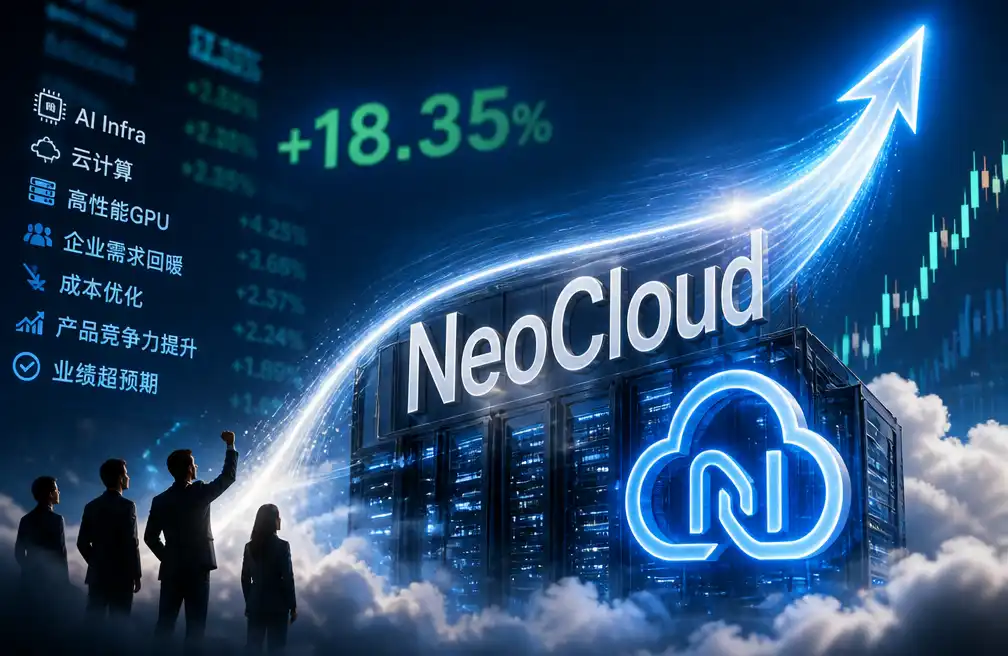
This round of tech stock rebound saw NeoCloud companies like CoreWeave and Nebius among the biggest gainers. The market is essentially pricing in highly leveraged AI infrastructure assets with locked-in, fast-deployable compute capacity. The key driver is a shift in AI bottlenecks from just GPUs to the entire ready-to-run capability—GPU clusters, power, data centers, networking—delivered within months. NeoCloud operators fit this gap perfectly. Their value lies in scarce, contractible assets: existing power capacity and data center space that can be locked in via long-term customer agreements. Recent earnings from CoreWeave and Nebius showcased a viable business model, shifting the narrative from "capital-intensive GPU lessors" to "order-backed AI infrastructure operators." Large backlogs and recurring revenue provide visibility, ease financing for expansion, and create a growth flywheel. The outperformance relative to storage or hyperscaler cloud stocks stems from greater leverage and exposure. NeoCloud's smaller revenue base offers higher earnings and valuation elasticity per new contract. Its leverage is threefold: operational (high fixed costs), financial (contracts enabling debt financing), and equity-based (amplified impact on equity value). Ultimately, the rally represents a re-rating of assets that combine GPU, power, and data center capacity into deliverable AI compute. Market focus is now on execution: converting massive backlogs into energized clusters, recognized revenue, and cash flow.

marsbit08/13 05:46

Why Has NeoCloud Experienced the Largest Rally in This Round of U.S. Tech Stock Rebound?

marsbit08/13 05:46

Wall Street Begins to Question Tech Giants' AI Narrative

Wall Street Questions the AI Narrative of Tech Giants Wall Street is shifting its focus from the hype surrounding artificial intelligence (AI) to a rigorous financial reality check. Following strong earnings reports from companies like Google and a massive $500 billion financing initiative from Nvidia for AI infrastructure, the market reaction has been mixed and skeptical. The core concern revolves around the massive capital expenditure (CapEx) required for AI development—building data centers and acquiring chips—and whether future cash flows can justify these upfront costs. Investors are now scrutinizing free cash flow (FCF), which measures the cash left after operational expenses and capital investments. A negative FCF, as seen recently with Alphabet (Google's parent company), signals heavy immediate spending, even if profits are growing. The divergent stock reactions highlight this new scrutiny. Microsoft's stock surged after its earnings, supported by strong operating cash flow, growing cloud revenue (Azure), and a large backlog of committed business. In contrast, Alphabet's stock fell despite profit growth because its capital spending caused FCF to turn negative for the first time. Similarly, Nvidia's announcement of a $500 billion financing platform, while potentially expanding its market, raised questions about whether AI build-out has become too expensive for tech companies to fund internally. Analysts are moving beyond simply asking if there is AI demand—which cloud revenue growth confirms—to deeper questions: the speed at which AI investments translate into revenue, profit, and ultimately, cash returns. The market is evaluating the "return on invested capital" (ROIC) over the long term, considering factors like rapid chip obsolescence, energy costs, and future competition. In summary, Wall Street's AI narrative is evolving from grand vision to a detailed financial and operational examination. The key question is no longer if AI is transformative, but whether companies can generate cash returns fast enough to outpace the immense costs of building it. Free cash flow has become a critical first filter in this reassessment.

marsbit08/12 12:31

Wall Street Begins to Question Tech Giants' AI Narrative

marsbit08/12 12:31

活动图片