# Banking Related Articles

HTX News Center provides the latest articles and in-depth analysis on "Banking", covering market trends, project updates, tech developments, and regulatory policies in the crypto industry.

The Banking Industry's Resistance: The Endless Debate Over Stablecoin Interest Payments

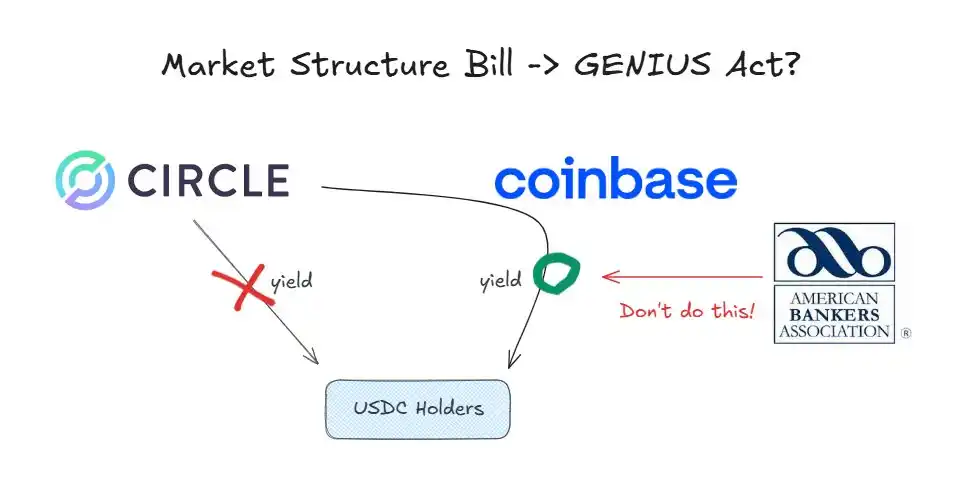
The article discusses the ongoing regulatory debate in the U.S. regarding interest payments on stablecoins. The proposed *GENIUS Act* currently prohibits stablecoin *issuers* from paying interest to holders. However, platforms like Coinbase can still offer yields (e.g., 3.35% on USDC) because they act as *distributors*, not issuers. This loophole has sparked a significant political battle. The American Bankers Association (ABA) is leading efforts to expand the interest ban to include distributors in the upcoming *Crypto Market Structure Bill*. Banks argue that stablecoins threaten their deposit base, reduce lending capacity, and lack FDIC insurance, thereby endangering their traditional business model. The crypto industry strongly opposes this expansion. Coinbase's Chief Policy Officer argues stablecoins haven't caused significant bank deposit outflows. Think tank Paradigm suggests that banning interest on stablecoins used for payments would be akin to a "holding tax" on consumers. The article contrasts the U.S. situation with approaches in China and South Korea. China's digital yuan (a CBDC) pays interest to promote adoption, while South Korea's policy mirrors the current U.S. stance—banning issuer interest but not distributor interest. The conclusion warns that if the ABA's lobbying succeeds, it would cripple the crypto industry. It argues that traditional finance should adapt to innovation, citing examples of banks and asset managers (like BNY Mellon, JPMorgan, and BlackRock) already embracing opportunities in stablecoins and tokenization.

marsbit01/09 12:44

The Banking Industry's Resistance: The Endless Debate Over Stablecoin Interest Payments

marsbit01/09 12:44

RWA Weekly: Central Bank to Steadily Develop Digital Yuan by 2026, WeChat and Alipay to Gradually Gain Authorization to Open Wallets

This RWA Weekly report covers developments from January 2-9, 2026. The total on-chain market cap for Real World Assets (RWA) grew steadily to $19.8 billion, with holders surpassing 607,000. Stablecoin market capitalization saw a slight decrease to $2.986 trillion, yet monthly transfer volume surged 29.04% to $7.02 trillion, indicating increased institutional large-scale settlement activity amid stagnant retail participation. Key regulatory developments include the People's Bank of China announcing it will steadily develop the digital yuan (e-CNY) in 2026, with plans for platforms like WeChat and Alipay to gradually gain permissions to open e-CNY wallets. South Korea proposed new rules requiring banks to have a majority controlling stake in stablecoin issuers. Russia is accelerating the large-scale integration of the digital ruble into its budget and banking systems. Notable project updates: Jupiter launched its compliant, reserve-backed stablecoin JupUSD. Tempo introduced the TIP-20 token standard designed for payments. Traditional finance integration advanced as UAE's RAKBank received approval to issue a dirham-pegged stablecoin, Lloyds Bank completed the UK's first tokenized deposit purchase of government bonds, and J.P. Morgan expanded its JPM Coin to the Canton network. Other developments include the launch of a yield-sharing Brazilian stablecoin (BRD) and the public issuance of Wyoming's official stablecoin, FRNT, on the Solana network. Insights from reports by BlackRock and Moody's highlight that stablecoins are evolving from niche crypto products into core market infrastructure, challenging traditional fiat currencies and reshaping the banking landscape, particularly in emerging markets.

marsbit01/09 08:29

RWA Weekly: Central Bank to Steadily Develop Digital Yuan by 2026, WeChat and Alipay to Gradually Gain Authorization to Open Wallets

marsbit01/09 08:29

活动图片