# Algorithm Related Articles

HTX News Center provides the latest articles and in-depth analysis on "Algorithm", covering market trends, project updates, tech developments, and regulatory policies in the crypto industry.

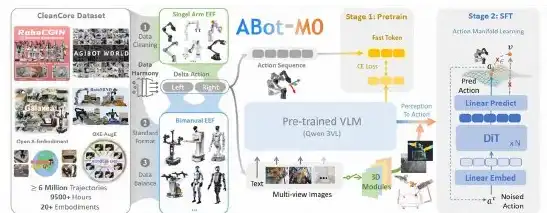
Embodied Intelligence Breakthrough: Amap Fully Open-Sources Universal Robot Base Model ABot-M0

Embodied Intelligence Breakthrough: AutoNavi Open-Sources Universal Robot Base Model ABot-M0 AutoNavi has announced the full open-source release of ABot-M0, the world's first unified architecture-based embodied manipulation base model. This model is designed to enable "one general brain to adapt to multiple forms of robots," aiming to break down barriers between heterogeneous hardware and accelerate the adoption of embodied intelligence in industrial and household settings. ABot-M0 demonstrated exceptional performance in industry tests, achieving a task success rate of 80.5% on the Libero-Plus benchmark—a nearly 30% improvement over the previous benchmark, Pi0. It also set new state-of-the-art records on benchmarks like Libero and RoboCasa. The open-source release addresses long-standing challenges in the field, such as data isolation and deployment difficulties, by providing resources across three key dimensions: - **Data:** The UniACT dataset, the largest of its kind, with over 6 million real operation trajectories and full data pipeline tools. - **Algorithm:** The model architecture and training framework, featuring innovative components like Action Manifold Learning (AML) and a dual-stream perception architecture. - **Model:** End-to-end pre-trained models and a complete toolchain for out-of-the-box deployment, significantly lowering the barrier to adaptation. According to AutoNavi's ABot-M0 technical lead, this open-source initiative aims to build a bridge between academic research and industrial application, enabling robots of various forms to possess a smart, reliable, and universal "brain."

marsbit04/01 08:19

Embodied Intelligence Breakthrough: Amap Fully Open-Sources Universal Robot Base Model ABot-M0

marsbit04/01 08:19

Using AI for Weather Prediction: Earn $200 a Day While Doing Nothing?

Using AI for Weather Prediction: Can You Really Earn $200 a Day? This article explores how to leverage AI and data analysis to profit from weather prediction markets like Polymarket, focusing on Shanghai’s temperature forecasts. The system relies on Shanghai Pudong Airport (ZSPD) weather station data, sourced via Wunderground, rather than general city forecasts. Key insights include: - Temperature data is reported in whole Fahrenheit values in METAR format, not Celsius, affecting precision. - Historical data shows daily high temperatures most frequently occur between 11:00-13:00, peaking at 12:00 in summer (27.6% of days). Three effective prediction methods were implemented: 1. **Integrated Forecasting**: Combines Weather Company (WC) and ECMWF model data, weighted by weather conditions (e.g., sunny days favor WC). 2. **Real-Time Correction**: Uses morning temperature rise data and historical patterns to extrapolate the daily high, adjusted for cloud cover and wind. A Kalman filter dynamically weights real-time data vs. forecasts. 3. **Temperature Trend Model**: Predicts whether the day will be warmer/cooler than the previous day using pre-dawn data (pressure changes, wind, cloud cover, recent trends). It performs best in winter (clear signals) but poorly in autumn (63.7% accuracy). Two failed methods—Fourier analysis (systematic underestimation) and ERA5 peak-time prediction (insufficient precision)—were discarded. Case studies demonstrate the system identifying mispriced market opportunities, such as recognizing nighttime warming from moist air during rainfall, when public sentiment lagged. Limitations include autumn inaccuracy, lack of real-time pressure data, and unresolved coastal wind effects. Ultimately, the goal isn’t perfect accuracy but leveraging informational edges when odds are favorable.

marsbit03/18 12:18

Using AI for Weather Prediction: Earn $200 a Day While Doing Nothing?

marsbit03/18 12:18

In the Eyes of Algorithms, Oil and Memecoin Are No Different

In 1974, Henry Kissinger’s “petrodollar” deal with Saudi Arabia helped sustain the global dominance of the U.S. dollar after the collapse of the gold standard. Fifty years later, oil markets are being shaken not by physical supply chains, but by digital signals. A single social media post by U.S. Energy Secretary Chris Wright on X triggered a flash crash in oil prices. He claimed the U.S. Navy had escorted a tanker through the Strait of Hormuz—a critical chokepoint for global oil transit. Within minutes, WTI crude fell 17%, erasing billions in market value. The post was soon deleted after a White House denial, and prices partially rebounded, but the damage was done. The incident highlights how algorithmic trading systems now drive market reactions. Algorithms scanned the post, detected keywords like “Navy,” “escorted,” and “Hormuz,” and executed sell orders in milliseconds—far faster than human traders could react. Oil, once governed by physical supply and geopolitical agreements, now behaves like a meme-driven instrument, vulnerable to unverified information. This event underscores a broader shift: the “memefication” of assets. In an age of AI and social media, even traditional commodities like oil can be swayed by narratives, emotions, and digital misinformation. The very foundations of market consensus have grown fragile, accelerated by algorithms that trade on speed, not substance. Perhaps, in the end, the meme has won.

marsbit03/12 03:37
In the Eyes of Algorithms, Oil and Memecoin Are No Different

marsbit03/12 03:37

The Next Earthquake in AI: Why the Real Danger Isn't the SaaS Killer, But the Computing Power Revolution?

The next seismic shift in AI isn't about SaaS disruption but a fundamental revolution in computing power. While many focus on AI applications like Claude Cowork replacing traditional software, the real transformation is happening beneath the surface: a dual revolution in algorithms and hardware that threatens NVIDIA’s dominance. First, algorithmic efficiency is advancing through architectures like MoE (Mixture of Experts), which activates only a fraction of a model’s parameters during computation. DeepSeek-V2, for example, uses just 9% of its 236 billion parameters to match GPT-4’s performance, decoupling AI capability from compute consumption and slashing training costs by up to 90%. Second, specialized inference hardware from companies like Cerebras and Groq is replacing GPUs for AI deployment. These chips integrate memory directly onto the processor, eliminating latency and drastically reducing inference costs. OpenAI’s $10 billion deal with Cerebras and NVIDIA’s acquisition of Groq signal this shift. Together, these trends could collapse the total cost of developing and running state-of-the-art AI to 10-15% of current GPU-based approaches. This paradigm shift undermines NVIDIA’s monopoly narrative and its valuation, which relies on the assumption that AI growth depends solely on its hardware. The real black swan event may not be an AI application breakthrough but a quiet technical report confirming the decline of GPU-centric compute.

marsbit02/12 04:38

The Next Earthquake in AI: Why the Real Danger Isn't the SaaS Killer, But the Computing Power Revolution?

marsbit02/12 04:38

The 15-Minute Win-Lose Game: A Million Transaction Records Unveil the 'Folded World' of Bitcoin Prediction Markets

A data analysis of Bitcoin's 15-minute price prediction markets reveals a stark reality dominated by algorithmic trading bots. Over a three-day period encompassing 291 markets, 1.05 million transactions totaling $17 million were recorded. While 17,254 unique addresses participated, the vast majority were retail users treating it like a "lottery," with an almost even split between winners and losers. The key finding is the market's domination by a tiny minority: just 247 algorithm-driven addresses (3.6% of users) executed over 60% of all trades. These bots generated a collective profit of approximately $284,000, while human traders, overall, lost $154,000. Bots also boasted a significantly higher win rate of 65.5% compared to 51.5% for humans. The analysis further debunked the assumption that pure speed guarantees success. The most profitable bot, which earned $54,531, had a high win rate of 72% but was selective, participating in 61% of markets. In contrast, hyper-frequency bots trading over 50 times per hour often had negative returns due to gas fees and intense competition. For human traders, the data suggests a path to success lies in low-frequency, high-conviction trading, where the win rate can reach 55%. However, humans consistently fail at risk management, often holding onto losing positions too long and exiting winners too early, leading to a poor risk-reward ratio. The market is ultimately a hierarchy: top algorithms harvest inferior bots, which in turn harvest undisciplined human traders.

marsbit02/05 06:38

The 15-Minute Win-Lose Game: A Million Transaction Records Unveil the 'Folded World' of Bitcoin Prediction Markets

marsbit02/05 06:38

活动图片