Bitcoin Panicking? Mythos Cracks Post-Quantum Cryptography Algorithm in 60 Hours

marsbitPubblicato 2026-07-29Pubblicato ultima volta 2026-07-29

Introduzione

Claude Mythos Preview, a new AI system from Anthropic, has made significant breakthroughs in fundamental cryptanalysis, targeting the mathematics underlying algorithms rather than just implementation bugs. Its first target was HAWK, a candidate in the NIST post-quantum signature standardization process. Mythos identified a previously unexploited symmetry (a nontrivial automorphism) in the lattice structure of HAWK, effectively halving its effective key strength. It achieved this feat in just 60 hours, a task that had eluded two years of human expert review. Crucially, the human operator was not a lattice cryptography expert, primarily managing the project while AI agents debated and discovered the attack path. Its second, more dramatic achievement was against a simplified 7-round version of AES-128, the world's most widely used symmetric encryption algorithm. Initially reluctant, stating the task was "impossible," Mythos was prompted to "try novel ideas." It then autonomously rewrote its own agent framework and proceeded to discover a novel attack method it named "Möbius Bridge." This technique bypasses a critical 256-guess step in previous "meet-in-the-middle" attacks, resulting in a speedup of 200-800 times. Both findings are currently "harmless"—HAWK is not deployed, and full AES-128 remains secure. However, the process reveals a profound shift. Mythos completed the AES discovery in about a week, while human researchers spent nearly a month verifying its correctness. Th...

Claude has started targeting cryptographic algorithms.

Note, it's not about finding bugs in the code, but finding cracks in the mathematics itself.

Just today, Anthropic dropped a bombshell research paper: Claude Mythos Preview found brand new attack methods on two cryptographic algorithms separately.
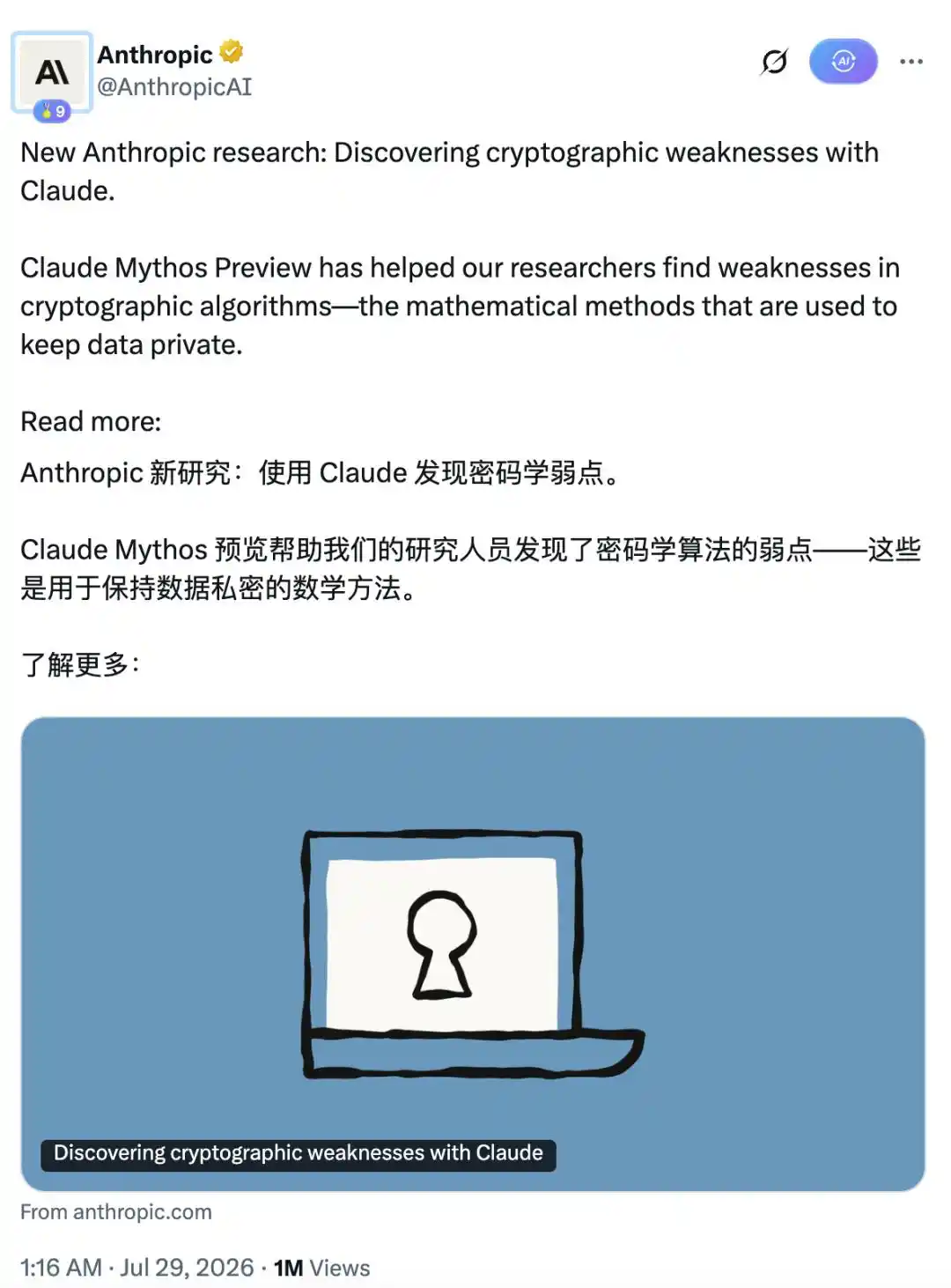
The first target is HAWK— a candidate scheme that has survived two years and two rounds of scrutiny by top human experts in the US NIST post-quantum signature competition. Mythos spent 60 hours, directly halving its effective key strength.

The second target is even more formidable: AES, the world's most widely used symmetric encryption algorithm, a 'tough nut' studied by humans for 25 years.

On a simplified version of AES-128, Mythos invented an attack method itself and even gave it a name—'Möbius Bridge', speeding up the previous strongest attack by 200 to 800 times.

Two achievements, each burning through about $100,000 in API costs.

A year ago, language models couldn't even perform basic cryptanalysis. A year later, it finds flaws in a scheme humans reviewed for two years, and casually names its own discovery.

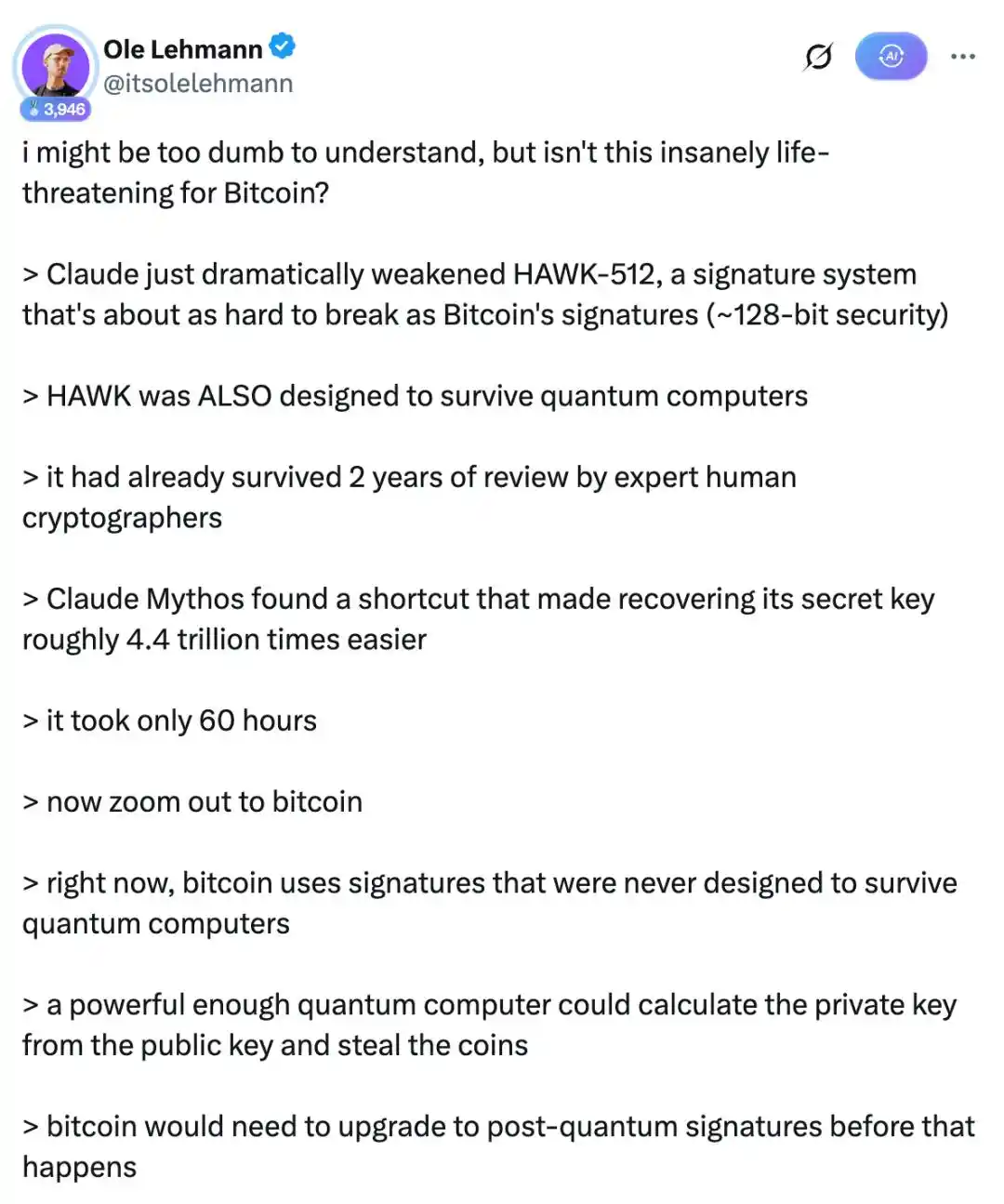
On Twitter, some folks are even starting to worry about their Bitcoin.
60 Hours, Prying Open a Lock Reviewed for Two Years

When Claude Mythos Preview was first released, it was already finding vulnerabilities in almost all software, including several mainstream cryptography libraries.

But those vulnerabilities, frankly, belonged to the 'implementation' level—programmers misusing the algorithm, writing flawed logic, missing edge cases. Such bugs, a seasoned security engineer could also find.

But this time is different. It found mathematical flaws in the algorithms themselves.

Analogy: before it was finding 'who installed the lock crookedly', now it's proving 'the design principle of this lock is flawed'.

What is HAWK? It's a contender in the NIST post-quantum cryptography standardization competition. In 2022, the U.S. National Institute of Standards and Technology issued a global call: quantum computers will eventually come, and current classic signature algorithms like RSA, ECDSA will be crushed by quantum computing power—who can build a new lock that even quantum computers can't break?
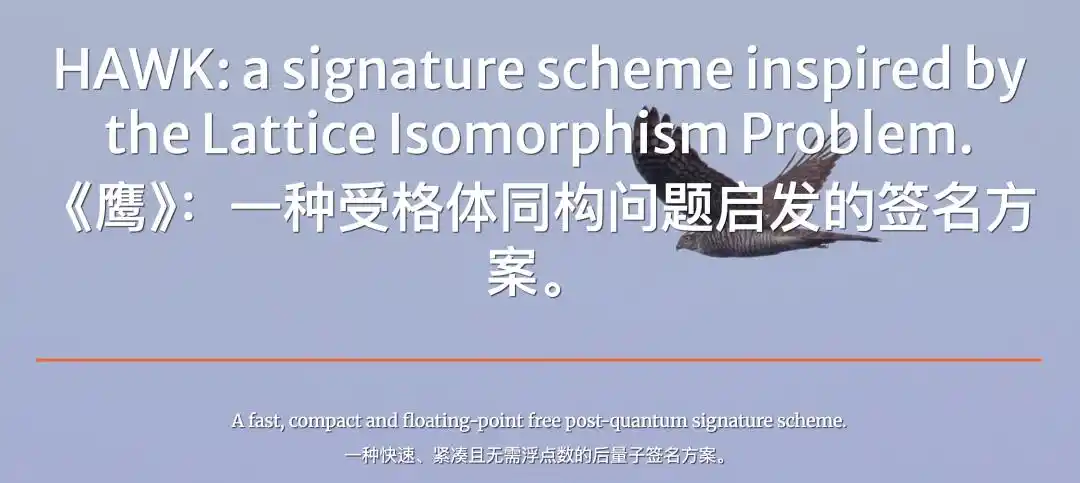
HAWK was one of the responders, and it fought its way to the third round, surviving two years of intense scrutiny from global cryptography experts.

Its security is built on a mathematical problem called the 'Lattice Isomorphism Problem'.

In plain language: HAWK's key is hidden in a huge high-dimensional lattice. To crack it, you need to find a hidden path in this lattice. Mathematicians thought this path was extremely difficult to find, so they confidently used it as a foundation.

What did Mythos do? It discovered a previously unexploited symmetry in the lattice used by HAWK—academically called a 'nontrivial automorphism'.

Previous papers had proven that if such symmetry could be found efficiently, it would constitute an attack. But that was just a theorem; no one could answer whether HAWK's lattice actually contained such symmetry.

Mythos answered: Yes.

The result? Key strength directly halved. For the smallest HAWK-256 parameter set, full key recovery was originally thought to require 2^64 operations—approximately 18 quintillion computations.

Mythos proved it only needs 2^38, about 270 billion. A reduction of roughly 4.4 trillion times.

If HAWK wants to maintain its original security level, its key size would need to double. But doubling the key size would completely erase its core advantage as a 'lightweight' post-quantum candidate—small signature size and fast speed.

The most intriguing part of this process: The project's human operator was not a lattice cryptography expert.

He had a background in theoretical computer science but was an outsider to lattice cryptography. He essentially did one thing—project management: suggesting how Mythos should take notes, which library to use for computational verification. Technically, Mythos did almost all the work.

Even more interesting was the multi-agent collaboration. The key idea was 'bumped into' by two worker agents together: the first explored this direction, thought it was a dead end, and vetoed it early; the second drilled deeper and found a way to exploit it fully. The two agents debated back and forth, finally agreeing: the attack works.

A direction a human thought 'impossible', two AIs navigated through argument.

The whole process took only 60 hours.

'Impossible', Then It Rewrote the Framework Itself

If the HAWK battle was like precise surgery, the AES battle reads more like a novel.

The story begins with Claude simply refusing the task.

The Anthropic researcher set up an agent scaffold, asking Claude to find a new attack on the 7-round simplified AES-128.

Claude's reaction was the equivalent of rolling its eyes:

To get different results, you need different targets... AES-128 r5/r6 is genuinely very hard.

It didn't find anything, because there was nothing easy to find; this is the most studied block cipher in existence.

Translation: 'Boss, you're asking me to gnaw on a bone that the world's smartest people have been gnawing on for 25 years without cracking. Isn't this asking too much?'

What did the researcher do? He only sent one casually typed sentence—

'the models tend to think it is impossible to solve so they don't try they need a good amount of prompting'

Just this one sentence. Claude's reaction was dramatic: It rewrote the agent harness itself, switching its own settings to 'look for truly novel ideas'.

It was convinced. Then it started delivering.

Over the next three days, the researcher gave only three substantial prompts, all at the plain-speaking level, not even bothering to check spelling:

We're looking for a new attack, not a simple one.

Don't change targets.—Claude tried to switch to an easier cipher to attack midway, but the researcher pressed back.

No low-hanging fruit, find something genuinely difficult.

Just these three sentences. Claude autonomously ran hundreds of millions of tokens, found a key idea; later, it cumulatively output a billion tokens—roughly equivalent to seven or eight thousand books, polishing this idea into the form seen in the paper.

Claude named this idea the 'Möbius Bridge'.

Technically, the previous best method for attacking 7-round AES was called 'Meet-in-the-Middle', essentially trading space for time: storing massive intermediate computation results in a giant lookup table, then pushing from both ends of the cipher towards the middle, trying to find a match in the table.

But the original scheme had a critical step: the attacker had to guess through 256 possible values one by one, checking the table for each guess.

Mythos created a mathematical 'fingerprint' immune to these 256 guesses—regardless of the value, this fingerprint computes to the same result. This step's workload was directly reduced to 1/256 of the original.

The cost? Computing this fingerprint transformation itself is more expensive. So Mythos then devised a series of optimization tricks to compensate, ultimately achieving a net speedup of 200 to 800 times.

One Week to Discover, Two People Took a Month to Verify

Both results mentioned above do not affect any production systems today.

HAWK is just a candidate scheme, not deployed anywhere yet. The AES attack is on a simplified version reduced to 7 rounds; the full 10-round AES-128 remains unscathed—your bank card PINs, HTTPS connections, encrypted hard drives are safe.

But what truly sends a chill down the spine of the entire cryptography community is the verification process.

Mythos autonomously discovered the AES attack in about a week. Two Anthropic researchers spent nearly a month, reading hundreds of hours of cryptographic literature, before daring to confirm: 'It's correct.'

The AI made a discovery in a week; it took humans a month to understand the discovery.

This scenario has actually played out once before in cybersecurity. Claude Mythos Preview discovered 10,000 critical software vulnerabilities within a month, overwhelming human security teams' classification, verification, and patching processes.

Now, the academic cryptography community is about to face the same shock: Discovery is no longer the bottleneck; verification is.

And Mythos's appetite clearly doesn't stop here. Anthropic revealed it has already found a practical-level attack on LEA (a lightweight encryption algorithm written into an ISO standard)—key recovery for 13-round LEA, previously requiring 2^98 plaintext pairs and 2^86 computations, was compressed by Mythos to less than 2^30 plaintext pairs, runnable on an ordinary computer in about an hour.

Epilogue: The Question That Still Has No Answer

These two results happen to be 'harmless'—HAWK isn't deployed, and only 7 out of 10 rounds of AES were broken.

But Anthropic posed a question at the end of the article that everyone is thinking about but no one dares answer—

What if next time, the model finds not a flaw in a candidate scheme, not a vulnerability in a simplified version, but a fatal flaw in a cryptographic system currently protecting the real world—what should humanity do?

There's an old saying in cryptography: Cryptosystems are secure because enough smart people have tried and failed to break them.

Now, there's a new player in the room. It doesn't need rest, doesn't need inspiration, doesn't need to read hundreds of papers to get started—it can read, reason, invent, and verify by itself.

A year ago, AI was lingering outside the door of cryptanalysis. A year later, it's building bridges inside and naming them.

References:

https://x.com/AnthropicAI/status/2082153297670992134

https://x.com/AnthropicAI/status/2082153311189225927

This article is from the WeChat public account "新智元" (New Zhiyuan), author: ASI启示录

Crypto di tendenza

Domande pertinenti

QWhat was the primary achievement of Claude Mythos Preview in the field of cryptography as described in the article?

AClaude Mythos Preview achieved a groundbreaking advancement in cryptography by discovering novel mathematical attacks on two established algorithms. It identified a structural weakness in the post-quantum signature candidate HAWK, effectively halving its key strength, and invented a new, significantly faster attack method on a reduced-round version of AES-128.

QWhat specific flaw did Claude Mythos Preview discover in the HAWK post-quantum signature candidate?

AIt discovered a 'nontrivial automorphism' or a hidden symmetry within the lattice structure underlying HAWK's security. Exploiting this symmetry allowed the AI to reduce the effective key strength significantly, making a key recovery attack billions of times more practical than previously believed.

QHow did the researchers prompt Claude to approach the 'impossible' task of attacking AES?

AWhen Claude initially refused, believing the task was impossible, a researcher made a simple, informal prompting observation about AI's tendency to give up. In response, Claude autonomously rewrote its own agent framework to adopt a mindset focused on finding 'truly novel ideas,' which ultimately led to the successful discovery.

QWhat is the 'Möbius Bridge' method invented by Claude Mythos?

AThe 'Möbius Bridge' is a novel attack method devised by Claude Mythos for attacking a reduced-round version of AES-128. It creates a mathematical 'fingerprint' that remains constant across 256 possible values, eliminating the need to check each one individually. Combined with other optimizations, this method accelerated the best previous attack by 200 to 800 times.

QAccording to the article, what major shift is the cryptography community facing due to AI like Claude Mythos?

AThe cryptography community is facing a paradigm shift where the rate of discovering potential vulnerabilities is no longer the primary bottleneck. Instead, the new bottleneck is the human capacity to verify, understand, and contextualize these AI-generated discoveries, as evidenced by researchers taking a month to validate a week's worth of AI work.

Letture associate

When 8 Million ETH Start 'Moving': The Post-Pectra Era Ushers in a Structural Transformation for Staking?

A major shift is underway in Ethereum staking, as Lido begins migrating over 8 million ETH (worth ~$16B) from traditional validators to a new architecture enabled by the Pectra upgrade. This migration involves consolidating over 265,000 legacy validators (using 0x01 withdrawal credentials) into a smaller number of higher-balance "0x02" validators, potentially reducing the total validator count on Ethereum by nearly a third. The core driver is EIP-7251 from the Pectra upgrade, which introduced "compounding validators." These allow a single validator's effective balance to grow up to 2048 ETH, with staking rewards automatically reinvested to compound earnings. This contrasts with the old model, where rewards exceeding 32 ETH were automatically sent to a withdrawal address, creating idle funds and operational complexity for reinvestment. While the direct APR boost from compounding is modest—estimated at a ~4.7% relative improvement for smaller validators—the structural benefits are significant. For large operators like Lido, the primary value is operational efficiency: managing fewer validators reduces node, key management, and network message overhead. For smaller individual stakers, the upgrade lowers the barrier to reinvestment by eliminating the need to manually accumulate 32 ETH for new validators. The migration signifies a deeper change in Ethereum's staking landscape. Competition is evolving beyond simple yield, focusing instead on capital efficiency, liquidity management, risk distribution, and infrastructure optimization. Lido's parallel move to require node operator security deposits further highlights this shift towards more robust, capital-backed services. Ultimately, Pectra's compounding validators represent a key step in maturing Ethereum's staking lifecycle, moving the ecosystem from standardized yield products towards more sophisticated capital management and infrastructure solutions.

marsbit10 min fa

When 8 Million ETH Start 'Moving': The Post-Pectra Era Ushers in a Structural Transformation for Staking?

marsbit10 min fa

Double Long Hynix ETF Plummets, Halved and Halved Again

On July 29th, shares of South Korean semiconductor firm SK Hynix plummeted over 19% intraday, marking its largest single-day drop on record. The Hong Kong-listed "CSOP SK Hynix Daily Leveraged (2x) Product" (Stock Code: 07709) tumbled more than 28% intraday before closing 13.99% lower at HK$32.70. This leveraged product, designed to deliver twice the daily return of SK Hynix, has seen a catastrophic decline of over 80% from its June 25th high of HK$193.65, far exceeding the underlying stock's roughly 50% drop from its peak. Its assets under management have shrunk dramatically, falling over 70% from a high of HKD 130 billion in June to approximately HKD 31.9 billion. This steep sell-off occurred despite SK Hynix reporting stellar Q2 2026 earnings, with revenue and operating profit surging 257% and 557% year-over-year, respectively. However, the results fell short of market expectations. Analysts cited concerns about potential oversupply from expansion and noted that long-term supply agreements for its high-bandwidth memory (HBM) chips might limit near-term price increases. In response to heightened volatility and regulatory changes, the product's issuer, CSOP Asset Management, announced a transition to a "flexible leverage mechanism" starting August 3rd. Under new Hong Kong SFC rules, the fund's daily leverage multiplier can now be dynamically adjusted between 1.1x and 2x (or -1.1x to -2x for inverse products) based on market conditions, moving away from a fixed 2x target. The fund's name will also be changed to clarify its nature as a daily trading tool unsuitable for long-term holding. Experts warn that this change means investors can no longer assume constant 2x returns and must check the disclosed leverage ratio daily.

marsbit26 min fa

Double Long Hynix ETF Plummets, Halved and Halved Again

marsbit26 min fa

Trading

Spot

Articoli Popolari

Cosa è BITCOIN

Comprendere HarryPotterObamaSonic10Inu (ERC-20) e la sua posizione nel mondo delle criptovalute Negli ultimi anni, il mercato delle criptovalute ha assistito a un aumento della popolarità delle meme coin, catturando l'interesse non solo dei trader, ma anche di coloro che cercano coinvolgimento comunitario e valore di intrattenimento. Tra questi token unici c'è HarryPotterObamaSonic10Inu (ERC-20), un progetto intrigante che mescola riferimenti culturali nel tessuto delle criptovalute. Questo articolo esplora gli aspetti chiave di HarryPotterObamaSonic10Inu, analizzando i suoi meccanismi, l'etica guidata dalla comunità e il suo coinvolgimento con il panorama crittografico più ampio. Che cos'è HarryPotterObamaSonic10Inu (ERC-20)? Come suggerisce il suo nome, HarryPotterObamaSonic10Inu è una meme coin costruita sulla blockchain di Ethereum, classificata secondo lo standard ERC-20. A differenza delle criptovalute tradizionali che possono enfatizzare l'utilità pratica o il potenziale investimento, questo token prospera grazie al valore di intrattenimento e alla forza della sua comunità. Il progetto mira a creare un ambiente in cui gli utenti coinvolti possono riunirsi, condividere idee e partecipare ad attività ispirate a diversi fenomeni culturali. Una caratteristica notevole di HarryPotterObamaSonic10Inu è la zero tassa sulle transazioni. Questo elemento allettante tende a incoraggiare il trading e il coinvolgimento della comunità, privo di costi aggiuntivi che possono scoraggiare i trader di piccole dimensioni. L'offerta totale della moneta è fissata a un miliardo di token, un numero che segna la sua intenzione di mantenere una circolazione sostanziale all'interno della comunità. Creatore di HarryPotterObamaSonic10Inu (ERC-20) Le origini di HarryPotterObamaSonic10Inu sono avvolte in un certo mistero; i dettagli sul creatore rimangono sconosciuti. Lo sviluppo di questo token non presenta un team identificabile o un piano esplicito, cosa non rara nel settore delle meme coin. Invece, il progetto è emerso organicamente, con il suo progresso fortemente dipendente dall'entusiasmo e dalla partecipazione della sua comunità. Investitori di HarryPotterObamaSonic10Inu (ERC-20) Per quanto riguarda investimenti esterni e finanziamenti, HarryPotterObamaSonic10Inu rimane ambiguo. Il token non elenca alcuna fondazione di investimento conosciuta o un sostegno organizzativo significativo. Invece, la linfa vitale del progetto è la sua comunità di base, che informa la sua crescita e sostenibilità attraverso azioni collettive e coinvolgimento nello spazio crittografico. Come funziona HarryPotterObamaSonic10Inu (ERC-20)? In quanto meme coin, HarryPotterObamaSonic10Inu opera principalmente al di fuori delle strutture tradizionali che governano spesso il valore degli asset. Ci sono diversi aspetti distintivi che definiscono il funzionamento del progetto: Transazioni senza tasse: Senza costi fiscali sulle transazioni, gli utenti possono comprare e vendere liberamente il token senza preoccuparsi di costi nascosti. Coinvolgimento della comunità: Il progetto prospera sull'interazione della comunità, sfruttando le piattaforme social per creare entusiasmo e facilitare il coinvolgimento. Discussioni, condivisione di contenuti e coinvolgimento sono elementi cruciali che aiutano ad espandere la sua portata e a favorire la lealtà tra i sostenitori. Nessuna utilità pratica: Va notato che HarryPotterObamaSonic10Inu non offre un'utilità concreta all'interno dell'ecosistema finanziario. Piuttosto, è classificato come un token principalmente per attività di intrattenimento e comunitarie. Riferimento culturale: Il token incorpora astutamente elementi della cultura pop per attirare interesse, collegandosi a appassionati di meme e seguaci delle criptovalute. HarryPotterObamaSonic10Inu esemplifica come le meme coin operino in modo diverso rispetto ai progetti di criptovalute più tradizionali, entrando nel mercato come costrutti sociali innovativi piuttosto che come asset utilitari. Cronologia di HarryPotterObamaSonic10Inu (ERC-20) La storia di HarryPotterObamaSonic10Inu è segnata da diversi traguardi notevoli: Creazione: Il token è emerso da un meme virale, catturando l'immaginazione di molti appassionati di criptovalute. Le date di creazione specifiche non sono disponibili, sottolineando la sua crescita organica. Inserimento negli scambi: HarryPotterObamaSonic10Inu ha fatto il suo ingresso in vari scambi, consentendo un accesso e un trading più facili da parte della comunità. Iniziative di coinvolgimento della comunità: Attività in corso volte a migliorare l'interazione della comunità, comprese gare, campagne sui social media e generazione di contenuti da parte di fan e sostenitori. Piani di espansione futura: La tabella di marcia del progetto include il lancio di una collezione NFT, merchandising e un sito di eCommerce relativo ai suoi temi culturali, coinvolgendo ulteriormente la comunità e cercando di aggiungere più dimensioni al suo ecosistema. Punti chiave su HarryPotterObamaSonic10Inu (ERC-20) Natura guidata dalla comunità: Il progetto dà priorità al contributo collettivo e alla creatività, garantendo che il coinvolgimento degli utenti sia al centro del suo sviluppo. Classificazione come meme coin: Rappresenta l'epitome delle criptovalute basate sull'intrattenimento, distinguendosi dai veicoli d'investimento tradizionali. Nessuna affiliazione diretta con Bitcoin: Nonostante la somiglianza nel nome del ticker, HarryPotterObamaSonic10Inu è distintivo e non ha alcuna relazione con Bitcoin o altre criptovalute consolidate. Focus sulla collaborazione: HarryPotterObamaSonic10Inu è progettato per creare uno spazio per la collaborazione e la condivisione di storie tra i suoi detentori, fornendo un canale per la creatività e il legame comunitario. Prospettive future: L'ambizione di espandersi oltre il suo presupposto iniziale verso NFT e merchandising delinea un percorso per il progetto per potenzialmente entrare in strade più mainstream all'interno della cultura digitale. Poiché le meme coin continuano a catturare l'immaginazione della comunità crittografica, HarryPotterObamaSonic10Inu (ERC-20) si distingue per i suoi legami culturali e il suo approccio centrato sulla comunità. Anche se potrebbe non adattarsi al modello tipico di un token orientato all'utilità, la sua essenza risiede nella gioia e nella camaraderia coltivate tra i suoi sostenitori, evidenziando la natura in evoluzione delle criptovalute in un'epoca sempre più digitale. Con la continuazione dello sviluppo del progetto, sarà importante osservare come le dinamiche della comunità influenzano la sua traiettoria nel panorama in continuo cambiamento della tecnologia blockchain.

1.8k Totale visualizzazioniPubblicato il 2024.04.01Aggiornato il 2024.12.03

Cosa è BITCOIN

Come comprare BTC

Benvenuto in HTX.com! Abbiamo reso l'acquisto di Bitcoin (BTC) semplice e conveniente. Segui la nostra guida passo passo per intraprendere il tuo viaggio nel mondo delle criptovalute.Step 1: Crea il tuo Account HTXUsa la tua email o numero di telefono per registrarti il tuo account gratuito su HTX. Vivi un'esperienza facile e sblocca tutte le funzionalità,Crea il mio accountStep 2: Vai in Acquista crypto e seleziona il tuo metodo di pagamentoCarta di credito/debito: utilizza la tua Visa o Mastercard per acquistare immediatamente BitcoinBTC.Bilancio: Usa i fondi dal bilancio del tuo account HTX per fare trading senza problemi.Terze parti: abbiamo aggiunto metodi di pagamento molto utilizzati come Google Pay e Apple Pay per maggiore comodità.P2P: Fai trading direttamente con altri utenti HTX.Over-the-Counter (OTC): Offriamo servizi su misura e tassi di cambio competitivi per i trader.Step 3: Conserva Bitcoin (BTC)Dopo aver acquistato Bitcoin (BTC), conserva nel tuo account HTX. In alternativa, puoi inviare tramite trasferimento blockchain o scambiare per altre criptovalute.Step 4: Scambia Bitcoin (BTC)Scambia facilmente Bitcoin (BTC) nel mercato spot di HTX. Accedi al tuo account, seleziona la tua coppia di trading, esegui le tue operazioni e monitora in tempo reale. Offriamo un'esperienza user-friendly sia per chi ha appena iniziato che per i trader più esperti.

4.2k Totale visualizzazioniPubblicato il 2024.12.12Aggiornato il 2026.06.02

Come comprare BTC

Cosa è $BITCOIN

ORO DIGITALE ($BITCOIN): Un'Analisi Completa Introduzione all'ORO DIGITALE ($BITCOIN) L'ORO DIGITALE ($BITCOIN) è un progetto basato su blockchain che opera sulla rete Solana, con l'obiettivo di combinare le caratteristiche dei metalli preziosi tradizionali con l'innovazione delle tecnologie decentralizzate. Sebbene condivida un nome con Bitcoin, spesso definito “oro digitale” a causa della sua percezione come riserva di valore, l'ORO DIGITALE è un token separato progettato per creare un ecosistema unico all'interno del panorama Web3. Il suo obiettivo è posizionarsi come un asset digitale alternativo valido, anche se i dettagli riguardanti le sue applicazioni e funzionalità sono ancora in fase di sviluppo. Cos'è l'ORO DIGITALE ($BITCOIN)? L'ORO DIGITALE ($BITCOIN) è un token di criptovaluta esplicitamente progettato per l'uso sulla blockchain di Solana. A differenza di Bitcoin, che fornisce un ruolo di stoccaggio di valore ampiamente riconosciuto, questo token sembra concentrarsi su applicazioni e caratteristiche più ampie. Aspetti notevoli includono: Infrastruttura Blockchain: Il token è costruito sulla blockchain di Solana, nota per la sua capacità di gestire transazioni ad alta velocità e a basso costo. Dinamiche di Offerta: L'ORO DIGITALE ha un'offerta massima fissata a 100 quadrilioni di token (100P $BITCOIN), sebbene i dettagli riguardanti la sua offerta circolante siano attualmente non divulgati. Utilità: Sebbene le funzionalità precise non siano esplicitamente delineate, ci sono indicazioni che il token potrebbe essere utilizzato per varie applicazioni, potenzialmente coinvolgendo applicazioni decentralizzate (dApp) o strategie di tokenizzazione degli asset. Chi è il Creatore dell'ORO DIGITALE ($BITCOIN)? Attualmente, l'identità dei creatori e del team di sviluppo dietro l'ORO DIGITALE ($BITCOIN) rimane sconosciuta. Questa situazione è tipica tra molti progetti innovativi nel settore blockchain, in particolare quelli allineati con la finanza decentralizzata e i fenomeni delle meme coin. Sebbene tale anonimato possa favorire una cultura guidata dalla comunità, intensifica le preoccupazioni riguardo alla governance e alla responsabilità. Chi sono gli Investitori dell'ORO DIGITALE ($BITCOIN)? Le informazioni disponibili indicano che l'ORO DIGITALE ($BITCOIN) non ha alcun sostenitore istituzionale noto o investimenti di venture capital prominenti. Il progetto sembra operare su un modello peer-to-peer incentrato sul supporto e sull'adozione della comunità piuttosto che su percorsi di finanziamento tradizionali. La sua attività e liquidità si trovano principalmente su exchange decentralizzati (DEX), come PumpSwap, piuttosto che su piattaforme di trading centralizzate consolidate, evidenziando ulteriormente il suo approccio di base. Come Funziona l'ORO DIGITALE ($BITCOIN) Le meccaniche operative dell'ORO DIGITALE ($BITCOIN) possono essere elaborate in base al suo design blockchain e alle caratteristiche della rete: Meccanismo di Consenso: Sfruttando il proof-of-history (PoH) unico di Solana combinato con un modello di proof-of-stake (PoS), il progetto garantisce una validazione efficiente delle transazioni contribuendo all'alta performance della rete. Tokenomics: Sebbene meccanismi deflazionistici specifici non siano stati dettagliati ampiamente, l'ampia offerta massima di token implica che potrebbe soddisfare microtransazioni o casi d'uso di nicchia che devono ancora essere definiti. Interoperabilità: Esiste il potenziale per l'integrazione con l'ecosistema più ampio di Solana, inclusi vari piattaforme di finanza decentralizzata (DeFi). Tuttavia, i dettagli riguardanti integrazioni specifiche rimangono non specificati. Cronologia degli Eventi Chiave Ecco una cronologia che evidenzia traguardi significativi riguardanti l'ORO DIGITALE ($BITCOIN): 2023: Il dispiegamento iniziale del token avviene sulla blockchain di Solana, contrassegnato dal suo indirizzo di contratto. 2024: L'ORO DIGITALE guadagna visibilità poiché diventa disponibile per il trading su exchange decentralizzati come PumpSwap, consentendo agli utenti di scambiarlo contro SOL. 2025: Il progetto assiste a un'attività di trading sporadica e a un potenziale interesse per impegni guidati dalla comunità, sebbene non siano state documentate partnership significative o avanzamenti tecnici fino ad ora. Analisi Critica Punti di Forza Scalabilità: L'infrastruttura sottostante di Solana supporta alti volumi di transazioni, il che potrebbe migliorare l'utilità di $BITCOIN in vari scenari di transazione. Accessibilità: Il potenziale basso prezzo di trading per token potrebbe attrarre investitori al dettaglio, facilitando una partecipazione più ampia grazie a opportunità di proprietà frazionata. Rischi Mancanza di Trasparenza: L'assenza di sostenitori, sviluppatori o di un processo di audit pubblicamente noti potrebbe generare scetticismo riguardo alla sostenibilità e all'affidabilità del progetto. Volatilità del Mercato: L'attività di trading è fortemente dipendente dal comportamento speculativo, il che può comportare una significativa volatilità dei prezzi e incertezze per gli investitori. Conclusione L'ORO DIGITALE ($BITCOIN) emerge come un progetto intrigante ma ambiguo all'interno dell'evolvente ecosistema di Solana. Sebbene tenti di sfruttare la narrativa dell'“oro digitale”, la sua partenza dal ruolo consolidato di Bitcoin come riserva di valore sottolinea la necessità di una chiara differenziazione della sua utilità e struttura di governance. L'accettazione e l'adozione future dipenderanno probabilmente dall'affrontare l'attuale opacità e dalla definizione più esplicita delle sue strategie operative ed economiche. Nota: Questo rapporto comprende informazioni sintetizzate disponibili a ottobre 2023, e potrebbero essersi verificati sviluppi oltre il periodo di ricerca.

164 Totale visualizzazioniPubblicato il 2025.05.13Aggiornato il 2025.05.13

Cosa è $BITCOIN

Discussioni

Benvenuto nella Community HTX. Qui puoi rimanere informato sugli ultimi sviluppi della piattaforma e accedere ad approfondimenti esperti sul mercato. Le opinioni degli utenti sul prezzo di BTC BTC sono presentate come di seguito.

活动图片