Synthetix returns to Ethereum mainnet after 3 years: ‘We can run it back’

cointelegraphPublished on 2025-12-18Last updated on 2025-12-18

Abstract

Synthetix, a perpetuals trading platform, is returning to Ethereum's mainnet after three years, citing significantly improved network conditions. Founder Kain Warwick stated that high gas fees and congestion previously made it impractical to run complex trading infrastructure on Ethereum, leading many platforms, including Synthetix, to migrate to Layer-2 solutions. However, reduced demand and ongoing scaling improvements have now made Ethereum Layer-1 viable again. Warwick emphasized that Ethereum mainnet hosts most of crypto's liquidity, assets, and margin, making it the most efficient onchain market. He expects other perpetual DEXs to follow suit, leveraging Ethereum's enhanced capacity and lower transaction costs.

Perpetuals trading platform Synthetix is returning to Ethereum’s mainnet, with its founder arguing the network is now more than capable of supporting high-frequency financial applications after years of network congestion drove derivatives activity elsewhere.

“By the time perp DEXs became a thing, the mainnet was too congested, but now we can run it back,” Synthetix founder Kain Warwick told Cointelegraph during an interview on Wednesday.

“It’s kind of crazy that there really hasn’t been a Perp DEX on mainnet,” he added, explaining that reduced demand after the perp DEX exodus, combined with ongoing scaling improvements, has made Ethereum layer 1 more viable again.

“It’s definitely the best place to run a perp DEX,” he said.
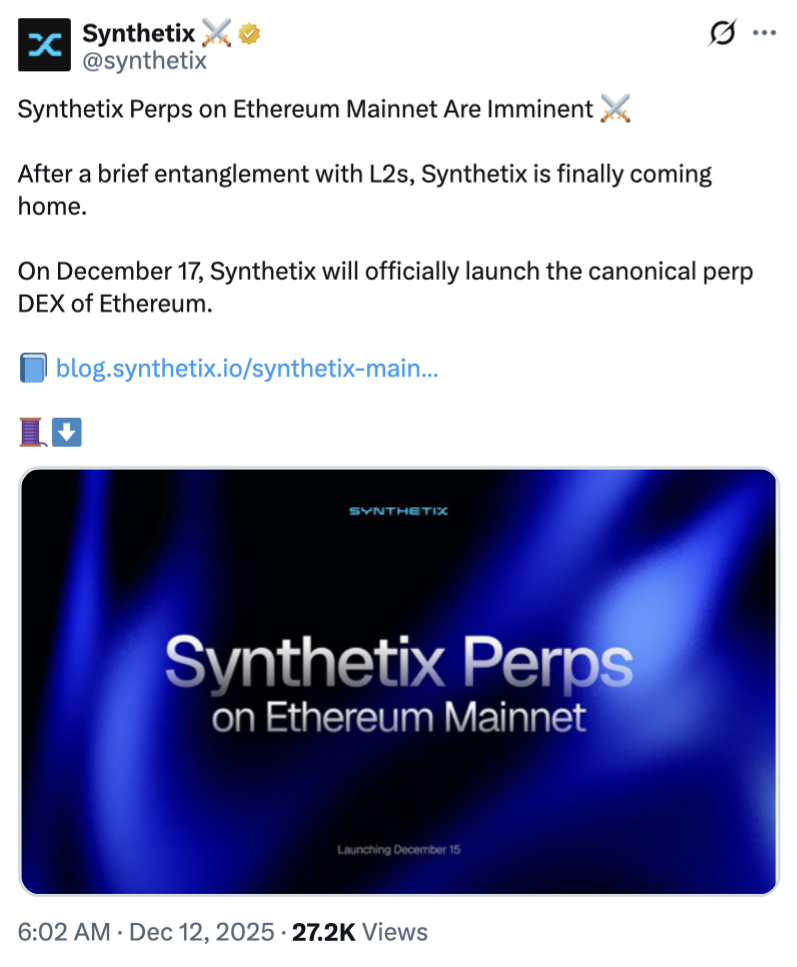
Source: Synthetix

Warwick said that high gas fees and network congestion previously made it impractical to operate complex trading infrastructure on the network.

For several years, many perpetual platforms migrated to layer-2 networks or alternative blockchains, and Synthetix followed a similar path, he said, moving to the Ethereum layer-2 network Optimism in 2022 and later expanding to Arbitrum and Base.

Around the same time, decentralized derivatives exchange dYdX transitioned from mainnet to StarkWare layer-2 solution StarkEx.

Warwick says fees were “just too high” to make it feasible

Warwick said it wasn’t feasible to run critical infrastructure because the costs were “just too high.”

“The cost per transaction and therefore the efficiency of the markets on the chain really degraded,” Warwick said. On Wednesday, Ethereum’s average gas fee stood at approximately 0.71 gwei, nearly 26 times lower than on the same day twelve months ago, when it averaged 18.85 gwei, according to Etherscan.
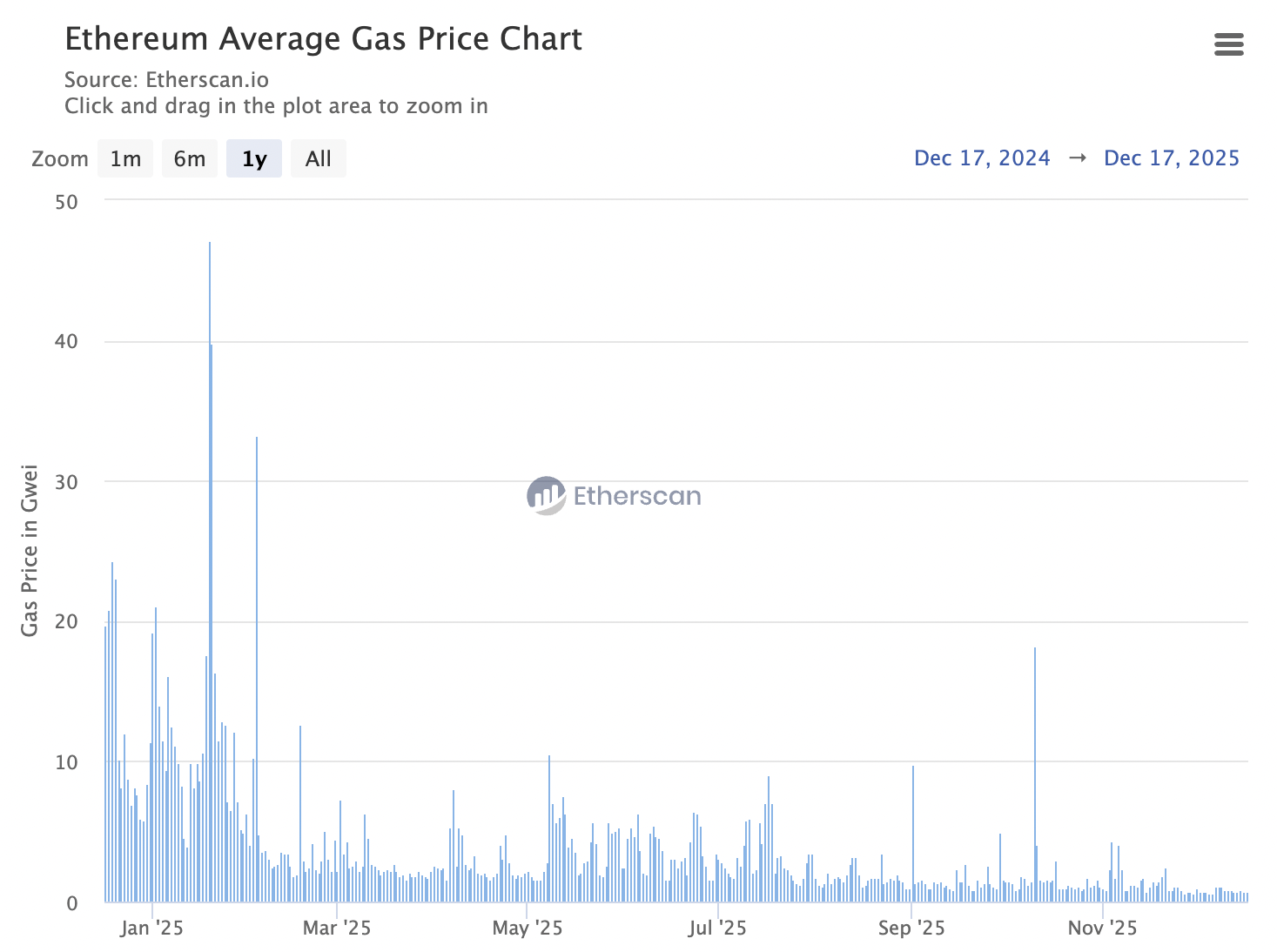
Ethereum gas fees are significantly lower than they were twelve months ago. Source: Ether Scan

Warwick said that the combination of layer-2 and layer-1 scaling means that ”you can actually run critical infrastructure on mainnet again.”

Some Ethereum proponents have predicted further improvements toward network capacity in 2026. Ethereum educator Anthony Sassano recently said the goal to significantly increase Ethereum’s gas limit to 180 million next year is a baseline rather than a best-case scenario.

Warwick expects other perpetual exchanges to follow Synthetix

Warwick expects other perpetual DEXs to follow Synthetix back to mainnet, arguing Ethereum now has the capacity to support multiple perp DEXs simultaneously.

Related: Ripple pilots RLUSD on Ethereum L2s in multichain push

“It wouldn’t be a Synthetix launch if someone didn’t try and, you know, follow us within 20 minutes,” Warwick said.

“The main advantage is most of the liquidity in the crypto world is on Ethereum mainnet; most of the assets, most of the margin, most liquidity, almost everything is there. It is the most efficient onchain market,” he said.

Warwick added that Ethereum’s development has improved significantly in 2025, and it has potentially been the best year for the network since the Merge in September 2022.

“There’s been a renewed kind of focus on, like, the needs of builders, in a way that I think in the past, maybe it was much more focused on the network itself,” he said.

Magazine: Big questions: Would Bitcoin survive a 10-year power outage?

Trending Cryptos

Related Questions

QWhy is Synthetix returning to the Ethereum mainnet after three years?

ASynthetix is returning to the Ethereum mainnet because the network is now more capable of supporting high-frequency financial applications, with significantly lower gas fees and reduced congestion compared to the past.

QWhat was the main reason that originally drove Synthetix and other perpetual DEXs away from the Ethereum mainnet?

AHigh gas fees and network congestion made it impractical and too costly to operate complex trading infrastructure on the Ethereum mainnet, leading many platforms to migrate to layer-2 networks or alternative blockchains.

QAccording to the founder, what is the current state of Ethereum gas fees compared to a year ago?

AAs of the interview, the average Ethereum gas fee was approximately 0.71 gwei, which is nearly 26 times lower than the average of 18.85 gwei on the same day twelve months prior.

QWhat does Kain Warwick predict will happen after Synthetix moves back to the mainnet?

AKain Warwick predicts that other perpetual DEXs will follow Synthetix back to the Ethereum mainnet, as the network now has the capability to support multiple perp DEXs simultaneously.

QWhat does Warwick cite as the main advantage of running a perp DEX on Ethereum mainnet?

AThe main advantage is that most of the liquidity, assets, and margin in the crypto world are on the Ethereum mainnet, making it the most efficient onchain market.

Related Reads

Stocks Fell Even More Violently Than Crypto, Where Did the Money Go?

From June to late July 2026, global stock markets, particularly technology and semiconductor stocks, experienced severe declines, with South Korea's KOSPI index facing historic circuit breakers and shedding 40% from its June peak. Key catalysts included SK Hynix's earnings miss despite record profits and competitive pressures from China's CXMT IPO. A global forced deleveraging event unfolded, devastating highly leveraged instruments like the 2x leveraged SK Hynix ETF, which lost over 80% of its value. Surprisingly, Bitcoin showed relative stability during this period, rising roughly 15% from its July low. The article clarifies this wasn't due to an inflow of equity flight capital but because Bitcoin had already undergone a significant correction in May and June, with U.S. spot Bitcoin ETFs seeing record outflows. True safe-haven flows went to gold, severing Bitcoin's short-term "digital gold" narrative. The sell-off is characterized not as an AI story collapse but a liquidity-driven清算 of crowded leveraged positions, potentially halfway through according to some analysts. For substantial capital to return to Bitcoin, the article cites necessary conditions: eased global liquidity pressure, a soft-landing Fed rate cut, and regulatory clarity from the stalled U.S. CLARITY Act. The conclusion is that Bitcoin is not a current safe haven but a pre-cleared asset. Its decoupling from tech stocks highlights its potential future role as a non-correlated asset for institutional portfolios, positioning it favorably for when global capital reallocates post-crisis.

marsbit32m ago

Stocks Fell Even More Violently Than Crypto, Where Did the Money Go?

marsbit32m ago

"The Final Phase Before the New Cycle". What Will Happen to Bitcoin in August

"Bitcoin Faces Crucial Test in August: Experts Predict Consolidation or Further Decline" The price of Bitcoin (BTC) is expected to remain under pressure in August, with experts anticipating either consolidation within a narrow range or a potential drop below $60,000. Despite a double-digit recovery from its July low near $58,000, BTC ended the month trading around $63,500, still roughly 50% below its October 2025 peak of $126,200. Analysts cite several headwinds: a challenging macroeconomic environment with high US interest rates and persistent inflation, which makes fixed-income assets more attractive than speculative ones like crypto. Furthermore, competition for capital is intense, with many investors favoring AI-related stocks. This is reflected in significant outflows from US spot Bitcoin ETFs, with a record $4.5 billion leaving in June and a net outflow of $5.4 billion for the first half of the year. Historically, August is a weak month for crypto, with a median return of -7.49% from 2013 to 2025. Experts also note regulatory uncertainty in the US, particularly the stalled CLARITY Act, as a dampening factor. Despite the bearish near-term outlook, several experts view the current phase as the "last phase before a new Bitcoin cycle" begins, potentially in Q4 2024. This makes it a favorable time for accumulating Bitcoin for the long term. Key price levels to watch are support at $60,000-$61,000, with a break below $58,000 potentially leading to $53,000-$55,000. A move above $67,000 could target $70,000-$75,000, though this is considered a lower probability scenario.

cryptonews.ru38m ago

"The Final Phase Before the New Cycle". What Will Happen to Bitcoin in August

cryptonews.ru38m ago

Trading

Spot

Hot Articles

Discussions

Welcome to the HTX Community. Here, you can stay informed about the latest platform developments and gain access to professional market insights. Users' opinions on the price of ETH (ETH) are presented below.

活动图片