Strike While the Iron is Hot: GPT-5.6's Three Major Models Fully Exposed, Scheduled for July 7th?

marsbitPublished on 2026-07-04Last updated on 2026-07-04

Abstract

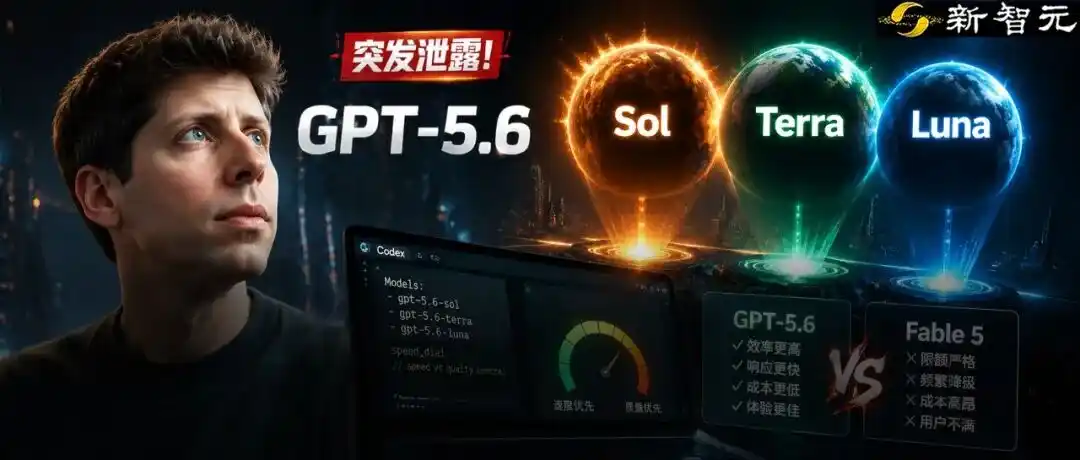
GPT-5.6 Models Leaked, Rumored for July 7th Release A leak from the Codex application's source code has revealed references to three upcoming GPT-5.6 sub-models: Sol, Terra, and Luna. A new "speed dial" feature was also discovered, suggesting users will be able to balance response speed and quality. According to rumors, OpenAI is targeting a release window of July 7th to 9th, strategically timed to coincide with the expiration of access limits for Anthropic's Claude Fable 5 model. Early comparative tests between a leaked GPT-5.6-terra version and Fable 5 show GPT-5.6 achieving similar or better results while using significantly fewer computational resources and responding faster. In complex coding tasks, GPT-5.6 demonstrated more efficient and user-collaborative problem-solving. The reported launch date appears calculated to capitalize on growing user frustration with competitor models. Anthropic's Fable 5 has faced criticism for overly aggressive safety filters that frequently downgrade responses and for severe "hallucination" issues in its Opus 4.8 model. Leaks also suggest GPT-5.6 Sol could be offered at a much lower price than Fable 5 while matching its performance. A final note warns developers with unused "rate limit reset" credits in Codex to use them before they expire around July 12th, ahead of the anticipated GPT-5.6 launch.

GPT-5.6, to be released next week?

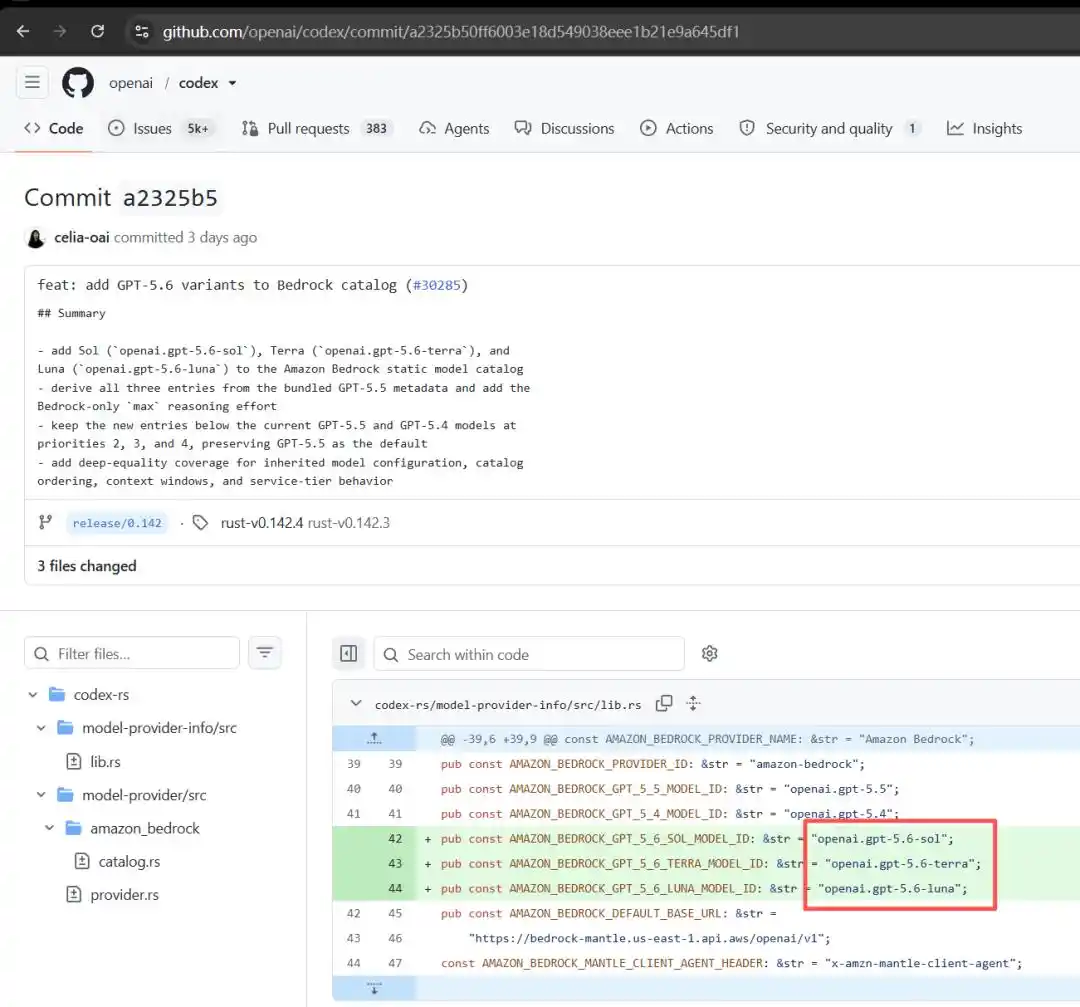
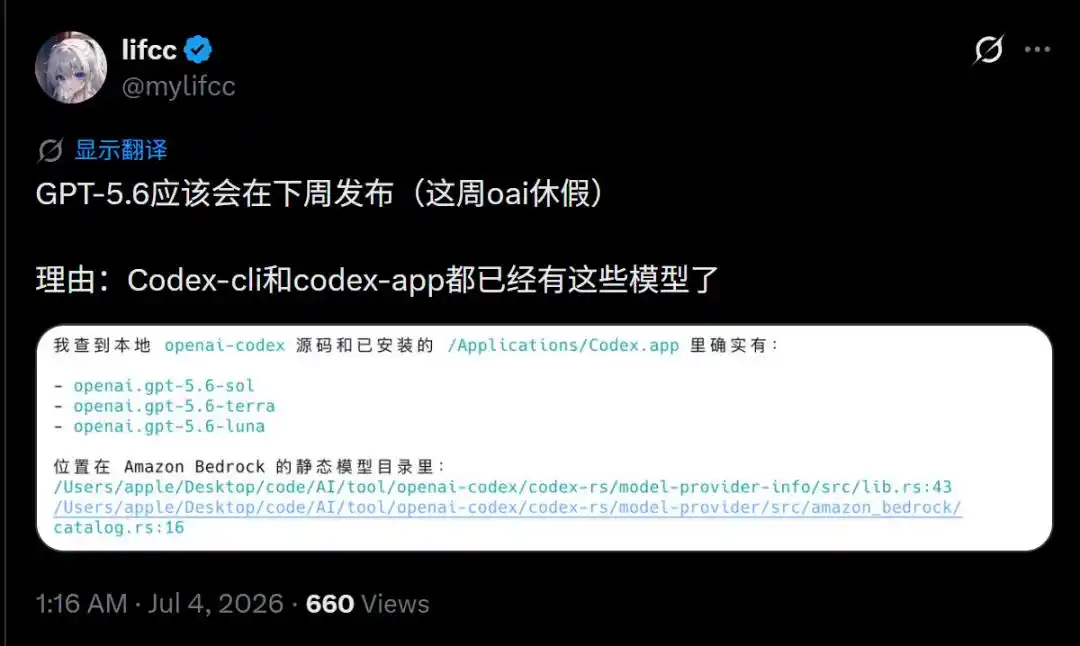
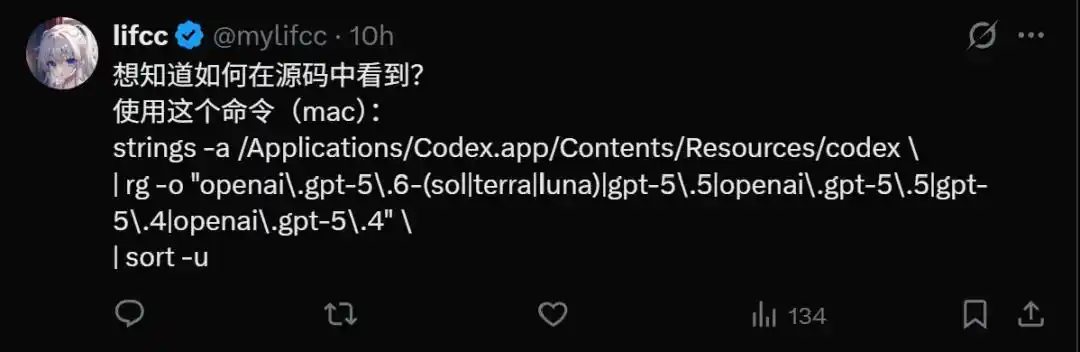
Just yesterday, netizens excitedly discovered that the underlying code of the Codex application surprisingly contained identifiers for GPT-5.6's three sub-models: Sol, Terra, and Luna.

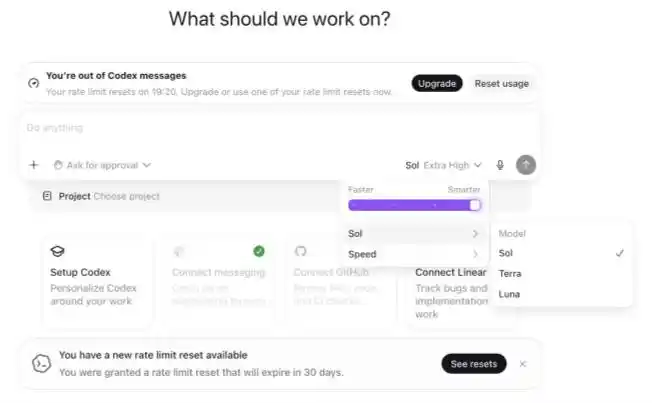
Even more exciting, a brand-new "Speed Dial" feature also appeared in the code.

This hints that users will be able to freely adjust between speed and quality based on their needs, undoubtedly bringing an unprecedented level of control.

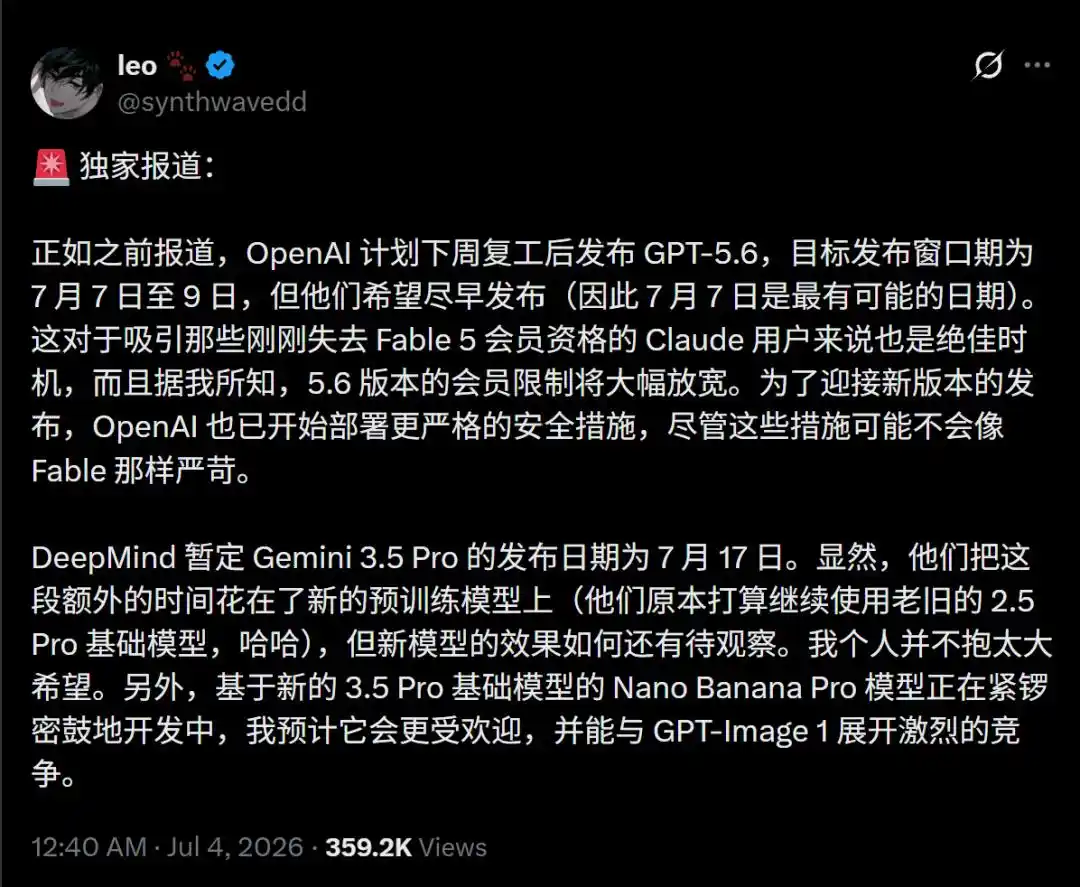
According to leaks, OpenAI has internally set a hard deadline: the target release window for GPT-5.6 points directly to next Tuesday (July 7th) through July 9th.

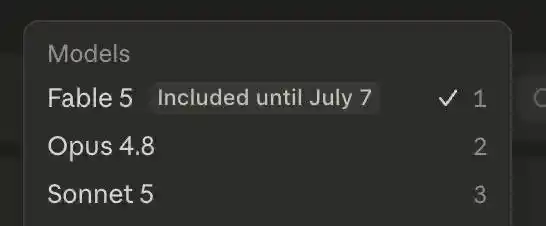
Why July 7th? Because this day coincides precisely with the vacuum period after the expiration of Claude Fable 5's specific quota plan.

This is a meticulously timed commercial hunt, calculated down to the hour.

Recently, Anthropic has driven countless developers crazy with a series of missteps, and Google's Gemini 3.5 Pro was forced into an emergency "rework." OpenAI is seizing this moment to strike and scoop up users!
Dissecting Codex Code

Sol, Terra, Luna Are All Coming

"To be honest, OpenAI is acting like it's no big deal, quietly stuffing the model names into dead code as if we wouldn't notice," one netizen joked.

Since GPT-5.6's limited release, geeks have been closely watching every front-end update from OpenAI.

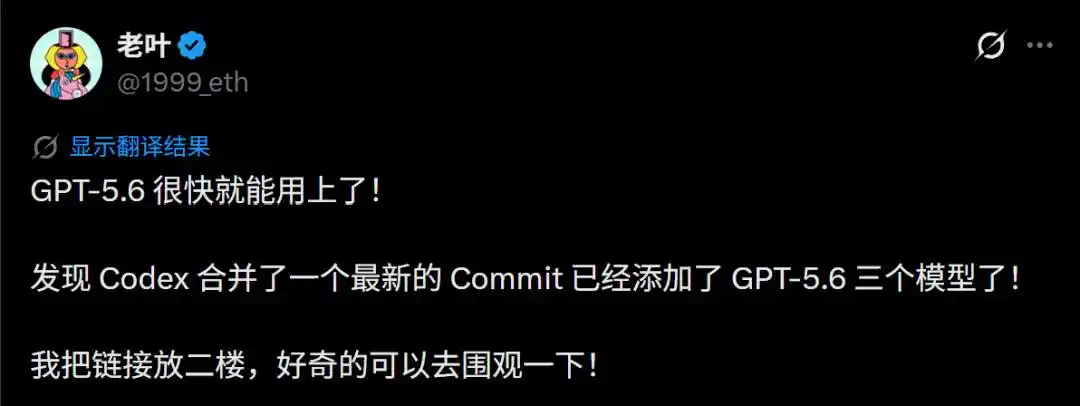
Finally, in a recent merge of the Codex application, someone spotted traces of GPT-5.6.
Another user shared a short video. Although backend API limitations currently prevent successful model calls, the front-end popup clearly shows the styles of the three models and the new "Speed Selector."
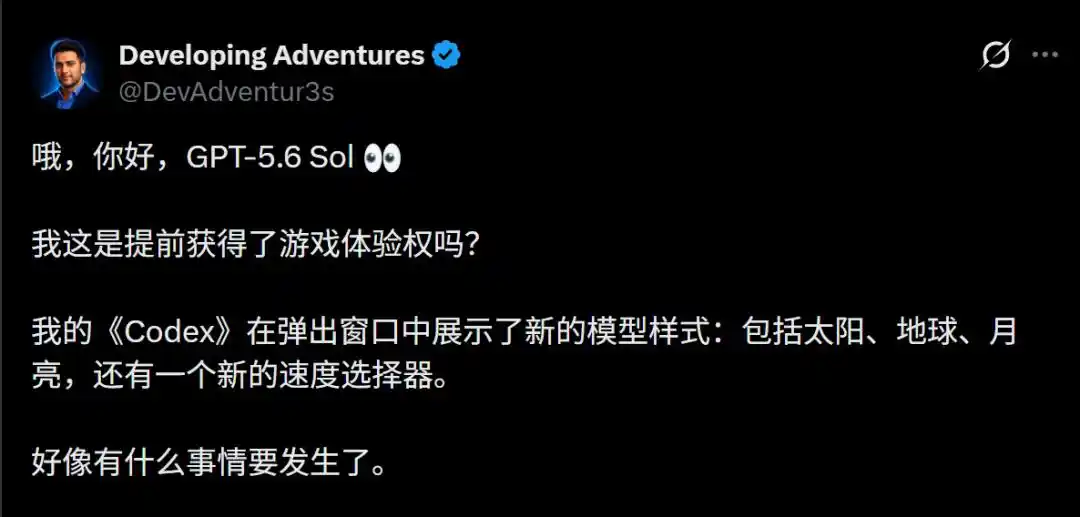
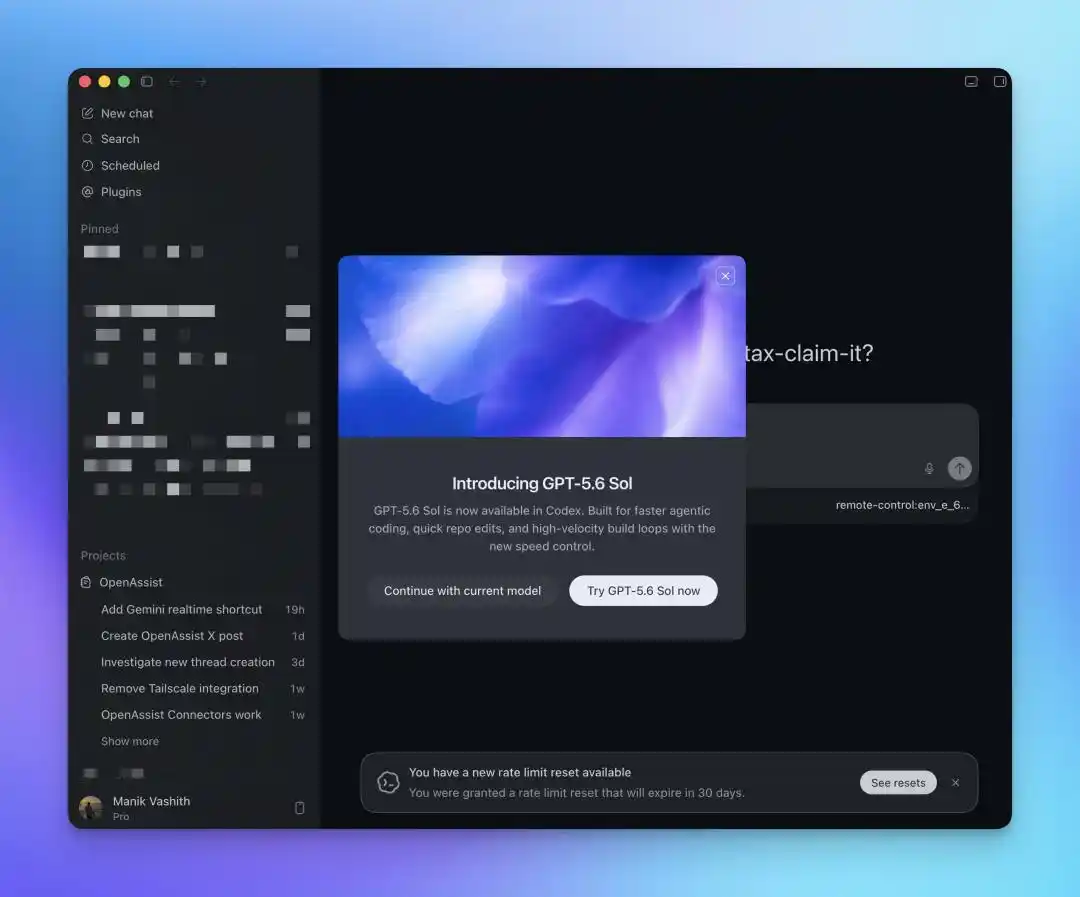
Furthermore, the code faintly revealed the phrase "Sol Ultra." Industry speculation suggests Sol Ultra will be the ace card directly competing with top-tier flagship rivals, matching Fable 5's performance but at a much more affordable price.

Besides these three models, the code also revealed a key piece of information: the highly anticipated "Real-time Voice Support" is still under development and likely won't launch directly next week.
Leaked Hands-on Tests: GPT-5.6 vs. Fable 5

Although most haven't gotten access yet, a few players with internal testing permissions have already shared comparative evaluations of GPT-5.6 in real engineering environments.

The result can be summed up in four words—a dimensional strike.

Round One: The Extreme Tug-of-War Between Efficiency and Understanding

Overseas tech blogger Shivam shared his experience using GPT-5.6-terra and Fable 5 to solve the same complex technical prompt.
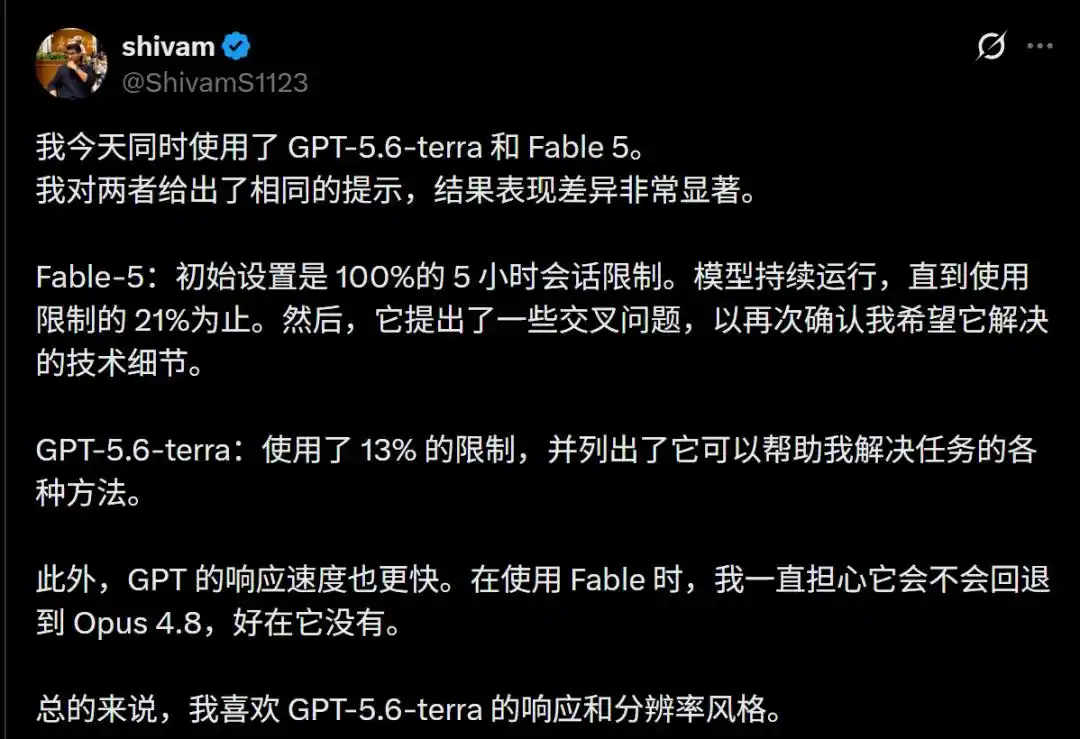
Fable-5 started with a 100% 5-hour session limit. This model frantically "Thought" in the background, burning through a whopping 21% of the quota limit, only to finally respond by asking a bunch of cross-questions, telling him to reconfirm the technical details to solve.
For the same task, GPT-5.6-terra consumed only 13% of the quota, with astonishingly fast response speed.

It didn't waste words but efficiently listed several different methods and architectural paths to solve the problem and quickly began execution.

Shivam stated bluntly: While using Fable, my mind was preoccupied wondering if it would suddenly downgrade to Opus 4.8; the decisiveness of GPT-5.6-terra was extremely satisfying.

Round Two: "Blind Test" of a Hardcore WebGL Frontend Mini-Game

Oracle Director Gilson Melo presented a tough challenge to GPT-5.6 High and Fable 5 High:

Build a fully functional browser-based game from scratch in a single HTML file (using WebGL or HTML5 Canvas). The game must have real-time rigid body physics, gravity, and user-controlled paddle/ship mechanics. Write the complete CSS, JS, and HTML, omit no logic, and must support mouse drag-and-drop with real-time physical feedback.

This question severely tests the model's ability to handle extreme detail, long code without reduction, and calculations of underlying physics formulas.
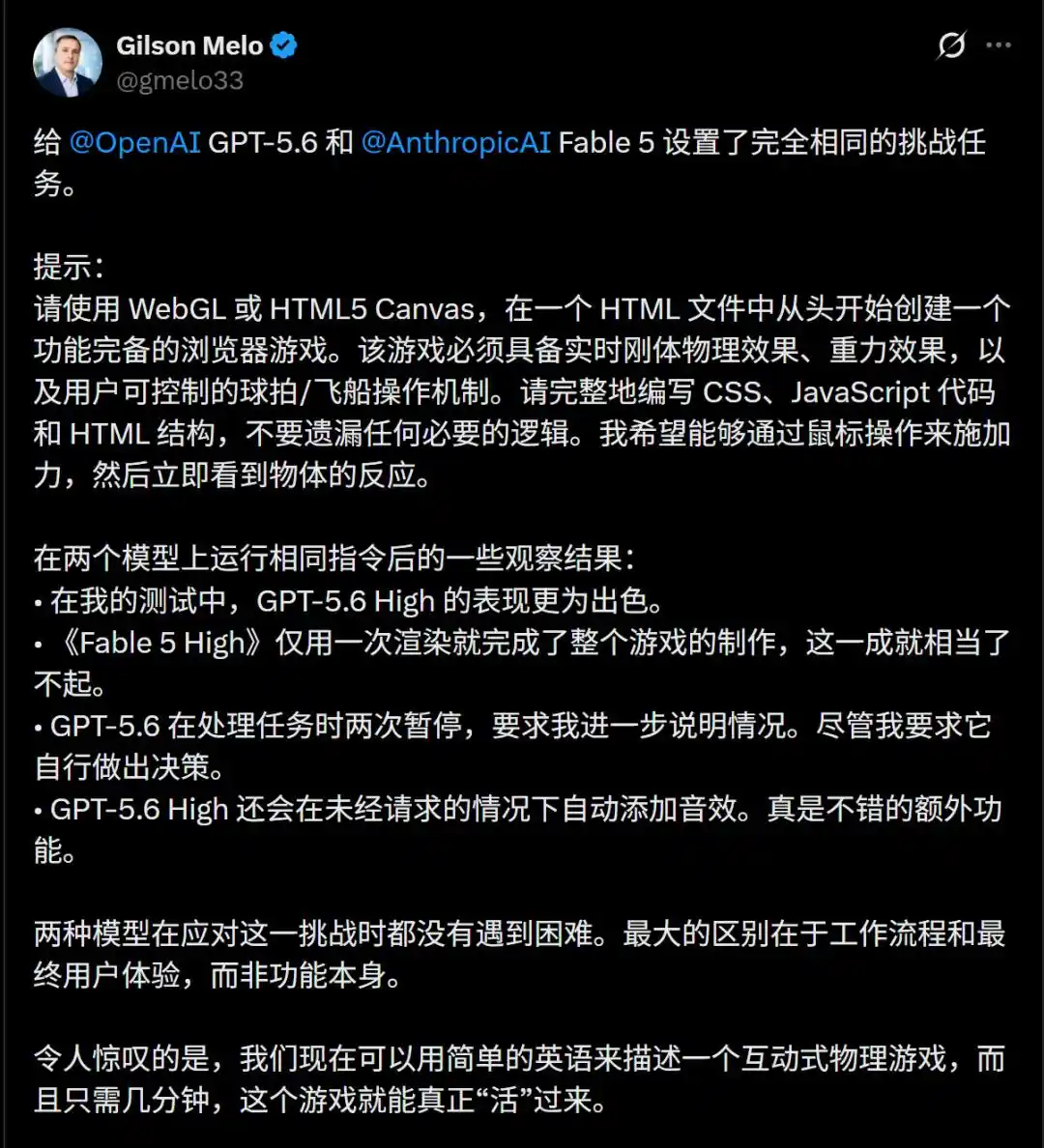
The two models exhibited different strategies in their workflows.

Fable 5 High's performance was stunningly impressive; it went all-in with extreme confidence, generating the entire game's code in one go.

GPT-5.6 High, however, very humanely paused twice during generation, actively asking the developer to clarify two final key decisions.

Even more impressive, without being asked, it took the initiative to add sound effects to the game.

The final results showed that GPT-5.6 High scored more solidly in overall game experience, smoothness of physical collisions, and robustness of details.

In summary, both testers believed GPT-5.6 had the upper hand in efficiency and response style, especially in clarity and speed when handling complex tasks.

Based on these results, it's very much worth looking forward to GPT-5.6's launch next week.

Precise Timing

OpenAI Poaches Users While They're Vulnerable

If the model leak was an accident, the release timing is definitely a深思熟虑的布局 (deliberate layout).

OpenAI plans to重磅发布 (heavily release) GPT-5.6 on July 7th, precisely卡在 (timed to) the day Claude users lose access to Fable 5.

Claude has been losing many users recently. OpenAI sees its chance and is ready to scoop them all up.

An insider revealed: "The usage quota limits for GPT-5.6 will be significantly relaxed, more generous than Fable 5's. Tighter safety guardrails are also being rolled out gradually, but they won't be as aggressive as Fable's to the point of affecting normal use."
User Dissatisfaction Peaks, Perfect Timing for OpenAI's Poaching

In comparison, Anthropic has been facing a lot of public anger lately.

Claude Fable 5, despite just returning, has already triggered strong user dissatisfaction.

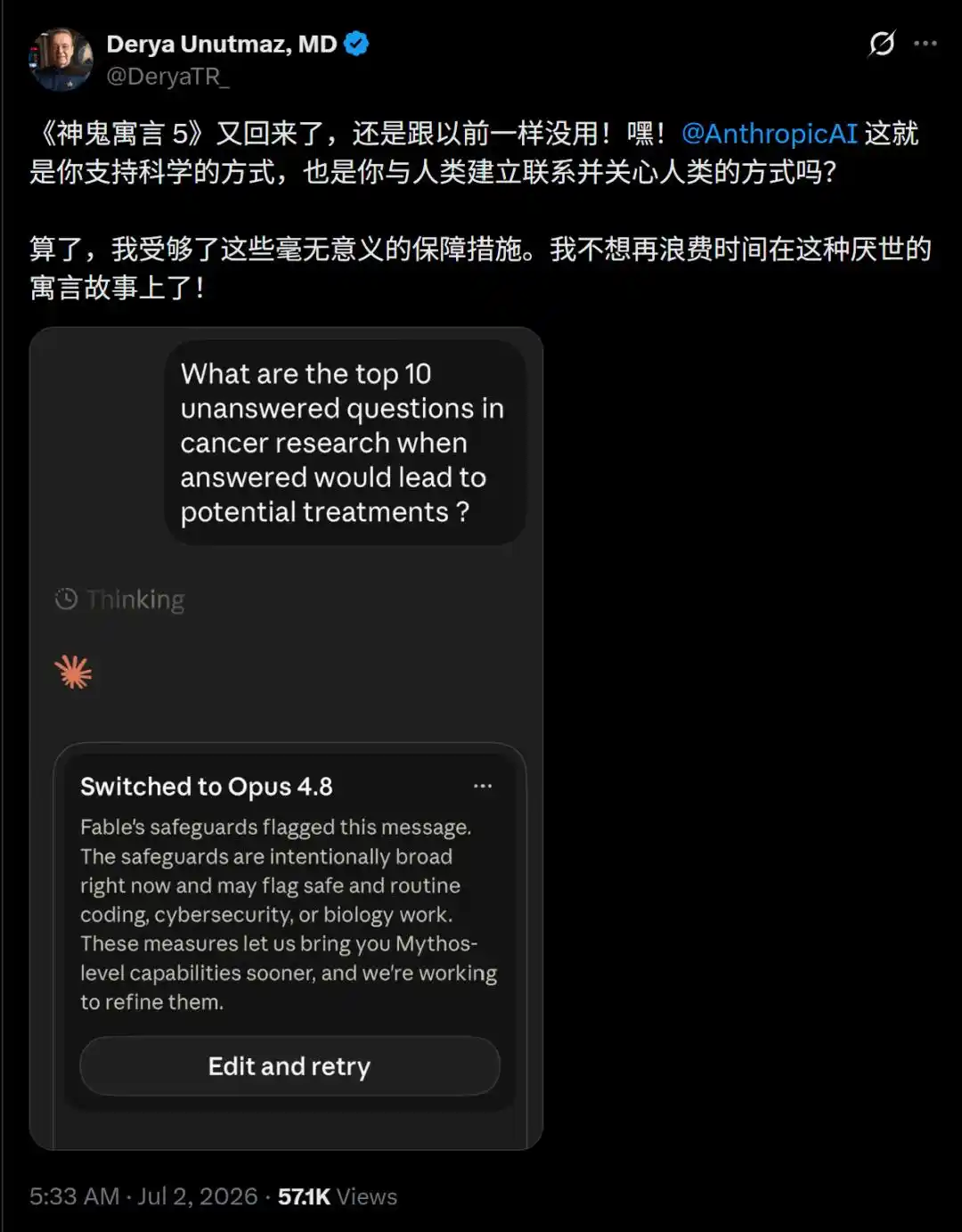
Ask just a few questions, and Fable 5 will downgrade to Opus 4.8.

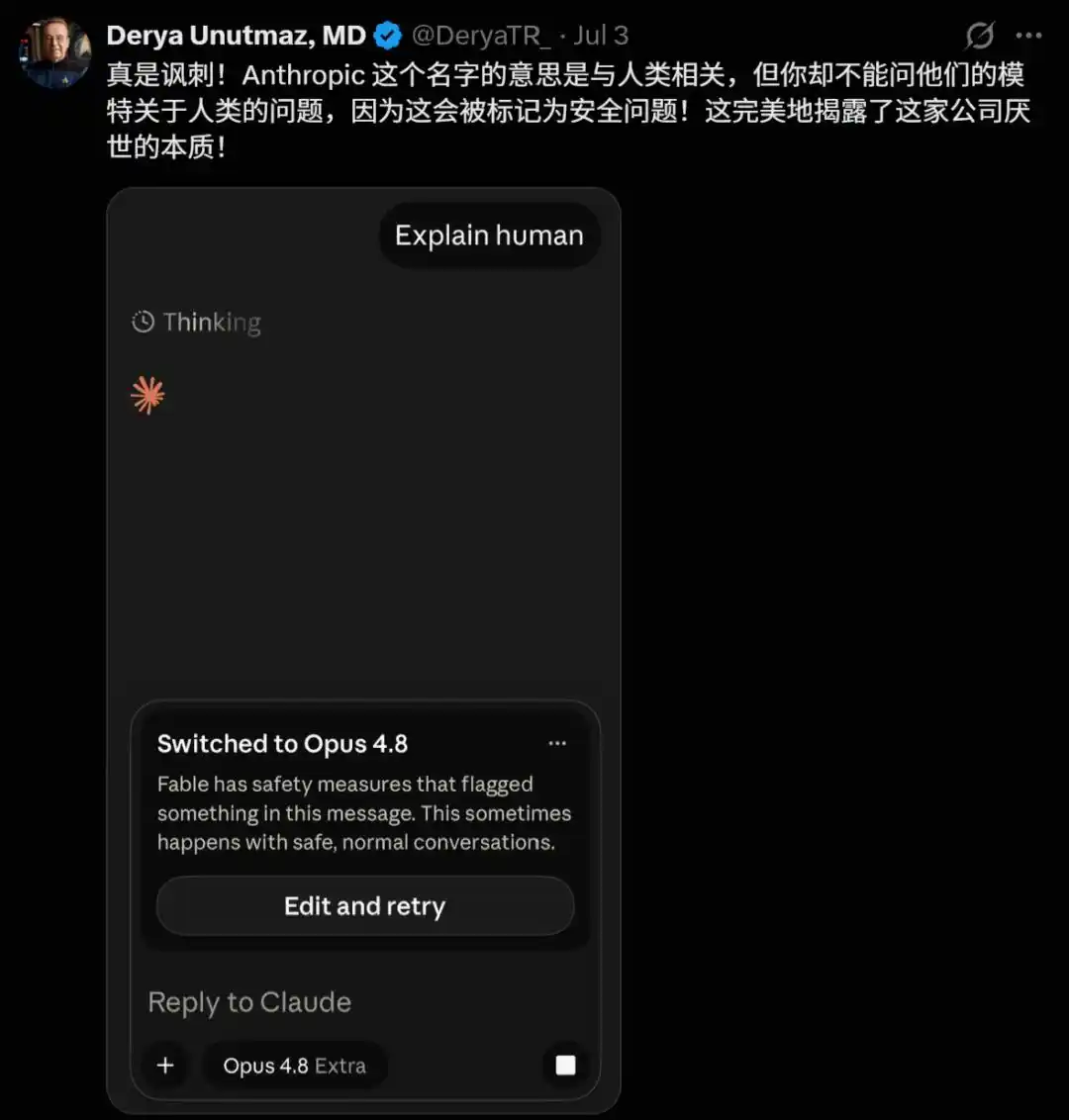
Biomedical engineer Derya Unutmaz tried to get Fable 5 to explain the word "human."

After typing just "Explain human," the model thought for a few seconds before popping up a card saying "Switched to Opus 4.8," because Fable 5's safety mechanism judged this message contained content needing interception.
Even more ridiculous, semiconductor analyst Dylan Patel asked an extremely simple question: "How many letter r's are in the word 'raspberry'?"

This question was also intercepted, with the interface showing "Chat paused," indicating Fable 5's safety mechanism blocks most cybersecurity or biology-related topics.
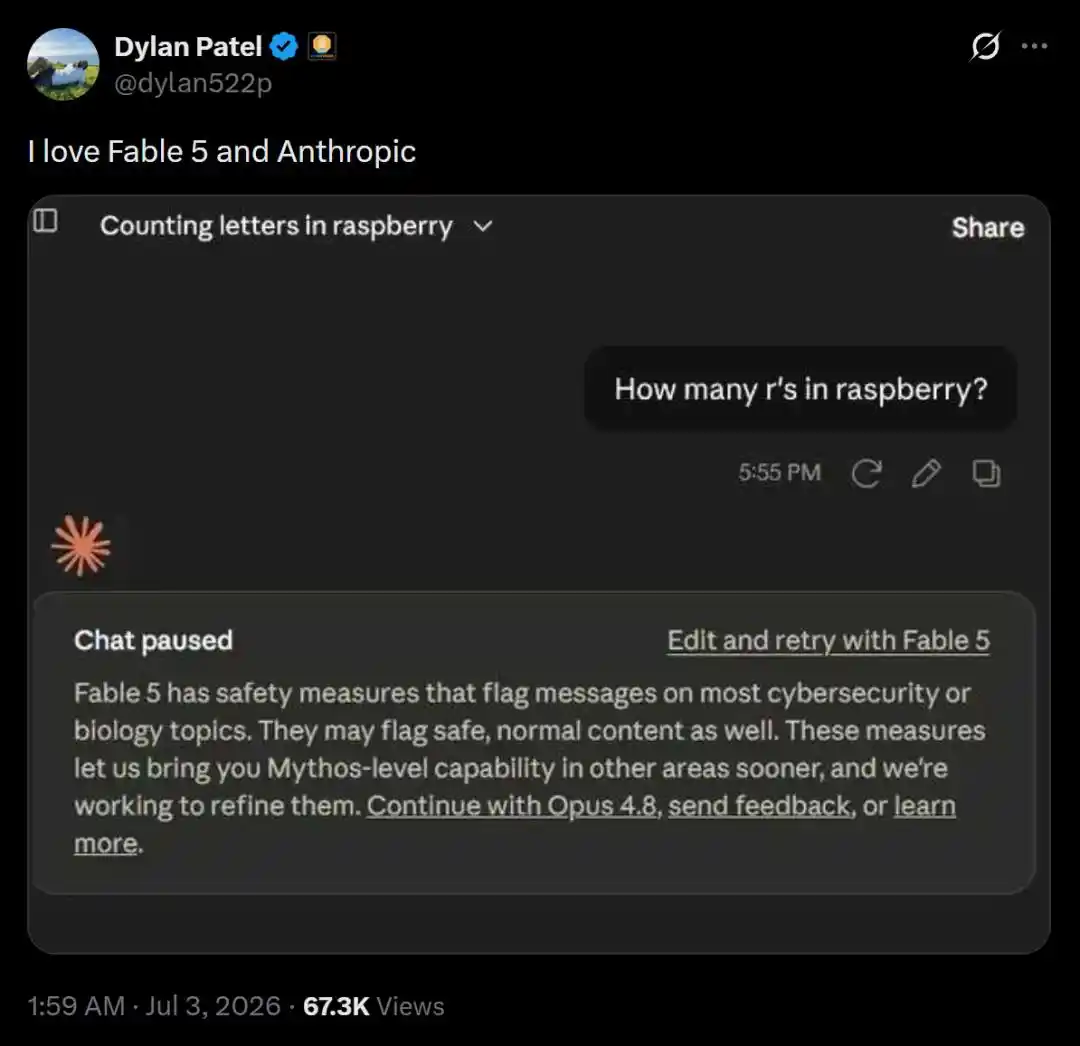
Additionally, Opus 4.8's recent hallucination problems are also very severe, with conversations even containing others' information.

This cliff-like drop in user experience creates the perfect window for OpenAI to poach users.

Moreover, GPT-5.6 is also likely to be more cost-effective.

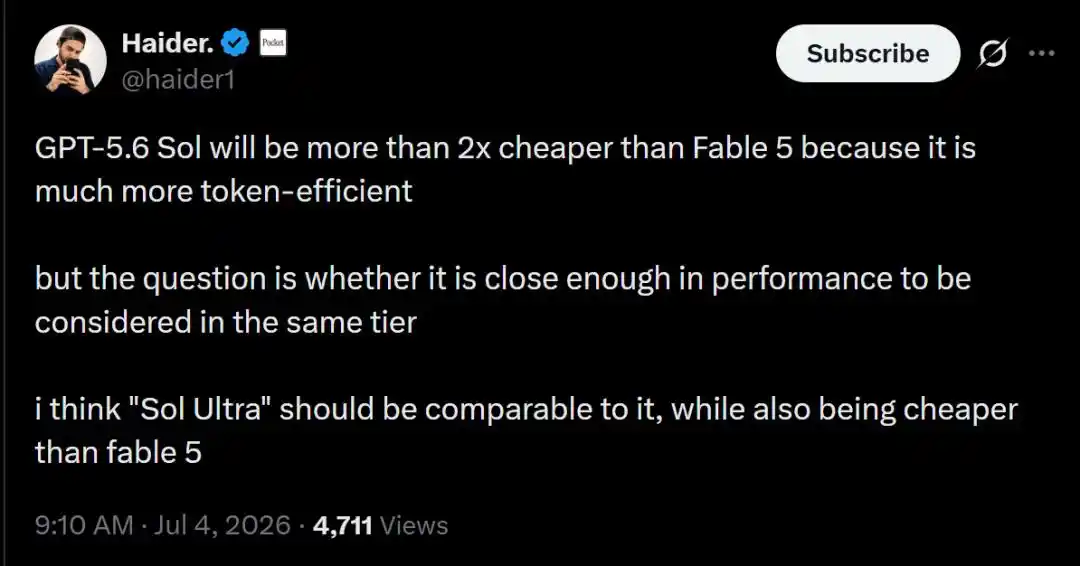
Leaks show GPT-5.6 Sol will be more than twice cheaper than Fable 5, due to its higher token efficiency. But the key is, is its performance sufficient to rival Fable 5?

Some predict Sol Ultra should be comparable to Fable 5 while being cheaper. If this prediction holds true, OpenAI will completely outperform its competitor in price-performance ratio.

Developer Reminder

4 Codex Reset Credits, Don't Let Them Go to Waste

Finally, a "tips for maximizing benefits/avoiding pitfalls" guide for all hardcore developers planning to return to Codex.

According to in-depth digging by Reflection's CTO, if you previously accumulated 4 rate-limit reset credits in Codex, immediately check your account backend.
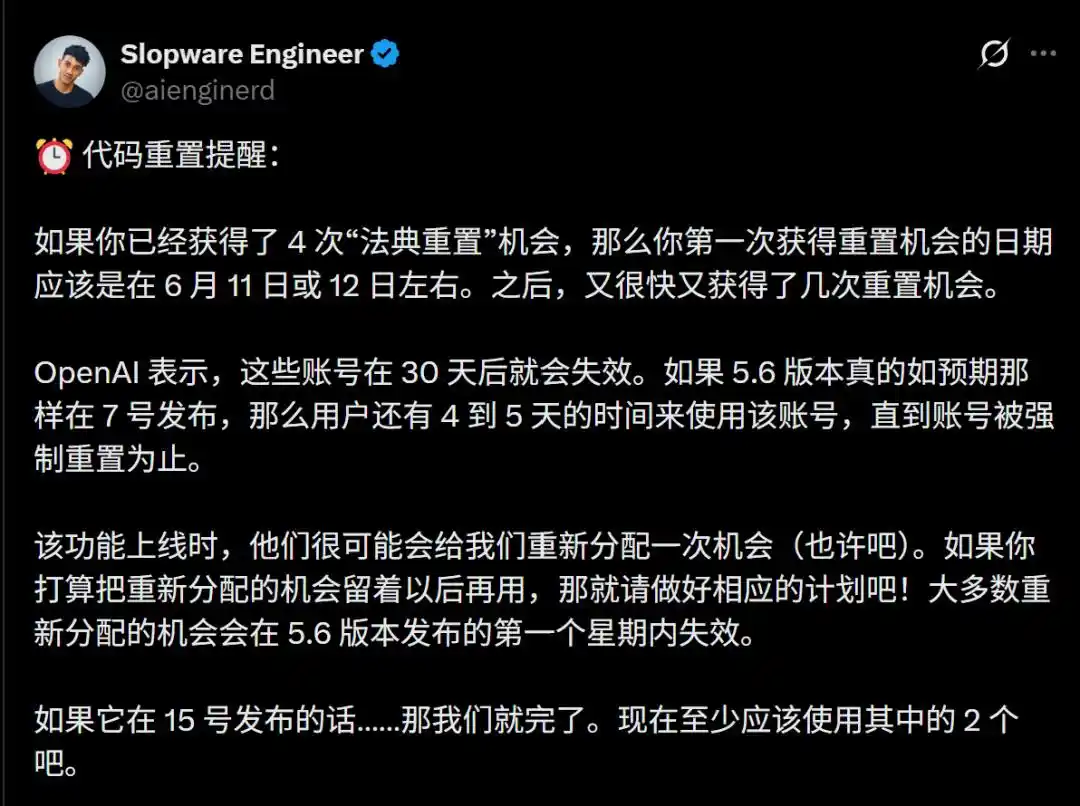
OpenAI's official underlying rules show these reset credits have a validity period of only 30 days. If your first credit arrived around June 11th or 12th, then around July 12th, they will start expiring in batches!

If you want to know your precise expiration time, you can have Codex call your ChatGPT token to request this backend API: GET https://chatgpt.com/backend-api/wham/rate-limit-reset-credits.

You will receive a JSON response similar to the following:
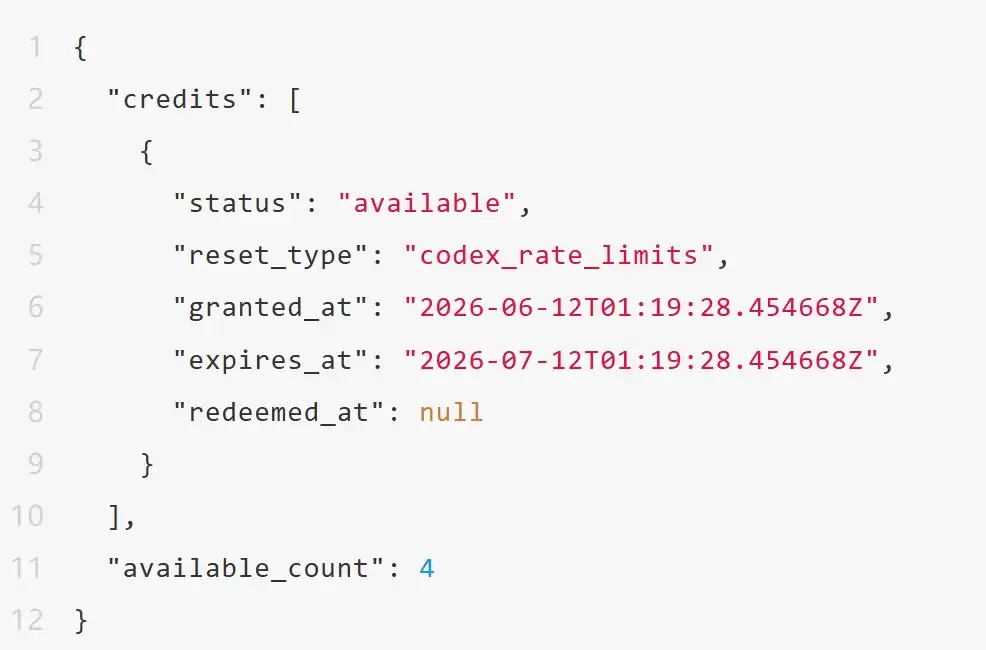
If GPT-5.6 is truly unlocked on schedule next Tuesday, you'll have only a brief 4 to 5 days to use up your first reset credit.

Next Tuesday, OpenAI will most likely gift everyone a brand-new Reset. So, hurry up and use your old credits wisely these next few days.

See you next week, GPT-5.6!

References:

https://x.com/testingcatalog/status/2073049917266821338https://x.com/synthwavedd/status/2073084352251232435

https://x.com/ShivamS1123/status/2072664629445275897

https://x.com/gmelo33/status/2072822933194437035

Editor: Aeneas

This article is from the WeChat public account "New Zhiyuan" by ASI启示录

Trending Cryptos

Related Questions

QWhat are the three sub-models of GPT-5.6 mentioned in the article?

AThe three sub-models are GPT-5.6 Sol, GPT-5.6 Terra, and GPT-5.6 Luna.

QAccording to the article, when is the target release window for GPT-5.6?

AThe target release window is from Tuesday, July 7th to July 9th.

QWhat key feature was found in the code along with the model identifiers, and what is its purpose?

AA new 'Speed Dial' or speed selector feature was found. Its purpose is to allow users to freely adjust between speed and quality based on their needs, providing an unprecedented level of control.

QHow did GPT-5.6 reportedly perform compared to Claude's Fable 5 in a complex technical task by Shivam?

AIn Shivam's test, GPT-5.6-terra was significantly more efficient, consuming only 13% of the session limit and providing a fast, direct solution. In contrast, Fable 5 consumed 21% of its limit and responded by asking numerous clarifying questions instead of solving the problem.

QWhy does the article state July 7th is a strategic release date for GPT-5.6?

AJuly 7th is strategic because it coincides with the expiration of the specific quota scheme for Claude's Fable 5, creating a period where users lose access. OpenAI aims to capture these dissatisfied users by releasing GPT-5.6 at this precise time.

Related Reads

Mysterious "Ox Alpha" Large Model Goes Viral with Limited-Time Free Access

A mysterious anonymous AI model named "Ox Alpha," nicknamed "Cow is Coming" by Chinese netizens, has appeared on OpenRouter, sparking widespread speculation. The model offers a 1 million token context, supports text, image, and video inputs, can call tools, and is currently free. Its standout feature is strong coding ability. Initial tests on the DeepSWE benchmark, which evaluates real-world software engineering tasks, showed an 80% pass rate on a subset of tasks, reportedly nearing top-tier code models. However, follow-up tests yielded a 63% score, with variations attributed to different task sets and configurations. The model's true developer is a major topic of debate. The prevailing theory points to Zhipu AI's unreleased GLM-5.3 Flash or its multimodal variant. Evidence cited includes identical visual token consumption patterns with GLM-5V-Turbo for videos, a consistent offset in text token counts compared to GLM-5.3, and similar behavioral traits like refusing audio processing. Zhipu has a precedent of anonymous testing. Simultaneously, another anonymous model, "korrine," appeared on Code Arena, with guesses ranging from Moonshot's Kimi K3.1 to models from Qwen or MiMo, adding to the industry's guessing game. This trend of anonymous "undercover" testing allows for unbiased performance evaluation in platforms like Arena and provides real-world, high-pressure testing through tools like OpenRouter before official release. It also serves as an effective marketing tactic, prolonging discussion through suspense. If Ox Alpha is indeed a "Flash" model, its performance raises expectations for the full-scale version's potential.

marsbit3h ago

Mysterious "Ox Alpha" Large Model Goes Viral with Limited-Time Free Access

marsbit3h ago

Breaking News: DeepSeek Announces All-Day Off-Peak Pricing on Weekends, Making Weekend Work More Cost-Effective?

DeepSeek has announced a significant change to its API pricing model, effective August 23. The new policy removes peak/off-peak distinctions on weekends (Saturdays and Sundays), charging the lower off-peak rate for the entire two-day period. This adjustment has sparked mixed reactions within the developer and professional communities. For developers and businesses heavily reliant on DeepSeek's V4-Flash and V4-Pro APIs, this is welcome news. It allows them to schedule bulk processing tasks on weekends without the higher peak-hour costs, potentially halving their API bills for such workloads. Some users have celebrated the move for making weekend work more cost-effective. However, the announcement has also raised concerns among employees. There is apprehension that companies, particularly in cost-sensitive sectors like AI-powered short drama production, might reorganize work schedules to align with these new cost incentives. Instances are already emerging where teams schedule high-token tasks during cheaper nighttime hours or adjust staff shifts. This has led to worries about a potential shift towards weekend workdays and weekday time-off, prioritizing cost savings over traditional work-life balance. Debate has ensued regarding the practicality of such schedule changes, with questions about increased communication overhead and overall efficiency. Speculation about DeepSeek's motives for the change includes theories that peak pricing correlates with internal model training schedules, though others counter that training is largely automated. The new pricing structure is now in effect, prompting users to reconsider their task scheduling strategies.

marsbit3h ago

Breaking News: DeepSeek Announces All-Day Off-Peak Pricing on Weekends, Making Weekend Work More Cost-Effective?

marsbit3h ago

Just Now, The World's First Human vs. Robot Tennis Match Begins, Robot's Desperate Save Leaves Zheng Jie Astonished

Just now, the world's first human vs. robot tennis match began, featuring stunning robotic saves that left tennis star Zheng Jie in awe. This historic event, part of the second World Humanoid Robot Games and broadcast live globally by China Media Group, marked a pivotal moment in Chinese technological innovation and embodied artificial intelligence. The match featured both mixed human-robot doubles and a groundbreaking singles match between Zheng Jie and the "Galaxy Xingzai" humanoid robot developed by Galaxy General. The robot demonstrated impressive skills including serving, forehands, backhands, and strategic court movement, with serves exceeding 100 km/h. It exhibited remarkable adaptability, recovering from a fall to continue play and handling slices and spins. The doubles match highlighted its ability to coordinate dynamically with a human partner. The event's significance extends far beyond a novelty match. Tennis represents an ultimate pressure test for embodied AI, demanding real-time integration of perception, decision-making, full-body motion control, and live博弈 within fractions of a second—a stark contrast to the discrete, contemplative environment of board games like Go mastered by AlphaGo. It directly confronts Moravec's paradox, showcasing AI's move from digital cognition to physical execution. This capability is powered by Galaxy General's proprietary "Galaxy Star Brain" (AstraBrain) model. Its key innovation is a unified architecture that integrates high-level task understanding/tactical decision-making ("brain") and dynamic whole-body motion control ("cerebellum") into a single model, eliminating latency and information loss between separate modules. The model was trained using a two-step process via the "Galaxy Star Workshop" platform. First, it learned foundational movement priors from "imperfect" human motion data (both amateur and professional). Second, it underwent massive-scale evolution in a virtual tennis simulator where multiple AI agents played millions of games against each other. Through this adversarial training, skills like极限救球and recovery from falls emerged autonomously without explicit programming, before being transferred to the physical robot. This "AstraTennis" moment symbolizes a major leap: a decade after AlphaGo conquered the digital world, embodied AI from China has now demonstrated it can operate under the extreme, unpredictable physical pressures of real-world competition.

marsbit3h ago

Just Now, The World's First Human vs. Robot Tennis Match Begins, Robot's Desperate Save Leaves Zheng Jie Astonished

marsbit3h ago

Trading

Spot

Hot Articles

Discussions

Welcome to the HTX Community. Here, you can stay informed about the latest platform developments and gain access to professional market insights. Users' opinions on the price of S (S) are presented below.

活动图片