Strategy’s STRC retakes $90 after 24% rebound from June closing low

cointelegraphPublished on 2026-08-04Last updated on 2026-08-04

Abstract

Strategy's variable-rate preferred stock, STRC, closed above $90 for the first time in seven weeks, marking a nearly 24% rebound from its June closing low of $74.57. The recovery follows company actions to support the stock, including selling 1,638 Bitcoin for $104.7 million—with half used to fund dividends and half for STRC repurchases. Strategy also raised $290.6 million through MSTR share sales, allocating a portion to further repurchases and increasing its dollar reserve to $4 billion. Despite the rebound, STRC remains below its target trading range of $99 to $100.

Strategy’s variable-rate preferred stock, STRC, closed above $90 for the first time in seven weeks, extending its recovery from a June selloff that raised concerns about the Bitcoin treasury company’s financial resilience.

STRC closed at $92.32 on Monday, up 3.2% from Friday’s $89.46 close, according to Yahoo Finance data. It was the first close above $90 since June 16. The stock has recovered nearly 24% from its June 26 closing low of $74.57.
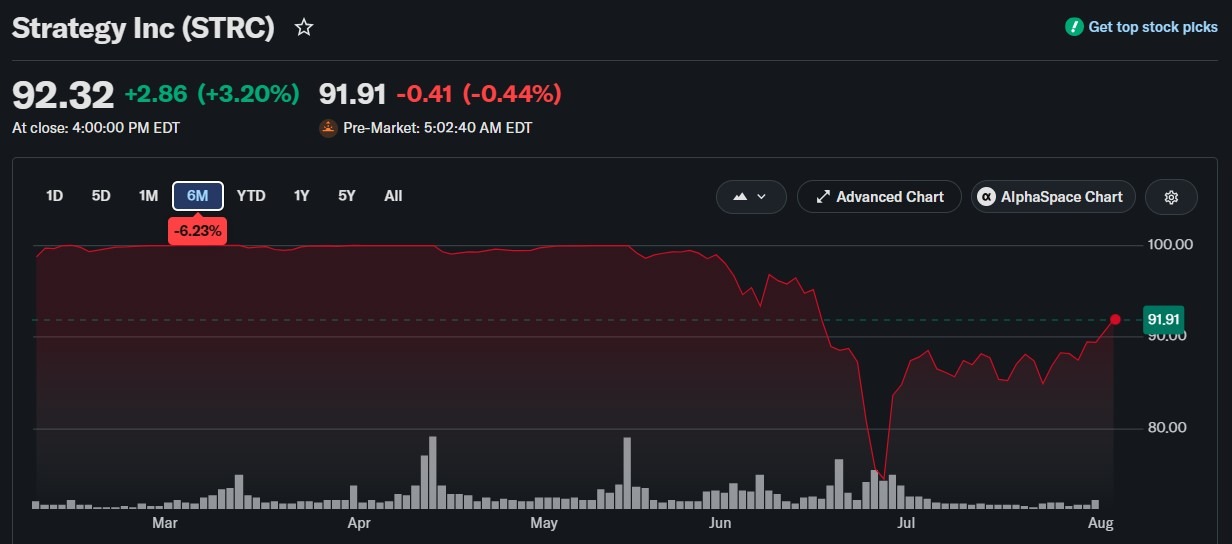
STRC price chart. Source: Yahoo Finance

STRC is Strategy’s perpetual preferred stock with a dividend rate that can be adjusted monthly to encourage trading near its $100 stated amount. Despite the rebound, it remains below the company’s $99 to$100 target range.

The recovery followed steps by Strategy to support STRC, including the sale of 1,638 Bitcoin for $104.7 million, disclosed Monday in its latest 8-K filing. Strategy used $52.4 million to fund preferred-stock dividends and $52.3 million to repurchase STRC.

Strategy also raised $290.6 million through MSTR share sales, including $250 million for its dollar reserve and $28.9 million for STRC repurchases. It repurchased 912,143 STRC shares for $81.2 million and increased its dollar reserve to $4 billion.

Related: Has Strategy’s capital overhaul put an end to ‘death spiral’ fears?

Trending Cryptos

Related Questions

QWhat is the ticker symbol of Strategy's variable-rate preferred stock, and what is its current status according to the article?

AThe ticker symbol is STRC. It closed above $90 for the first time in seven weeks, reaching $92.32 on Monday, marking a 24% rebound from its June closing low of $74.57.

QWhat specific action did Strategy take, as disclosed in its 8-K filing, to support the STRC preferred stock?

AStrategy sold 1,638 Bitcoin for $104.7 million. It used half of the proceeds ($52.4 million) to fund preferred-stock dividends and the other half ($52.3 million) to repurchase STRC shares.

QBesides the Bitcoin sale, what other financing move did Strategy make to support its financial position and STRC?

AStrategy raised $290.6 million through MSTR share sales. Of this, $250 million was allocated to its dollar reserve and $28.9 million was used for further STRC repurchases.

QWhat is the stated purpose and target trading range for Strategy's STRC preferred stock?

ASTRC is a perpetual preferred stock with a monthly adjustable dividend rate designed to encourage trading near its $100 stated amount. The company's target range for it is between $99 and $100.

QWhat was the initial concern that prompted Strategy's recent financial actions, as mentioned in the article?

AA June selloff in STRC raised concerns about the Bitcoin treasury company's financial resilience, often referred to as 'death spiral' fears, which the recent capital overhaul aimed to address.

Related Reads

After Memes, Solana Foundation's 'Survival Roadmap'

**Title:** After Memes, Solana Foundation's "Survival Roadmap" **Summary:** Solana Foundation's recent hiring spree for senior roles in stablecoins, AI, Asian institutional growth, and DeFi signals a strategic pivot away from its meme-driven past. This move comes as the blockchain faces a 43% quarterly drop in real economic value and declining application revenue, despite maintaining high network activity. While meme platforms like Pump.fun still dominate fee generation, new demand is emerging in tokenized equities (with $5.8B volume in Q2, a 114% increase) and institutional adoption (7 global systemically important banks are now active on Solana). The foundation's new hires aim to bridge a critical gap: transforming this growing non-speculative demand into sustainable, fee-generating activity. The stablecoin lead seeks "step-change growth" for a sector lagging behind competitors. The Asia-focused roles aim to convert institutional interest into concrete pipelines, leveraging upcoming network upgrades for millisecond settlement. The AI ecosystem role is tied to new stablecoin payment channels for AI agents, a nascent but promising revenue stream. The core challenge is clear: reduce reliance on volatile meme trading income and successfully monetize the rising institutional and real-world asset activity. The success of this "survival roadmap" will be measured by whether projects from these new focus areas can break into Solana's top revenue rankings, displacing the current meme-centric leaders.

marsbit13m ago

After Memes, Solana Foundation's 'Survival Roadmap'

marsbit13m ago

Anchorage Unveils Plan to Protect Against Quantum Threats

Regulated crypto bank Anchorage Digital has presented a strategy for preparing institutional assets for the post-quantum era, including implementing hybrid protection for internal TLS connections. The bank highlights that for cryptocurrencies, the main quantum risk lies in digital signatures, as Shor's algorithm could theoretically derive a private key from a public one. To mitigate this, Anchorage uses Bitcoin addresses based on a hash of the public key, which keeps the key hidden until a transaction is sent, and practices minimal address reuse. Internally, the company has deployed post-quantum key encapsulation for employee devices on ChromeOS and is implementing post-quantum cryptography within its hardware security modules (HSMs). A key proposal is the "Post-Quantum Turnstile" mechanism, which uses STARK zero-knowledge proofs to allow users to migrate signing rights to a post-quantum key without exposing their old private or public key. This could help secure an estimated two-thirds of circulating coins that might otherwise become inaccessible if the network phases out classical signatures. Furthermore, Anchorage open-sourced its Rust implementation of the SQIsign digital signature scheme, which it claims offers signatures about seven times smaller than the Falcon algorithm. This comes amid warnings that around 6 million BTC in addresses with exposed public keys could be vulnerable to future quantum attacks.

cryptonews.ru46m ago

Anchorage Unveils Plan to Protect Against Quantum Threats

cryptonews.ru46m ago

Trading

Spot

Hot Articles

Discussions

Welcome to the HTX Community. Here, you can stay informed about the latest platform developments and gain access to professional market insights. Users' opinions on the price of S (S) are presented below.

活动图片