Strategy Sets Ambitious Goal to Become the Largest Public Company in the World

cryptonews.ruPublished on 2026-08-06Last updated on 2026-08-06

Abstract

Strategy Inc. (Nasdaq: MSTR) has reaffirmed its ambition to become the world's largest company by market capitalization, a goal first stated in its Q2 2026 earnings presentation. The company aims to achieve this through a synergistic capital structure involving Bitcoin ($BTC), its digital debt securities (STRC), and its common stock (MSTR). Bitcoin serves as the reserve asset, STRC attracts yield-focused capital, and MSTR provides leveraged exposure to Bitcoin for equity holders. As of August 5, Strategy held 842,138 BTC (4.01% of the maximum supply), with a total reserve of $58.4B. The company targets annual STRC sales equal to 10-20% of its Bitcoin reserves and aims to double Bitcoin-per-share value within seven years. Leadership, including Michael Saylor and Phong Le, positions Strategy as the "JPMorgan of the cryptoeconomy," combining Bitcoin reserves, digital debt, and active balance sheet management. The company has also endorsed the CLARITY Act to support regulatory clarity for digital assets.

Strategy Inc. (Nasdaq: MSTR) reiterated its ambition to become the world's largest company by market capitalization in an August 5 post on X, confirming a goal first outlined in its Q2 2026 financial results presentation published on July 30. The company stated it plans to achieve this goal by holding the largest capital in the form of bitcoin, issuing the most reliable credit instruments through its STRC digital credit securities, and creating the best stocks through MSTR.

In the company's presentation, bitcoin, digital credit, and common stock are presented within a mutually reinforcing capital structure. $BTC provides the reserve base, STRC attracts capital in the form of digital credit, and MSTR offers common stock holders enhanced exposure to bitcoin within the company's capital management strategy.
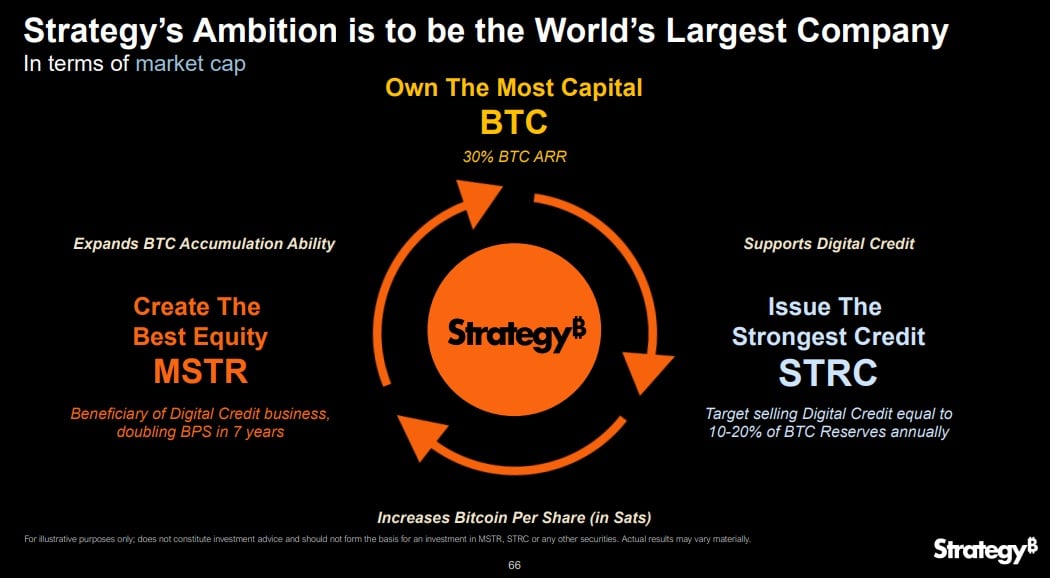
Strategy's aspiration to become the world's largest company. Source: Strategy Inc. Q2 presentation

This model integrates Strategy's bitcoin reserve, digital credit securities, and common stock into a unified capital structure designed to strengthen each component. Management states that this approach facilitates capital formation, continued bitcoin accumulation, and growth in bitcoin per share, while expanding the company's financial flexibility.

According to Strategy's updated dashboard, as of August 5, the company held 842,138 $BTC, representing 4.01% of the maximum bitcoin supply, and had a reserve of $58.4 billion and a net reserve of $36.3 billion. Also listed were a market capitalization of $38.1 billion, debt of $6.75 billion, preferred stock of $15.35 billion, a USD reserve of $4 billion, and a net leverage ratio of 5.06%.

STRC Expands Strategy Beyond Bitcoin Accumulation

The strategy concept positions STRC as a digital credit product that supports bitcoin accumulation while simultaneously expanding the company's access to yield-focused investors. The presentation targets annual digital credit sales volume equal to 10–20% of $BTC reserves and aims to double the bitcoin value per share within seven years.

On August 4, the company stated on X that STRC's return to its $100 USD par value remains a key goal. The $100 figure represents the stated par value of the preferred security and serves as a benchmark to assess whether STRC is trading at a discount or premium, while its market price continues to reflect investor demand and prevailing market conditions.

Founder and Executive Chairman Michael Saylor continues to link the company's long-term positioning with disciplined capital management in volatile markets. He recently reaffirmed Strategy's bitcoin-centric focus, highlighting bitcoin, credit quality, deal execution transparency, and long-term value creation as core corporate priorities.

Strategy Positions MSTR as an "Equity Growth Engine"

Strategy describes MSTR as a tool with enhanced bitcoin exposure, using leverage intelligently to increase bitcoin per share and strengthen the long-term value of common stock. The company's presentation showed that since adopting the "bitcoin standard" in August 2020, MSTR has delivered an annualized return of 42%, compared to 32% for bitcoin itself.

President and CEO Phong Le also reported that MSTR has outperformed bitcoin on a return basis in every examined rolling four-year holding period since the treasury strategy began. Alongside these results, institutional investor participation has expanded: 13 of the company's 15 largest shareholders increased their aggregate positions by 27% in the first quarter.

Le characterized Strategy as the "JPMorgan of the cryptoeconomy," positioning the company more as a bitcoin-focused capital markets platform than a traditional corporate treasury. Saylor later echoed this phrase on X, emphasizing a model combining bitcoin reserves, digital credit, preferred securities, equity issuance, and active balance sheet management.

Broader regulatory support is also part of the company's efforts to accelerate institutional adoption of digital assets. On July 31, Strategy and Saylor endorsed the CLARITY Act, describing it as a framework for consumer protection, property rights enforcement, and strengthening US capital markets, while providing greater regulatory clarity for digital assets.

end-content

Trending Cryptos

Related Questions

QWhat is Strategy Inc.'s ambitious goal as announced on August 5th?

AStrategy Inc.'s goal is to become the world's largest public company by market capitalization.

QHow does Strategy Inc. plan to achieve its goal of becoming the largest public company?

AStrategy Inc. plans to achieve this goal by holding the most bitcoin, issuing the highest-quality debt through its STRC digital credit securities, and creating the best equity through MSTR shares, all within a mutually reinforcing capital structure.

QWhat are the key components of Strategy Inc.'s capital structure model?

AThe key components are the company's bitcoin reserve, its digital credit securities (STRC), and its common stock (MSTR). These are integrated to strengthen each other, facilitate equity formation, continue bitcoin accumulation, and grow the amount of bitcoin per share.

QAs of August 5th, how many bitcoins does Strategy Inc. hold, and what does this represent?

AAs of August 5th, Strategy Inc. holds 842,138 bitcoins, which represents 4.01% of Bitcoin's maximum supply.

QHow does Strategy Inc. describe the role of its common stock, MSTR, within its strategy?

AStrategy Inc. describes MSTR as a 'stock growth engine' and an instrument with amplified bitcoin exposure. It is designed to increase the amount of bitcoin per share and build long-term value for common shareholders, having outperformed bitcoin itself on an annualized return basis since August 2020.

Related Reads

Home Furnishing Listed Companies Are Trying to Turn Around with AI and Semiconductors

Chinese home furnishing listed companies are increasingly turning to AI and semiconductor cross-border ventures to revive their fortunes amid declining core businesses. A prominent example is PVC flooring giant **Elegant Home Furnishing**, whose stock price skyrocketed with 10 consecutive trading limits after announcing a plan to acquire a majority stake in **Ou Kang Nuo**, a semiconductor storage testing equipment and services company. Despite Elegant Home's own financial struggles—including recent losses and tight cash flow—the acquisition, funded through asset sales and loans, has dramatically boosted its market value. The deal involves a cross-shareholding structure with Ou Kang Nuo's controlling shareholder. This trend is widespread. Over the past year, numerous home furnishing firms with stagnant main operations have seen their stock prices surge after announcing moves into hot sectors like AI, semiconductors, or computing power. Key cases include: * **Markor Home Furnishings** ("high-end home furnishing first share"), after years of heavy losses, acquired an AI server high-speed copper cable company and later introduced AI computing power investors. * **Zhenai Meijia** ("blanket king") became the first A-listed manufacturer controlled by an AI large model company following a takeover. * **Fasilon** (integrated ceiling) saw its stock soar after establishing an AI subsidiary. * **Jinlong Decoration** experienced multiple trading limits after being linked to "commercial aerospace" and "AI computing," despite clarifying these segments contribute less than 1% of its business. Statistics show over 20 A-share companies announced semiconductor crossovers in 2025, with home furnishing and building materials firms being the most active. This shift is largely driven by pressures from the real estate downturn, shrinking overseas demand, and trade tariffs, pushing companies to seek growth through trendy concepts rather than core business improvement. However, the article warns that such speculative frenzies often end when the hype fades, leaving stock prices to eventually reflect the companies' weak fundamentals, as seen in Jinlong Decoration's subsequent sharp price correction. The repeated attempts to "ride the trend" highlight a desperate struggle for survival in a challenging traditional industry.

marsbit39m ago

Home Furnishing Listed Companies Are Trying to Turn Around with AI and Semiconductors

marsbit39m ago

"Sell America" Trade Resurfaces: Global Funds Reprice Washington Policy Risks, Dollar and Treasuries Bear the Brunt

"Sale of America" Trade Resurges as Global Funds Reprice Washington Policy Risks, Hitting Dollar and Treasuries First Recent policy signals from Washington are prompting global bond and foreign exchange investors to reignite the "Sale of America" debate. Uncertainty stems from Fed Chair Wash's shift towards less policy communication, Treasury Secretary Bessant's approval of joint intervention with Japan to support the Yen (the first such coordinated move in nearly 30 years), expanding fiscal deficits, and trade war fears. These factors are undermining confidence in U.S. assets. The 30-year Treasury yield recently broke above 5%, hitting a high not seen since 2007, while the Bloomberg Dollar Spot Index has fallen about 2% from its June peak. This dollar weakness is unusual given still-high U.S. interest rates. Investors cite policy uncertainty as a key driver, with one manager calling the Fed Chair and Treasury Secretary a "double whammy" creating a "Trump administration premium." While the S&P 500 continues hitting record highs and foreign holdings of U.S. Treasuries remain high, parts of the bond and FX markets are adjusting. A core concern is whether the Fed under Wash can effectively anchor inflation expectations; analysts warn that if the Fed lags the hiking cycle, long-end yields could face further upward pressure. The 30-year term premium has risen sharply. The U.S.-backed Yen intervention has also sparked debate on the dollar's structural outlook. While framed by Bessant as a "reallocation of reserves," market participants caution that if Japan—America's largest foreign creditor—must sell Treasuries to fund interventions, ripple effects could hit the bond market. Strategists predict moderate dollar depreciation ahead. Most experts are not predicting an end to dollar hegemony or the safe-haven status of Treasuries. However, a key underlying risk is highlighted: the pace of foreign buying of U.S. debt may not keep up with the speed of American borrowing, gradually eroding the structural advantages that have long supported "American exceptionalism."

marsbit40m ago

"Sell America" Trade Resurfaces: Global Funds Reprice Washington Policy Risks, Dollar and Treasuries Bear the Brunt

marsbit40m ago

Trading

Spot

Hot Articles

Discussions

Welcome to the HTX Community. Here, you can stay informed about the latest platform developments and gain access to professional market insights. Users' opinions on the price of S (S) are presented below.

活动图片