Spain’s regulator sets out MiCA transition rules for crypto platforms

cointelegraphPublished on 2025-12-16Last updated on 2025-12-16

Abstract

Spain's National Securities Market Commission (CNMV) has published a Q&A document detailing the national transition rules for implementing the EU’s Markets in Crypto-Assets Regulation (MiCA). The guidelines clarify authorization procedures, operational conduct, and transitional timelines for crypto-asset service providers (CASPs). Spain has set a shortened transition period ending December 30, 2025, requiring all in-scope entities to obtain MiCA authorization by that date or cease operations. The move aligns with broader EU efforts to reduce regulatory uncertainty and strengthen investor protection, mirroring similar steps taken by Italy and other member states.

Spain’s national securities regulator, the Comisión Nacional del Mercado de Valores (CNMV), has published a dedicated Q&A laying out how it intends to apply the European Union’s Markets in Crypto-Assets Regulation (MiCA) on the ground.

The document outlines what crypto companies can expect on authorizations, notifications, day-to-day conduct, and the transitional regime, pushing platforms toward a clear “comply or quit” decision as MiCA comes into force.

The move puts Spain alongside other EU member states, such as Italy, which are actively using MiCA’s transitional flexibilities rather than allowing prolonged regulatory uncertainty.

CNMV spells out MiCA approvals

CNMV’s MiCA FAQ walks crypto-asset service providers (CASPs) through the main questions around getting authorized in Spain, clarifying how national procedures fit with MiCA.
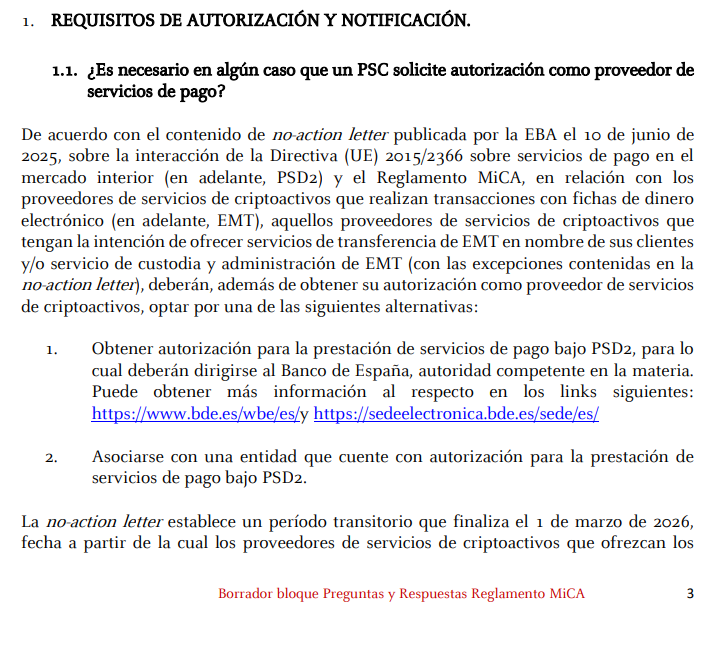
The CNMV published a Q&A on MiCA. Source: CNMV

It addresses which firms fall within scope, how MiCA interacts with existing national registrations, and how entities should approach the authorization and notification processes CNMV has already put in place.

The Q&A also explains how authorization-related notifications and cross-border activity should be handled during the transitional period, stressing that firms must take transitional deadlines seriously.

Related: EU may consolidate crypto regulations, IMF warns of stablecoin risk: Global Express

Operating during the transition

Under MiCA, member states may permit existing providers to continue operating for a limited transitional period, until July 1, 2026, or until they are granted or denied authorization, whichever comes first. However, Spain has opted for a shortened transitional period ending on Dec. 30, 2025.

Entities benefiting from the transition must obtain MiCA authorization by that date if they wish to continue providing in-scope crypto-asset services in Spain.

Companies that fail to do so will no longer be permitted to operate, and continued activity without authorization would breach MiCA rules. Businesses must be prepared to adapt their models or cease operations depending on the outcome of their authorization process.

Related: Poland resubmits vetoed crypto bill with ‘not even a comma’ changed

Wider supervisory tightening

The Q&A is accompanied by new criteria on how MiCA will apply to funds, venture capital vehicles, and MiFID II entities, as well as updated guidance on when investment-related influencers are considered to be engaging in client acquisition. The regulator frames these measures as part of a broader effort to strengthen investor protection as MiCA enters into force.

The move follows similar action in Italy, where the Italian regulator CONSOB set a deadline of Dec. 30, 2025, for existing VASPs to apply for MiCA-style authorization or exit, with transitional operation permitted only for those that file and, in any event, no later than June 30, 2026.

Related: Europe reconsiders crypto oversight as ESMA centralization gains momentum

Trending Cryptos

Related Reads

Bitcoin Has Yet to Hit Bottom, While Exchange AscendEX Has Already "Run Away"

On July 6, 2026, cryptocurrency exchange AscendEX officially announced it is ceasing operations, with a complete shutdown scheduled for July 1, 2026. The platform cited the full implementation of the EU's MiCA regulation alongside market, financial, and operational challenges. Users can no longer perform most functions, with accounts limited to withdrawal purposes only. Prior to the announcement, on-chain investigator ZachXBT had issued warnings about significant withdrawal delays and a severe lack of high-liquidity assets (like ETH, USDT, SOL) in AscendEX's public hot wallets. Following the news, ZachXBT confirmed that the exchange lacks sufficient liquid assets to process multiple verified seven-figure withdrawal requests. AscendEX acknowledged that all withdrawals now require manual review, with no guarantees on processing times. Chain analysis via Arkham Intelligence shows the platform's marked wallets hold minimal readily accessible funds, with most recent activity being small withdrawals. One highlighted wallet reportedly contains only $13.46 million in altcoins. AscendEX, formerly known as BitMax, launched in 2018 and raised $50 million in a 2021 funding round. However, it suffered a major security breach in December 2021, losing approximately $77.7 million from hot wallets. The exchange compensated users but never fully recovered. The current crisis underscores the inherent risks of centralized exchanges, where poor liquidity management, regulatory pressure, and bear market conditions can trigger a collapse. The event is seen as part of a broader industry shakeout, highlighting the importance for users to prioritize non-custodial wallets or exchanges with transparent proof-of-reserves.

Foresight News57m ago

Bitcoin Has Yet to Hit Bottom, While Exchange AscendEX Has Already "Run Away"

Foresight News57m ago

Sevenfold Oversubscription, Can SK Hynix Save the Semiconductor Industry This Time?

SK Hynix's planned US ADR listing is drawing intense interest, with its offering reportedly oversubscribed by over seven times, potentially making it the largest foreign listing in US history. The fundraising of approximately $24.5 billion is intended for expanding its Korean production capacity, including advanced packaging and EUV equipment. This massive demand from long-term funds and prominent institutions like Baillie Gifford and Situational Awareness Partners (led by noted investor Leopold Aschenbrenner) presents a stark contrast to the recent downturn in the broader semiconductor sector. The sector has faced a significant correction, with SK Hynix's own stock falling nearly 30% from its June high. This sell-off was triggered by concerns that major tech giants might slow their AI infrastructure spending, following signals like Meta's reported plan to sell surplus computing capacity. The strong ADR appetite suggests long-term investors still believe in the AI investment cycle's fundamentals, viewing the recent decline more as a valuation reset than a demand collapse. Some market speculation even suggests the pre-IPO price drop could be strategic, setting the stage for a stronger post-listing performance. While SK Hynix's successful listing may act as a short-term positive catalyst for market sentiment, the article argues the true signal for a sustained semiconductor recovery will come from upcoming earnings reports of tech giants like Microsoft, Google, Meta, and Amazon. Their future capital expenditure plans will be crucial in determining whether the AI-driven growth cycle can continue.

Odaily星球日报1h ago

Sevenfold Oversubscription, Can SK Hynix Save the Semiconductor Industry This Time?

Odaily星球日报1h ago

Breaking News: Musk Delivers the Most Powerful Grok 4.5, Slashes Price of Top-tier Opus Intelligence Drastically

**Elon Musk Launches Grok 4.5: A Cost-Effective, High-Performance AI Rival** SpaceXAI, in collaboration with Cursor, has released Grok 4.5, its new flagship AI model designed specifically for coding and agentic tasks. Trained on tens of thousands of NVIDIA GB300 GPUs using massive, high-quality data filtered from trillions of Cursor developer interactions, the model emphasizes "per-token intelligence." In benchmark performance, Grok 4.5 is highly competitive. It scores 64.7% on SWE Bench Pro (surpassing GPT-5.5's 58.6% and Opus 4.7's 64.3%), 83.3% on Terminal Bench 2.1 (nearly matching GPT-5.5), and 62.0% on DeepSWE 1.0 (beating Opus 4.8). Overall, it ranks fourth in AAAI official tests and first in the Harvey legal agent benchmark. The model's key advantage is its combination of speed, efficiency, and low cost. It generates responses at 80 tokens per second and, crucially, uses far fewer tokens to complete tasks—4.2 times fewer than Opus 4.8 on SWE Bench Pro. It is priced at $2 per million input tokens and $6 per million output tokens, significantly undercutting competitors. Musk stated it is "roughly equivalent to Opus 4.7, but much faster." Early user tests show Grok 4.5 can generate functional code for applications like 3D solar system simulators and basic games from simple prompts, though some note it still lags behind top models in certain creative tasks. Musk has hinted at a major update next month, leveraging real-world engineering data from his companies, with an even larger 2-trillion parameter version reportedly in development. Grok 4.5 positions itself not as the absolute strongest model, but as a highly efficient and affordable alternative in the top tier.

marsbit1h ago

Breaking News: Musk Delivers the Most Powerful Grok 4.5, Slashes Price of Top-tier Opus Intelligence Drastically

marsbit1h ago

Trading

Spot

Hot Articles

Discussions

Welcome to the HTX Community. Here, you can stay informed about the latest platform developments and gain access to professional market insights. Users' opinions on the price of S (S) are presented below.

活动图片