"Teletubbies" Robot Cleaning Service, $30/Hour, Pure·Manual·Intelligence

marsbitPublished on 2026-08-03Last updated on 2026-08-03

Abstract

Anthropomorphic "Teletubby" robot offers cleaning services in San Francisco at $30/hour, but it's entirely remote-controlled. The robot, created by startup Tau Robotics, can perform household tasks like washing hands, mopping floors, and taking out trash. While the initial demo videos appear impressive and are notably shown at normal speed (unlike many sped-up robot demos), the company reveals the actions are performed via human teleoperation, not autonomous AI. Tau Robotics, founded in 2024, argues this "cheat" is a strategic way to bridge the current capability gap, ensure task completion, and collect real-world home data to eventually train autonomous systems. Their service features three robot models: Chelsea for kitchens/bathrooms, Elon for regular tidying with memory, and Tony for deep cleaning. Priced at $30 per hour, it's cheaper than average human cleaners in the US. The article discusses the broader challenge of deploying humanoid robots in homes, comparing Tau's approach to others like China's Ziliang and the US's 1X Neo, which also use teleoperation. A key reason for choosing a humanoid form is to make remote control more intuitive for human operators. The piece also notes the potential "emotional value" of having a humanoid servant. The service is currently invite-only in San Francisco.

San Francisco now has humanoid robots to help with household chores.

Great, another significant step towards entering homes, after all...

This dude can wash his own hands!!!

Amazing, squeezing soap, turning off the faucet... and even knows to wipe his hands with a towel at the end.

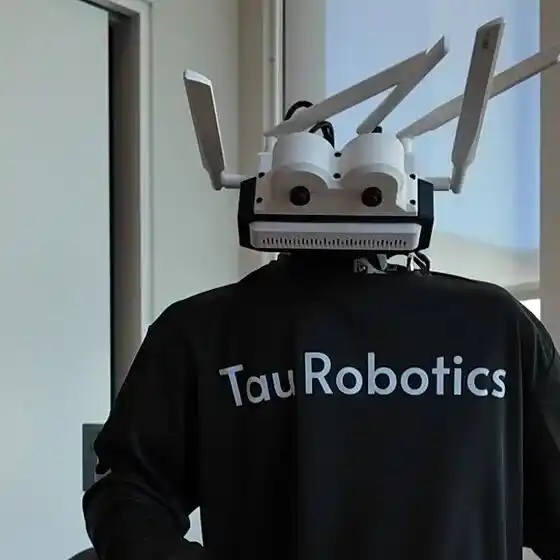
It just looks a bit weird, with a Wi-Fi router on its head—like a Teletubby, right?

Doesn't affect its work, though. This mopping demo is quite interesting; while mopping, it sees trash on the floor, bends down to pick it up, turns around, walks a few steps, and throws it into the trash bin.

Could this be what mom calls "having an eye for work"? (just kidding).

But, and I have to say but.

Scrolling to the comments section, I found out that all of the above was remote-controlled. Pure·Manual·Intelligence.

Honestly, when I saw that line, my heart sank halfway...

But thinking about it calmly, there are still things worth praising.

All the videos above are at 1x speed.

You have to know, most home demos of robots on the market start at 2x speed as a baseline, some even crank it up to 4x speed just to look passable.

Maybe at this stage, it's still too difficult for humanoid robots to both work and be aesthetically pleasing. Remote control is a clever workaround, I suppose.

This is the debut of the US robotics company Tau Robotics.

Yes, the τ of Embodied AI (just kidding).

The "Wi-Fi Router" Doing Housework

Tau Robotics is an American robotics startup founded in 2024, headquartered in the San Francisco Bay Area. It's very small, less than 10 people, quite early-stage.
Their approach is quite interesting.

Instead of jumping straight into autonomous AI, they "cheat" via remote control to bridge the gap, aiming to kickstart the data flywheel once real-world home deployment is achieved.

They raised about $3 million in Pre-seed funding in September 2024 and then went quiet. Now they've finally presented their work—

A humanoid robot cleaning service.

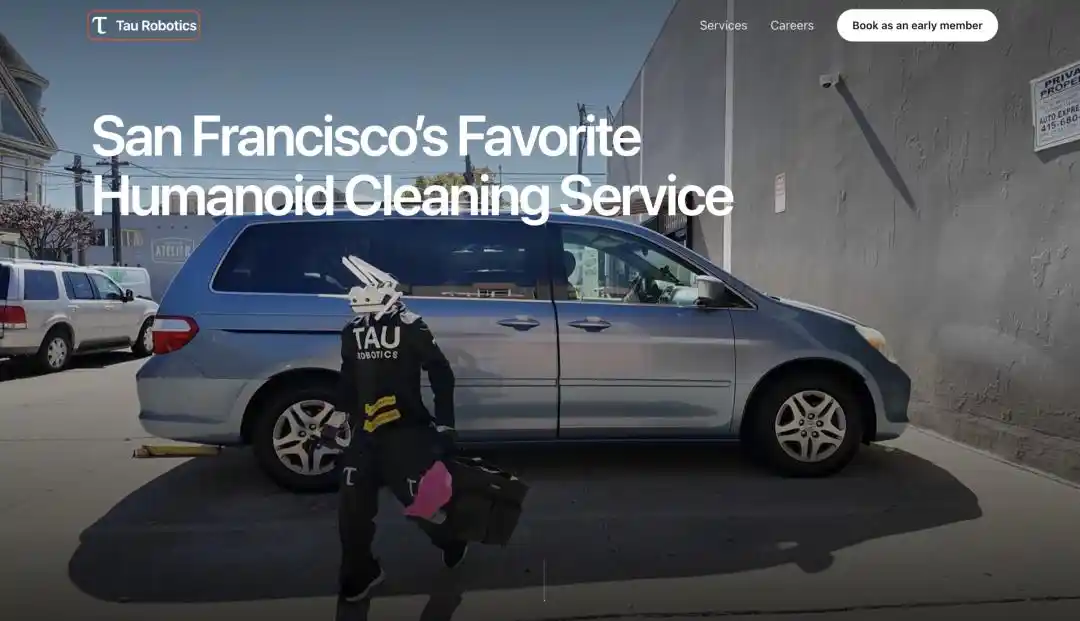
Honestly, at first glance, I was wondering where the robot was.

After all, this guy is dressed in dark work clothes, getting out of a van looking quite human-like—

Until I saw that Wi-Fi router on its head...

The founder specifically explained, saying it does look a bit funny, but there's no choice, it's the best spot to place the antenna for the humanoid robot.

Bro, the key is I didn't know it was remote-controlled at first. Seeing that antenna suddenly gave me goosebumps, has Embodied AI already developed to this level??

You can tell the official team is more than a little satisfied with this demo. The website background loops this getting-out-of-the-van video endlessly...
Once inside the home, it starts working officially.

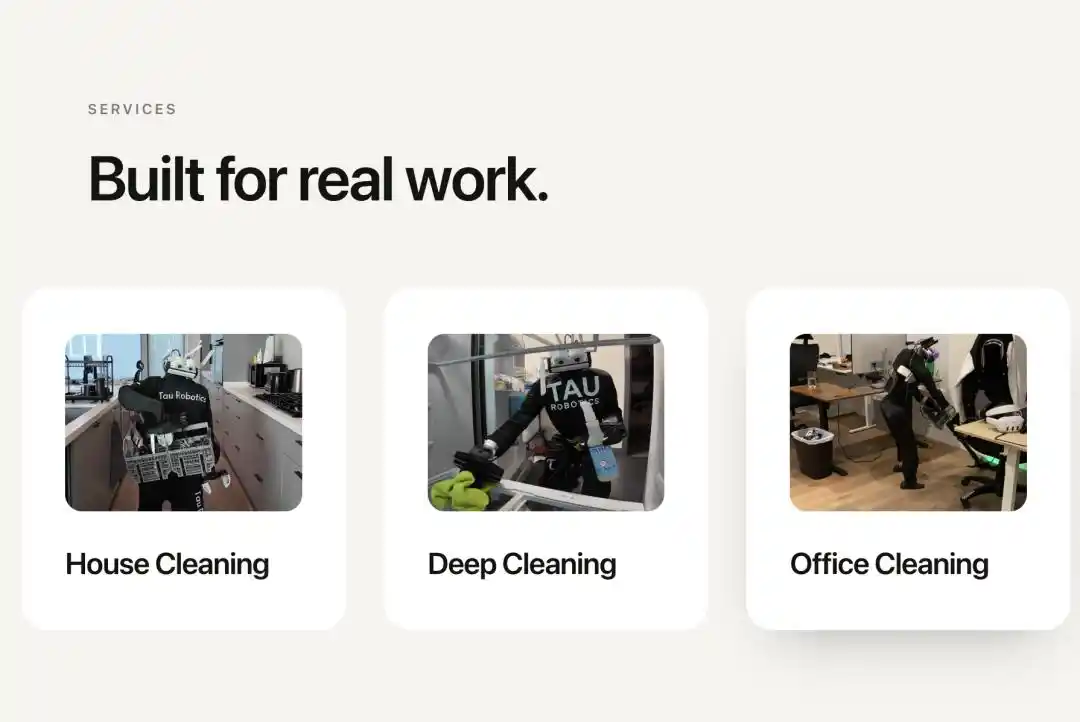
Tau has three "employees".

The first one, Chelsea.
That's the guy who got out of the van. The kitchen and bathroom are its strengths—sink, countertops, mirrors, tiles, floors...

The second one, Elon.

That name, little Musk, huh?

Elon handles regular weekly visits. After a few sessions, it can remember where things are in your home and put everything back in its place after cleaning.

The third one, Tony.
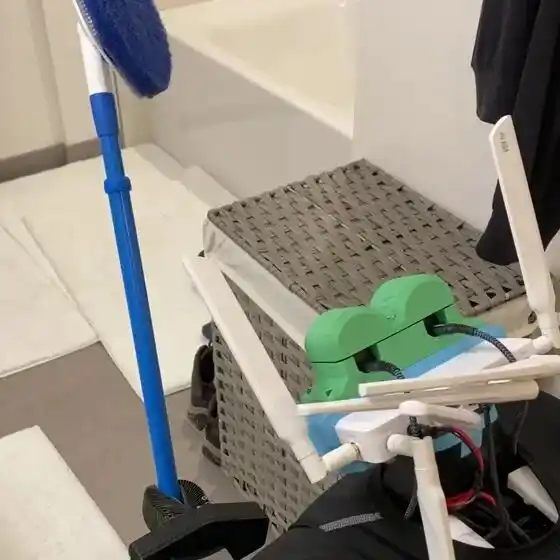
Tony specializes in deep cleaning—baseboards, grout lines, window tracks, under the fridge, behind the washer—targeting years of built-up grime.

But, I really have to complain.

Tau, for your first public debut, couldn't you spend some money to hire a photographer for proper portrait shots??I honestly couldn't find where Tony was in the picture...

No need to go into detail about the demos, as they are remote-controlled and theoretically can do anything a human can.

Wiping tables.

Mopping floors.

Taking out the trash.

Finally, the question everyone cares about most—how much does it cost?

Not bad, $30 per hour (approx. 200 RMB).

Honestly, that's quite affordable in the US. Hiring a real human cleaner can easily cost fifty or sixty dollars per hour.

Humanoid Robots Entering Homes

Last week, I attended WAIC and chatted with several friends working in Embodied AI. A common observation was that getting humanoid robots into homes is indeed extremely, extremely difficult.

It's not like China hasn't made any attempts either, but it's still in the early stages. For example, Ziliang's recent collaboration with 58.com to launch smart cleaning is a good case of entering households.
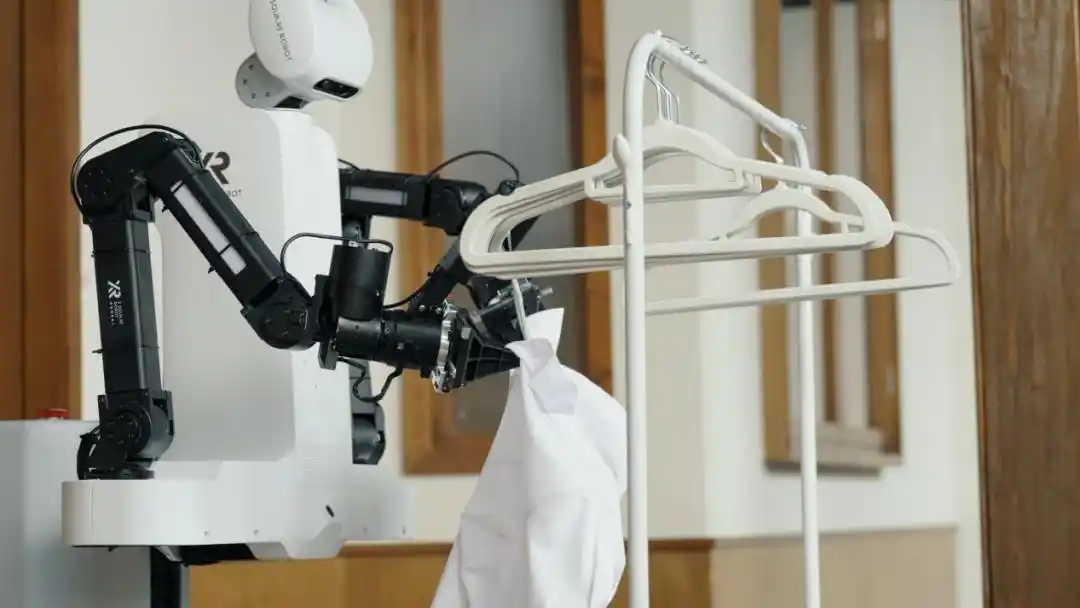
However, many netizens also criticized it, wondering what's the point of having a human cleaner specifically watching over the robot while it works.

Sigh, you can only say there's really no other way. Embodied AI has such a tough starting point; they have to enter the scene first, otherwise they can't collect data at all.

But currently, the main focus domestically is prioritizing industrial applications, where the environment is relatively controllable, and it can provide direction for gradual optimization and enable a closed data loop.

The logic in the US is somewhat different. The demand for manufacturing isn't as strong as in China, which has instead spurred some companies to start from the home scene. For example, 1X Neo, which gained some popularity last year, also promoted the concept of entering homes via teleoperation.

After all, the gap is indeed huge, and remote control is a relatively smart method, somewhat similar to the shadow mode in autonomous driving, ensuring work efficiency while collecting data.

But whether consumers are willing to pay $30 an hour to have a remotely-controlled robot with built-in monitoring working in their homes is another story...

It's been 9 months since the announcement, and 1X Neo still hasn't officially launched on a large scale. It's hard to judge how the market will react.

So let's return to the technology itself.

Some netizens expressed confusion: Why insist on humanoid form for entering homes?

The narrative about bipedal forms being better suited for non-standardized environments has, honestly, been told to death. Robotic vacuum cleaners basically move around homes unimpeded. Aren't wheels great?

I discussed this topic with SuDu half a month ago. Their perspective was that the root cause must be found from the data side

If a person were to remotely operate a wheeled base and perform complex mobile manipulation tasks, the difficulty would be extremely high. For humanoids, operators can map their own body intuition onto the robot, lowering the barrier significantly.

Looking at it this way, Tau and 1X's insistence on humanoid form is likely largely due to considerations for remote control.

It's quite a first-principles choice.

Of course, another point that cannot be ignored.

This humanoid thing, well, it truly is top-tier in providing emotional value.

A human-shaped machine walking around your home, wiping tables, mopping floors, taking out trash, while you sit on the sofa watching... how to put it? Spending $30 to experience life as an Athenian citizen isn't a bad deal either (doge).

Currently, Tau's "Teletubby" is operating on an invitation basis. Friends in San Francisco can go to the official website to sign up for a try (doge).

"Athenian Citizen" Experience Address: https://www.tau-robotics.com/

References:

[1]https://x.com/alexkoch_ai/status/2082135074615763251

This article is from the WeChat public account "QbitAI" (ID: QbitAI), author: Focus on Frontier Technology


Related Questions

QWhat is the main service offered by the robot company Tau Robotics, and how much does it cost per hour?

ATau Robotics offers a humanoid robot house cleaning service. The cost is 30 US dollars per hour (approximately 200 RMB).

QWhat key limitation of the Tau Robotics cleaning robots is revealed in the article?

AThe key limitation is that the robots' impressive actions, such as washing hands and picking up trash, are not autonomous. They are operated via remote control, described as 'pure human intelligence'.

QAccording to the article, what is one advantage of using humanoid robots for remote operation in home settings, as opposed to wheeled robots?

AOne advantage is the lower barrier for human operators. It's easier for an operator to remotely control a humanoid robot because they can intuitively map their own body movements onto the robot. Controlling a wheeled base for complex mobile manipulation tasks would be much more difficult.

QBesides the cleaning function, what additional value might the 'Antenna Baby' robot provide, as suggested in the article?

AThe article suggests that the humanoid robot provides superior emotional value. The sight of a human-shaped machine moving around and doing chores in one's home could offer a unique experience, humorously compared to 'spending 30 dollars to experience the life of an Athenian citizen'.

QWhat is the name of another US-based company mentioned in the article that also uses a teleoperation (remote control) approach for home service robots?

AThe article mentions another US-based company called 1X, specifically its Neo robot, which also uses a teleoperation concept to enter the home service market.

Related Reads

Annual Salary of Millions Competing for Electricians, Meta Rushes to Open Its Own Technical School

The AI boom is facing an unexpected bottleneck: a severe shortage of skilled construction workers and electricians. As tech giants like Meta, OpenAI, and Alphabet race to build massive data centers—such as OpenAI's $16 billion "Stargate" project—they are hitting a critical labor wall. The U.S. needs an estimated 130,000 more electricians, 240,000 construction workers, and 150,000 supervisors by 2030 for AI infrastructure alone, but tens of thousands of electrician jobs go unfilled each year. While AI companies offer high premiums, with electricians earning up to $280,000 annually, worker scarcity still causes massive losses—delays on a single project can cost $14.2 million per month. The complexity of building AI data centers, which require immense power (equivalent to powering hundreds of thousands of homes), sophisticated electrical systems, and advanced liquid cooling solutions, demands highly skilled technicians who are in short supply. To combat this, companies are investing heavily in training. Meta has committed $115 million to a free training school offering tuition, housing, and stipends, targeting 5,000 new workers. OpenAI is partnering with unions to secure skilled labor. These efforts are paying off, with a significant rise in Gen Z interest in trade schools over college. However, the power demands are staggering. AI data centers are driving a rapid surge in electricity consumption, projected to account for up to 12% of U.S. power use by 2028 and raising costs for consumers. Furthermore, the construction boom is project-based, leading to a potential future glut of trained workers once building peaks, which could depress wages industry-wide. The race for AI supremacy now depends as much on skilled hands as on advanced chips.

marsbit5m ago

Annual Salary of Millions Competing for Electricians, Meta Rushes to Open Its Own Technical School

marsbit5m ago

OpenAI No Longer Sells Its Most Expensive Model for Profit

OpenAI is shifting its business strategy away from promoting its most expensive, flagship models for every task. Recent price cuts—80% for GPT-5.6 Luna and 20% for Terra—signal a deeper change: the company now actively advises users that many tasks don't require the most powerful model. Instead, OpenAI recommends a tiered approach: use the high-end GPT-5.6 Sol for complex planning and analysis, then delegate execution to cheaper models like Luna. This mirrors moves by Anthropic, which recently launched Claude Opus 5 at half the price of its top model, Fable 5. Both companies are de-emphasizing flagship models as primary revenue drivers, using them instead for brand prestige and technological showcases. The industry is entering a "mass-market" phase, similar to automotive, where high-volume, cost-effective models handle daily operations and drive scale. OpenAI's price reductions are partly enabled by AI models themselves optimizing underlying code and infrastructure, creating a self-reinforcing cycle of efficiency gains and cost reduction. Competition is shifting from "who is smartest" to "who offers the best value." The goal is no longer selling individual models but fostering widespread API adoption and ecosystem lock-in. By making AI calls cheap and ubiquitous, companies like OpenAI aim to become the indispensable, utility-like infrastructure powering automated workflows—the "water and electricity" of software, quietly embedded everywhere.

marsbit5m ago

OpenAI No Longer Sells Its Most Expensive Model for Profit

marsbit5m ago

Will the Fed Definitely Raise Interest Rates in September? How Will Crypto and U.S. Stocks Withstand the Pressure?

The market's expectation for a September Fed rate hike surged dramatically in early August, jumping from under 50% to over 80% within a week. This shift followed a contentious July FOMC meeting, where a 9-3 vote to hold rates revealed growing dissent from hawkish members advocating for an immediate hike to combat persistent inflation. The primary catalyst for this repricing is rising oil prices, driven by renewed geopolitical tensions around the Strait of Hormuz, which threaten global supply. Energy costs directly influence inflation metrics, making the upcoming July CPI report (due August 12th) a critical data point. If it shows inflation reaccelerating, the probability of a September hike will solidify. For Bitcoin and crypto assets, this is typically bearish news. Bitcoin continues to behave as a high-beta, liquidity-sensitive risk asset. A rate hike raises the opportunity cost of holding non-yielding assets and could drive capital toward money markets, pressuring crypto prices in the short term. However, historical patterns suggest that if a hike is perceived as the end of a tightening cycle rather than the start, any negative price impact may be brief. U.S. stocks, particularly crypto-linked equities like Coinbase and growth-oriented tech stocks, are also vulnerable. Higher rates increase discount rates in valuation models, putting pressure on high-multiple companies. This coincides with a pivotal tech earnings season where investor focus has shifted from massive AI capital expenditure to tangible revenue and cash flow generation. Companies with negative cash flow and weak growth narratives could face heightened volatility if borrowing costs rise in September. In summary, a September Fed hike has evolved into a mainstream market scenario. Key factors to watch are oil prices, the July CPI report, and Fed communications, which will determine the final decision and its impact on volatile crypto and equity markets.

marsbit15m ago

Will the Fed Definitely Raise Interest Rates in September? How Will Crypto and U.S. Stocks Withstand the Pressure?

marsbit15m ago

Trading

Spot
活动图片




