Space Recap | When a Weakening Dollar Meets a Resurgence in Liquidity: Crypto Market Trend Analysis and Tron TRON Ecosystem Strategy

深潮Published on 2025-12-10Last updated on 2025-12-10

Abstract

A review of a recent Space discussion explores the connection between a weakening US dollar, improving global liquidity, and potential trends in the cryptocurrency market. While recent market rebounds align with these macro shifts, analysts caution against declaring a definitive trend reversal, characterizing the current state as a "repair" phase following excessive pessimism. Key takeaway is that a true market inflection point requires sustained signals: confirmation of a Fed easing cycle with continuous rate cuts, a fundamental weakening of the US economy suppressing the dollar, and a synchronized rise in non-US currencies. Investors are advised to monitor the next 1-2 months for persistence in dollar weakness and concrete Fed action. The discussion also outlined a probable capital flow trajectory: liquidity would first enter core mainstream assets like Bitcoin and Ethereum. Assets with solid utility, like TRX with its payment demand and user base, are also positioned for early benefit. This would be followed by a rotation into higher-yield, narrative-driven sectors like RWA, AI, and Meme coins. The Tron (TRON) ecosystem was highlighted as a strategic entry point and hub for this potential capital rotation. Its position as a major network for stablecoin circulation (like USDT) offers a low-risk, non-volatile on-ramp. Users can then earn stable yields through its DeFi protocols (e.g., JustLend DAO, SUN.io) while awaiting clearer market trends. Finally, its native DEX, Sun...

As the global macroeconomic landscape quietly shifts, two signal lights gradually illuminate through the market fog: the U.S. dollar index retreating from its highs and signs of a resurgence in global liquidity. These changes are touching the sensitive nerves of the crypto market, with Bitcoin and major cryptocurrencies stabilizing and rebounding, seemingly resonating in sync with this macro warm current.

However, in the crypto space, a brief liquidity-driven rebound and a true trend reversal are often separated by a distance that requires careful discernment. The core confusion for investors is not the phenomenon itself, but its sustainability and depth: Is this merely short-term volatility due to adjusted policy rhythms, or the beginning of a longer cycle of dollar weakness and liquidity expansion? Will funds truly be systematically reallocated to crypto assets on a large scale? How will the path of market recovery unfold?

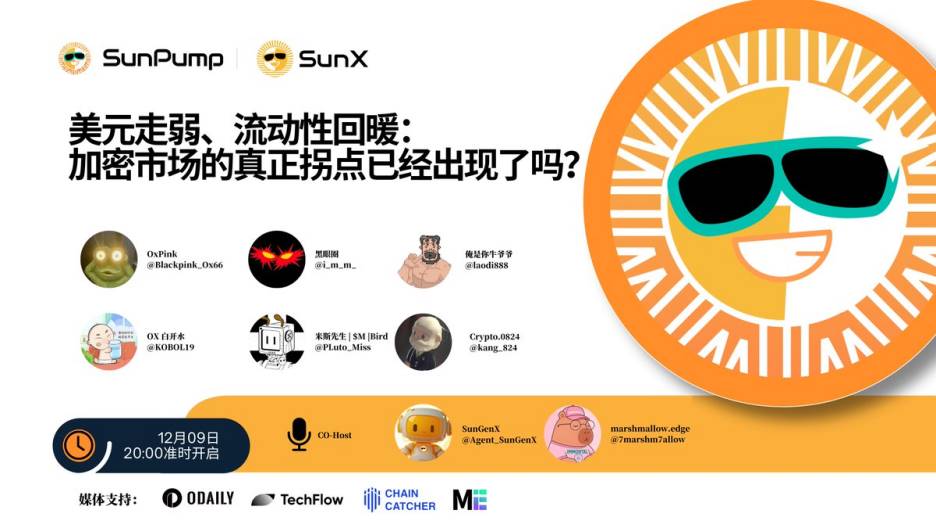
Against this backdrop, SunPump recently hosted a Space roundtable discussion focusing on the shift in macro liquidity and the prospects of the crypto market. It not only attempted to dissect the core proposition of "whether a weakening dollar and resurging liquidity constitute a trend inflection point for the crypto market" but also strived to translate the macro tidal changes into perceptible, executable fund allocation logic and phased strategies. This recap will梳理 (organize) the core insights from the discussion to help users more clearly discern direction amidst the changing tides of global capital.
A Weakening Dollar + Resurging Liquidity: Do They Truly Constitute a Trend Inflection Point for the Crypto Market?

In the first segment of the Space discussion, several seasoned observers engaged in a deep and cautious analysis around the core question: "Does a weakening dollar and resurging liquidity constitute a trend inflection point?" Although market sentiment has shown warmth, the guests generally leaned towards defining it as a "repair" rather than a "reversal," emphasizing that confirming a true trend inflection point requires more time and validation through multi-dimensional signals.

Hei Yan Quan first set a high standard for judgment. He believes short-term data fluctuations are insufficient to support a trend argument; a true inflection point needs the support of long-term logic: first, confirmation of the Federal Reserve's easing cycle, entering a sustained rate-cutting channel and substantive relaxation of quantitative tightening; second, dollar weakness needs to be based on a weakening U.S. economic fundamentals, thereby long-term pressure on dollar credit; third, global non-U.S. currencies need to form a pattern of synchronized strengthening. He emphasized that only when liquidity shows the dual sustainability of "total expansion" and "qualitative inflow into the crypto market" can the market shift from repair to a trend upward.

@laodi888, drawing from market historical experience, reminded investors with the year's multiple instances of "dashed expectations" that a single data point or a few days of dollar decline are not enough to support a long-term bull market. She defined the current market as a "strong repair after a deep correction," a correction of the excessively pessimistic sentiment from before. Her practical advice was to treat the next 1-2 months as a critical observation period, focusing on whether dollar weakness can persist and whether Fed rate cuts can materialize. During this time, one can participate in the market but must remain vigilant, not equating a rebound with a reversal.

0xPink also reviewed history, pointing out that every major crypto cycle has occurred against a backdrop of a weakening dollar and loose liquidity, so it's natural for the market to associate this with "a big rally is coming." But he pointed out sharply that the market is such that "one data point changes sentiment, but sustained data determines the trend." He shared personal indicators for confirming an inflection point: a comprehensive rebound in risk appetite (broad rally across various risk assets), consecutive growth in stablecoin supply, and major coins breaking through key resistance levels. He concluded that if U.S. Treasury yields continue to fall over the next two months and the Fed releases clearer dovish signals, the possibility of a major cycle arriving will increase.

Before the Inflection Point Arrives, Position First: Deciphering Capital Rotation Patterns and the Certain Opportunities in the Tron TRON Ecosystem

After clarifying that the current market is in an "observation period for repair" rather than a "confirmed inflection point," a more practical question follows: If liquidity continues to recover, what path will funds follow in their layout within the crypto world? In the second segment of the Space, guests combined historical patterns with the current market structure to outline a clear capital rotation roadmap and provided a highly operational strategic framework for ordinary investors.

Regarding the sequence of liquidity injection, the guests showed a high degree of consensus on a gradual process from "core mainstream" to "peripheral innovation." 0xPink used a vivid metaphor to describe this process: liquidity is like filling water; it will inevitably fill "reservoirs" like Bitcoin and Ethereum first. He particularly pointed out that assets like TRX, which have solid payment demand, a large user base, and stable cash flow, due to their unique utility and stability, also fall within the scope of early beneficiaries. Subsequently, the market enters a second stage where funds seek higher returns, flowing into sectors with strong narratives and amplified sentiment like RWA, AI, and Meme coins. The final stage, where funds permeate to small projects, often signifies the cycle is entering a later phase, with returns and risks both sharply amplified.

Mr. Mi Si supplemented the discussion on fund flow, noting that besides deep liquidity mainstream assets like Bitcoin and Ethereum, funds are also attracted to compliant stable yield products. The massive stablecoin assets carried on the Tron TRON network and its rich DeFi ecosystem are becoming the first stop for many users entering the crypto world and seeking stable returns.

Specifically, the "stable yield path" provided by Tron TRON is clear and attractive:

1. Low-risk entry: As one of the world's largest stablecoin circulation networks, a large amount of USDT and other stablecoins are issued and circulated on the Tron TRON chain, providing a crypto entry point with zero price volatility risk for funds seeking safety and stability.

2. Stable DeFi yield: After holding stablecoins, funds can earn yield without taking risks through mature DeFi protocols on the Tron TRON network. For example, depositing stablecoins into the JustLend DAO lending platform to obtain stable annualized yield, or participating in liquidity mining on the SUN.io platform. Currently, the TRX/USDT liquidity pool on SUN.io has $129 million, with a 24-hour trading volume of $42.8 million. This model provides a "buffer" that generates cash flow for funds during the观望期 (observation period), balancing safety and yield.

3. Asset hub connecting stability and growth: When market risk appetite increases, stable funds settled in the Tron DeFi ecosystem can be easily exchanged for other tokens within the Tron TRON ecosystem via SunSwap to participate in subsequent sector rotations. For example, investors can quickly switch part of their stablecoin yield to ecosystem projects with strong narratives and high volatility, such as AI (e.g., AINFT) or Meme (e.g., SunPump), thereby capturing the excess return opportunities brought by sector rotations while controlling overall risk.

At the current juncture where macro signals are初步显现 (initially appearing) and market sentiment is cautiously repairing, the core conclusion of this roundtable is clear and prudent: confirming the trend takes time, but the framework for action can be established first. A true inflection point is not defined by a single data point but by the resonance and sustained validation of multiple signals (macro cycle, fund flow, market structure). For investors, more important than predicting the exact "inflection point" is building their own "certainty" amidst uncertainty. The path demonstrated by Tron TRON—from stablecoin entry, DeFi yield generation, to efficient rotation within the ecosystem—precisely provides an operable现实样板 (practical example) for this strategy of "participating while observing, advancing steadily while being aggressive."

Ultimately, when the direction of the global liquidity tide becomes truly clear, those investors who are well-prepared, have a solid asset structure, and understand fund flows will be more likely to become trend riders, rather than merely passive followers. Market cycles always advance amidst fluctuations, and rationality and strategy are the fundamentals for anchoring value in every ebb and flow.

Related Questions

QAccording to the Space discussion, what are the key criteria for confirming a true trend reversal in the crypto market, rather than just a short-term rebound?

AThe key criteria include: 1) The Federal Reserve's easing cycle being confirmed, with sustained interest rate cuts and a substantial relaxation of quantitative tightening. 2) A weakening US dollar based on a疲软的 US economic fundamentals, which would suppress dollar credit long-term. 3) A synchronized strengthening of global non-US currencies. Additionally, liquidity must show both 'quantitative expansion' and 'qualitative inflow into the crypto market' with sustained momentum.

QHow do the panelists describe the typical path of capital flow when liquidity enters the crypto market?

AThe panelists describe a clear, gradual capital flow path: liquidity first fills 'reservoirs' like Bitcoin and Ethereum. Assets with solid utility, large user bases, and stable cash flows, such as TRX, also benefit early. In the second stage, capital seeks higher yields and flows into narrative-driven, high-sentiment sectors like RWA, AI, and Meme coins. The final stage involves capital trickling down to smaller projects, which is often a sign the cycle is in its later, riskier phase.

QWhat specific 'stable yield path' does the TRON network offer to investors during market uncertainty?

ATRON offers a three-part stable yield path: 1) A low-risk entry point as a major network for stablecoins like USDT, offering a crypto on-ramp with zero price volatility. 2) Stable DeFi yields by depositing stablecoins into protocols like JustLend DAO for fixed APY or providing liquidity on SUN.io. 3) An asset hub connecting stable holdings to growth, allowing users to swap stablecoin yields on SunSwap for higher-risk, higher-reward生态 tokens like those in the AI or Meme sectors.

QWhat was the general consensus among the panelists on the current state of the market: a 'repair' or a 'reversal'?

AThe general consensus among the panelists was that the current market state is a 'repair' or a 'powerful rebound after a deep correction,' not a confirmed 'reversal.' They emphasized that a true trend reversal requires more time and multi-dimensional signals for validation, advising caution and a 1-2 month observation period to see if the dollar's weakness persists and Fed rate cuts materialize.

QWhich specific metrics did the speaker 0xPink suggest watching to gauge a potential major cycle in the crypto market?

A0xPink suggested watching for: 1) A comprehensive rebound in risk appetite (a broad rally across various risk assets). 2) Consecutive growth in the stablecoin supply. 3) Major cryptocurrencies breaking through key resistance levels. He added that if US Treasury yields continue to fall and the Fed sends clearer dovish signals over the next two months, the possibility of a major cycle would increase.

Related Reads

Breaking: OpenAI Undergoes Major Reorganization, President Brockman Assumes Command

OpenAI has announced a major internal reorganization just months before its anticipated IPO. The company is merging its three flagship product lines—ChatGPT, Codex, and the API platform—into a single, unified product organization. The most significant leadership change involves co-founder and President Greg Brockman moving from a background technical role to take full, permanent control over all product strategy. This follows the indefinite medical leave of AGI Deployment CEO Fidji Simo. Additionally, ChatGPT's longtime lead, Nick Turley, has been reassigned to enterprise products, with former Instagram executive Ashley Alexander taking over consumer offerings. The consolidation, internally framed as a strategic move towards an "Agentic Future," aims to break down internal silos and create a cohesive "Super App." This planned desktop application would integrate ChatGPT's conversational abilities, Codex's coding power, and a rumored internal web browser named "Atlas" to autonomously perform complex user tasks. The reorganization occurs amid significant internal and external pressures. OpenAI has recently seen a wave of high-profile departures, including Sora co-lead Bill Peebles and other senior technical leaders, leading to concerns about a thinning executive bench. Externally, rival Anthropic recently secured funding at a staggering $900 billion valuation, surpassing OpenAI's own. Google's upcoming I/O developer conference also poses a competitive threat. Analysts suggest the dramatic restructure is a pre-IPO move to present a clearer, more focused narrative to Wall Street—streamlining operations and demonstrating decisive leadership under Brockman to counter internal turbulence and intense market competition.

marsbit2h ago

Breaking: OpenAI Undergoes Major Reorganization, President Brockman Assumes Command

marsbit2h ago

Two Survival Structures of Market Makers and Arbitrageurs

Market makers and arbitrageurs represent two distinct survival structures in high-frequency trading. Market makers primarily use limit orders (makers) to profit from the bid-ask spread, enjoying high capital efficiency (nominally 100%) but bearing inventory risk. This "inventory risk" arises from passive, fragmented, and discontinuous order fills in the limit order book (LOB). This risk, while a potential cost, can also contribute to excess profit if managed within control boundaries, allowing for mean reversion. Market makers essentially sell "time" (uncertainty over execution timing) to the market for price control and low fees. In contrast, cross-exchange arbitrageurs typically use market orders (takers) to exploit price differences or funding rates, resulting in lower nominal capital efficiency (requiring capital on both exchanges) and higher transaction costs. Their risk exposure stems from asymmetries in exchange rules (e.g., minimum order sizes), execution latency, and infrastructure risks (e.g., ADL, oracle drift). These exposures are active, exogenous gaps that primarily erode profits rather than contribute to them. Arbitrageurs essentially sell "space" (capital sunk across venues) for localized, immediate certainty. Both strategies engage in a trade-off between execution friction and residual risk. Optimal systems allow for temporary, controlled risk exposure rather than enforcing zero exposure at all costs. Their evolution converges towards hybrid models: arbitrageurs may use maker orders to reduce costs, while market makers may use taker orders or hedges for risk management. Ultimately, both use different forms of risk exposure—market makers exposing inventory, arbitrageurs immobilizing capital—to extract marginal, hard-won certainty from the market.

链捕手2h ago

Two Survival Structures of Market Makers and Arbitrageurs

链捕手2h ago

Who Will Define the Rules of the AI Era? Anthropic Discusses the 2028 US-China AI Landscape

This article, based on Anthropic's analysis, outlines the intensifying systemic competition between the U.S./allies and China for AI leadership by 2028. It argues that access to advanced computing power ("compute") is the critical bottleneck, where the U.S. currently holds a significant advantage through chip export controls and allied innovation. However, China's AI labs remain competitive by exploiting policy loopholes—via chip smuggling, overseas data center access, and "model distillation" attacks to copy U.S. model capabilities—keeping them close to the frontier. The piece presents two contrasting scenarios for 2028. In the first, decisive U.S. action to tighten compute controls and curb distillation locks in a 12-24 month AI capability lead, cementing democratic influence over global AI norms, security, and economic infrastructure. In the second, policy inaction allows China to achieve near-parity through continued access to U.S. technology, enabling Beijing to promote its AI stack globally and integrate advanced AI into its military and governance systems, altering the strategic balance. Anthropic contends that maintaining a decisive U.S. lead is essential for shaping safe AI development and governance. The core recommendation is for U.S. policymakers to urgently close compute and model access loopholes while promoting global adoption of the U.S. AI technology stack to secure a lasting strategic advantage.

marsbit4h ago

Who Will Define the Rules of the AI Era? Anthropic Discusses the 2028 US-China AI Landscape

marsbit4h ago

Trading

Spot
Futures

Hot Articles

What is GENIUS

I. Project Introduction1. What Is Genius?Genius (GENIUS) is positioned as the “ultimate on-chain terminal,” a decentralized trading platform focused on privacy and speed. By integrating top-tier privacy technology, it aims to build a next-generation privacy trading infrastructure across networks such as BNB Chain, enabling users to interact on-chain with a seamless experience comparable to centralized exchanges.2. How Does Genius Work?Genius's core technical architecture is structured as follows:(1) Chain-invisible: Users do not need to manually handle multi-step approvals for cross-chain operations, asset wrapping, or complex gas management.(2) Signatureless Trading: Through integrations such as Turnkey, Genius enables instant trading without pop-up confirmations or per-transaction authorization.(3) Aggregator of Aggregators: Genius is powered by a best-in-class aggregation stack integrated with more than 150 DEXs, claiming superior quote efficiency compared with competing products.(4) Account Management: The platform adopts a non-custodial architecture and leverages Turnkey and Lit Protocol for key management, allowing users to securely access their accounts through passkeys.3. Who Created Genius?According to its official Terms of Service, Genius was developed by Shuttle Labs, Inc. Based on the project’s official X account, Ryan Myher is one of the key contributors driving product iteration, including developments such as the rollout of the Ghost protocol, as well as broader community engagement.Binance founder CZ has officially joined the project as an advisor, with the goal of helping the team build a faster and more privacy-preserving on-chain trading experience.In addition, the project has received strong backing from YZi Labs, which has invested in Genius and works alongside the Genius Foundation, responsible for maintaining the core Genius Bridge Protocol (GBP).4. Genius TokenomicsGENIUS is the native token of the Genius ecosystem. As of now, the project has not released a full tokenomics document.Based on the latest official disclosures, Genius incorporates a deflationary mechanism, and 4.6% of the total token supply had already been burned during the early launch phase.Genius Points (GP) System:(1) Trade-to-Earn: The platform has established a reward pool of 200 million Genius Points, and users earn GP for every trade executed through the terminal.(2) Tiering and Badges: Genius features a progression-based badge system ranging from Smart to God, with higher levels unlocking additional perks and benefits.(3) Native Yield: Users holding designated assets such as usdGG in the dashboard can earn native yield directly without going through complex staking.(4) Referral Incentives: Referrers can earn fee rebates of over 45% paid in USDC, along with additional GP.5. Timeline & Key MilestonesMarch 2020: The project’s official X account was created, marking the beginning of its early preparation phase.January 13, 2026: Genius announced a multi-million-dollar investment from YZi Labs and simultaneously confirmed CZ as an advisor to accelerate the buildout of its privacy trading infrastructure.April 18, 2026: The project announced that the Ghost privacy protocol would be launching soon.April 29, 2026: The Ghost protocol officially opened to its first 50 testers, marking the beginning of a new era for privacy trading on BNB Chain. At the same time, the team confirmed 4.6% of tokens have been burnt.​II. Token Information1) Basic InformationToken name: GENIUS (Genius)III. Related LinksWebsite:https://www.tradegenius.com/homeExplorers:https://bscscan.com/address/0x1f12b85aac097e43aa1555b2881e98a51090e9a6Socials:https://x.com/GeniusTerminalNote: The project introduction comes from the materials published or provided by the official project team, which is for reference only and does not constitute investment advice. HTX does not take responsibility for any resulting direct or indirect losses.

1.2k Total ViewsPublished 2026.04.29Updated 2026.05.11

What is GENIUS

How to Buy GENIUS

Welcome to HTX.com! We've made purchasing Genius (GENIUS) simple and convenient. Follow our step-by-step guide to embark on your crypto journey.Step 1: Create Your HTX AccountUse your email or phone number to sign up for a free account on HTX. Experience a hassle-free registration journey and unlock all features.Get My AccountStep 2: Go to Buy Crypto and Choose Your Payment MethodCredit/Debit Card: Use your Visa or Mastercard to buy Genius (GENIUS) instantly.Balance: Use funds from your HTX account balance to trade seamlessly.Third Parties: We've added popular payment methods such as Google Pay and Apple Pay to enhance convenience.P2P: Trade directly with other users on HTX.Over-the-Counter (OTC): We offer tailor-made services and competitive exchange rates for traders.Step 3: Store Your Genius (GENIUS)After purchasing your Genius (GENIUS), store it in your HTX account. Alternatively, you can send it elsewhere via blockchain transfer or use it to trade other cryptocurrencies.Step 4: Trade Genius (GENIUS)Easily trade Genius (GENIUS) on HTX's spot market. Simply access your account, select your trading pair, execute your trades, and monitor in real-time. We offer a user-friendly experience for both beginners and seasoned traders.

2.4k Total ViewsPublished 2026.04.29Updated 2026.05.11

How to Buy GENIUS

Discussions

Welcome to the HTX Community. Here, you can stay informed about the latest platform developments and gain access to professional market insights. Users' opinions on the price of A (A) are presented below.

活动图片