Space Announces Public Sale of Its Native Token $SPACE

深潮Published on 2025-12-17Last updated on 2025-12-17

Abstract

Space announces the public sale of its native token $SPACE. Built on Solana, Space is a leveraged prediction market offering 10x leverage on real-world outcomes across crypto, politics, sports, and more. The project, created by the team behind the UFO project, features a central limit orderbook (CLOB) with no maker fees and a token flywheel where 50% of revenue is used to buy back and burn $SPACE. The public sale begins December 17, 2025, at 18:00 UTC with a $2.5M target. The FDV starts at $50M and can rise linearly to a $99M cap. It features a variable token allocation model to ensure a fair, single clearing price for all participants. Contributions are accepted in USDC, USDT, or SOL with no minimum or maximum limits. Early participants can achieve higher tiers for bonus airdrops, lifetime referral rewards, trading fee discounts, and积分 multipliers. The total token supply is 1 billion. The platform is set to launch in January 2026.

Space is the first leveraged trading market on Solana offering 10x leverage, allowing users to trade real-world outcomes in crypto, politics, sports, tech, culture, and more, with rewards. Today, they announced the public sale of their native token $SPACE.

The company employs a token flywheel mechanism, with 50% of revenue used to buy back and burn $SPACE.

Space is built by the UFO team, UFO was a top 100 project on CoinMarketCap in 2021 with a market cap exceeding $1.5 billion and a massive on-chain community. This success came from distribution and community, not insiders. The same ethos drives Space.

Core Features

  • Central Limit Order Book (CLOB) with no maker fees for traders

  • Well-designed user acquisition and retention mechanisms

  • 50% of revenue used for buyback and burn

  • Gamified points, rankings, and seasonal airdrops

  • Liquidity and referral rewards

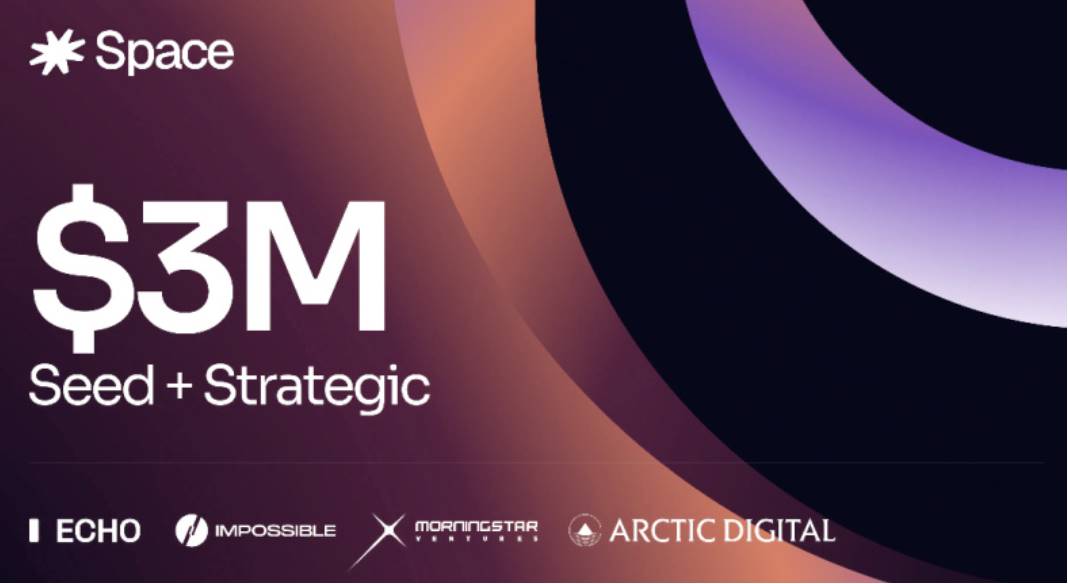
Space's $3 million seed and strategic rounds were led by Morningstar Ventures and Arctic Digital. Additionally, it set a record with 1360% oversubscription on Echo and received participation from Impossible Finance investors.
Now, they are opening up ownership to the community. The team believes that those who use, trade, build, and support Space should own a piece of it. The public sale places ownership in the hands of the community, ensuring everyone can participate at the same price. The public sale uses a variable token distribution model. The number of tokens allocated depends on the final market clearing price. This ensures fair and efficient price discovery while guaranteeing all participants get the same price.

Key Details

  • Chain: Solana

  • Start Time: December 17, 2025, 18:00 UTC

  • Target: $2.5 million

  • Minimum FDV: $50 million

  • Maximum FDV: $99 million

  • FDV Curve: Linear ($0.05 → $0.099)

  • Unlock: 100% at TGE

  • Accept: USDC, USDT, SOL

  • Minimum Contribution: None

  • Maximum Contribution: None

How It Works

After the countdown, sale.into.space will open for contributions. The sale starts at a floor valuation of $50 million FDV and maintains this level until the $2.5 million target is reached. After the target is met, the sale enters a price discovery phase where the FDV increases linearly up to the $99 million cap. At the end of the sale, all participants pay the same clearing price. If demand exceeds the tokens available at the final price, the team will manage allocations and refund any excess contributions to ensure fair participation for all contributors.

Tiers & Rewards

Tiers will change every 24 hours. Users who commit earlier achieve higher tiers, increasing their likelihood of allocation: unlocking larger bonus airdrops, lifetime privileges, and benefits on the Space platform.

Minimum contributions are used to unlock tiers and subsequent rewards. There is no minimum contribution requirement to participate in the public sale.
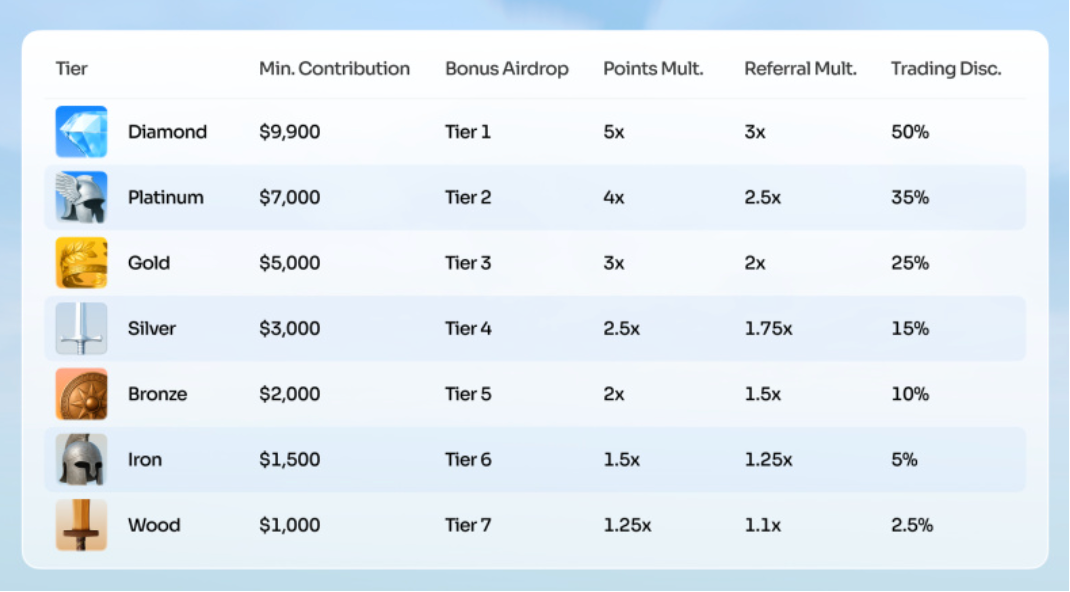
Reward Benefits

  • Reward Airdrops: Unlock additional bonus token airdrops

  • Points Multiplier: Earn points faster during Airdrop Seasons 1-4 (Q1-Q4 2026)

  • Referral Multiplier: Lifetime rewards from trading fees of referred users

  • Trading Fee Discounts: Reduced fees on user trades for 12 months

A user's total contribution is cumulative, but a tier is only achieved if the minimum contribution is met during that tier's active window. Once a user earns a tier, it is终身 associated with their Space profile with additional benefits.

Allocation & Refunds

In case of oversubscription, the team will manage allocations to ensure fairness. After the sale concludes, refunds will be processed for any excess contributions, with specific criteria disclosed post-sale.

Tokenomics

  • Total Supply: 1 billion

  • Flywheel Mechanism

    • All platform fees power a self-sustaining loop:

      • 50% of revenue → Buyback and burn $SPACE

      • 50% of revenue → Protocol treasury

Next Steps

  • Public Sale: December 17, 2025, 18:00 UTC

  • Refunds: Immediately after the sale

  • TGE: After the public sale

  • Platform Launch: January 2026

How to Participate

Users can:

  1. Visit sale.into.space

  2. Connect a self-custody wallet (Phantom recommended)

  3. For the best user experience, use a desktop device

  4. Select contribution amount in USDC, USDT, or SOL

  5. Sign and confirm the transaction

Important: Do not send from a centralized exchange (CEX). Use a self-custody wallet like Phantom.

About Space

Space is a leveraged trading market on Solana, created by the UFO team, UFO was a top 100 project with a market cap exceeding $1.5 billion. It combines a central limit order book, 10x leverage, and zero maker fees to address liquidity challenges common in prediction markets. Space integrates gamified rewards, referral incentives, and seasonal airdrop systems to enhance user engagement.

The protocol raised $3 million, including a round with 1360% oversubscription on Echo.xyz, backed by Echo, Impossible Finance, Morningstar Ventures, and Arctic Digital. By allocating 50% of platform revenue to a buyback and burn mechanism, Space aims to serve as a foundational layer for decentralized prediction markets, supporting traders, developers, and token holders.

Website: https://into.space/

Trending Cryptos

Related Questions

QWhat is the main purpose of the $SPACE token public sale announced by Space?

AThe public sale aims to open ownership to the community, allowing users, traders, builders, and supporters to own a part of Space at the same price, ensuring fair participation.

QWhat is the unique token economic model adopted by Space?

ASpace uses a token flywheel mechanism where 50% of platform revenue is used to buy back and burn $SPACE tokens, while the other 50% goes to the protocol treasury.

QOn which blockchain is the Space platform built and when does the public sale start?

ASpace is built on the Solana blockchain, and the public sale starts on December 17, 2025, at 18:00 UTC.

QWhat are the key features of the Space platform as mentioned in the article?

AKey features include a central limit order book (CLOB) with no maker fees, 10x leverage, gamified points and rankings, seasonal airdrops, liquidity and referral rewards, and a user acquisition and retention mechanism.

QHow does the public sale ensure fair participation and allocation in case of oversubscription?

AThe sale uses a variable token distribution model where all participants pay the same clearing price. If oversubscribed, the team manages allocations and refunds any excess contributions to ensure fairness.

Related Reads

The Biggest Political Economy Question in the AI Era: As Robots Become More Capable, How Do Humans Share the Value?

In the AI era, the most pressing political economy question is: as machines become increasingly capable, how can humanity share in the value they create? An article originally critiquing China's tech focus has sparked a deeper debate on this global challenge. Historically, industrial progress improved efficiency but still relied on human labor for wealth creation and distribution. AI is fundamentally different—it is now replacing cognitive and knowledge work. As AI and robots take over more tasks, economic growth may continue while direct human participation in value creation shrinks, creating a core tension between productivity gains and widespread income generation. The issue is not unique to China. While leading tech companies amass enormous wealth, labor's share of income is declining globally. The core problem is a broken link: technological innovation and corporate profits are not translating into sufficient consumer income and demand. Three potential paths forward are outlined: a traditional capitalist model where profits primarily go to capital owners; a state-capitalist approach with public investment in AI; and more innovative models like digital sovereign wealth funds, universal shareholding, or AI-era basic income schemes to directly distribute AI-generated value. The future competitive advantage may lie not just in technological supremacy, but in which society can build a new, inclusive distribution system for the intelligent economy. The ultimate challenge is ensuring that as AI creates value, humans have a means to obtain income and share in the resulting widespread social benefits.

marsbit4m ago

The Biggest Political Economy Question in the AI Era: As Robots Become More Capable, How Do Humans Share the Value?

marsbit4m ago

Generating Profits for Seven Consecutive Quarters, Emerging Markets Carry Trade Outperforms Everything

For the seventh consecutive quarter, dollar-funded emerging market carry trades have delivered positive returns, marking the longest winning streak since 2008. According to Bloomberg's index, this strategy has gained approximately 22% since late 2024, outperforming U.S. Treasuries, emerging market sovereign, and corporate dollar debt. The core of the trade involves borrowing low-interest currencies like the U.S. dollar, euro, or yen to invest in high-yielding emerging market assets, such as Turkish lira bonds offering over 40% returns. Returns were amplified by favorable currency moves, with the dollar weakening against most emerging market currencies and other traditional funding currencies. For instance, the trade gained 48% on the Colombian peso in the past year. A key test came in August 2024 with a historic joint U.S.-Japan currency intervention, which caused only a modest 1% dip in the carry trade risk premium as investors shifted funding from the yen to the euro and Swiss franc. Looking ahead, the primary risk is the timing of Federal Reserve policy changes. While persistent inflation allows the Fed to hold rates, a rapid rise in long-term U.S. yields could threaten the trade. Another concern is crowding, as massive inflows increase vulnerability to a sudden reversal. High interest rates in regions like Latin America and Eastern Europe, supported by external factors like Middle East tensions and energy prices, continue to sustain the opportunity. Major investors remain engaged, favoring currencies like the Mexican peso, South African rand, and Turkish lira.

marsbit19m ago

Generating Profits for Seven Consecutive Quarters, Emerging Markets Carry Trade Outperforms Everything

marsbit19m ago

Unpacking the Truth Behind On-chain Assets: Leverage, Liquidity, and Risk

The article analyzes the concept of "real-world asset" (RWA) tokenization, arguing that while tokenizing assets on-chain is a useful step, it is far from transformative on its own. The author compares it to placing a barcode on a shipping container—it enables identification but does not build the necessary market infrastructure. The core argument is that true value emerges not from tokenization, but from integrating these tokens into DeFi systems where they can be valued, financed, hedged, traded, and liquidated under stress. Key challenges identified include: 1. **Multiple Time Clocks**: A fundamental tension exists between blockchain's 24/7 settlement and the slower, business-hour-dependent processes of traditional markets, custody, and redemption. This "duration mismatch" can create dangerous liquidity gaps during crises. 2. **Liquidity Misconceptions**: True liquidity is not measured by Total Value Locked (TVL) or trading pairs, but by the ability to exit a position within a required timeframe at an acceptable price. It requires analyzing multiple exit paths and stress-testing scenarios. 3. **Leverage and Risk**: Leverage unlocks economic utility (e.g., using tokenized assets as collateral) but also introduces fragility. Risk models must account for more than asset volatility, incorporating factors like legal enforceability, oracle freshness, and market structure. Paradoxically, a "safer" asset like tokenized Treasury bonds could require a higher collateral discount than ETH due to slower, less-proven liquidation mechanisms. 4. **A Risk Graph**: RWA risk should be modeled as a network of interconnected dependencies (e.g., issuers, custodians, oracles, stablecoin pools), not a single score. Failures can propagate through this graph, turning operational issues into systemic liquidity crises. The article states that tokenized government bonds are merely an entry point, while more complex frontiers like computing power and energy assets present greater challenges and opportunities. It also examines the interplay and risks between tokenized stocks and perpetual futures contracts. The conclusion is that the future lies not in "tokenizing everything," but in building robust market layers where tokenized rights become resilient financial primitives within a programmable capital system. The token is just the barcode; the market is the machine.

marsbit43m ago

Unpacking the Truth Behind On-chain Assets: Leverage, Liquidity, and Risk

marsbit43m ago

Trading

Spot

Hot Articles

Discussions

Welcome to the HTX Community. Here, you can stay informed about the latest platform developments and gain access to professional market insights. Users' opinions on the price of SOL (SOL) are presented below.

活动图片