S&P 500 perpetual launches on Hyperliquid, bringing 24/7 equity exposure on-chain

ambcryptoPublished on 2026-03-18Last updated on 2026-03-18

Abstract

A new S&P 500 perpetual contract has launched exclusively on-chain on Hyperliquid, developed through a collaboration between S&P Dow Jones Indices and trade.xyz. This product provides 24/7/365 exposure to the benchmark equity index, a significant shift from traditional market hours. It uses official S&P index data to maintain price alignment and operates as a crypto-native derivative, not direct ownership of the underlying stocks. The launch is supported by Hyperliquid's substantial growth, with its Total Value Locked (TVL) reaching approximately $4.7 billion, establishing a foundation for complex traditional finance products on-chain. This move challenges conventional market structure by offering global, continuous access to major financial benchmarks.

A new on-chain derivatives product tied to the S&P 500 has launched, marking a step toward round-the-clock access to traditional financial benchmarks.

The product, developed through a collaboration between S&P Dow Jones Indices and trade.xyz, introduces a perpetual contract tracking the S&P 500, available exclusively on Hyperliquid.

Unlike traditional equity markets, which operate within fixed trading hours, the new contract offers continuous exposure to the S&P 500, trading 24/7/365.

S&P 500 trading moves on-chain

The S&P 500 has long served as a benchmark for global equity markets, typically accessed through regulated exchanges, ETFs, and futures products.

The newly launched perpetual contract represents a shift in how that exposure can be accessed. Instead of relying on intermediaries and market hours, users can now gain exposure through an on-chain derivatives platform.

The product uses official index data from S&P Dow Jones Indices to maintain pricing alignment while operating in a crypto-native trading environment.

How the perpetual contract works

Unlike traditional futures contracts, perpetual contracts do not expire. Instead, they use a funding mechanism to keep prices aligned with the underlying reference—in this case, the S&P 500 index.

This structure allows traders to maintain positions continuously without needing to roll contracts, a model widely used in crypto derivatives markets.

However, the product remains a derivative instrument, not direct ownership of S&P 500 stocks or a regulated equity product.

Hyperliquid’s growth underpins launch

Data from DeFiLlama showed that Hyperliquid’s total value locked [TVL] stood at approximately $4.7 billion as of mid-March. This highlights the platform’s rapid expansion over the past year.
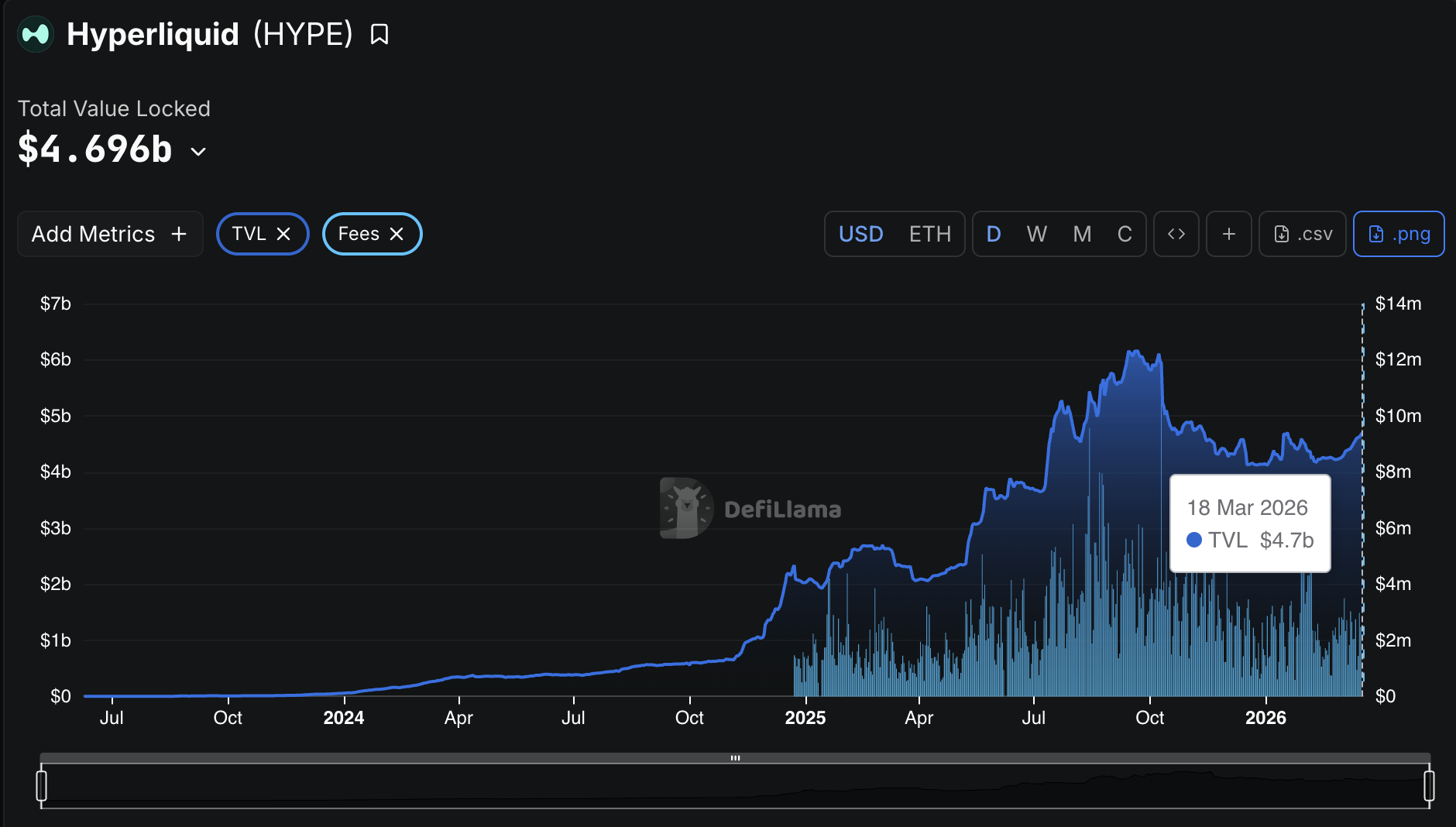
Source: DefiLlama

The protocol has grown from minimal liquidity to a multi-billion-dollar scale, with particularly strong acceleration through 2025. While TVL has fluctuated in recent months, it has largely stabilized within the $4B–$6B range, indicating sustained activity.

This level of liquidity provides the foundation to support more complex derivatives tied to traditional financial benchmarks, including products linked to major indices such as the S&P 500.

24/7 access challenges traditional market structure

One of the defining features of the new product is its continuous trading availability.

Traditional equity markets are constrained by regional trading hours and infrastructure, limiting access based on geography and time zone. By contrast, the on-chain perpetual model allows global participants to engage with the S&P 500 at any time.

This shift reflects a broader trend in crypto markets toward always-on financial infrastructure, which could influence expectations around accessibility in traditional finance.


Final Summary

  • The launch of an S&P 500 perpetual contract on Hyperliquid introduces 24/7 access to a major equity benchmark through on-chain derivatives.
  • Hyperliquid’s rapid growth to ~$4.7B in TVL underscores the expanding role of crypto-native platforms in bridging traditional finance and decentralized markets.


Related Questions

QWhat is the new on-chain derivatives product launched on Hyperliquid and what does it track?

AThe new product is a perpetual contract that tracks the S&P 500 index.

QWhich two organizations collaborated to develop this new S&P 500 perpetual contract?

AS&P Dow Jones Indices and trade.xyz collaborated to develop the product.

QWhat key feature distinguishes this perpetual contract from traditional equity market access?

AIt offers continuous, 24/7/365 trading, unlike traditional markets which operate within fixed trading hours.

QWhat mechanism does the perpetual contract use to maintain its price alignment with the underlying S&P 500 index?

AIt uses a funding mechanism to keep its price aligned with the underlying index, a model common in crypto derivatives.

QWhat was Hyperliquid's Total Value Locked (TVL) as of mid-March, as cited in the article?

AHyperliquid's Total Value Locked (TVL) was approximately $4.7 billion as of mid-March.

Related Reads

UBS: The Crowdedness of A-Share Tech Stocks Is Far From Reaching Historical Peaks

UBS: A-share tech stocks still far from peak crowding levels A-shares' technology sector has seen a strong rebound, with trading activity hitting record highs, raising concerns about market crowding. However, UBS Securities argues that a key indicator of institutional positioning suggests the current crowding level remains well below historical peaks. While the large-cap tech sector's share of total A-share trading volume and market capitalization have reached historical highs, the overweight ratio of domestic mutual funds in this sector stood at 9.9% in Q1 2026. This is down from 11.6% in Q3 2025 and significantly lower than the historical peak of 14.1% in Q4 2015. It also pales in comparison to the historical peak overweight of 18.7% for the consumer sector. UBS notes that typical cycles from a low to a peak in fund overweighting last about three years, and the current outperformance of the tech/growth style has lasted less than two years since the policy pivot in September 2024. UBS expects A-share earnings recovery to accelerate, providing fundamental support. It forecasts 2026 A-share profit growth to rise to 11% from 3.9% in 2025. Non-financial A-share profits grew 11.8% YoY in Q1 2026, with gross and net profit margins at their highest since 2023. Persistent fund inflows, the expansion of thematic ETFs, and a recovery in private fund issuance are supporting market liquidity. In tactical allocation, UBS favors growth and cyclical styles under its "slow bull" base case, with overweight ratings on six sectors: Electronics (benefiting from semiconductor inventory recovery and AI innovation), Communications (driven by AI computing demand), Machinery (aided by domestic capex recovery), Non-ferrous Metals (due to rising copper/aluminum prices), Chemicals (supported by anti-involution policies), and Electrical Equipment (driven by policy support and AI data center power demand).

marsbit1h ago

UBS: The Crowdedness of A-Share Tech Stocks Is Far From Reaching Historical Peaks

marsbit1h ago

Trading

Spot
Futures

Hot Articles

Discussions

Welcome to the HTX Community. Here, you can stay informed about the latest platform developments and gain access to professional market insights. Users' opinions on the price of S (S) are presented below.

活动图片














