"This year, not a single customer's demand can be fully met."
South Korean chip giant SK Hynix stated that the company's overall inventory of DRAM and NAND is only about 4 weeks, at a historically low level. From cloud providers like Google and Microsoft to AI companies like OpenAI, and then to consumer electronics terminal manufacturers, all customers are unable to receive full supply.
Price increases are inevitable. Starting from the third quarter of 2025, SK Hynix raised HBM3E prices by 15%-20%, with the price of DDR5 16Gb颗粒 (chips) surging by 102% in a single month. Starting in November, prices for all categories of DRAM increased, and NAND contract prices were also raised. In January 2026, another significant price hike occurred, with increases ranging from 20% to 60%.
And the rise in stock prices is also inevitable. Since the beginning of 2025, SK Hynix's stock price has skyrocketed about sixfold, while the stock price of another South Korean chip giant, Samsung Electronics, has accumulated an increase of nearly four times.
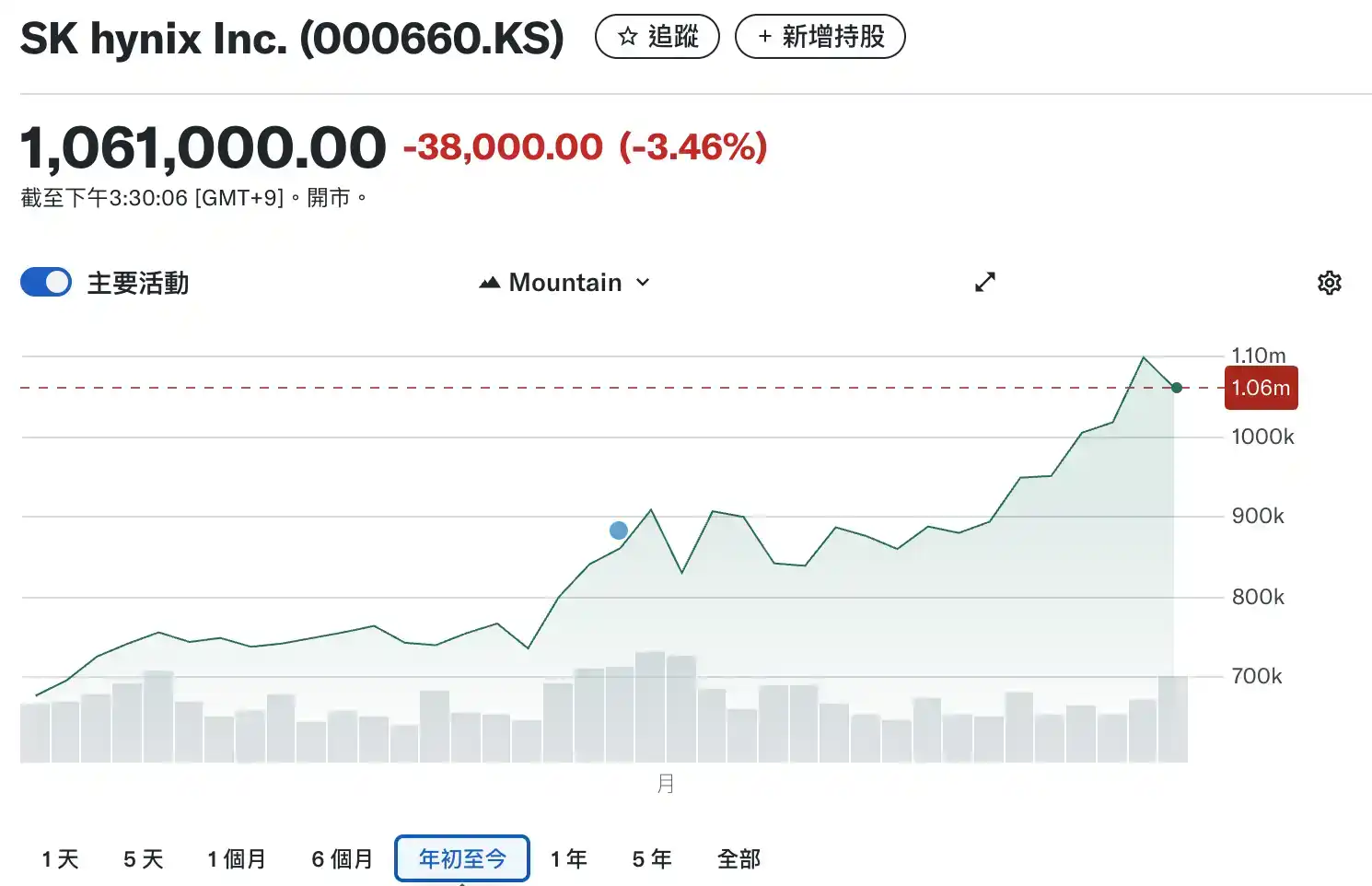
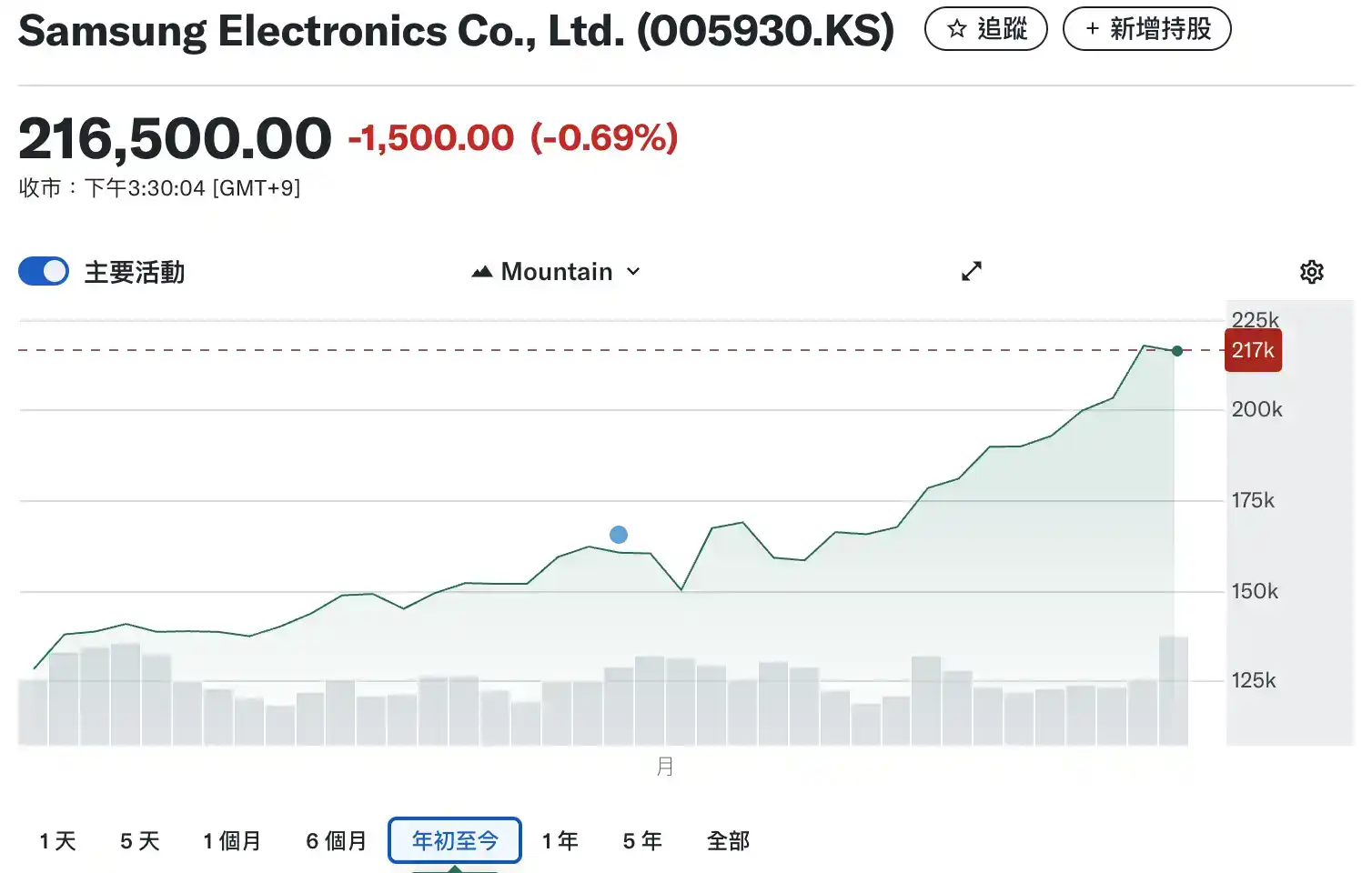
This has also led the South Korean stock market KOSPI index to break through the 6000-point mark for the first time. The total market capitalization of the South Korean stock market exceeded $3.76 trillion, increasing by about $2.23 trillion since the beginning of 2025, surpassing the stock markets of Germany and France and historically entering the global top ten, rising to the ninth position globally. Since 2026, the index has accumulated a gain of nearly 45%, becoming one of the best-performing major stock markets in the world.
South Korea, this tiny territory, whose stock market was long neglected by overseas funds due to low valuations, has now become the focus of the global capital markets. It has also captured the attention of South Korea's youth, who were originally疯狂 (crazy) about crypto.
Repricing Samsung and SK Hynix
In the consumer electronics era, the industrial paradigm represented by Apple Inc. dominated for twenty years.
As Apple's largest contract manufacturer, Foxconn employs over 1.4 million workers in China, located at the bottom of the "Smiling Curve." Design, brand, and sales occupy the two ends of the curve, where profits curve upwards. Profit distribution thus presents a stable structure: downstream (finished products/platforms) get the meat, upstream gets the soup. After all, there are numerous upstream suppliers, they are highly replaceable; product definition power lies with the brand manufacturers; demand is concentrated at the terminal; switching costs are low.
Many Chinese manufacturers take pride in being "Apple accessory manufacturers," but from an investment perspective, the consensus is: if you can buy Apple, don't buy Foxconn.
But when high technological concentration, slow capacity expansion speed, strong downstream dependence, and no alternative path in the short term these four conditions appear simultaneously, the upstream shifts from being "component suppliers" to becoming "system bottlenecks." The upstream反而 (instead) gains pricing power.
This is exactly what is happening in the current AI industry, in the HBM (High Bandwidth Memory)赛道 (track/field).
For over a decade, the semiconductor industry assumed a premise: the computing power bottleneck lies in the computing chip itself. But large model training shattered this perception. When the parameter scale moves from billions to trillions, GPUs face a more practical problem: no matter how fast they compute, they need data fed into them. HBM (High Bandwidth Memory) determines whether the GPU can run at full capacity; whether cluster efficiency is maximized; whether the unit computing power cost can decrease. It has become the "vascular system" of AI chips.
The more advanced the GPU, the deeper the dependence on memory. Taking NVIDIA as an example, from A100 to H100, then to H200 and subsequent roadmaps, the HBM capacity and bandwidth bound to each generation of GPU are increasing step by step. Computing power doubles, HBM usage almost doubles simultaneously. The proportion of HBM cost in the entire card's BOM (Bill of Materials) is getting higher and higher.
And the number of players globally with true large-scale mass production capabilities is very few: Samsung Electronics, SK Hynix, and (relatively smaller scale) Micron Technology. Apple needs Samsung, NVIDIA needs SK Hynix.
When demand grows exponentially and supply cannot be released quickly, price elasticity is amplified infinitely. In the traditional PC era, CPU/GPU took the lion's share of profits, while memory had strong cycles and weak bargaining power. In the AI server era, HBM has become an irreplaceable component. When a component simultaneously possesses irreplaceability and supply constraints, it means it has absolute pricing power, and it almost inevitably gains超额利润 (supernormal profits).
Repricing Samsung and SK Hynix has become the main theme in most financial markets, including South Korea. The allure of this theme has even surpassed that of crypto.
South Korean Retail Investors Dive Headfirst into Semiconductors
If you opened the chat windows of South Korean young people late at night in 2023 or 2024, Bitcoin was definitely a frequently discussed topic. For a long time, South Korea has been one of the most retail-driven cryptocurrency markets globally, playing a pivotal role.
And 2026 is the fourth year after the LUNA crash. The last person who brought巨大注意力 (huge attention) to South Korea from the financial industry, Do Kwon, has already been sentenced to 15 years in prison. This year, the丙午 (Bingwu) Fire Horse year, is a year of strong fire. The AI industry is still exploding, and South Korea, whose geographical location is associated with fire (in五行, Five Elements theory),显然火气过旺 (obviously has excessive fire energy).
When律动 (Lydian, likely a media name) editors recently opened Naver's investment forum贴吧 (tieba, forum), most posts were about "Samsung Electronics" (삼성전자) and "SK Hynix" (SK하이닉스). Samsung and SK Hynix.
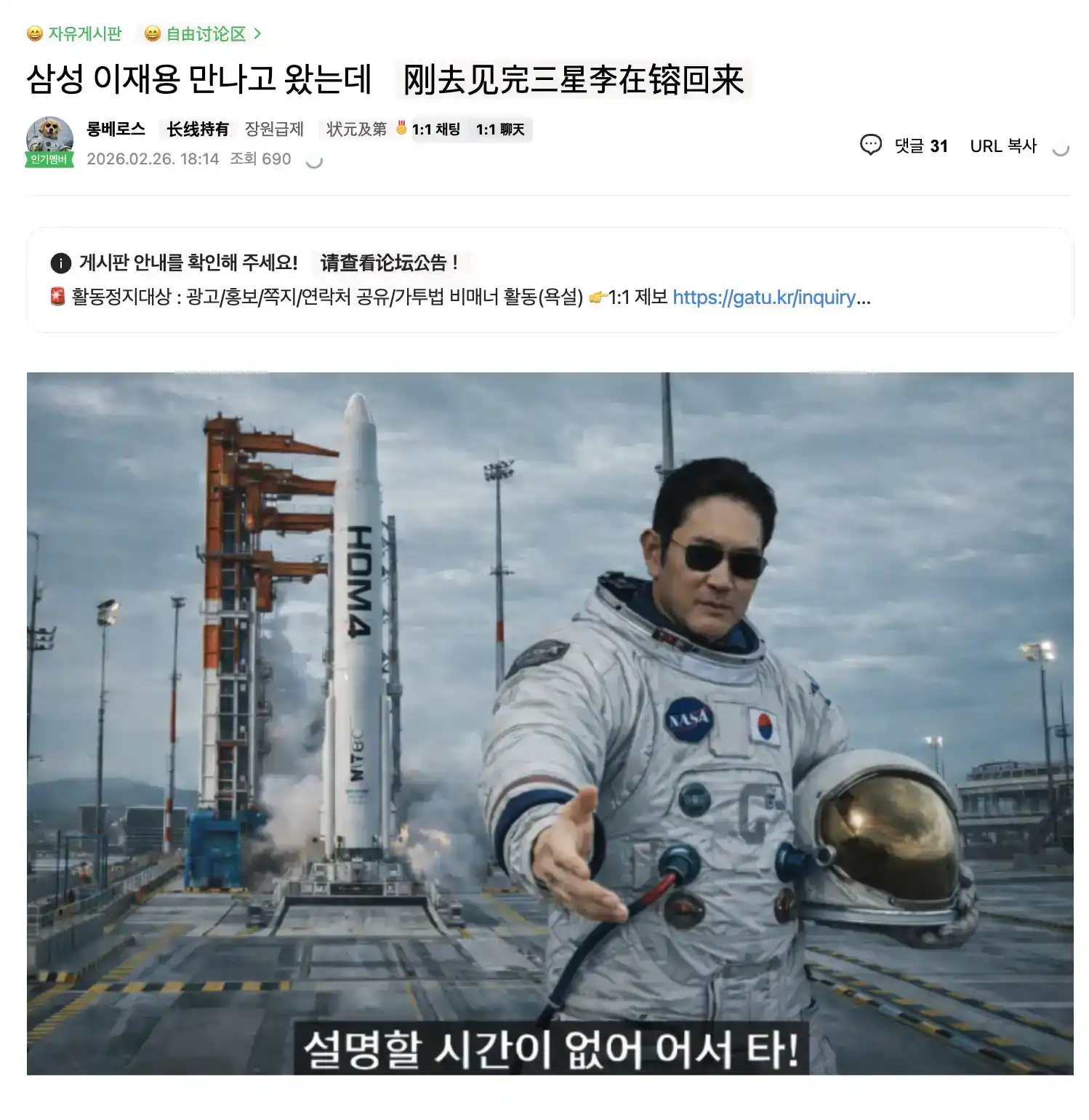
South Korean investors, who were keen on highly volatile altcoins, are now reallocating funds to domestic and foreign stocks, particularly those related to artificial intelligence and robotics.
According to Bloomberg statistics, the trading volume on local South Korean cryptocurrency trading platforms in January decreased by approximately 65% year-on-year. In stark contrast, the trading volume of the KOSPI, the core benchmark of the South Korean stock market, surged by 221% during the same period. The margin balance at securities firms has exceeded 30 trillion won (approximately $208 billion).
The speculative nature of South Korean youth has not changed, but they have shifted their阵地 (battlefield/position).
This sign was already apparent at the end of 2025.
In 2025, Upbit's trading volume fell by 80% compared to the same period in 2024; the activity of the Bitcoin-KRW trading pair was far less than in previous years. Instead, the South Korean stock market was booming, with the KOSPI index surging over 70% during the year, continuously hitting historical highs. On Kakao Talk and Naver forums, retail investors who used to discuss altcoins every day are now talking about "AI semiconductor concept stocks."
This migration also resonates微妙地 (subtly) with the political atmosphere. The current President, Lee Jae-myung, prominently proposed the "KOSPI 5000" target during his campaign. It is rumored that he repeatedly lost money in the stock market when he was young, and this experience of "being harvested like leeks" became his motivation for promoting financial reform.
Furthermore, Lee Jae-myung很清楚一件事 (understands one thing very clearly): whether the stock market can reach 5000 ultimately depends on whether corporate profits can reach a new level. And the South Korean stock market's weight is highly concentrated in technology and semiconductor leaders, so he押 (bets) heavily on these industries.
After taking office, he quickly released strong capital market-friendly signals: establishing a "KOSPI 5000 Special Committee"; promoting amendments to the Commercial Act; strengthening rules for equalization of shareholder rights; enhancing board accountability. On the eighth day of his term, he specially visited the Korea Exchange. The goal is singular: to keep South Korean residents' money in the stock market for the long term.
As for how much the South Korean stock market can rise, some analysis also suggests that besides the impact of the AI sector, political circles would also希望 (hope) the upward trend continues until the local elections in June this year.
This atmosphere has also deeply affected the liquidity still in the crypto circle.
On February 11, 2026, the Lighter exchange launched the world's first batch of on-chain perpetual contracts for South Korean stocks, including Samsung Electronics, SK Hynix, Hyundai Motor, and the KOSPI index, with leverage up to 10x. A few days later, Trade XYZ listed Samsung and Hynix, also with tenfold leverage.
This is also a highly symbolic scene: trading platforms that once hosted the altcoin狂欢 (carnival) are now hosting South Korean stocks.
After all, in this era where AI is reshaping the world, semiconductors are sexier than altcoins.