Solana’s Next Leg Higher Looks Strong, But Ozak AI Forecast Appears Far Steeper

TheNewsCryptoPublished on 2025-12-19Last updated on 2025-12-19

Abstract

Crypto market sentiment is strengthening as Solana (SOL) trades near $131, with analysts anticipating a major upward move due to strong network activity, growing adoption, and institutional interest. However, the article highlights Ozak AI (OZ) as offering a potentially steeper growth trajectory. Ozak AI is an operational AI-native intelligence engine featuring millisecond-level predictive analysis, autonomous agents, and a distributed node network. Its value compounds through computational intelligence and data processing, unlike Solana's linear adoption-driven growth. While Solana is expected to see significant gains, Ozak AI's presale has already raised over $4.9 million, with some analysts projecting 50x–100x returns by 2025–2026.

Crypto market sentiment continues strengthening as Solana trades near $131 and prepares for what analysts believe could be its next major upside leg. Network activity remains high, developer traction is accelerating, and liquidity continues flowing into SOL as one of the fastest-growing Layer-1 ecosystems. With institutional interest rising and on-chain usage expanding across DeFi, gaming, and payments, Solana is well-positioned for another powerful surge.

Yet while SOL’s next run looks convincingly bullish, the long-term trajectory capturing the highest ROI expectations is Ozak AI (OZ). As a functioning AI-native intelligence engine with millisecond-level analysis, autonomous agents, and accelerating early-stage growth, Ozak AI introduces a far steeper expansion curve than even top-tier large-cap assets like Solana.

Ozak AI (OZ)

Ozak AI’s strength begins with its real, operational intelligence infrastructure—a rarity among presale projects. Its predictive engine uses HIVE’s ultra-fast 30 ms market signals to scan blockchain activity at a speed unreachable by human traders or conventional analytics tools. Above this predictive layer operate SINT-powered autonomous agents capable of analyzing multiple chains simultaneously, reacting to emerging patterns, and refining strategies without human intervention.
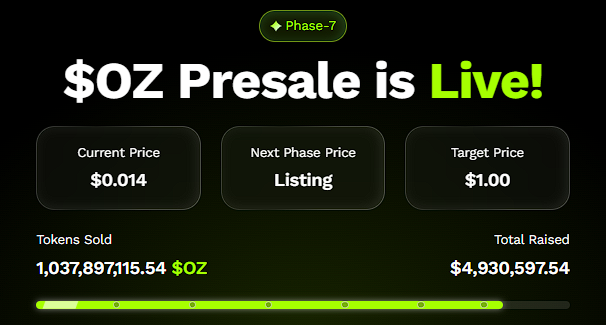
This growth model becomes even stronger through Perceptron Network’s 700K+ distributed nodes that continuously feed cross-chain intelligence into Ozak AI’s system, allowing the AI to improve every hour it runs. Unlike Solana, whose growth depends on adoption waves, Ozak AI grows through computation, meaning its value compounds as its intelligence deepens. The Ozak AI Presale has already surpassed $4.9 million, signaling intense early interest as investors position themselves before later pricing stages. With Ozak AI Presale demand accelerating rapidly, analysts increasingly project a 50x–100x upside range in the 2025–2026 window.

Solana (SOL)

Solana’s position around $131 reflects a market steadily building pressure for a broader breakout. Key support sits around $129, reinforcing the current trend, while deeper structural stability is found at $124 and $119 — levels where accumulation has historically reappeared before significant upside movements. These supports provide SOL with a strong foundation as it approaches its next bullish wave.
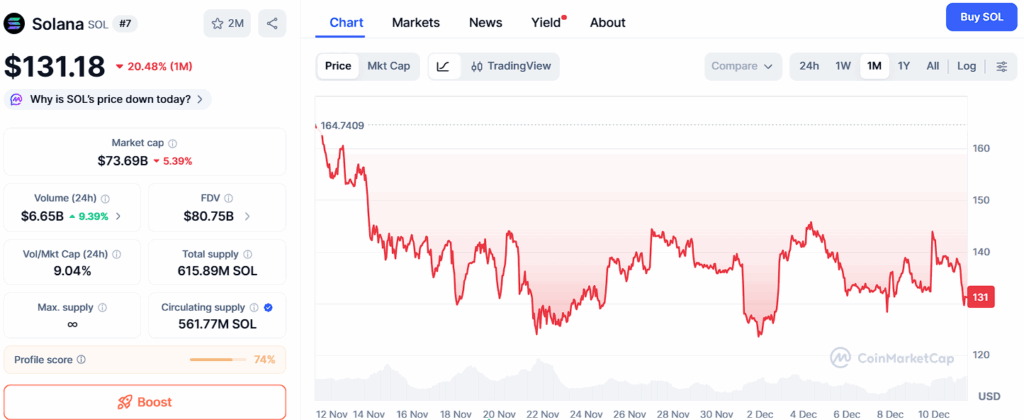
On the resistance side, Solana faces important breakout points at $136, $141, and $148. Clearing these levels typically sends SOL into rapid acceleration phases, where liquidity floods in and multi-week rallies unfold. With its expanding developer ecosystem, fast execution speeds, and rapidly growing consumer footprint, Solana remains one of the most fundamentally strong blockchain assets heading into 2025. Analysts expect it to revisit $600–$850 in a full bull cycle—a powerful move, but still structurally limited compared to early-stage AI-native networks like Ozak AI.

Why Ozak AI’s Forecast Appears Far Steeper

Solana grows when user activity rises, when liquidity increases, and when ecosystem adoption expands. Ozak AI grows every time its intelligence engine processes new data—a compounding mechanism that strengthens the project even when market sentiment is neutral. Each predictive refinement, autonomous agent execution, and cross-chain scan enhances Ozak AI’s long-term capability, creating a trajectory that accelerates naturally over time.

This gives Ozak AI a fundamentally different growth curve. Solana’s upside is strong but linear, tied to measurable adoption cycles. Ozak AI’s upside is exponential, fueled by self-improving intelligence and massive cross-chain data ingestion. As more networks integrate with Ozak AI and the predictive models continue maturing, the system scales in value at a pace traditional L1 assets cannot replicate.

Solana may deliver one of the strongest large-cap rallies of the next cycle, but Ozak AI is positioned to deliver one of the strongest ROI outcomes. As 2025–2026 approaches, Solana looks powerful, yet Ozak AI appears transformational—the project most likely to outperform even top-tier blockchain leaders with a far steeper, intelligence-driven growth arc.

About Ozak AI

Ozak AI is a blockchain-based crypto project that provides a technology platform that specializes in predictive AI and advanced data analytics for financial markets. Through machine learning algorithms and decentralized network technologies, Ozak AI enables real-time, accurate, and actionable insights to help crypto enthusiasts and businesses make the correct decisions.

For more, visit:

  • Website: https://ozak.ai/
  • Telegram: https://t.me/OzakAGI
  • Twitter: https://x.com/ozakagi

Disclaimer: TheNewsCrypto does not endorse any content on this page. The content depicted in this Press Release does not represent any investment advice. TheNewsCrypto recommends our readers to make decisions based on their own research. TheNewsCrypto is not accountable for any damage or loss related to content, products, or services stated in this Press Release.


TagsBlockchainOzak AI ($OZ)Solana

Related Questions

QWhat is the current trading price of Solana (SOL) mentioned in the article, and what are the key support levels?

ASolana is trading near $131. Key support levels are around $129, with deeper structural stability at $124 and $119.

QWhat is the core technological advantage of Ozak AI (OZ) as described in the article?

AOzak AI's core advantage is its functioning AI-native intelligence engine, which uses HIVE’s ultra-fast 30 ms market signals and SINT-powered autonomous agents to analyze multiple blockchains simultaneously and react to patterns without human intervention.

QHow does the growth model of Ozak AI fundamentally differ from that of Solana?

ASolana's growth is linear and depends on user adoption, liquidity, and ecosystem expansion. Ozak AI's growth is exponential and compounds through computation, as its value increases every time its intelligence engine processes new data and improves its predictive models.

QWhat milestone has the Ozak AI Presale achieved, and what is the projected upside range for the token?

AThe Ozak AI Presale has surpassed $4.9 million. Analysts project a 50x to 100x upside range for the token in the 2025-2026 window.

QWhat is the long-term price target analysts expect for Solana (SOL) in a full bull cycle, and how does it compare to the potential of Ozak AI?

AAnalysts expect Solana to revisit $600–$850 in a full bull cycle. While this is a powerful move, the article states that Ozak AI's intelligence-driven, exponential growth arc is projected to be far steeper and has the potential to outperform even top-tier blockchain leaders like Solana.

Related Reads

Huang Renxun Dramatically 'Saves' South Korean Stock Market

In early June, South Korea's stock market experienced a sharp decline, with the KOSPI index dropping over 5% and triggering a trading halt. Amid this volatility, NVIDIA CEO Jensen Huang's visit to Seoul provided a dramatic boost to market sentiment. During his trip, Huang held a dinner meeting with SK Group Chairman Chey Tae-won and SK Hynix CEO Kwak Noh-Jung. He announced that NVIDIA's new Vera CPU would utilize SK Hynix DRAM and confirmed a multi-year technical collaboration between the two companies. This partnership aims to co-develop next-generation memory for NVIDIA's AI infrastructure roadmap, covering products from data center supercomputers to personal AI devices. Huang also publicly commented that AI company stocks were attractively priced. A key announcement was that NVIDIA's upcoming Vera Rubin AI supercomputer systems will use HBM4 memory, with supply qualifications granted to all three major suppliers: SK Hynix, Samsung Electronics, and Micron Technology. Despite this multi-sourcing strategy, Huang warned that the industry-wide chip shortage, affecting everything from wafers to packaging, is expected to persist for several years due to relentless demand from global AI factory construction. The collaboration extends beyond memory supply. SK Hynix will employ NVIDIA's AI platforms and Omniverse digital twin technology to enhance its own semiconductor design, simulation, and manufacturing processes, aiming for more autonomous factory operations. This visit builds upon a prior October 2025 agreement for SK Group to build a large-scale AI data center using over 50,000 NVIDIA GPUs. Huang's itinerary also included meetings with other Korean giants like Hyundai, LG, and Samsung, indicating NVIDIA's broader strategy to deepen ties with South Korea's tech industry.

链捕手3h ago

Huang Renxun Dramatically 'Saves' South Korean Stock Market

链捕手3h ago

When Inference Becomes a Scarce Resource, Who Captures the Value?

When Inference Becomes the Scarce Resource, Who Captures the Value? The core AI bottleneck has shifted from model training to inference (runtime execution). While concerns persisted about an "AI compute gap"—initially a $200B, now a $600B problem—the market is now recognizing that the solution and value lie in the inference layer. Nvidia's financial restructuring around "serving tokens" and Cerebras's successful IPO highlight this shift. Inference is a recurring, usage-based cost, estimated to be 10-50x larger than the one-time training market, especially with the rise of agentic AI. The inference stack spans six layers: silicon (e.g., Nvidia), bare metal (e.g., CoreWeave), GPU rental/aggregation, deployment/optimization, model APIs, and end applications. Most companies operate in one layer. However, Hyperbolic uniquely spans three layers (GPU rental, deployment, and model APIs) without owning any hardware. It aggregates fragmented GPU supply from multiple cloud providers into a standardized pool, offering developers the cheapest available compute through intelligent routing. Its multi-cloud aggregation creates a data moat and a flywheel: more supply leads to better pricing data and liquidity, attracting more developers and providers. In contrast, applications like Venice operate at the top of the stack, reselling privacy-wrapped inference but remaining dependent on and constrained by the underlying compute costs they purchase. As inference demand explodes, value accrues not just to consumer applications but increasingly to the aggregation and routing layer that captures their cost of revenue. The coming potential GPU oversupply reinforces this dynamic. While hardware owners may suffer from depreciation, asset-light aggregators like Hyperbolic benefit from price arbitrage, routing workloads to the cheapest available capacity. The ultimate winner in the inference economy may not be the entity with the most GPUs, but the one that can most efficiently discover, aggregate, and route the world's fragmented compute.

链捕手3h ago

When Inference Becomes a Scarce Resource, Who Captures the Value?

链捕手3h ago

Trading

Spot
Futures

Hot Articles

Discussions

Welcome to the HTX Community. Here, you can stay informed about the latest platform developments and gain access to professional market insights. Users' opinions on the price of S (S) are presented below.

活动图片














