Solana stalls despite $1.8B RWA growth – Where is SOL’s liquidity going?

ambcryptoPublished on 2026-03-21Last updated on 2026-03-21

Abstract

Despite Solana (SOL) struggling to break the $100 psychological level, its ecosystem is experiencing significant liquidity movement, particularly in the real-world asset (RWA) sector. Solana's RWA total value locked (TVL) has surged nearly 64% this year, reaching a new all-time high of over $1.8 billion. Additionally, active DeFi TVL within Solana's RWA sector hit a record $465 million, indicating that capital is actively being used in lending, staking, and liquidity pools rather than sitting idle. This growth is further amplified by Ondo Finance's strategic expansion, adding over 50 tokenized assets—including stocks and ETFs like Galaxy Digital and BlackRock’s IBIT—bringing its total listings on Solana to more than 250. This move positions Solana as a major DeFi hub for tokenized assets, highlighting a disconnect between its stagnant price action and robust on-chain fundamentals. The data suggests that liquidity isn't exiting the market but is instead being redirected into RWA-related DeFi activities on Solana.

DeFi acts as a strong bridge between a network’s on-chain stats and fundamentals.

The logic is simple: a Layer-1 looking weak on the numbers doesn’t tell the full story of its market valuation if network fundamentals aren’t moving in the same direction. Notably, DeFi has become the go-to spot to gauge this gap, offering clues about where dry powder is sitting.

In this context, the stablecoin market hitting a record $316 billion amid the ongoing risk-off mood starts to carry weight, showing that liquidity is flowing back into the market. Naturally, the question arises: Where is this liquidity heading, as Solana [SOL] continues to chop below the $100 psychological level?
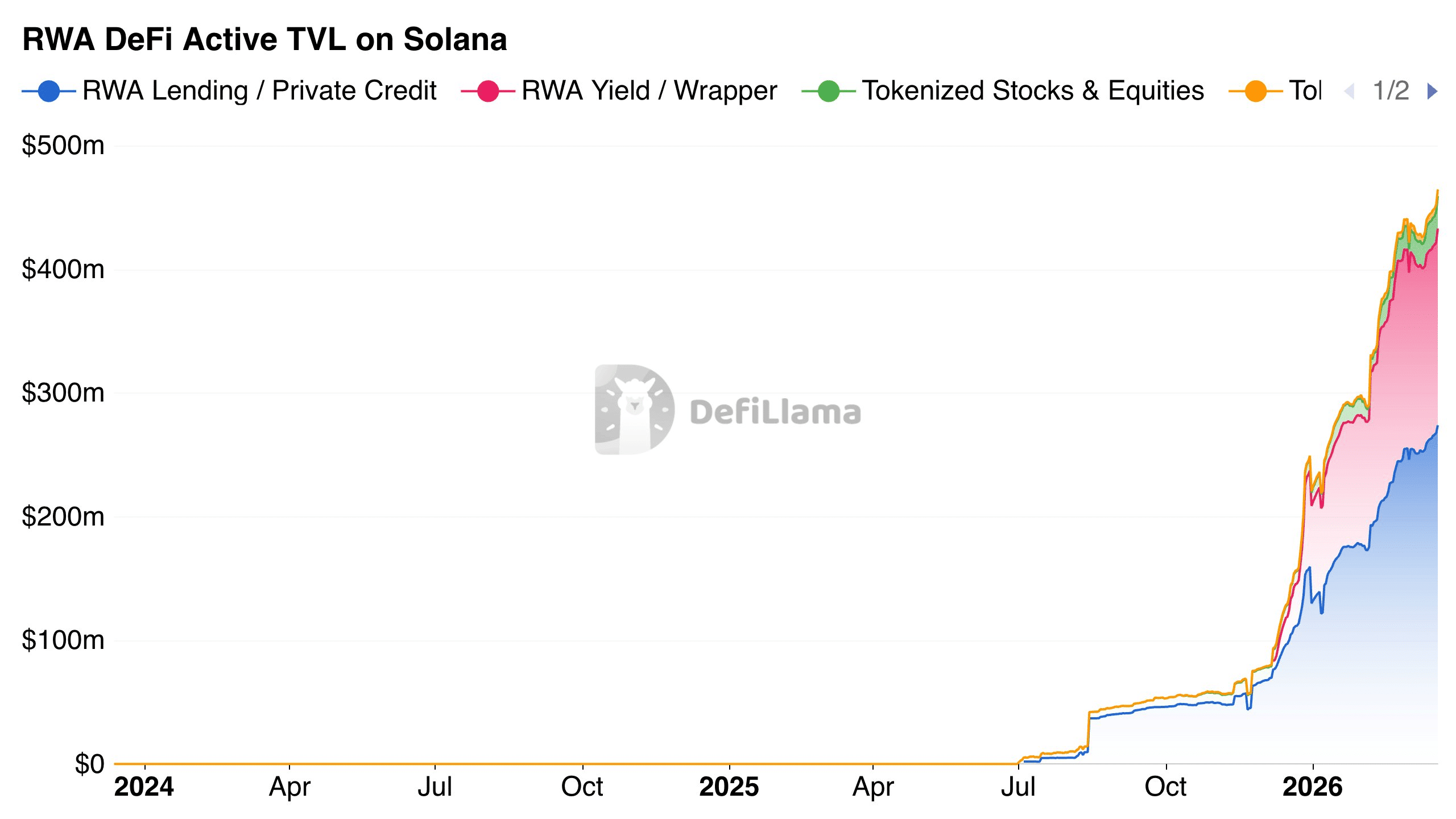
Source: DeFiLlama

According to AMBCrypto, that’s precisely where DeFi flows start to matter.

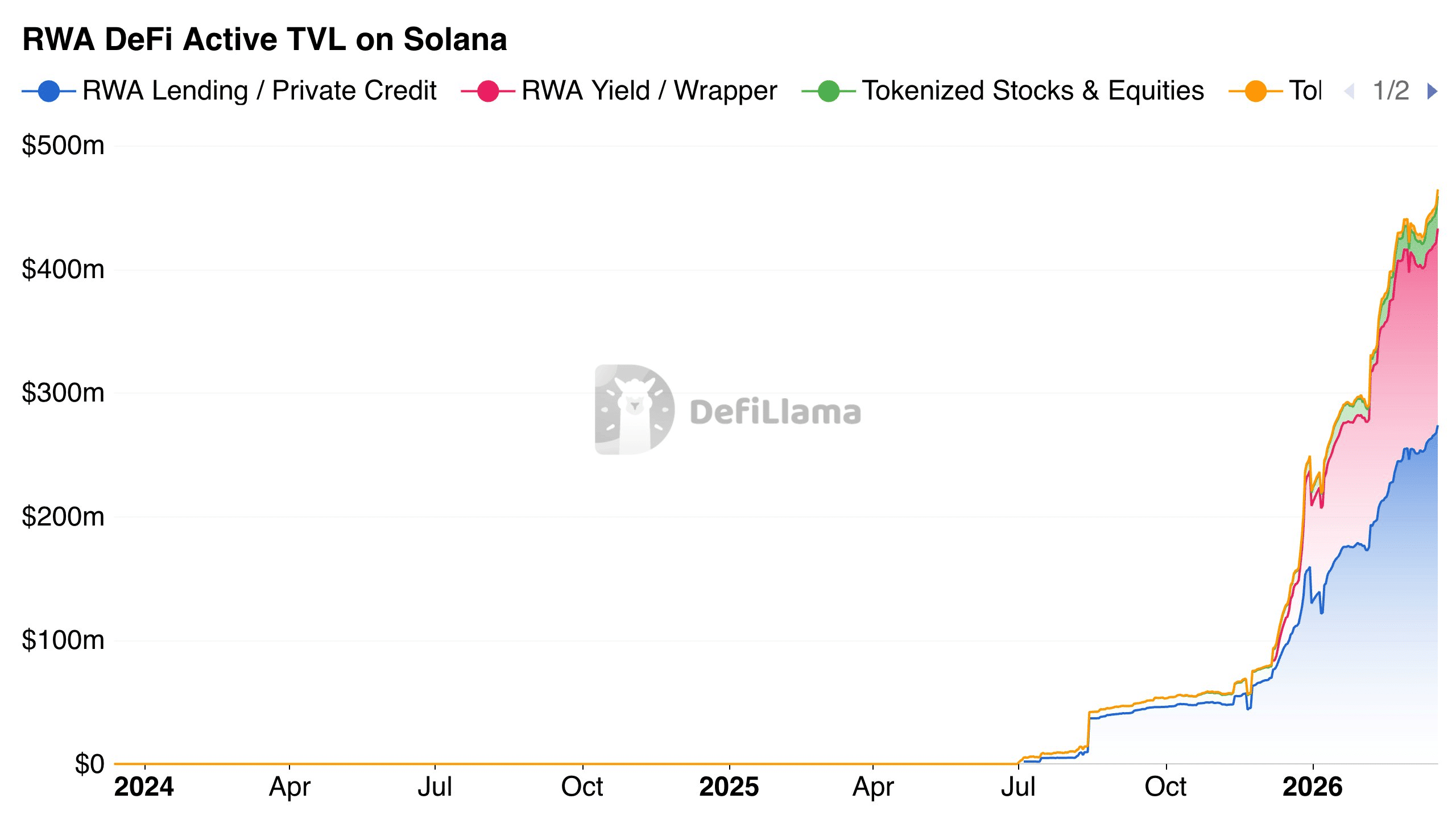
In a post on X, SolanaFloor highlighted a key setup: Solana RWAs active DeFi TVL has hit a new all-time high of $465 million, signaling that investors are increasingly moving capital into tokenized assets on the network.

As a result, this surge in DeFi activity offers a clearer picture of how liquidity is circulating, even when the charts themselves might look flat or bearish. In this context, could Ondo Finance adding 50 tokenized assets on Solana be a strategic move to leverage this trend, highlighting a deeper shift in where SOL’s sidelined capital is flowing?

Tokenized assets are turning Solana into a DeFi hotspot

The timing of Ondo Finance’s move couldn’t be more strategic.

For context, OndoFinance is expanding tokenized equities on Solana, adding 50+ new stocks and ETFs, including Galaxy Digital and BlackRock’s IBIT, bringing total listings on Ondo Global Markets to over 250.

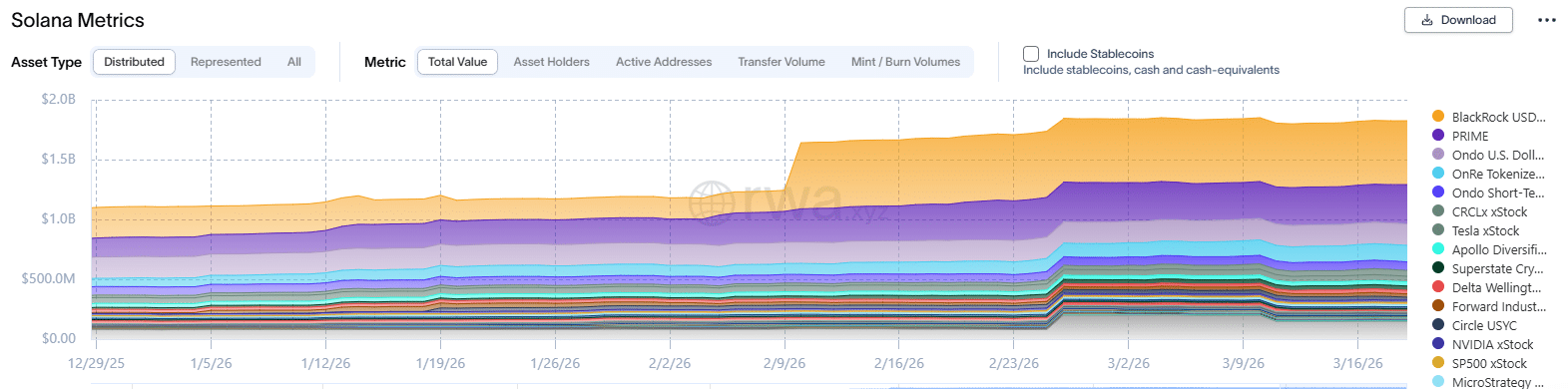
Looking at data from RWA.xyz, this move starts to make sense. On the charts, Ethereum [ETH] (the largest chain by total RWA value) has seen about 25% growth so far this year. By comparison, Solana’s RWA has jumped nearly 64%, reaching a new all-time high of over $1.8 billion.
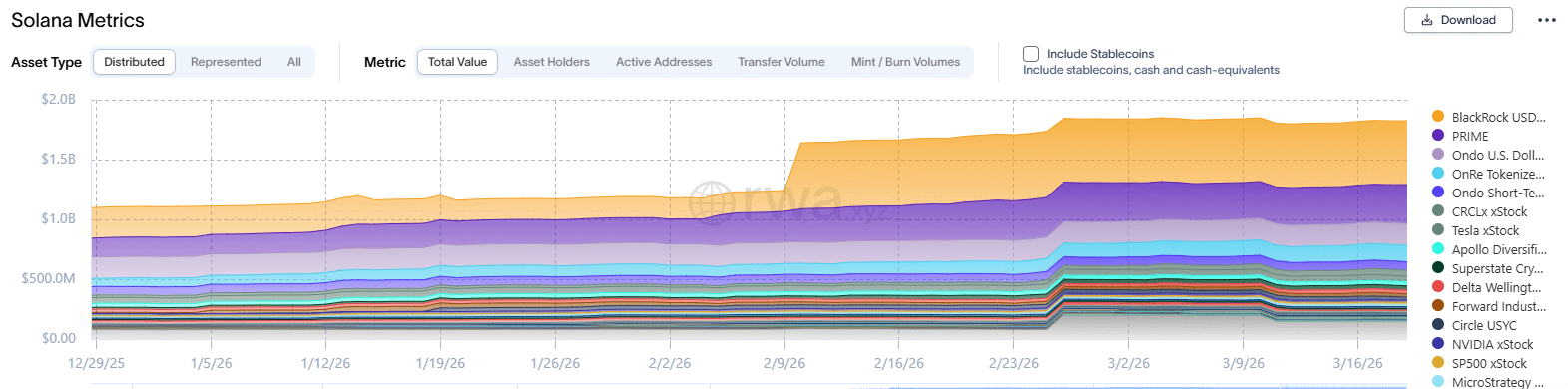
Source: RWA.xyz

Adding to that, Solana’s RWA active DeFi TVL, which is also hitting a record $465 million, makes it clear that a significant portion of tokenized assets on the network isn’t just sitting idle.

Instead, these assets are actively being used in DeFi protocols, including lending, staking, and liquidity pools, showing that Solana’s ecosystem is really putting capital to work. Taken together, Solana’s high total RWA value, along with record active DeFi TVL, highlights just how much liquidity is moving on the network.

In this context, Ondo Finance’s move to add 50 more tokenized assets on Solana further boosts this activity, showing that capital isn’t leaving the market but is instead being parked in the RWA sector. As a result, this area is becoming a major DeFi hub, highlighting the gap between the charts and what’s actually happening on the ground.


Final Summary

  • Total RWA TVL on Solana has jumped nearly 64%, with active DeFi TVL hitting $465 million, showing that liquidity is flowing and investors are putting capital to work.
  • Ondo Finance adding 50 tokenized assets turns the RWA sector into a major DeFi hub, highlighting the gap between the charts and what’s really happening on the network.


Related Questions

QWhat is the current total value of Real World Assets (RWA) on the Solana network, and what does its growth indicate?

AThe total RWA TVL on Solana has reached a new all-time high of over $1.8 billion, representing a growth of nearly 64% this year. This indicates that a significant amount of capital is flowing into tokenized assets on the network.

QWhat is the significance of Solana's active DeFi TVL for RWA hitting $465 million?

AThe record $465 million in active DeFi TVL signifies that the tokenized assets on Solana are not sitting idle but are actively being used within DeFi protocols like lending, staking, and liquidity pools, showing that capital is being put to work.

QHow does Ondo Finance's recent move contribute to Solana's RWA and DeFi ecosystem?

AOndo Finance expanded by adding over 50 new tokenized stocks and ETFs on Solana, bringing its total listings to over 250. This strategic move leverages the growing RWA trend and further boosts DeFi activity, turning the RWA sector into a major liquidity hub on the network.

QDespite the growth in RWA, what is the current price behavior of SOL?

ADespite the substantial growth in RWA, the price of SOL continues to trade below the key psychological level of $100, showing a choppy or stalled price action.

QWhat does the article suggest is the 'gap' that DeFi helps to gauge?

AThe article suggests that DeFi helps to gauge the gap between a network's on-chain metrics (like a weak price chart) and its underlying fundamentals (like strong RWA growth and active DeFi TVL), offering clues about where the real liquidity and 'dry powder' are moving.

Related Reads

OpenAI Goes Left, DeepSeek Goes Right

On April 24, 2026, DeepSeek released V4, a Chinese large language model offering a free "million-token context window," enabling it to process vast amounts of data like entire books or years of corporate documents in one go. In contrast, OpenAI’s GPT-5.5, released around the same time, is more powerful but significantly more expensive, charging up to $180 per million output tokens. DeepSeek’s strategy represents a shift from a pure AI research firm to a heavy-infrastructure player, building data centers in Inner Mongolia’s Ulanqab to bypass U.S. chip export restrictions. This move, supported by Huawei’s Ascend chips and China’s cheap green electricity, highlights a fundamental divergence in AI development models: U.S. firms focus on high-cost, high-margin services, while Chinese players like DeepSeek prioritize accessibility and affordability. Facing intense talent poaching from tech giants, DeepSeek is seeking a $44 billion valuation funding round to retain researchers and scale infrastructure. Meanwhile, Chinese manufacturers are compressing AI models to run on smartphones, making AI accessible offline and across the Global South. Through open-source models and localized solutions, Chinese AI is empowering non-English speakers and low-income users, driving a form of "digital equality." While Silicon Valley builds walled gardens, DeepSeek and others are turning AI into a public utility—like tap water—flowing freely to those previously left behind.

marsbit7m ago

OpenAI Goes Left, DeepSeek Goes Right

marsbit7m ago

$292 Million KelpDAO Cross-Chain Bridge Hack: Who Should Foot the Bill?

On April 18, 2026, an attacker stole 116,500 rsETH (worth ~$292M) from KelpDAO’s cross-chain bridge in 46 minutes—the largest DeFi exploit of 2026. The stolen assets were deposited into Aave V3 as collateral, causing $177–200M in bad debt and triggering a cascade of losses across nine DeFi protocols. Aave’s TVL dropped by ~$6B overnight. This legal analysis argues that KelpDAO and LayerZero Labs share concurrent liability, with fault apportioned 60%/40%. KelpDAO negligently configured its bridge with a 1-of-1 decentralized verifier network (DVN)—a single point of failure—despite LayerZero’s explicit recommendation of a 2-of-3 setup. LayerZero, which operated the compromised DVN, failed to secure its RPC infrastructure against a known poisoning attack vector. Both protocols’ terms of service cap liability at $200 (KelpDAO) or $50 (LayerZero), but these limits are likely unenforceable due to unconscionability, gross negligence exceptions, and potential securities law invalidation (if rsETH is deemed a security under the Howey test). Aave’s governance also faces fiduciary duty claims for raising rsETH’s loan-to-value ratio to 93%—far above competitors’ 72–75%—without adequately assessing bridge risks, amplifying the systemic fallout. Practical recovery targets include LayerZero Labs (a registered Canadian entity), KelpDAO’s founders, auditors, and identifiable Aave governance delegates. The incident underscores escalating legal risks for DeFi protocols, infrastructure providers, and governance participants.

marsbit1h ago

$292 Million KelpDAO Cross-Chain Bridge Hack: Who Should Foot the Bill?

marsbit1h ago

Insider Trading in War: 5 People Involved, the Highest Earner Was Arrested

On April 24, the U.S. Department of Justice arrested U.S. Army Special Forces Staff Sergeant Gannon Ken Van Dyke for insider trading related to the capture of Venezuelan President Nicolás Maduro on January 3. Van Dyke allegedly profited over $400,000 by placing bets on a prediction market, Polymarket, using insider knowledge of the covert operation. According to the indictment, Van Dyke registered an account (0x31a5) on December 26 and made a series of bets predicting Maduro’s capture and U.S. military involvement in Venezuela. He withdrew most of his funds on the day of the operation and attempted to obscure his tracks by transferring assets through crypto and brokerage accounts. This case marks the first time the DOJ has prosecuted insider trading on Polymarket. PolyBeats had previously identified five suspicious accounts, including Van Dyke’s—the highest earner—in January. The other accounts, with profits ranging from $34,000 to $145,000, remain under unofficial scrutiny but have not been charged. Their lower profits, indirect access to information, and unclear legal boundaries may complicate prosecution. Polymarket has since strengthened its market integrity rules, explicitly prohibiting trading based on confidential or insider information. Van Dyke’s arrest, nearly four months after his trades, signals increased regulatory attention and the persistent traceability of blockchain-based transactions.

marsbit1h ago

Insider Trading in War: 5 People Involved, the Highest Earner Was Arrested

marsbit1h ago

Trading

Spot
Futures

Hot Articles

Discussions

Welcome to the HTX Community. Here, you can stay informed about the latest platform developments and gain access to professional market insights. Users' opinions on the price of S (S) are presented below.

活动图片













