Solana Market Hit by Wave Of Treasury-Driven Selling, SOL’s Pullback To Extend?

bitcoinistPublished on 2026-03-31Last updated on 2026-03-31

Abstract

The cryptocurrency market is bearish, with Solana (SOL) struggling as its price drops toward $80. A wave of treasury-driven selling is intensifying pressure, as large firms have been offloading significant portions of their SOL holdings over recent months. This distribution is expanding the available supply, causing speculation about near-term price stability and indicating a potential sentiment shift or portfolio reshuffling. Analyst Ted Pillows notes a lack of buying demand, suggesting this could extend the bearish trend, potentially pushing SOL down to $50 by 2026. Furthermore, the Solana network is showing weakness with a notable decline in stablecoin supply, experiencing outflows of over $250 million in the past month—a key metric considered reliable and hard to manipulate. Technically, SOL is at a critical support level near $81. A break below this could trigger a further decline toward $45. Currently, SOL is trading around $83 with a slight 24-hour bounce of 1.14%, though trading volume has increased by over 36%.

The cryptocurrency market has turned highly bearish, and Solana‘s price continues to struggle with volatility as it drops toward the $80 level. Amid the persistent waning action, there has been a noticeable selling activity among treasury firms across the sector, which has triggered serious questions about its price outlook in the short to medium term.

Treasury Holders Are Selling Off Solana

As Solana’s price continues its downward trend into the new week, selling pressure around the asset has increased along with the bearish performance. After a period of dumping from short-term and long-term holders, this selling activity appears to have moved toward the SOL treasury companies across the sector.

Looking at the chart shared by Ted Pillows, a seasoned macro analyst and investor, large Solana treasury companies have been dumping their SOL holdings over the past few months. Currently, these firms are selling significant portions of their holdings towards new lows.

Such a wave of distribution from treasury firms is expanding the available supply of SOL in the market, causing speculation about its price stability in the near term. Furthermore, this typically points to a shift in sentiment or the desire for these companies to reshuffle their crypto portfolios, a key development in the market.
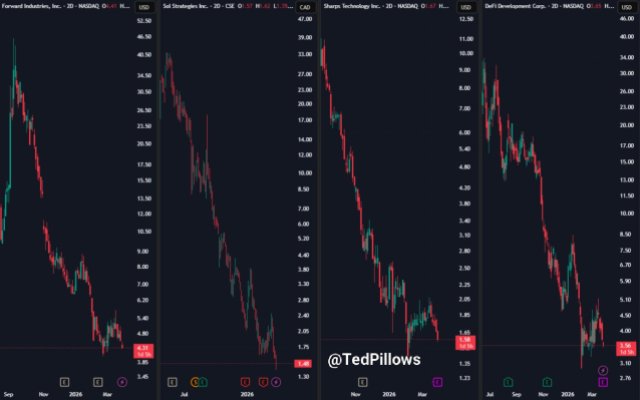
Source: Chart from Ted Pillows on X

According to the expert, no buying demand is coming for Solana, which is an extremely negative development, and could extend the ongoing bearish price action. Ted believes that the persistent selling from treasury firms might push SOL further downward to the $50 price level in 2026.

In terms of unchain activity, Solana is demonstrating weakening performance as the network sees a massive decline in stablecoin supply. AdrianoFeria.eth on the X platform stated that the SOL network is dying compared to Ethereum, which is thriving, amassing a substantial amount of stablecoin supply.

Over the past month, the SOL network has experienced notable outflows of more than $250 million. In the crypto sector, stablecoin supply is considered one of the few metrics that cannot be gamed or faked, making it a crucial indicator to determine network trajectory.

SOL’s Price Action Still Looking Weak

Solana has lost its upside momentum due to the market’s pullback during the weekend. Following an analysis of the weekly chart, UniChartz, a crypto analyst, has revealed that Solana is exhibiting some weakness and is positioned at a critical support area.

This support, which is sitting at the near the $81 level, is now a key point in determining the altcoin’s next direction. If SOL makes a clean break down and acceptance below the level, it could trigger a continued downward trend. When this happens, the next big price level to watch out for is around $45.

At the time of writing, the price of SOL is trading at $83 after a brief bounce of 1.14% over the last 24 hours. While the price has slightly increased, its trading volume has picked up, rising by more than 36% over the past day.

SOL trading at $84 on the 1D chart | Source: SOLUSDT on Tradingview.com

Trending Cryptos

Related Questions

QWhat is the main reason for the recent selling pressure on Solana (SOL) according to the article?

AThe main reason is a wave of treasury-driven selling, where large Solana treasury companies have been dumping significant portions of their SOL holdings over the past few months.

QWhich key support level is Solana's price testing, and what is the potential downside target if it breaks?

ASolana is testing a key support level near $81. If it breaks and closes below this level, the next major downside target could be around $45.

QWhat negative on-chain metric is cited as evidence of Solana's weakening performance?

AThe network has experienced a massive decline in stablecoin supply, with outflows of more than $250 million over the past month, which is considered a crucial and reliable indicator.

QAccording to analyst Ted Pillows, what is the potential price target for SOL in 2026 due to persistent selling?

ATed Pillows believes that the persistent selling from treasury firms could push SOL's price down to the $50 level in 2026.

QWhat was the change in SOL's trading volume alongside its slight price increase in the last 24 hours?

AWhile SOL's price saw a slight increase of 1.14%, its trading volume picked up significantly, rising by more than 36% over the past 24 hours.

Related Reads

IPO Imminent, OpenAI Faces Major Personnel Upheaval

OpenAI, preparing for a potential IPO, is experiencing significant leadership turmoil. In mid-August 2026, longtime "GPU geek" Scott Gray quietly left, and within three days, Chief Operating Officer Brad Lightcap (8-year veteran) and Chief Revenue Officer Denise Dresser (8-month tenure) departed. This follows a broader exodus of at least 10 senior executives in 2026, including heads of product, safety, and ethics. Analysts view this as a strategic "surgery" to transform from a research lab into a sales-driven enterprise company before going public. Revenue now tilts toward enterprise clients, surpassing consumer income sooner than expected, with annualized revenue reaching $40 billion. The new CRO, Dali Rajic, is a veteran enterprise sales leader. Concurrently, OpenAI has disbanded independent safety teams like "Preparedness," which assessed catastrophic risks, integrating their functions into core research. Critics warn this removes dedicated "brakes" on AI development. The leadership vacuum raises questions about who is the clear second-in-command after former apps CEO Fidji Simo moved to an advisory role. Co-founder Greg Brockman appears to be consolidating power. As OpenAI races against rival Anthropic ($47B annualized revenue), it faces the dual challenge of commercial execution while managing the departure of foundational technical talent and ensuring responsible AI development remains a priority.

marsbit8m ago

IPO Imminent, OpenAI Faces Major Personnel Upheaval

marsbit8m ago

AI Can 'Have Moods Too'! New Research from USTC: Confusion and Anxiety Make AI Work Better

The article discusses research from the University of Science and Technology of China and Oxford, revealing that allowing AI to recognize and act upon simulated "internal emotions" can significantly improve its performance. The study demonstrates a coherent pairing between specific emotional states in AI agents and their subsequent skill choices. For instance, an agent feeling curious and desirous will search for products, while one feeling confused and tense will rephrase queries. This mirrors human decision-making influenced by emotions. Statistical validation showed a 76.5% semantic consistency in these pairings. Crucially, the research challenges the traditional view of AI errors as flaws to be eliminated. It found that "bad" emotions like confusion, tension, or frustration serve as useful metacognitive signals, indicating a mismatch between the current strategy and the environment. By responding to these signals, AI can proactively adjust before a failure occurs. This is particularly effective in complex tasks prone to failure. For example, in tasks like "heating an item" and "picking up two items," success rates surged from 9.6% to 56.9% and 4.4% to 31.3%, respectively, when using the emotion-driven skill selection method (EMOTION2SKILL). The AI's "nervous" state about a closed microwave, for instance, prompted it to check and open it first, preventing failure. The article also mentions related work from Tianjin University, which embeds emotional prediction into world models (Large Emotional World Model, LEWM), significantly improving prediction accuracy in human-centric environments. Removing emotional data was found to degrade performance even in unrelated logical reasoning tasks. These studies build on earlier findings, like those from Anthropic, that identifiable emotional representations exist within large language models (LLMs). The focus is shifting from philosophical debate about AI emotion to practically harnessing these internal states as functional signals to enhance AI robustness and capability.

marsbit44m ago

AI Can 'Have Moods Too'! New Research from USTC: Confusion and Anxiety Make AI Work Better

marsbit44m ago

Trading

Spot

Hot Articles

Discussions

Welcome to the HTX Community. Here, you can stay informed about the latest platform developments and gain access to professional market insights. Users' opinions on the price of S (S) are presented below.

活动图片