Original | Odaily Planet Daily (@OdailyChina)
Author | Azuma (@azuma_eth)
From December 11th to December 13th, the fifth Breakpoint was successfully held in Abu Dhabi. As Solana's largest and most influential ecosystem conference, Breakpoint often carries the expectations of the entire Solana ecosystem for information exchange on value judgments, future directions, and wealth opportunities.
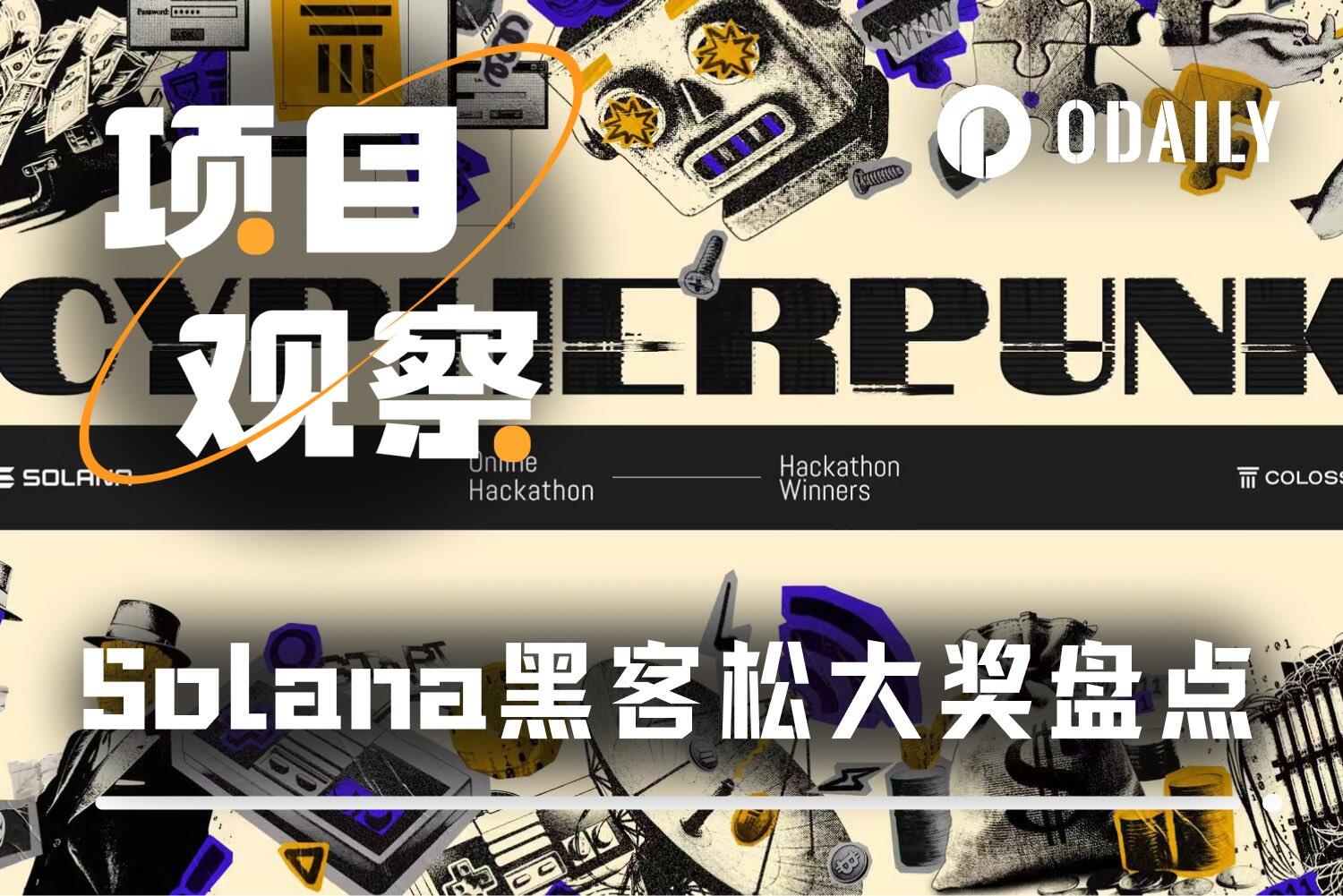
During the Breakpoint period, the Solana Cypherpunk Hackathon, hosted by the Solana Foundation and organized by Colosseum, gained significant exposure and attention. This hackathon brought together entrepreneurs and developers from over 150 countries, with more than 9,000 participants forming teams and submitting 1,576 projects. These projects covered infrastructure, consumer applications, DeFi, stablecoins, RWA, and various innovative products in undefined tracks, making this the largest crypto-themed hackathon to date.
Below is Odaily Planet Daily's detailed overview of the award-winning projects from this hackathon. In the current climate of a sluggish market and exhausted narratives, these new projects not only carry inherent investment opportunities but also have the potential to become the seeds that ignite the next cycle, driving the industry towards a new wave of growth.
Grand Prize: Unruggable
X Link: https://x.com/unruggable_io
Introduction: Unruggable is the first hardware wallet and companion app specifically designed for Solana, aiming to create a simple, fast, easy-to-use, and fully Solana-optimized self-custody solution. Existing hardware wallets are mostly multi-chain designs; while they support various blockchains, they are not deeply optimized for any single chain, and support for Solana is often secondary—for example, Ledger only supported SLP format tokens in 2025.
Through the Unruggable hardware wallet and app, users can directly perform swaps, staking, lending, earning yields, transfers, and asset management. Unruggable deeply integrates with Jito for transaction optimization and includes native functionalities such as S quads multisig, Jupiter lending and swapping, Titan aggregated trading, Anza private transfers, SNS, DeFi Carrot, and Privacy Cash.
Unruggable aims to provide the speed and convenience of a hot wallet for Solana while achieving cold wallet-level security. Users can complete the security setup in less than 30 seconds. The companion app is fully cross-platform compatible, completely open-source, and entirely written in Rust.
Category: Consumer Applications
First Place: Capitola
X Link: https://x.com/ryanchern
Introduction: Capitola is a native prediction market aggregator that allows users to place bets on all events across platforms at the best prices.
Second Place: Superfan
X Link: https://x.com/superfan_one
Introduction: Superfan is a metaverse record label built on Solana and MetaDAO infrastructure, aiming to convert fan belief into artist credit through prediction market mechanisms. Fans can hold label shares via tokens, vote on which artists to fund, and benefit from repayments.
Third Place: Fora
X Link: https://x.com/ForaMarkets
Introduction: Fora is a social trading platform and prediction market protocol that supports group chats.
Fourth Place: Toaster.trade
X Link: https://x.com/ToasterDotTrade
Introduction: Toaster.trade is a lightweight Solana trading platform powered by Hyperliquid.
Fifth Place: Nomu
X Link: https://x.com/EatwithNomu
Introduction: Nomu is a marketplace that allows users to purchase products in advance and receive rewards when the products are sold. Nomu aims to build a two-way feedback business ecosystem rather than a one-way consumption chain. When consumers support a product, their purchase not only provides funding for the product but also injects into a transparent reward pool. As the community buys, trades, and promotes, the reward pool grows. When the product is successfully launched, the participants who drove this process share the profits. Through Nomu, consumption can be converted into liquid capital rather than a sunk cost.
Other Recommended Projects (Non-Winners)
- Here.: A Seeker phone-exclusive social service. Users can take timestamped photos, optionally adding GPS location proof, and earn rewards from interactions or transactions generated by posts.
- Pyro: A sponsorship trading platform where sponsors can buy and burn creator tokens to obtain banner ad space during live streams.
- Dolero: A decentralized 1v1 card game inspired by Blackjack mechanics.
- TBD: Collects, predicts, and presents human emotions to assist prediction market betting.
- Feels: An anti-Rug DEX.
- Ralli: A fantasy-style sports game app where you can compete with friends.
- Seeker OS: An operating system built for Agents, not mobile apps.
Category: DeFi
First Place: Yumi Finance
X Link: https://x.com/YumiFinance
Introduction: Yumi Finance aims to build a fully on-chain "Buy Now, Pay Later" (BNPL) solution, covering the entire process from credit assessment and fund allocation to loan origination and bad debt handling.
Second Place: Kormos
X Link: https://x.com/Kormos_Finance
Introduction: Kormos aims to create high-yield solutions for Solana without leverage through a fractional reserve mechanism. Kormos Vaults will intelligently allocate user funds within the Solana DeFi ecosystem. Its depositors are divided into two roles:
- Liquid Depositors — Enjoy higher yields (compared to other liquid DeFi yields) but may need to wait in a first-in-first-out queue for redemption in case of a "bank run" (under normal circumstances, instant redemption is available).
- Locked Depositors — Enjoy even higher yields (compared to assets with the same lock-up period), can choose their own redemption cycle, with longer cycles yielding higher returns.
Kormos features a deposit protection mechanism where Locked Depositors act as a priority buffer for Liquid Depositors, bearing losses first if the underlying protocols incur losses.
Third Place: Rekt
X Link: https://x.com/GetRektApp
Introduction: Rekt is a mobile trading app designed to make trading accessible to ordinary users through a simple, gamified experience. With Rekt, users don't need large capital or deep financial knowledge; they can start making directional predictions on BTC, ETH, or SOL with just $1.
Fourth Place: Archer
X Link: https://x.com/ArcherExchange_
Introduction: Archer is an anti-MEV trading base protocol that protects market makers from adverse selection and latency competition, providing traders with the most competitive prices.
Archer's innovative matching engine allows market makers to compete purely by offering the best prices and depth for traders, while minimizing multiple MEV attacks against both market makers and takers.
Fifth Place: Hobba
X Link: https://x.com/hobba_io
Introduction: Hobba aims to build safer, more efficient, and worry-free lending services. Hobba automatically allocates liquidity across Solana to obtain the best interest rates, generates yield on idle funds, and uses these yields to continuously repay user loans.
When collateral assets appreciate, Hobba accelerates repayments; when their value decreases, an off-chain risk engine automatically adjusts positions to ensure user safety.
Other Recommended Projects (Non-Winners)
- Blueprint: An AI automated investment tool.
- Condor: A mobile liquidity management application.
- Lomen: An AI trading assistant tool that allows users to perform multi-step position operations across apps, assets, and protocols with one click.
- RevTec: A liquid staking product that captures priority fees and tip income from transactions in addition to staking revenue.
- Ktulu: A centralized liquidity management tool supporting automated reinvestment, rebalancing, and taking profits.
- OPSONCHAIN: An automated trading engine.
- Lifted: An interest-bearing stablecoin protocol.
- Alyra: A modular execution layer. Alyra abstracts away fragmented multi-chain infrastructure (bridges, DEXs, aggregators, relays) and provides a single API and SDK for seamless cross-network execution.
Category: Infrastructure
First Place: Seer
X Link: None
Introduction: Seer is a groundbreaking tool for Solana transaction debugging. Similar to Tenderly on EVM, it provides a complete display of function and line-level tracing for transaction execution, including source code mapping, standard Solana logs and error messages, and data snapshots of local variables at specific locations.
Second Place: Corbits
X Link: https://x.com/corbits_dev
Introduction: Corbits enables AI agents to instantly pay API fees via the x402 protocol — no account needed, no keys, pay-per-use. For merchants, adding a payment method takes only hours, endpoint agent configuration takes minutes, and transactions are processed in real-time.
Third Place: Ionic
X Link: None
Introduction: Ionic is building the missing data aggregation layer for Solana. Solana's 0.4-second block time and over 800 transactions per second generate a massive amount of data, making it nearly impossible for traditional tools to handle complex real-time statistics. Ionic's pre-processed analytics service returns results in milliseconds, whereas traditional tools (like Dune, BitQuery) take minutes.
Ionic's target customers include projects migrating to Solana and platforms requiring complex real-time data.
Fourth Place: Pine Analytics
X Link: https://x.com/PineAnalytics
Introduction: Pine Analytics is building a full-stack blockchain analytics platform that captures, aggregates, and interprets on-chain data in real-time, transforming it into clear visual charts and an AI-readable data layer.
Fifth Place: Hyperstack
X Link: https://x.com/hyperonsol
Introduction: Hyperstack is the infrastructure-as-code for Solana. Users simply define the data schema connecting on-chain accounts, and Hyperstack will handle creating the backend infrastructure. Hyperstack's goal is to provide developers with a familiar development experience while eliminating the need to deal with all the complex underlying Solana infrastructure, allowing them to deliver products on Solana at unprecedented speeds.
Other Recommended Projects (Non-Winners)
- CatScope: An ultra-low latency MEV toolkit built specifically for Solana.
- Arrow API: A transaction data builder API specifically for SOL/SPL.
- subZero: Solves the "last mile" for blockchain applications and end-users, ensuring uninterrupted low-latency private connections.
- Solder: A backend framework for Solana DApps, like Next.js + Vercel for building off-chain infrastructure on Solana.
- ChainDex: A real-time blockchain indexer built on ReifyDB.
- Excalead: An automated smart contract auditing service.
- Solforge: A next-generation Solana development environment combining blazing-fast localnet performance with integrated AI-assisted functionality.
- Shiroi: A block builder module system and validator client for the Solana blockchain.
- Fystack: A digital asset custody solution for enterprises.
Category: RWA
First Place: Autonom
X Link: https://x.com/AutonomRWA
Introduction: Autonom is an oracle designed for real-world assets, capable of providing dynamic on-chain pricing based on different corporate actions and conditions, addressing the off-chain asset pricing issues that currently plague on-chain markets.
Currently, real-world assets (especially equities) have not truly entered the perpetual futures domain, at least not widely within the Solana ecosystem. A key reason for this is that stocks undergo various corporate actions (such as stock splits, dividends, or mergers and acquisitions) that affect their price, and existing oracle systems do not account for these factors.
Second Place: Bore.fi
X Link: None
Introduction: Bore.fi wants to bring boring but cash-flow-stable businesses on-chain.
"Builders, laundromats, logistics companies... the world is full of boring, cash-flow-stable, profitable businesses. They don't chase trends but consistently generate cash flow. Bore.fi aims to acquire these boring businesses and bring them on-chain, turning mundane yet cash-flow-steady operations into on-chain profit-generating machines, thereby creating the world's first tokenized private equity protocol for SMEs. Real-world yield doesn't from leverage or meme coins, it comes from — and we're bringing these businesses to Solana."
Third Place: Legasi
X Link: https://x.com/legasi_xyz
Introduction: Legasi brings institutional-grade long-term lending into the digital age through crypto asset-backed Lombard loans. As a compliant on-chain credit layer, Legasi allows anyone to borrow fiat currency instantly using their digital assets as collateral.
Fourth Place: Pencil Finance
X Link: https://x.com/pencilfinance_
Introduction: Pencil Finance is the first DeFi protocol to bring real-world student loans on-chain, creating a new yield-bearing asset class backed by education.
Pencil Finance partners with accredited student loan originators in emerging markets, tokenizes loan portfolios, and structures them into risk-tranched layers. Global investors can participate via fixed-income senior tokens or high-yield junior NFTs, with repayments and defaults handled transparently on-chain.
Fifth Place: Watchtower
X Link: https://x.com/watchtower150
Introduction: Watchtower aims to provide collateralized financing for on-chain assets related to space infrastructure projects.
Other Recommended Projects (Non-Winners)
- VitalFi: A DeFi protocol based on Solana aiming to tokenize medical receivables in Brazil. Users can deposit USDT into transparent on-chain vaults to provide funding for healthcare providers and generate sustainable yields.
- Cream: A decentralized energy grid on Solana aiming to turn community rooftops into tokenized assets, converting energy into stable income.
Category: Stablecoins
First Place: MCPay
X Link: https://x.com/mcpaytech
Introduction: MCPay is an open payment infrastructure connecting MCP and x402, enabling the commercialization of MCP tools, data sources, and professional agent capabilities via the x402 protocol.
Second Place: Credible Finance
X Link: https://x.com/crediblefin
Introduction: Credible Finance aims to create the first stablecoin-driven USD-Indian Rupee remittance corridor. Designed for banks, fintech companies, and businesses, it offers better foreign exchange rates — 2% better than platforms like Wise, XE, or Remitly.
Third Place: Cloak
X Link: https://x.com/cloaklabz
Introduction: Cloak aims to enable private payments on Solana. Cloak will build a private fund pool. Miners within the ecosystem can maintain and protect network privacy by submitting valid proof-of-work and generating transaction traffic, ensuring system liveness isn't solely dependent on user traffic. On-chain, the network only sees the path "fund pool → recipient," not "sender → recipient." Each new deposit and withdrawal processed by mining continuously expands the entire anonymity set.
Fourth Place: Mercantill
X Link: https://x.com/0xTemporal
Introduction: Mercantill, built on Squads Grid, is enterprise-grade banking infrastructure for AI Agents. Mercantill will provide the audit trails, team controls, and spending safeguards necessary for enterprises to deploy payment-capable Agents.
Fifth Place: SP3ND
X Link: https://x.com/SP3NDdotshop
Introduction: SP3ND is a platform that supports purchasing products on Amazon using stablecoins.
Other Recommended Projects (Non-Winners)
- Janus: A Solana-native tokenized credit protocol.
- Xeno: The first payment network on Solana parallel to Visa and Mastercard.
- Cashmere: A zero-slippage, one-click full-chain transfer middleware infrastructure.
Category: Undefined Track
First Place: attn.markets
X Link: https://x.com/twentyOne2x
Introduction: attn.markets aims to tokenize the nearly $2 billion in total revenue of the Solana ecosystem to unlock more DeFi possibilities. Currently, the annual revenue of Solana ecosystem applications is estimated at $1.72 billion. For example, Pump.fun's creator rewards generate an annualized revenue of up to $300 million. Such massive cash flows are currently completely outside the DeFi ecosystem.
Second Place: Echo
X Link: https://x.com/endrohq
Introduction: Echo aims to build an automated expert network, precisely matching scientists with funders, significantly reducing the time cost of verifying the impact of scientific achievements.
Third Place: PlaiPin
X Link: https://x.com/plaipinHQ
Introduction: PlaiPin is a wearable plush robot companion and its interaction protocol. By combining with decentralized digital identity (DID), it can catalyze embodied social interactions and supports mutual transactions between Agents based on proximity awareness.
When two PlaiPin robots approach each other, the PlaiPin Companion Interaction Protocol (PICP), upon authorization, enables device discovery, bidirectional authentication, and micro-message passing, facilitating new modes of information discovery and exchange beyond traditional thematic limitations.
Fourth Place: Solana ATM
X Link: https://x.com/solanaATMstable
Introduction: Solana ATM is a physical device that will operate as a peer-to-peer cash/stablecoin liquidity pool.
Fifth Place: Humanship ID
X Link: https://x.com/humanship_id
Introduction: Humanship ID is a privacy-focused human identity verification layer that allows anyone to prove their human identity without providing personal data. No more worrying about data leaks or sharing sensitive information with any party.
Other Recommended Projects (Non-Winners)
- Lockbox: A password manager that can't be lost; passwords are encrypted and stored on the Solana chain.
- legends.fun: Uses the LST token LegendsSOL to increase developers' exposure and influence, thereby attracting investment — users can use LST to choose to support products they believe in while amplifying their yields within the Solana ecosystem.
- Scanna: Market research infrastructure on Solana. Provides real-time, verified behavioral analytics data for AI and prediction markets through convenient tokenized incentive mechanisms.
Other Awards
University Award: Pythia
The University Award recognizes outstanding achievements by the best projects across all fields led by university students. This award was given to Pythia. Pythia is a prediction market built specifically for the International Collegiate Mathematical Modeling Contest (ICM).
Public Good Award: Samui Wallet
The Public Good Award recognizes open-source projects that benefit developers in the Solana ecosystem. This award was given to Samui Wallet. Samui Wallet is an open-source wallet and toolbox for Solana developers. It is not an ordinary consumer wallet but a developer-centric tool.