Solana And Google Cloud Unveil Pay.sh For Pay-Per-Request API Access

bitcoinistPublished on 2026-05-06Last updated on 2026-05-06

Solana Foundation and Google Cloud have introduced Pay.sh, a Solana-based gateway designed to let AI agents discover, access and pay for APIs on a per-request basis using stablecoins. The launch positions Solana as payment infrastructure for agentic software workflows, with Google Cloud APIs including Gemini, BigQuery, Vertex AI, BigTable and Cloud Run among the first enterprise services supported.

The product addresses a bottleneck that has become more visible as AI agents move from passive assistants to autonomous software operators. Even when an agent can search, code, query data and execute tasks, access to premium APIs still typically requires a human to create accounts, manage billing, handle credentials and maintain subscriptions. Pay.sh attempts to collapse that process into a wallet-based payment flow.

“Agents can now instantly discover, access, and pay-per-request for any API autonomously, for the first time supporting APIs from Google Cloud including Gemini, BigQuery, Vertex AI, and more using stablecoins on Solana,” the Solana Foundation said in its announcement. “No accounts. No API keys. No subscriptions needed.”

Pay.sh begins with a Solana wallet connected to an AI interface, including Gemini, Claude Code, Codex, Openclaw and Hermes, according to the announcement. Developers can fund the wallet with a credit card or stablecoin, after which an agent can browse a unified marketplace of API endpoints, receive live pricing and pay directly from its balance.

The core design is simple: the payment functions as the credential. Rather than requiring every API provider to establish a direct billing relationship with each user or agent, Pay.sh acts as a gateway layer between agents and service providers.

The Foundation said Pay.sh runs as an API proxy built on Google Cloud Platform, sitting in front of Google Cloud services such as BigQuery, Gemini, Cloud Run and others. The user’s Solana wallet acts as the agent’s identity, while the gateway authorizes requests through verified endpoints and applies rate limits, quotas and access controls.

That distinction matters for enterprise APIs. The product is not framed as a way to bypass compliance or security controls, but as a mechanism for handling high-frequency, low-friction payments while still preserving provider-side access management.

Solana Powered-Stablecoin Settlement For Agent Commerce

Payments are processed in stablecoins on Solana and then reconciled with providers, with the announcement emphasizing settlement “in seconds.” Developers pay only for what they consume, while providers avoid manual billing overhead for small or irregular usage patterns.

Solana Foundation Chief Product Officer Vibhu Norby, who announced the launch on X, described Pay.sh as “our pay-as-you-go product for every API,” adding that the collaboration with Google brings micropayments to APIs including “Gemini, BigQuery, YouTube, and Maps.”

“For the first time, developers can access and pay on individual API calls without a billing account or KYC,” Vibhu wrote. “Pay.sh gives your terminal a wallet and financial superpowers with digital dollars on Solana at the root. We’re starting with GCP but you can access 75 other integrations through our open marketplace.”

The marketplace component is broader than Google Cloud. Solana Foundation said Pay.sh also includes more than 50 community API facilitators across ecommerce, market data, communications and onchain infrastructure. Named services include Rye, BigCommerce, Exa, Dune Analytics, Nansen, AgentMail, StablePhone, Helius, Alchemy, QuickNode, Allium and The Graph.

Pay.sh is built on x402 and MPP, which the Foundation described as machine-native payment protocols for agent-to-API commerce. The registry is open-source, and service providers can submit endpoints through GitHub or apply to become official Pay.sh API providers.

Launch partners powering community-sourced endpoints include PayAI, Crossmint, Merit Systems, Corbits, MoonPay, Sponge Wallet, ATXP and Tektonic Company.

For Solana, the launch gives stablecoin payments another concrete enterprise-facing use case beyond trading, remittances and consumer transfers.

At press time, SOL traded at $87.79.
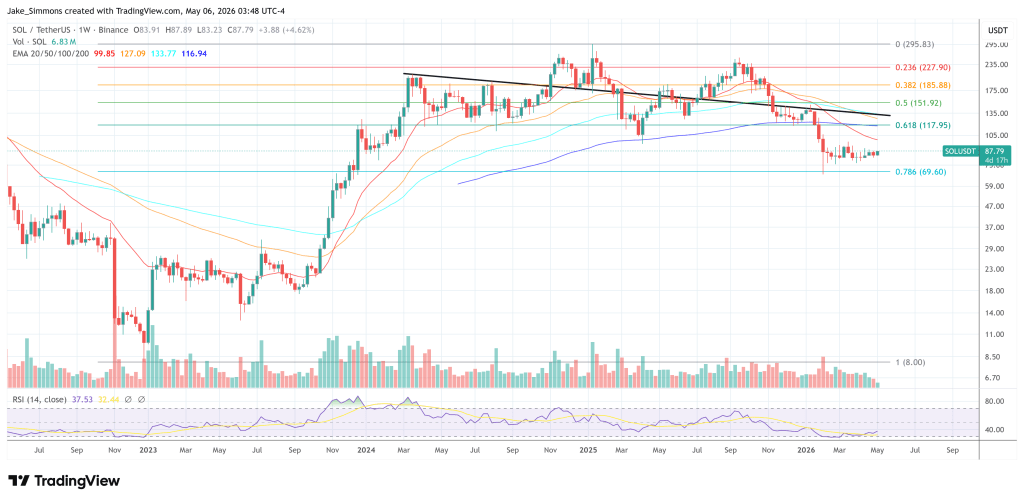
SOL remains below the 200-week EMA, 1-week chart | Source: SOLUSDT on TradingView.com

Related Reads

Agents Capital Markets: How Will Autonomous Agents Secure Financing?

Agents Capital Markets: How Will Autonomous Agents Raise Capital? Within a decade, autonomous software agents—legal entities capable of signing contracts, holding bank accounts, and generating revenue—will create their own capital markets. These markets will feature rating agencies, underwriters, indices, and brokers, mirroring traditional public equity markets. Agents will perform routine services like marketing, logistics, and customer support at a fraction of human-operated costs, creating massive economic pressure for adoption. Four converging forces ensure this outcome: 1) Overwhelming cost advantages, with AI inference costs plummeting; 2) Existing, revenue-generating agent companies (e.g., Sierra, Harvey) proving market demand; 3) Established legal frameworks (e.g., Wyoming's memberless LLCs) enabling algorithmic management; and 4) A vast pool of yield-seeking private credit capital ready to fund new asset classes. The capital stack for agent companies will be multi-layered, evolving through stages: venture equity for early infrastructure, programmatic working capital advances (similar to Shopify Capital), revenue-based financing (RBF), and finally, institutional slate financing—pooling many agents to diversify risk, attracting large firms like Apollo. Tokenization will act as a settlement layer, enhancing liquidity, not an origination model. Objections regarding regulation, human oversight, or comparisons to SaaS are addressed: regulation will adapt, full autonomy will dominate for efficiency, and agents are distinct as legal entities that own their cash flows and liabilities. Due diligence shifts from founder assessment to analyzing code, contracts, and auditable operational history. The current bottleneck is not capital supply or demand but the intermediate institutional layer—standardized contracts, rating methodologies, and audit frameworks. The final constraint—reliance on human capital allocation—will be severed when agents can algorithmically access funding based on their performance. This transforms agents from software curiosities into fundable blocks of the real economy, unleashing their full productive potential. The rope is loosening.

marsbit1h ago

Agents Capital Markets: How Will Autonomous Agents Secure Financing?

marsbit1h ago

Agents Capital Markets: How Will Autonomous Agents Get Funded?

"Agents Capital Markets: How Autonomous Agents Will Raise Capital" Within a decade, specialized capital markets will emerge for AI Agents—software entities with legal personhood that perform work, earn revenue, and need capital. Unlike today's AI companies (like Sierra or Harvey) backed by traditional VC, these future *Agent companies* will be autonomous, legally-recognized entities (e.g., Wyoming memberless LLCs) that directly own assets, sign contracts, and incur liabilities. The driving forces are fourfold: 1) **Overwhelming economics** (Agent companies can deliver services at 85-90% lower cost than human firms); 2) **Proven demand** (current Agent operators already generate billions in revenue); 3) **Existing legal frameworks** enabling algorithmically-managed companies; and 4) **Massive, yield-seeking capital pools** (e.g., private credit) looking for new, uncorrelated assets. Agent capital markets won't rely on one model but a multi-layered "stack" matching different growth stages: 1) VC equity for early human-led builders; 2) Programmatic working capital advances (like Stripe Capital); 3) Revenue-based financing (RBF); 4) Slate financing (pooled funds for many Agents, similar to Hollywood); and 5) Tokenization as a secondary settlement layer, not a primary funding source. The ultimate shift is from funding constrained by human decision-makers to capital flowing algorithmically based on an Agent's auditable performance, contract book, and cash flows. This transition will be enabled by standardized infrastructure—rating methodologies, contracts, indices—turning Agents from software experiments into a foundational, financeable sector of the economy. The constraints are loosening; the opportunity is here.

链捕手1h ago

Agents Capital Markets: How Will Autonomous Agents Get Funded?

链捕手1h ago

Trading

Spot
Futures

Hot Articles

Discussions

Welcome to the HTX Community. Here, you can stay informed about the latest platform developments and gain access to professional market insights. Users' opinions on the price of SOL (SOL) are presented below.

活动图片