Shiba Inu May Run 25x Again, Yet Ozak AI’s 2026 Outlook Looks Far More Explosive

TheNewsCryptoPublished on 2025-12-14Last updated on 2025-12-14

Abstract

Analysts project Shiba Inu (SHIB) could surge 20x–25x in the upcoming bull cycle, supported by strong community engagement and technical accumulation patterns. However, Ozak AI (OZ) is gaining more attention for its advanced real-time AI intelligence engine, featuring millisecond predictive models, autonomous multi-chain agents, and cross-chain analytics. Already operational with over $4.9 million raised in its presale, Ozak AI’s self-improving technology and data-driven approach lead analysts to forecast a 50x–100x growth trajectory by 2026, positioning it as a high-potential AI-crypto investment with lower early-stage risk compared to meme-driven assets like SHIB.

Crypto market excitement continues rising as Shiba Inu shows one of the cleanest accumulation structures among major meme assets, with analysts projecting the possibility of another 20x–25x surge during the upcoming bull cycle. SHIB’s strong community energy, expanding ecosystem, and recurring viral momentum place it firmly on the list of high-upside meme tokens for 2025.

Yet while SHIB’s potential remains impressive, the project generating far more analyst attention—and far more explosive long-term forecasts — is Ozak AI (OZ), the real-time AI intelligence engine already operating with millisecond predictive models, autonomous multi-chain agents, and cross-chain analytics. Its 2026 outlook suggests a growth curve far steeper than SHIB’s, positioning Ozak AI as one of the strongest exponential ROI opportunities of the next cycle.

Shiba Inu (SHIB)

Shiba Inu trades near $0.000008498 and continues forming a strong multi-layer support base that historically precedes sharp meme-driven expansions. Support at $0.000008320 stabilizes immediate price action, while deeper foundations at $0.000008120 and $0.000007900 reinforce the long-term macro trend.
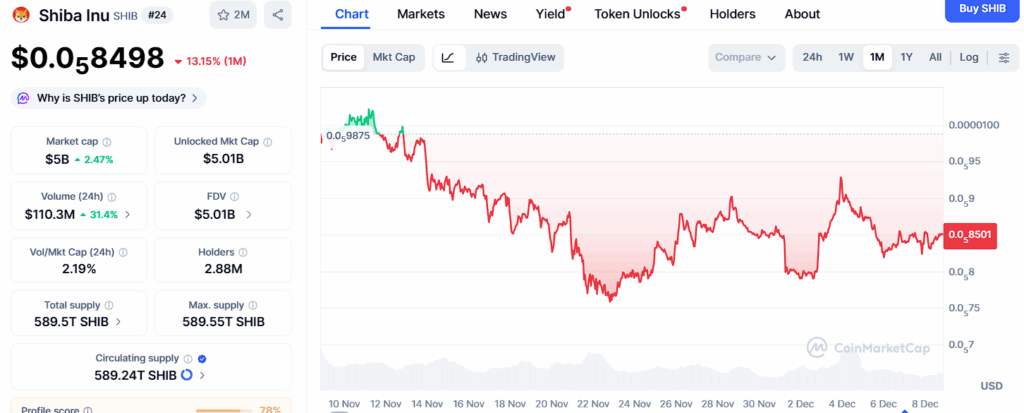
SHIB begins generating bullish continuation pressure as it approaches resistance at $0.000008740, followed by higher challenge zones at $0.000008960 and $0.000009240 — classic breakout regions that have triggered explosive upside during previous cycles.

This setup supports the possibility of another major SHIB rally, but analysts highlight that meme coins ultimately rely on social sentiment, not functional utility. Ozak AI represents the opposite model: value generated through intelligence, real-time performance, and evolving cross-chain capability.

Ozak AI (OZ)

Ozak AI’s rapid rise in analyst forecasts is driven by one defining advantage — its technology is already active before launch. Its intelligence engine analyzes blockchain conditions in milliseconds, interpreting liquidity shifts, volatility patterns, and market activity with precision. HIVE’s 30 ms execution-grade signals feed high-resolution predictive data directly into the core system, while SINT-powered autonomous agents scan multiple chains and adjust strategies instantly.

Perceptron Network’s 700K+ node architecture strengthens this even further, giving Ozak AI true multi-chain visibility and constant data inflow. As more data passes through the system, Ozak AI becomes smarter, faster, and more accurate—a self-improving intelligence cycle that compounds its long-term valuation potential. This intelligence-driven evolution is why analysts position Ozak AI for a 50x–100x trajectory by 2026, far surpassing even the strongest SHIB projections.

Ozak AI Presale

The Ozak AI Presale surpassing $4.9 million signals a rare level of early conviction among both retail investors and strategic buyers. Unlike typical presales that depend on future development, Ozak AI enters the market with real, functioning infrastructure. This dramatically lowers early-stage risk and increases long-term adoption potential.
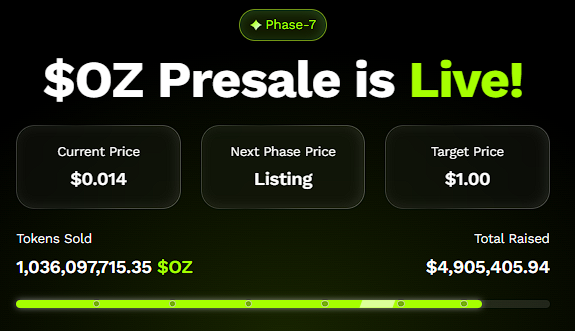
Investors who successfully captured early exponential gains in previous cycles—from LINK to MATIC to SOL — are now rotating early into Ozak AI, citing its intelligence-first architecture and low entry valuation as catalysts for massive future returns. SHIB remains a strong meme asset, but Ozak AI is increasingly viewed as a technological cornerstone for the emerging AI-crypto convergence.

Ozak AI Leads the 2026 Explosive Forecast

Shiba Inu may still deliver a major 25x rally, and history suggests SHIB is capable of spectacular cycle peaks. Its structure supports this, and its community remains one of the most powerful forces in crypto.

But Ozak AI operates on a completely different trajectory — one shaped by real-time intelligence, cross-chain predictive capability, autonomous AI agents, and compounding learning models that improve continuously. SHIB grows through hype. Ozak AI grows through intelligence.

This distinction is why analysts overwhelmingly favor Ozak AI for the strongest explosive potential heading into 2026. As the market prepares for the next wave of AI-driven expansion, Ozak AI is emerging as the project most likely to generate life-changing returns — far outpacing even a powerful SHIB rally.

About Ozak AI

Ozak AI is a blockchain-based crypto project that provides a technology platform that specializes in predictive AI and advanced data analytics for financial markets. Through machine learning algorithms and decentralized network technologies, Ozak AI enables real-time, accurate, and actionable insights to help crypto enthusiasts and businesses make the correct decisions.

For more, visit:

  • Website: https://ozak.ai/
  • Telegram: https://t.me/OzakAGI
  • Twitter: https://x.com/ozakagi

Disclaimer: TheNewsCrypto does not endorse any content on this page. The content depicted in this Press Release does not represent any investment advice. TheNewsCrypto recommends our readers to make decisions based on their own research. TheNewsCrypto is not accountable for any damage or loss related to content, products, or services stated in this Press Release.


TagsCryptocurrencyOzak AIShiba Inu

Trending Cryptos

Related Reads

Li Fei-Fei's Latest Long-Form Article: When Video Generation, Robotics, and NVIDIA All Call Themselves World Models, We Need a Taxonomy

In a new article, Dr. Fei-Fei Li addresses the widespread and often inconsistent use of the term "world model" in AI. She proposes a clear, functional taxonomy rooted in the classic Partially Observable Markov Decision Process (POMDP) loop (agent → action → state → observation → agent). According to this framework, current systems called "world models" are different projections of this loop, categorized by their primary output: 1. **Renderers**: Output observations (pixels). Their goal is visual fidelity for human consumption (e.g., video generation models like Sora). They are the most commercially mature but are limited by a focus on appearance over physical accuracy. 2. **Simulators**: Output states (geometric, physical, dynamic representations). They provide a structurally accurate world for both human professionals (e.g., architects) and computational agents (e.g., robots for training). Li argues simulators are the crucial, underappreciated bridge, as they can underpin both rendering and planning. 3. **Planners**: Output actions. Given an observation and a goal, they decide what an agent should do next (e.g., robotic action models). This area is highly promising but remains the least mature for real-world deployment. Li highlights a key trend: the boundaries between these three categories are beginning to blur, as they all rely on a shared underlying understanding of geometry, physics, and dynamics. The logical endpoint is a unified world foundation model capable of switching between rendering, simulation, and planning based on downstream needs. This convergence, she concludes, is central to advancing spatial intelligence—enabling machines not just to talk about the world, but to truly understand, imagine, and interact with it.

marsbit1h ago

Li Fei-Fei's Latest Long-Form Article: When Video Generation, Robotics, and NVIDIA All Call Themselves World Models, We Need a Taxonomy

marsbit1h ago

Forbes Feature: Stablecoin Cross-Border Payments Are Faster, But Not Yet Cheaper

A Forbes feature delves into the state of stablecoin-based cross-border payments, noting rapid growth but a key shortfall: while faster and more accessible, they are not yet cheaper. At a recent industry conference in Mexico City, optimism about technology, regulation, and volume was tempered by discussions with practitioners. The core issue is liquidity. Traditional FX brokers charge 60-70 basis points, and stablecoins promise to slash this to 2-5 basis points. However, this theoretical cost advantage cannot be realized until deep liquidity pools are established at scale, requiring significant institutional capital inflow. A major adoption barrier is trust. Businesses often rely on long-standing relationships with traditional brokers, valuing reliability over marginal cost savings. This shift will be gradual. Furthermore, successful companies in the space are not positioning themselves as replacements for legacy systems like SWIFT, but as complements. They leverage stablecoins for speed while using traditional rails for their standardization and reliability in ensuring accurate payment details—a critical factor for supplier payments to avoid customs issues. Companies like Caliza, experiencing high monthly growth, exemplify this hybrid approach. The industry anticipates consolidation, as long-term viability will depend on securing the essential trifecta: proper licensing, robust fiat on/off-ramps, and deep liquidity. Without these, firms risk being mere intermediaries rather than building sustainable businesses.

marsbit1h ago

Forbes Feature: Stablecoin Cross-Border Payments Are Faster, But Not Yet Cheaper

marsbit1h ago

Li Feifei's Latest Article: When Video Generation, Robotics, and NVIDIA All Claim to Have 'World Models,' We Need a Taxonomy

"World Model" has become a widely used yet ambiguous term in AI. Drawing from the classic POMDP framework (agent → action → state → observation), this article proposes a functional taxonomy to clarify the concept. It identifies three distinct types, categorized by their output in the perception-action loop: 1. **Renderers**: Output visual observations (pixels). These models, like advanced video generators, prioritize visual fidelity but often lack underlying physical accuracy. 2. **Simulators**: Output the state of the world (geometry, physics, dynamics). They provide a structurally accurate representation for professionals (e.g., architects) and serve as training environments for robots and AI agents. 3. **Planners**: Output actions. Given an observation and a goal, they determine what an agent should do next, closing the perception-action loop (e.g., vision-language-action models). While renderers are currently the most commercially mature and planners are the most aspirational, the article argues that **simulators are the crucial, underappreciated hub**. By working at the level of geometry and physics, a simulator can project upwards to create visuals for humans and downwards to predict action consequences for agents. The future lies in the convergence of these three functions. Emerging research and products, like World Labs' Marble model which outputs both visual splats and physical collision meshes, are beginning to blur these boundaries. The logical endpoint is a unified world foundation model capable of rendering, simulating, and planning based on a shared understanding of spatial and temporal structures—ultimately enabling machines to understand, imagine, and interact with the physical world.

链捕手2h ago

Li Feifei's Latest Article: When Video Generation, Robotics, and NVIDIA All Claim to Have 'World Models,' We Need a Taxonomy

链捕手2h ago

Trading

Spot

Hot Articles

Discussions

Welcome to the HTX Community. Here, you can stay informed about the latest platform developments and gain access to professional market insights. Users' opinions on the price of S (S) are presented below.

活动图片