SharpLink CEO: How to Understand Ethereum Developers Just Exceeded 1 Million?

链捕手Published on 2026-06-16Last updated on 2026-06-16

Abstract

SharpLink CEO reflects on the milestone of Ethereum surpassing 1 million historical developers, emphasizing that this figure represents the largest pool of technical talent ever assembled around an open, permissionless blockchain network. While approximately 232,000 developers remain active, the key question for the crypto industry is not which chain is fastest, but where the best builders choose to build long-term. Ethereum's advantage lies in a decade-long accumulation of infrastructure, standards, tools, liquidity, and a cohesive culture, making it the default operating system for programmable finance. This developer base is tackling complex challenges: the Glamsterdam upgrade aims to enhance scalability while preserving core principles; synchronous composability seeks to unify Rollup ecosystems; and significant efforts are underway for post-quantum security. Ethereum's deeper network effects stem from composability and shared standards (like the EVM and Solidity), creating a flywheel of more developers, tools, and liquidity. Three reinforcing strengths cement Ethereum's lead: credible neutrality (secured by ~900k validators), a modular architecture with interconnected Rollups, and a culture that attracts top researchers. The ecosystem is consolidating as the trusted coordination layer for internet-native finance, favored by large institutions valuing security and liquidity. The future of Ethereum is being built by this global community of founders and architects.

Author: Joseph Chalom

Compiled by: Jiahuan, ChainCatcher

I just returned from Asia, where I spent time with Ethereum developers and ecosystem leaders. Special thanks to Nonce Classic, Four Pillars, and DSRV in Seoul, our friends at SNZ, and the recently opened Ethereum Community Center in Hong Kong. This center is Asia's first long-term operational physical Ethereum community space, supported by the Ethereum Foundation.

What impressed me most was not just the vibrancy, but also the rigor and ambition of the builders there. The high-caliber projects, experimental spirit, and long-term thinking emerging from the global Ethereum ecosystem were truly inspiring.

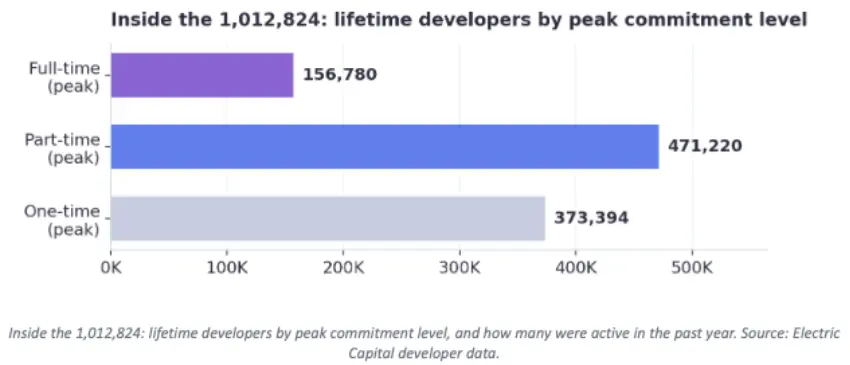
This also brought a number to life: data from Electric Capital shows that the total number of historical Ethereum developers has now exceeded one million, with 1,012,824 individuals having contributed to the ecosystem. No other ecosystem in crypto can compare.

A Milestone Worth Noting

One million is a round number, and round numbers can sometimes feel hollow. But this one is not. It represents the largest pool of technical talent ever assembled around an open, permissionless blockchain network. More importantly, this talent pool continues to deepen and widen.

Of this one million developers, approximately 232,000 remained active over the past twelve months.
Why Ethereum: The Real Important Question

For years, crypto discussions have revolved around speed, fees, and throughput. Every new chain claims to be "faster than Ethereum." But the core question in crypto has never been which chain is the fastest, but another:

"Where will the most skilled builders choose to build long-term?"

On this issue, Ethereum maintains a clear advantage. This advantage is not just technical; it's institutional, cultural, economic, and structural—the result of a decade of accumulation of developers, infrastructure, standards, tools, liquidity, research, applications, and social coordination that no other ecosystem can replicate.

Ethereum has become the default operating system for programmable finance and internet-native capital formation.

What Are These Million Builders Constructing, and Why It Reinforces the Moat

The significance of these million builders lies in what they are doing *right now*. The current focus is on the hardest, highest-stakes problems in the industry: core protocol scalability, privacy, quantum resistance, and the autonomous agent systems that will run on top of it.

Glamsterdam Upgrade: Innovating Without Breaking Core Principles. The Glamsterdam upgrade, expected in 2026, demonstrates how Ethereum progresses while holding firm to its core values. Core changes include enshrined proposer-builder separation (ePBS) and block-level access lists (BALs), unlocking parallel execution and higher throughput, and the potential to raise the gas limit, significantly increasing Layer 1 capacity.

Scaling for future demand while defending credibly neutral trust, security, and MEV fairness is itself an evolving moat.

Synchronous Composability: Making Many Rollups Feel Like One Chain. Composability has always been Ethereum's superpower; the next leap is extending it to Layer 2. Native Rollups and Based Rollups, combined with synchronous composability, address this. A contract on one rollup can call a contract on Mainnet or another rollup in a single atomic transaction—no bridges, no waiting.

Linea, Ethereum Economic Zone, Gnosis, Zisk, and the Ethereum Foundation are collaborating to combine this design with real-time proofs. The result is that dozens of rollups no longer operate like isolated networks but begin to function like a unified chain. This is a direct response to fragmentation criticism.

Quantum Resistance: Ethereum's Most Obvious Lead. No other mainstream ecosystem is more prepared for the post-quantum era. The "Lean Ethereum" roadmap, the Ethereum Foundation's Post-Quantum Security team established in early 2026, pq.ethereum.org, and over a dozen client teams already running weekly post-quantum interoperability devnets constitute a coordinated, open-source migration targeting completion around 2029.

When quantum risk becomes a reality, institutions hosting trillions of dollars in assets will care about one thing: which chain was prepared earliest and most thoroughly.

Moat Beyond Developers: Composability, Standards, and Trust

The concentration of developer talent compounds because of how Ethereum itself is built. Its deepest network effect is not liquidity, but the depth of composability: applications function like interoperable financial Lego bricks.

Lending, stablecoins, exchanges, wallets, tokenized assets, oracles, and Layer 2 rollups all interact through shared standards; developers never have to start from scratch. The EVM is crypto's application layer, and Solidity skills are transferable to Base, Arbitrum, Optimism, Polygon, zkSync, Scroll, Linea, and hundreds of other networks.

Learning the Ethereum tech stack maximizes optionality, which drives a flywheel effect: more developers, more tools, more liquidity, more institutions, which in turn attracts more developers to build composable protocols and assets. Liquidity begets liquidity, composability begets composability.
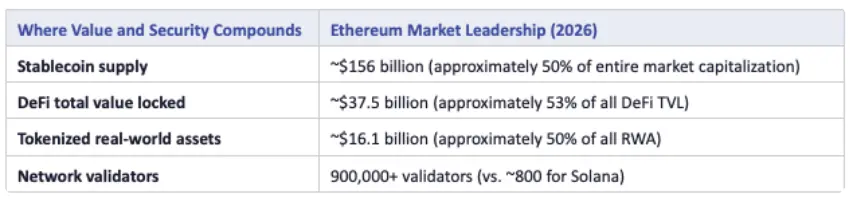
Moreover, Ethereum dominates where real value settles, not just where the loudest noise is made:

Three forces reinforce this lead.

Credible Neutrality: Ethereum is secured by over 900,000 validators, while Solana has around 800. Large institutions place immense value on this level of decentralization and platform neutrality.

Modularity: Rollups like Base, Arbitrum, and Optimism are not fragmenting Ethereum; they are expanding it into an increasingly interconnected modular internet economy that inherits Mainnet's security.

Culture: Ethereum attracts top researchers, cryptographers, and EIP standards authors far beyond any other ecosystem, setting the direction for the entire industry. This is perhaps the hardest advantage for other ecosystems to replicate.

There is Only One Ethereum

There's a fundamental difference between generating on-chain activity and being the long-term coordination layer for internet-native finance. The latter means being the layer trusted by the world's largest financial institutions.

Ethereum has firmly captured the mindshare of major asset holders, institutions that value trust, security, and liquidity above all. I saw this firsthand from the front row during my tenure at BlackRock.

In technology markets, ecosystems consolidate over time around standards, liquidity, and developer attention. This is Ethereum's moat.

After meeting these developers, builders, and ecosystem leaders in Seoul and Hong Kong, I am more convinced than ever of Ethereum's competitive advantage. I met the talent building the next generation of financial infrastructure—the founders and architects of our industry's future and agentic finance. These are the people and teams that will change the world.

Ethereum's future is happening now.

Trending Cryptos

Related Questions

QAccording to the SharpLink CEO, what makes the milestone of 1 million historical Ethereum developers significant, beyond just being a large number?

AIt represents the largest technical talent pool ever assembled around an open, permissionless blockchain network. This talent pool is not only vast but also continues to deepen and broaden in expertise and scope.

QIn the CEO's view, what is the most fundamental question for the crypto industry, and what is the current answer to it?

AThe most fundamental question is not which chain is the fastest, but: 'Where will the best builders choose to build for the long term?' The clear answer, according to the article, is Ethereum.

QWhat three key technical frontiers is the article's author most impressed that Ethereum's developer community is tackling?

AThe author highlights three key areas: 1) Core protocol scalability, privacy, and MEV fairness through upgrades like Glamsterdam; 2) Achieving synchronized composability across multiple rollups; and 3) Preparing for post-quantum security through a coordinated, long-term roadmap.

QWhat does the author identify as the deepest network effect of Ethereum that goes beyond just developer count?

AThe deepest network effect is the depth of composability. Applications can interact like interoperable financial Lego bricks, thanks to shared standards like the EVM. This allows developers to build on existing infrastructure without starting from scratch, creating a powerful compounding effect.

QWhat three specific forces does the author argue are strengthening Ethereum's leading position, particularly for large institutions?

AThe three forces are: 1) Credible Neutrality, secured by a highly decentralized network of validators; 2) A Modular architecture where L2 rollups expand rather than fragment the ecosystem; and 3) A deeply ingrained Culture that attracts top researchers and standard-setters, which is the hardest advantage for competitors to replicate.

Related Reads

Ethereum's 11th Year: Why Is This Year Particularly Crucial?

Ethereum's 11th year proved pivotal, marked by a dual evolution in its technical roadmap and organizational structure. The year saw the completion of the Fusaka upgrade, introducing PeerDAS to make data availability sampling more efficient and laying groundwork for future L2 scaling. This was followed by a significant reorganization of the Ethereum Foundation (EF). The EF downsized, redefining its core mandate around user sovereignty and CROPS principles, while spinning off key functions. Independent entities like Ethlabs (non-profit R&D), Ethereum Institutional (institutional onboarding), and EthSystems (institutional privacy solutions) now operate separately. Technologically, the community debated a bold, long-term vision outlined in Justin Drake's "Lean Ethereum" proposal and the collaborative "Strawmap." These point toward a "third major iteration" for Ethereum, targeting goals like faster finality (~1 second), gigagas-scale L1 throughput, teragas-scale L2 capacity, post-quantum cryptography, and protocol-level privacy. Data underscores Ethereum's dominant position: its L1 still holds roughly half of all stablecoin value, leads in tokenized Real-World Assets (RWA), and commands over 55% of total DeFi TVL. While L2s now handle over 10x more transactions than the mainnet, high-value assets remain concentrated on L1. The launch of Robinhood Chain, an EVM-compatible L2 for stock tokens, signals growing institutional adoption. The immediate roadmap includes the Glamsterdam upgrade (featuring ePBS for in-protocol proposer-builder separation and Block Access Lists for parallelism), potentially followed by Hegotá focusing on anti-censorship via FOCIL. In summary, Ethereum's 11th year was defined by setting ambitious technical foundations for its next decade and restructuring its core development ecosystem to be more modular and sustainable, all while maintaining its role as the leading settlement layer for decentralized finance and assets.

marsbit1m ago

Ethereum's 11th Year: Why Is This Year Particularly Crucial?

marsbit1m ago

Notable Forecast from an Analytical Company Regarding Bitcoin (BTC): After This Date, a New Bull Season Could Begin!

Bitcoin continues to trade sideways around $64,000 amid ongoing uncertainty regarding U.S. monetary policy and geopolitical risks in the Middle East. As BTC struggles for direction, an analyst predicts the next major uptrend could commence after the U.S. midterm elections. João Wedson, founder and CEO of crypto analytics firm Alphractal, revisited the connection between Bitcoin's price movements and the U.S. election calendar in his latest analysis. Wedson claims that analyzing past market cycles reveals similar patterns in Bitcoin's price behavior, particularly around U.S. midterm and presidential elections. Historically, Bitcoin has faced headwinds leading up to midterms but tends to recover once election-related uncertainty subsides. Based on historical data, Bitcoin entered bear markets roughly a year before past midterm elections, only to initiate prolonged bull markets after the elections concluded. In some cycles, price bottoms formed just days before the vote, while in others, the low occurred immediately after. The analyst also noted presidential elections have a distinct impact: Bitcoin experiences strong rallies each time a president wins re-election and approaches the peak of its main cycle shortly after the presidential inauguration. As an example, Wedson pointed to XRP, which began a sharp rise on the day Donald Trump won the 2024 election and reached a local peak on January 20, 2025, his inauguration day.

cryptonews.ru16m ago

Notable Forecast from an Analytical Company Regarding Bitcoin (BTC): After This Date, a New Bull Season Could Begin!

cryptonews.ru16m ago

Lummis: The CLARITY Act mechanism "is not working" as the Senate drags its feet

U.S. Senator Cynthia Lummis has argued that the current regulatory framework for digital assets is inadequate, harming industry, investors, and regulators alike. She is urgently pushing for the Senate to pass the Digital Asset Market Clarity Act (H.R. 3633/CLARITY Act) before the August recess, warning the current momentum for the bill is a unique opportunity this decade. The legislation aims to divide oversight between the SEC and CFTC. Time is running out, as the Senate must act before its August 8th recess. Delays would push the debate to September, further squeezing the legislative calendar before the midterm elections. Forecasting platforms now estimate only a 30% chance of the bill becoming law in 2026, a sharp drop from over 80% in February. Passage requires 60 votes, meaning at least seven Democrats must join Republicans, a task complicated by Democratic opposition. Key objections from figures like Senator Elizabeth Warren center on concerns the bill could weaken oversight of decentralized finance (DeFi) and consumer protection, potentially endangering the financial system. Over 200 crypto industry organizations, including Coinbase and Ripple, are lobbying for a vote, arguing continued uncertainty drives innovation and jobs overseas. Lummis contends the bill's custody and disclosure rules are precisely the consumer protections needed to close existing loopholes. The bill's fate now hinges on whether Senate Majority Leader John Thune schedules a vote this week or delays it until the fall session, where it would face an even more constrained political environment.

cryptonews.ru16m ago

Lummis: The CLARITY Act mechanism "is not working" as the Senate drags its feet

cryptonews.ru16m ago

Trading

Spot

Hot Articles

Discussions

Welcome to the HTX Community. Here, you can stay informed about the latest platform developments and gain access to professional market insights. Users' opinions on the price of ETH (ETH) are presented below.

活动图片