Serenity: LeaderDrive, the "Chinese Core" in the Robotics Race

marsbitPublished on 2026-06-08Last updated on 2026-06-08

Abstract

The author argues that LeaderDrive (688017) is a uniquely attractive investment in China's robotics sector as a high-barrier components leader, distinct from low-margin assemblers or low-value part makers. It is highlighted by Western institutions like Goldman Sachs for its technical expertise in areas like harmonic reducers and its potential to capture a high bill-of-materials cost per humanoid robot, including components like planetary roller screws. The investment thesis covers high-entry-barrier parts, significant value per unit, and low-cost mass-production capability. Key risks include competition from other emerging Chinese firms and potential margin compression from mass production. However, the author believes non-Chinese companies cannot match China's low-cost production scale, predicting a bifurcated supply chain: cheap robots from China and costly ones from the West. The current valuation may seem high, but the author views it through the lens of the future massive TAM for humanoid robots, with predictions of millions of units annually. The long-term investment case is that LeaderDrive's current market cap will appear small if it captures substantial share in the exponentially growing humanoid robotics market over the next 3-5 years. This is presented as a long-term hold, not a short-term trade.

Author: Serenity

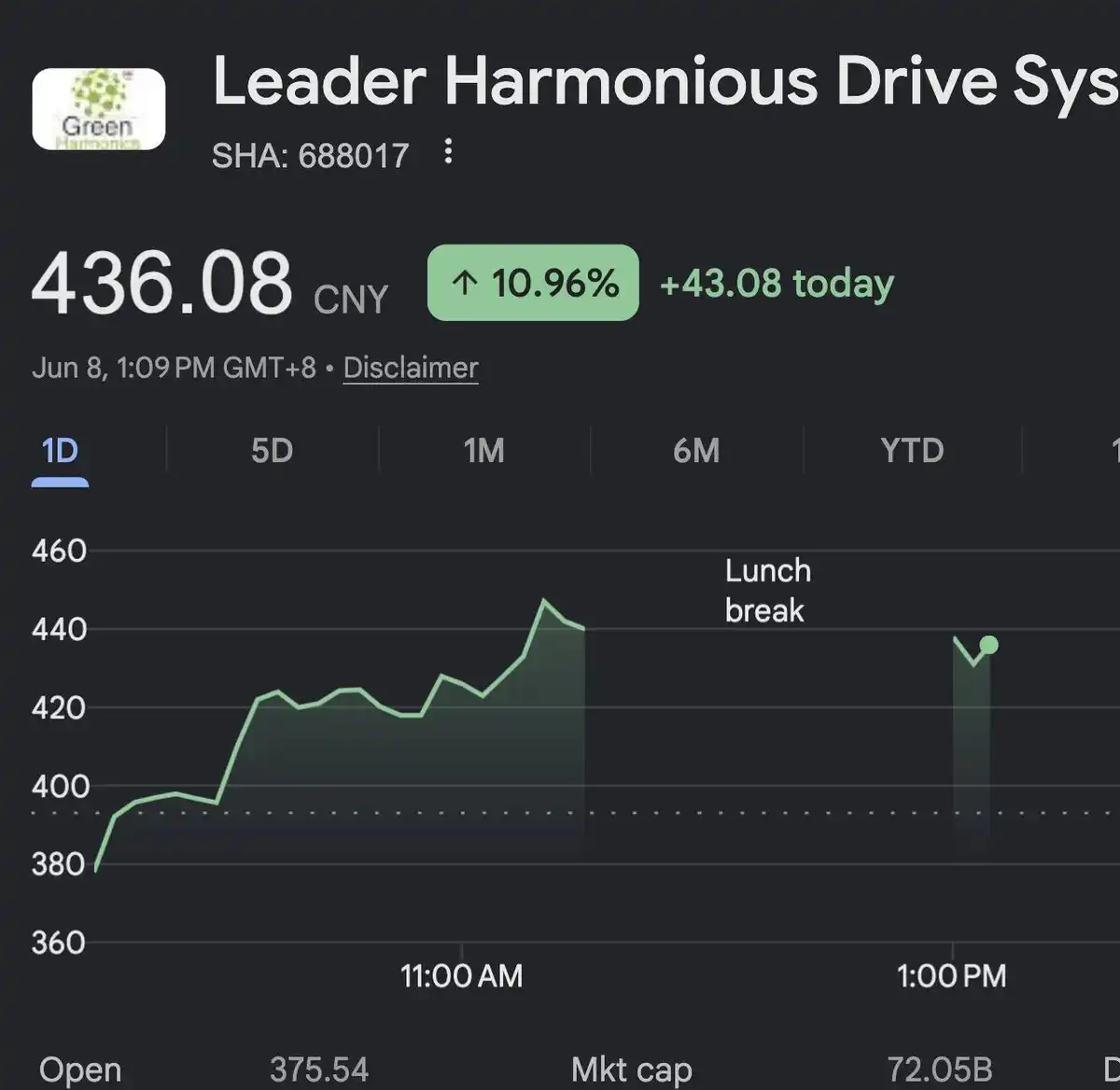
I do believe LeaderDrive (688017) is an outstanding component leader in the Chinese robotics industry.

I have done extensive research on other robotics targets / $TSLA Optimus suppliers, but LeaderDrive is extremely unique.

Compared to other companies engaged in low-margin assembly or low-value components, the latter also faces higher risks of design obsolescence.

Western institutions like Goldman Sachs Research have repeatedly named LeaderDrive:

-> As a company with high technological barriers (e.g., harmonic reducers).

-> And as one likely to capture the cost of high-value components like planetary roller screws per humanoid robot produced.

In simpler terms, by investing in LeaderDrive, you cover:

1. A variety of different components with high entry barriers.

2. High BOM per humanoid robot if they are combined.

3. Low-cost, large-scale production capability.

For every humanoid robot produced.

Do your own research on this topic before making any decisions; but in the long run, if you believe in the growth of the humanoid robotics industry: I find LeaderDrive (688017) very attractive.

The main risks come from other emerging Chinese companies capturing market share in different individual components.

And from large-scale production profits declining over time; just like $VPG's sensors dropped from $750 in the early pre-production stage to $150.

But overall, I don't believe companies outside China like Harmonic Drive (6324) can achieve the same large-scale production costs, which is why $TSLA Optimus is building a broad supply chain from China.

Therefore, we are likely to see a bifurcation in the supply chain: cheap, mass-produced $15k-$20k humanoid robots from the Chinese supply chain, and high-cost humanoid robots from Western supply chains.

Again, if you look at the current P/E ratio and think it's high; a lot of the misunderstanding comes from not seeing future growth:

There is no mass production yet. AGIbot recently achieved a production run of 10,000 units in March.

But over the next 3-5 years, the TAM for the humanoid robot/robotics industry as forecast by Elon Musk and others is enormous, if he expects to produce millions of humanoid robots annually.

Thus, my expectation is that the current $10.65 billion market cap will appear very small in retrospect, as LeaderDrive captures its share of the overall robotics market.

So I think arguments like this shouldn't be measured with a short-term timeframe (or people shouldn't actively trade a target like this).

Instead, this is more of a long-term investment thesis about how this company can capture a material share of the overall humanoid robotics market, which is expected to grow exponentially in the coming years.
Trending Cryptos

Related Questions

QWhat are the key reasons the author finds LeaderDrive (688017) to be a unique and attractive investment in the robotics industry?

AThe author highlights three main reasons: 1) LeaderDrive produces high-barrier-to-entry, high-value components like harmonic reducers and planetary roller screws, which capture a significant portion of a robot's Bill of Materials (BOM). 2) It possesses low-cost, large-scale manufacturing capabilities. 3) Its position as a likely key supplier to Chinese supply chains, which are expected to produce low-cost humanoid robots, gives it a competitive advantage over non-Chinese companies.

QAccording to the article, what are the primary risks associated with investing in LeaderDrive?

AThe primary risks identified are: 1) Competition from other emerging Chinese companies that could capture market share in individual component segments. 2) The potential for profit margins to decline over time due to mass production, similar to price reductions seen in other sensor components. The author does not see non-Chinese competitors like Harmonic Drive (6324) as a major risk due to their higher production costs.

QHow does the author justify LeaderDrive's current valuation and suggest investors should view the investment?

AThe author argues that the current high P/E ratio and valuation (10.65 billion USD market cap) are misunderstood if one does not consider future growth. Since mass production of humanoid robots hasn't begun at scale yet, the author believes the company's market share in the exponentially growing humanoid robot market (predicted to be millions of units annually) will make the current valuation seem small in retrospect. Therefore, it should be viewed as a long-term investment thesis, not traded actively based on short-term timeframes.

QWhat does the author predict about the future structure of the humanoid robot supply chain?

AThe author predicts a bifurcation (split) in the supply chain: low-cost humanoid robots (priced around $15k-$20k) will be produced from Chinese supply chains, while higher-cost humanoid robots will come from Western supply chains. This is because Chinese companies like LeaderDrive can achieve lower mass-production costs.

QWhich specific high-value components does the article mention LeaderDrive provides that are critical for humanoid robots?

AThe article specifically mentions harmonic reducers (harmonic drive) and planetary roller screws as the high-value, high-barrier-to-entry components that LeaderDrive produces, which are expected to capture a significant cost portion of each humanoid robot's Bill of Materials (BOM).

Related Reads

Navigating the World of Event Trading: Top 5 Prediction Markets for Every Type of User

The prediction market industry has grown significantly, with trading volumes exceeding $20 billion monthly by mid-2026, driven by sports, politics, and macroeconomics. Success now depends heavily on platform choice and execution logistics. This guide compares five leading networks: **Polymarket**: A high-volume, decentralized platform on Polygon, using USDC for international and crypto-native users. It offers diverse markets but lacks built-in risk tools. **Kalshi**: A CFTC-regulated U.S. exchange for institutional traders, using direct fiat. It leads in regulated volume, especially for major sports and economic events, but has limited contract listings. **Outpoll**: A CeDeFi platform for advanced traders, focusing on professional tools. It uniquely features built-in stop-loss/take-profit orders, 0.1% fees, and full API support, with settlement in USDC. **OG Predictive**: A CFTC-regulated, sports-focused platform from Crypto.com. It offers granular player props and a flat fee structure, appealing to long-term position traders. **Manifold Markets**: A play-money, no-KYC platform for casual users and developers. It allows user-generated markets on any topic with zero fees, serving as a sandbox for strategy testing. Key differentiators include regulatory models (regulated vs. decentralized), funding (fiat vs. crypto), order types, risk management features, API access, and mobile support. The conclusion emphasizes that in today's event trading, profitability hinges not just on accurate predictions but on optimizing execution through platform infrastructure, liquidity, fees, and risk tools.

TheNewsCrypto35m ago

Navigating the World of Event Trading: Top 5 Prediction Markets for Every Type of User

TheNewsCrypto35m ago

Why Are Large-Scale Crypto Conferences No Longer Glamorous?

Why Are Major Crypto Conferences Losing Their Allure? A growing sense of fatigue surrounds large in-person crypto conferences, with many founders and investors now avoiding events they would never have missed just two years ago. While complaints cite declining ROI and information quality, the root causes are more structural. Crypto, global from inception, once relied on these mega-conferences as neutral hubs for essential face-to-face connections. However, their core value has been fragmented. High-quality participants—developers, investors—have largely migrated to smaller, private side-events, leaving main stages for repetitive content already shared online. The main conference often just becomes the excuse for being in the same city, with attendees scrambling between exclusive dinners and micro-events. While these intimate gatherings offer signal-rich conversations, they lose the "serendipitous encounters" of large conferences and can create insular echo chambers, especially as talent concentrates in hubs like New York. Meanwhile, invite-only, high-caliber summits are rising, offering quality and scale but at the cost of accessibility and crypto's early egalitarian ethos. This shift isn't unique to crypto; AI events in San Francisco show a similar trend. The perception of higher-value interactions drives core groups towards smaller, private settings, potentially creating a vicious cycle that drains larger events of their vitality. Yet, a more optimistic view exists. The apparent decline of crypto-centric events may signal industry maturation. Leading projects are now focused outward—on stablecoins for traditional finance, consumer-facing digital banks, or real-world assets. Crypto topics are increasingly integrated into mainstream finance and tech conferences. Just as dedicated "internet conferences" faded, dedicated crypto summits may become redundant as the technology embeds into every sector. The future likely holds far fewer large, inward-looking crypto conferences. The industry has moved past needing frequent self-congratulatory gatherings. True growth lies in engaging with the broader economy. This evolution towards private networking and mainstream integration, for better or worse, is a mark of the industry coming of age.

marsbit47m ago

Why Are Large-Scale Crypto Conferences No Longer Glamorous?

marsbit47m ago

Coin & Stock Compass: Global Listed Companies Net Sold $85.45 Million in BTC Last Week, Strategy's Dollar Reserves Scale Up to $3 Billion (July 14)

Global Public Companies Net Sell $85.45 Million in BTC; Strategy's Dollar Reserves Hit $3 Billion (July 14) Last week saw a significant net sell-off of Bitcoin by global public companies, excluding miners, totaling $85.45 million—a 908.42% decrease from the prior week. Major buyers like Strategy (formerly MicroStrategy) and Japan's Metaplanet were notably absent from the market. However, two companies, Brazil's OrangeBTC and asset manager Strive, made purchases, adding 8 and 18 BTC, respectively. The aggregate BTC holdings of tracked public companies now stand at 1,139,635 BTC, valued at approximately $71.38 billion and representing 5.7% of Bitcoin's circulating market cap. In corporate updates, Strategy announced its dollar reserves have grown by $450 million to reach $3 billion, while its BTC holdings remain at 843,775 coins. Hyperscale Data increased its BTC reserves past 1,000 coins. Strategy will report its Q2 2026 financial results on July 30. Mining firm Cleanspark added 454 BTC, bringing its total to 13,924 BTC. Conversely, BitFuFu sold 184 BTC, Bitdeer maintained zero net BTC holdings after selling its weekly production, and Empery Digital sold 1,400 BTC to fund an AI data center project and repay debt. Overall, public companies purchased 110,000 BTC in Q2 2026, 1.8 times the volume of the previous two quarters combined. In other cryptocurrency-related corporate news, Ethereum treasury company Bitmine increased its ETH holdings by 27,801 coins, with total staked ETH exceeding 4.9 million. Solana-focused company DFDV transferred daily operations of its meme coin DONT to an independent team. BNB treasury company BNB Plus was delisted from Nasdaq for failing to meet the $1 minimum bid price and moved to trade on the OTCQB market under the symbol BNBX. The broader equity markets showed mixed signals. Bank of America warned that bullish investor positioning indicated a potential pullback risk for stocks. In contrast, Morgan Stanley predicted the ongoing earnings season could broaden market gains beyond tech giants. Specific regional highlights included continued foreign investor outflows from South Korean stocks, pressure on US equities, and the upcoming IPO of Chinese memory chip maker ChangXin Memory. Most crypto-linked stocks remained in a downtrend.

marsbit1h ago

Coin & Stock Compass: Global Listed Companies Net Sold $85.45 Million in BTC Last Week, Strategy's Dollar Reserves Scale Up to $3 Billion (July 14)

marsbit1h ago

Why Are Major Crypto Conferences Losing Their Luster?

Why Are Major Crypto Conferences Losing Their Appeal? A growing sense of fatigue surrounds large-scale offline crypto conferences. Participants complain of declining returns and less substantial information, but the root cause is deeper. Initially, these global summits were vital for a decentralized industry without a physical hub, enabling crucial face-to-face connections. However, the value of large main-stage events has been eroded. High-quality developers and investors have migrated to exclusive, invitation-only side events and private dinners. While these offer focused networking, they lose the "serendipitous encounters" of larger gatherings and can create elitist barriers, contradicting crypto's open ethos. This fragmentation triggers a vicious cycle: as key people leave main events, their value diminishes further. Simultaneously, the industry's focus is shifting outward. Leading crypto firms are now engaging with traditional finance and real-world applications like stablecoins, digital banking, and prediction markets. Consequently, crypto-specific topics are increasingly integrated into mainstream financial conferences, making dedicated crypto summits potentially redundant. Looking ahead, the frequency of top-tier crypto conferences will likely decrease significantly. The industry has moved past its inward-looking phase. The migration of quality discourse to private settings and the push for mainstream adoption, while diluting the large conference model, are ultimately signs of the sector's maturation.

Foresight News1h ago

Why Are Major Crypto Conferences Losing Their Luster?

Foresight News1h ago

Trading

Spot

Hot Articles

How to Buy CORE

Welcome to HTX.com! We've made purchasing CORE (CORE) simple and convenient. Follow our step-by-step guide to embark on your crypto journey.Step 1: Create Your HTX AccountUse your email or phone number to sign up for a free account on HTX. Experience a hassle-free registration journey and unlock all features.Get My AccountStep 2: Go to Buy Crypto and Choose Your Payment MethodCredit/Debit Card: Use your Visa or Mastercard to buy CORE (CORE) instantly.Balance: Use funds from your HTX account balance to trade seamlessly.Third Parties: We've added popular payment methods such as Google Pay and Apple Pay to enhance convenience.P2P: Trade directly with other users on HTX.Over-the-Counter (OTC): We offer tailor-made services and competitive exchange rates for traders.Step 3: Store Your CORE (CORE)After purchasing your CORE (CORE), store it in your HTX account. Alternatively, you can send it elsewhere via blockchain transfer or use it to trade other cryptocurrencies.Step 4: Trade CORE (CORE)Easily trade CORE (CORE) on HTX's spot market. Simply access your account, select your trading pair, execute your trades, and monitor in real-time. We offer a user-friendly experience for both beginners and seasoned traders.

5.8k Total ViewsPublished 2024.03.29Updated 2026.06.02

How to Buy CORE

Discussions

Welcome to the HTX Community. Here, you can stay informed about the latest platform developments and gain access to professional market insights. Users' opinions on the price of CORE (CORE) are presented below.

活动图片