Senator Urges Banking Regulator To Block Crypto Charter Linked To Trump

bitcoinistPublished on 2026-01-14Last updated on 2026-01-14

Abstract

Senator Elizabeth Warren has urged the Office of the Comptroller of the Currency (OCC) to halt the review of a national trust bank charter application from World Liberty Financial, a crypto firm linked to former President Donald Trump. Warren argues that approving the charter while Trump retains financial ties could create serious ethical conflicts and undermine public trust in regulators. The firm aims to use the charter to issue and manage its dollar-pegged stablecoin, USD1, which has grown to over $3.3 billion in circulation since its launch. Other Democrats have expressed similar concerns, emphasizing the need for regulatory independence when reviewing politically connected applicants.

United States President Donald Trump’s family-backed crypto firm has applied for a national trust bank charter, and one of the Senate’s most vocal financial critics wants regulators to stop the process until the President severs his financial ties to the venture.

According to filings and public statements, the firm aims to use the charter to issue and manage a dollar-pegged stablecoin called USD1, which has grown quickly since launch.

Warren Raises Conflict Concerns With The OCC

US Senator Elizabeth Warren sent a formal letter to Comptroller Jonathan Gould asking the Office of the Comptroller of the Currency (OCC) to pause its review of the application until Trump divests and fully eliminates financial links to World Liberty Financial, reports say.

The senator wrote that approving a federally chartered bank while the sitting President retains ties to the business could create serious government ethics problems.
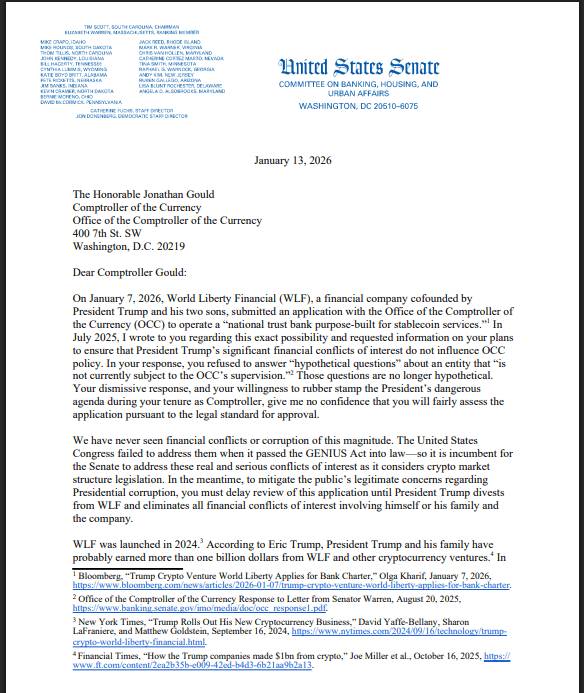
Warren's letter to Comptroller of the Currency, Jonathan Gould.

The Company’s Plan And Its Scale

World Liberty Financial wants a national trust bank that would offer stablecoin issuance, custody and conversion services.

The stablecoin USD1 has reached more than $3.3 billion in circulation since its launch, a figure regulators and lawmakers are watching closely as the firm seeks federal oversight.

The move would place certain crypto activities under the same kind of supervision given to traditional trust banks.

Pushback And Political Risk

Reports note that Warren’s demand is rooted in a concern about the public’s trust in regulators. She asked the OCC for a written reply by January 20, highlighting the urgency of the matter for lawmakers who oversee banking rules.

Other Democrats have signaled similar worries about the optics and legal questions that could follow if a regulator reviews a bank linked to the incumbent President.

Total crypto market cap currently at $3.19 trillion. Chart: TradingView

Industry Context And Reaction

Several crypto firms have recently sought national charters or conditional approvals, prompting a broader debate over how stablecoins should be regulated. Supporters of bank charters say federal oversight can protect customers and bring clarity.

Critics argue that when a highly political figure is connected to an applicant, extra caution is required so that regulatory independence is preserved. Reporting on this case has focused on both the bank application and the potential effect on trust in federal agencies.

Other Developments Around The Firm

World Liberty and related affiliates have been active on multiple fronts, including new product launches and international talks. Some outlets noted a newly announced partnership with external parties to explore broader payment uses for USD1, an effort that underlines how quickly the stablecoin has spread.

Featured image from Inc/Getty Images, chart from TradingView

Related Questions

QWhat is urging the banking regulator to block the crypto charter linked to former President Trump?

AUS Senator Elizabeth Warren is urging the banking regulator to block the crypto charter.

QWhat is the name of the crypto firm backed by Trump's family that applied for the charter?

AThe firm is called World Liberty Financial.

QWhat specific product does World Liberty Financial want to issue and manage with this charter?

AThe firm wants to issue and manage a dollar-pegged stablecoin called USD1.

QWhat major concern did Senator Warren raise in her letter to the Comptroller of the Currency?

AShe raised concerns about a serious conflict of interest and government ethics problems if the charter is approved while the former President retains financial ties to the venture.

QHow much circulation has the USD1 stablecoin reached since its launch?

AThe USD1 stablecoin has reached more than $3.3 billion in circulation.

Related Reads

Stocks Fell Even More Violently Than Crypto, Where Did the Money Go?

From June to late July 2026, global stock markets, particularly technology and semiconductor stocks, experienced severe declines, with South Korea's KOSPI index facing historic circuit breakers and shedding 40% from its June peak. Key catalysts included SK Hynix's earnings miss despite record profits and competitive pressures from China's CXMT IPO. A global forced deleveraging event unfolded, devastating highly leveraged instruments like the 2x leveraged SK Hynix ETF, which lost over 80% of its value. Surprisingly, Bitcoin showed relative stability during this period, rising roughly 15% from its July low. The article clarifies this wasn't due to an inflow of equity flight capital but because Bitcoin had already undergone a significant correction in May and June, with U.S. spot Bitcoin ETFs seeing record outflows. True safe-haven flows went to gold, severing Bitcoin's short-term "digital gold" narrative. The sell-off is characterized not as an AI story collapse but a liquidity-driven清算 of crowded leveraged positions, potentially halfway through according to some analysts. For substantial capital to return to Bitcoin, the article cites necessary conditions: eased global liquidity pressure, a soft-landing Fed rate cut, and regulatory clarity from the stalled U.S. CLARITY Act. The conclusion is that Bitcoin is not a current safe haven but a pre-cleared asset. Its decoupling from tech stocks highlights its potential future role as a non-correlated asset for institutional portfolios, positioning it favorably for when global capital reallocates post-crisis.

marsbit1m ago

Stocks Fell Even More Violently Than Crypto, Where Did the Money Go?

marsbit1m ago

"The Final Phase Before the New Cycle". What Will Happen to Bitcoin in August

"Bitcoin Faces Crucial Test in August: Experts Predict Consolidation or Further Decline" The price of Bitcoin (BTC) is expected to remain under pressure in August, with experts anticipating either consolidation within a narrow range or a potential drop below $60,000. Despite a double-digit recovery from its July low near $58,000, BTC ended the month trading around $63,500, still roughly 50% below its October 2025 peak of $126,200. Analysts cite several headwinds: a challenging macroeconomic environment with high US interest rates and persistent inflation, which makes fixed-income assets more attractive than speculative ones like crypto. Furthermore, competition for capital is intense, with many investors favoring AI-related stocks. This is reflected in significant outflows from US spot Bitcoin ETFs, with a record $4.5 billion leaving in June and a net outflow of $5.4 billion for the first half of the year. Historically, August is a weak month for crypto, with a median return of -7.49% from 2013 to 2025. Experts also note regulatory uncertainty in the US, particularly the stalled CLARITY Act, as a dampening factor. Despite the bearish near-term outlook, several experts view the current phase as the "last phase before a new Bitcoin cycle" begins, potentially in Q4 2024. This makes it a favorable time for accumulating Bitcoin for the long term. Key price levels to watch are support at $60,000-$61,000, with a break below $58,000 potentially leading to $53,000-$55,000. A move above $67,000 could target $70,000-$75,000, though this is considered a lower probability scenario.

cryptonews.ru7m ago

"The Final Phase Before the New Cycle". What Will Happen to Bitcoin in August

cryptonews.ru7m ago

What Structural Changes Have Occurred in the Cryptocurrency Industry by 2026?

By 2026, the crypto industry is undergoing profound structural shifts, moving beyond price speculation towards deeper integration with the real-world economy. Major changes are driven by four key areas. First, stablecoins, now a $300B+ market, are evolving from crypto-native trading tools into real-world payment and B2B settlement backbones, extending business chains and creating complex accounting and tax obligations. Second, global regulation is maturing. Frameworks like the EU's MiCA are moving from legislation to active enforcement, determining market access. Anti-money laundering rules, such as the Travel Rule, see wider adoption but face enforcement and cross-border challenges. Third, AI Agents are emerging as autonomous transaction entities. Protocols like Coinbase's x402 enable machine-to-machine micropayments using stablecoins, necessitating new frameworks for transaction authorization, tax attribution, and audit trails. Finally, tax transparency is entering an implementation phase. Initiatives like the OECD's CARF, EU's DAC8, and the US Form 1099-DA are shifting reporting burdens to platforms, requiring them to reconcile on-chain data with user identity and tax residency information. Collectively, these trends signify that crypto compliance is becoming foundational infrastructure, requiring consistent data and control systems to meet cross-border operational, regulatory, and audit demands.

marsbit28m ago

What Structural Changes Have Occurred in the Cryptocurrency Industry by 2026?

marsbit28m ago

Trading

Spot
活动图片