The broader crypto market structure, the CLARITY Act, has hit another snag, this time from the Senate Judiciary Committee.
The Committee’s Chair, Chuck Grassley (R-Iowa), and ranking member, Dick Durbin (D-Illinois), raised an alarm about a section of the bill.
They pointed out that it would exempt some DeFi software developers from financial licensing requirements for money-transmitting businesses (MTBs).
In a letter to Senate Banking Committee Chair Tim Scott and Ranking Member Elizabeth Warren (D‐Massachusetts), Senators Grassley and Durbin emphasized that they had not been consulted. They argued that the mandate nonetheless falls within their jurisdiction.
The Senate Judiciary Committee went further, warning that the bill’s exemptions “weaken” the federal criminal code. They stressed that this code is a critical enforcement tool for the Department of Justice in combating serious crime.
“By providing a sweeping exemption to non-controlling developers or providers from critical portions of Titles 18 and 31.”
The letter further stated,
“The Senate Judiciary Committee, which has jurisdiction over Title 18, was not consulted or given the opportunity to meaningfully review the proposed changes in advance.”
The senators warned that the proposed exemptions could allow founders, such as Roman Storm of the crypto mixer Tornado Cash, to walk free, even after facilitating the laundering of large‐scale criminal proceeds.
As a consequence, the Judiciary Committee urged its banking colleagues to reject these exemptions. They emphasized the need to close potential DeFi oversight “gaps” in the bill to ensure accountability.
Senate Banking defends developer protections
For perspective, Storm was convicted of conspiracy to operate an unlicensed MTBs despite not having custody of funds or discretionary control over transactions.
This section of the bill, known as the Blockchain Regulatory Certainty Act (BRCA), was added to the broader crypto legislation.
Its purpose is to protect software developers from what lawmakers describe as “unfair” prosecution. Specifically, it seeks to shield them from liability under the Bank Secrecy Act and criminal law.
Even pro-crypto Cynthia Lummis backed these exemptions, provided the platforms don’t control the funds or transactions.
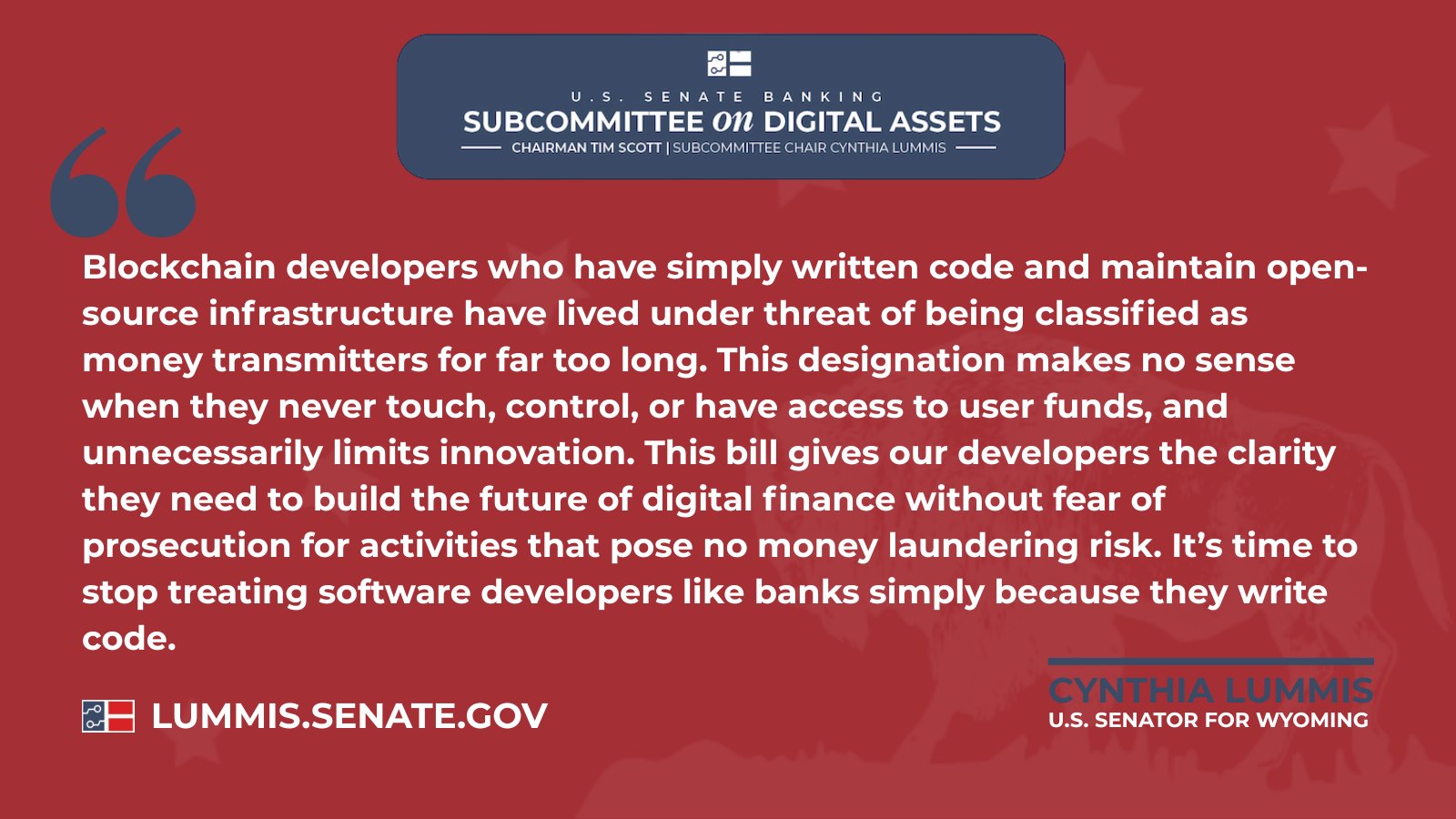
Source: X/Cynthia Lummis
In a response to Senate Judiciary claims, Tim Scott’s spokesperson, Jeff Naft, told Politico that BRCA falls within the Banking Committee and added,
“The Chairman (Scott) remains committed to protecting software developers while ensuring that law enforcement has the necessary tools to prosecute actual illegal money transmission operations.”
Uncertainty rocks crypto bill
The bill’s progress hit a roadblock after Coinbase withdrew support, citing ‘too many issues’ including a ban on stablecoin rewards.
Coinbase’s CEO Brian Armstrong’s “no bill, better than bad bill” stance has left the industry divided, intensifying uncertainty on the bill’s way forward.
That said, White House was reportedly unhappy with Coinbase’s move, calling it a ‘rug-pull’ against the entire industry.
According to reporter Eleanor Terrett, citing an insider, the White House will also pull support if Coinbase does come back to negotiations, adding that,
“This is President Trump’s bill at the end of the day, not Brian Armstrong’s”
It remains to be seen whether the bill will regain momentum in the coming days.
Final Thoughts
- Senate Judiciary pressed for rejection of DeFi software developer exemptions to strengthen DoJ oversight in the space.
- The White House reportedly warned Coinbase to return to negotiations or risk losing support.