SBI CEO Calls Ripple Stake A ‘Hidden Asset,’ Hints It Could Be Much Bigger

bitcoinistPublished on 2026-02-16Last updated on 2026-02-16

Abstract

SBI Holdings CEO Yoshitaka Kitao refuted a viral claim that the company holds $10 billion in XRP, clarifying that its true "hidden asset" is its 9% equity stake in Ripple Labs. He emphasized that Ripple's overall valuation—including its ecosystem—could be enormous, making SBI's stake significantly more valuable than its XRP holdings. Community estimates suggest Ripple's valuation could exceed $50 billion, valuing SBI's stake at over $4.5 billion with substantial future upside. SBI's long-term strategic partnership with Ripple, including investments dating back to 2016, underpins this position. At the time of reporting, XRP traded at $1.46.

SBI Holdings CEO Yoshitaka Kitao pushed back on a viral claim that the Japanese financial group holds $10 billion worth of XRP, arguing instead that SBI’s more consequential exposure sits in its equity position in Ripple Labs, a stake he suggested the market may be underappreciating.

The exchange began after an X account described SBI as “a major partner of Ripple” and “holder of $10 billion in XRP,” tying the claim to SBI’s growing footprint in Asia through the acquisition of Coinhako, a regulated crypto platform based in Singapore. Kitao replied directly, disputing the framing and pointing to SBI’s ownership in Ripple rather than a headline XRP number.

“Not $10 bil. in XRP but around 9% of Ripple Lab. So our hidden asset could be much bigger,” Kitao wrote in a Feb. 15 post.

SBI CEO Dials Up Ripple Valuation Speculation

Kitao’s response effectively reframed the conversation from balance-sheet token inventory to private-market ownership. Rather than validate a specific XRP figure, he emphasized SBI’s stake in Ripple Labs, a detail that matters because equity value is ultimately a function of Ripple’s overall valuation, not the spot price of XRP.

In a separate post the same day, Kitao went further, explicitly tying his view to Ripple’s broader footprint. “When it comes to Ripple Lab’s total valuation which obviously include its ecosystem that Ripple has created, that would be enormous,” he wrote. “SBI owns more than 9 % of that much.”

Community member “BankXRP” amplified the implications by referencing recent reports that place Ripple’s valuation at “$50B+,” arguing that such a mark would put SBI’s 9% stake at “$4.5B+,” with “massive future upside as the CEO hints.”

While Kitao did not put a dollar figure on SBI’s stake, the 9% number sets a clean valuation yardstick. If SBI’s Ripple ownership were worth more than $10 billion, Ripple’s implied valuation would need to exceed roughly $111 billion, because $10 billion divided by 0.09 equals about $111.1 billion.

Put differently, at a $90 billion Ripple valuation, a 9% stake would be about $8.1 billion; at $50 billion, it would be about $4.5 billion. The threshold for “more than $10 billion” is therefore not a subtle rounding error, it requires a triple-digit billions valuation for Ripple.

Notably, SBI’s roughly 9% position appears to be the product of a long-running strategic relationship rather than a single headline trade: SBI’s own investor materials describe the Ripple relationship as having been “established” in September 2012, with the group later investing in Ripple in March 2016 and then deepening operational ties through the SBI Ripple Asia joint venture (SBI 60%, Ripple 40%) launched in May 2016.

SBI also participated as an investor in Ripple’s $200 million Series C financing announced in December 2019, a round that included SBI alongside other backers, one of the clearer public datapoints showing continued equity exposure as Ripple raised capital.

At press time, XRP traded at $1.46.
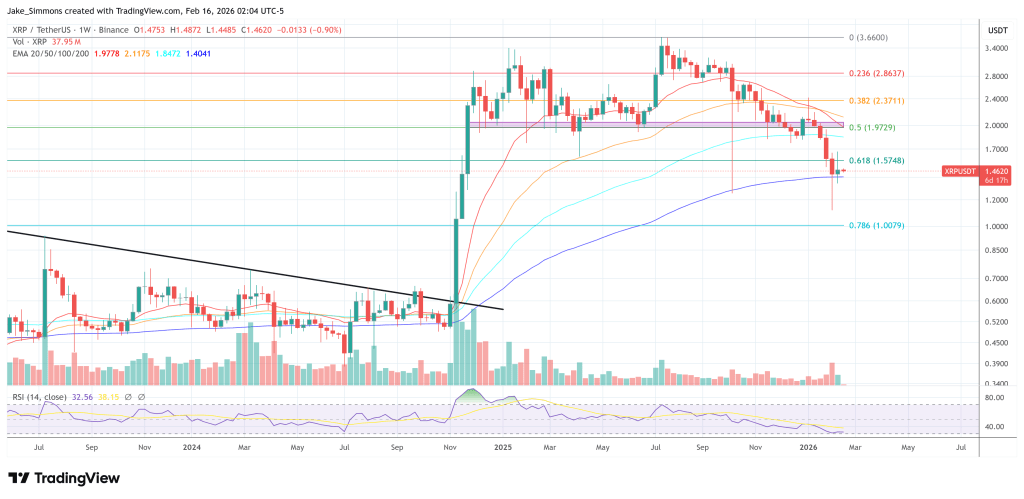
XRP remains above the 200-week EMA, 1-week chart | Source: XRPUSDT on TradingView.com

Related Questions

QWhat did SBI Holdings CEO Yoshitaka Kitao dispute regarding SBI's holdings?

AYoshitaka Kitao disputed the viral claim that SBI Holdings holds $10 billion worth of XRP, emphasizing instead that the company's more significant exposure is its equity stake in Ripple Labs.

QWhat percentage of Ripple Labs does SBI own, according to the CEO?

ASBI owns approximately 9% of Ripple Labs, as stated by CEO Yoshitaka Kitao.

QHow did the CEO describe SBI's stake in Ripple Labs?

AThe CEO described SBI's stake in Ripple Labs as a 'hidden asset' that could be much bigger than the market appreciates.

QWhat would Ripple's valuation need to be for SBI's 9% stake to be worth over $10 billion?

AFor SBI's 9% stake to be worth over $10 billion, Ripple's implied valuation would need to exceed roughly $111 billion.

QWhen did SBI first establish its relationship with Ripple, and what key investment did it make in 2016?

ASBI established its relationship with Ripple in September 2012 and made an investment in Ripple in March 2016, later deepening ties through the SBI Ripple Asia joint venture launched in May 2016.

Related Reads

The Tao (τ) Law Makes EDA Go Viral

In May 2026, Huawei's semiconductor division introduced the "Tao (τ) Law" at IEEE ISCAS, shifting the industry focus from Moore's Law's geometric scaling to "time scaling." Unlike traditional approaches relying on transistor miniaturization, τ Law optimizes the time constant (τ) across device, circuit, chip, and system levels to improve information processing speed and efficiency. Huawei has already applied this principle, mass-producing 381 chips across various applications, with a target to achieve performance equivalent to 1.4nm technology by 2031. The implementation of τ Law, involving techniques like Chiplet, 3DIC, and Logic Folding, places new demands on EDA tools, highlighting gaps in current offerings. Traditional 2D or pseudo-3D EDA flows lack native support for true 3D design, cross-layer co-optimization (STCO), and coupled multi-physics analysis (thermal, power, stress), which are crucial for advanced integration. Chinese EDA companies, such as Empyrean Software, Primarius Technologies, and Xpeedic, are evolving from point-tool specialists to providing full-flow, system-level solutions. For instance, Peking University has developed a prototype "true 3D" EDA tool showing significant improvements in wirelength and timing. Empyrean Software has also launched a comprehensive 3DIC design and verification platform. The τ Law framework presents an opportunity for the domestic EDA industry to transition from achieving basic functionality to developing robust, integrated toolsets essential for next-generation chip design.

marsbit1h ago

The Tao (τ) Law Makes EDA Go Viral

marsbit1h ago

It's Not Jensen Huang Who Wants to Change the PC, But the PC That's Revolting Against Itself

The 40-year-old PC industry is undergoing a fundamental transformation, driven by the rise of AI PCs. At the GTC Taipei 2026 event, NVIDIA, backed by Microsoft and major PC OEMs, announced the RTX Spark super chip for Windows PCs, marking its official entry into the PC core processor market. This move aims to redefine the AI PC by shifting its core from the CPU to an AI-focused SoC (System on Chip). NVIDIA envisions the PC evolving from a personal computer to a "personal AI"—a platform where local AI Agents can autonomously perform tasks. While Intel pioneered the AI PC concept earlier in 2026, NVIDIA's aggressive push, leveraging its vast CUDA developer ecosystem of 6 million, positions it to potentially reshape the industry's long-standing Wintel (Windows-Intel) power structure. NVIDIA's strategy extends beyond hardware; it's about embedding its CUDA, RTX, and AI software stack into the PC platform itself. The article identifies key shifts: 1) The move from a CPU-centric to an AI SoC-centric architecture, similar to Apple's approach with its M-series chips. 2) The PC's evolution from a human-operated tool to a platform for human-Agent collaboration. 3) The extension of NVIDIA's data center-centric CUDA ecosystem to personal devices via RTX Spark. Ultimately, the change is driven by the broader trend of AI moving to personal devices. Companies like Intel, AMD, Qualcomm, and Apple are all participating in this shift. NVIDIA's entry accelerates the competition, but the core driver is the technology itself finding its optimal expression in the PC. The industry is reinventing itself, with the outcome hinging on execution, ecosystem development, and the creation of compelling local AI applications.

marsbit3h ago

It's Not Jensen Huang Who Wants to Change the PC, But the PC That's Revolting Against Itself

marsbit3h ago

Trading

Spot
Futures
活动图片