Saylor Says Bitcoin Could Win Big If AI Destroys Traditional Moats

bitcoinistPublished on 2026-03-18Last updated on 2026-03-18

Abstract

Michael Saylor argues that Bitcoin could become a major beneficiary if artificial intelligence undermines long-term corporate moats and compresses traditional equity valuations. This view responds to Chamath Palihapitiya’s thesis that AI could accelerate disruption, making competitive advantages temporary and forcing investors to drastically reprice stocks based on near-term cash flows rather than long-dated growth. Palihapitiya suggested that heightened disruption risk could compress market multiples, potentially leading to a significant devaluation of equity markets. Saylor contends that in such a scenario, capital would shift to assets immune to AI disruption—specifically Bitcoin, which he describes as scarce, neutral, and resilient. The debate later turned to quantum computing risks, with Palihapitiya questioning Bitcoin’s resilience, while Saylor argued that quantum threats would affect the entire digital infrastructure, not just Bitcoin. Other industry figures, including BitGo’s CEO and Helius Labs’ CEO, offered nuanced perspectives on Bitcoin’s comparative vulnerabilities and strengths in a post-quantum world. At the time of writing, Bitcoin was trading at $74,140.

Michael Saylor says Bitcoin could emerge as one of the biggest winners if artificial intelligence compresses corporate “terminal value” and forces markets to stop paying up for long-dated growth. His argument came in response to Chamath Palihapitiya’s latest thought experiment, which framed AI not simply as a productivity engine, but as a force that could undermine the basic assumptions behind modern equity valuation.

Palihapitiya’s core thesis was stark. If AI makes disruption faster, cheaper, and more relentless, investors may no longer be willing to underwrite cash flows far into the future. In that world, equities would stop being valued as long-duration assets and instead trade closer to what they generate right now.

“The entire architecture of modern capital markets rests on a single, rarely examined assumption: that competitive advantages compound over time. Moats persist. Brands endure. Network effects defend,” Palihapitiya wrote. “Strip that assumption away, and you aren’t just repricing some stocks, you would be dismantling the philosophical foundation of how capital has been allocated for a century.”

He then pushed that logic through a valuation framework built around disruption risk. Using a US 10-year yield of roughly 4.5% as a starting point and an equity risk premium of 4% to 5%, Palihapitiya argued that a stable, durable business might justify a 10x to 12x free cash flow multiple. But once AI-driven obsolescence becomes a serious annual risk, those multiples fall fast. At a 20% annual disruption probability, he estimated fair value at about 3.9x FCF. At 30%, it drops to 2.8x. Even 10% only gets to roughly 6.5x.

That matters because, in his telling, markets have done this before. He pointed to newspapers after digital advertising, retailers facing Amazon, oil majors during the energy transition, and even New York taxi medallions after Uber. In each case, the market was not denying the existence of current cash flows. It was repricing how long those cash flows could realistically last.

Palihapitiya extended that argument to the broader market. With the S&P 500 valued at around $58 trillion and corporate free cash flow near $2.8 trillion annually, he argued that repricing the index at 5x FCF would imply a market value of about $14 trillion, or a 75% drawdown. Even a less severe compression would radically change how capital gets allocated.

Bitcoin Could Surge as AI Destroys Traditional Moats

Saylor’s response was brief and reiterated his previous public stance. “If AI compresses terminal value and makes every moat temporary, capital will rotate to assets with no disruption risk,” he wrote. “Bitcoin is Digital Capital – scarce, neutral, and impervious to AI disruption. $BTC should be the primary beneficiary of this shift.”

That exchange quickly turned to a familiar fault line in Bitcoin debates: quantum risk. Palihapitiya answered that Bitcoin “would need to be quantum resistant by then,” prompting Saylor to push back. “Your AI thesis assumes the digital world is quantum-resistant. If quantum breaks cryptography, it breaks AI, cloud infrastructure, banks, and the internet—not just Bitcoin. The entire stack upgrades together.”

Palihapitiya was unconvinced. “No. A store of value has to be 100% hacking resistant. It’s an existential feature,” he wrote. “For other industries it will be important but less binary/existential.”

Others in crypto added nuance. BitGo CEO Mike Belshe said both sides were partially right, arguing that Bitcoin is likely the “low-hanging fruit” for quantum attackers even if other systems would also be affected. He added: “It’s just too easy relative to other efforts. Similarly, Bitcoin also has the easiest job to be Quantum Resistant – it’s a clean solve technically, suffering only from lack of governance and decisiveness. The banking solution(s) to Quantum will be much harder with a much longer tail of work, but at least the centralized decision making is easier.”

Helius Labs CEO Mert Mumtaz made a similar distinction from another angle: “Those systems can detect, mitigate, and fix against a quantum threat infinitely faster than bitcoin in a non-messy way. That is the cost of decentralization. An EC2 machine getting hacked (won’t happen anyway) is nowhere near the severity of your entire financial getting drained.”

At press time, Bitcoin traded at $74,140.
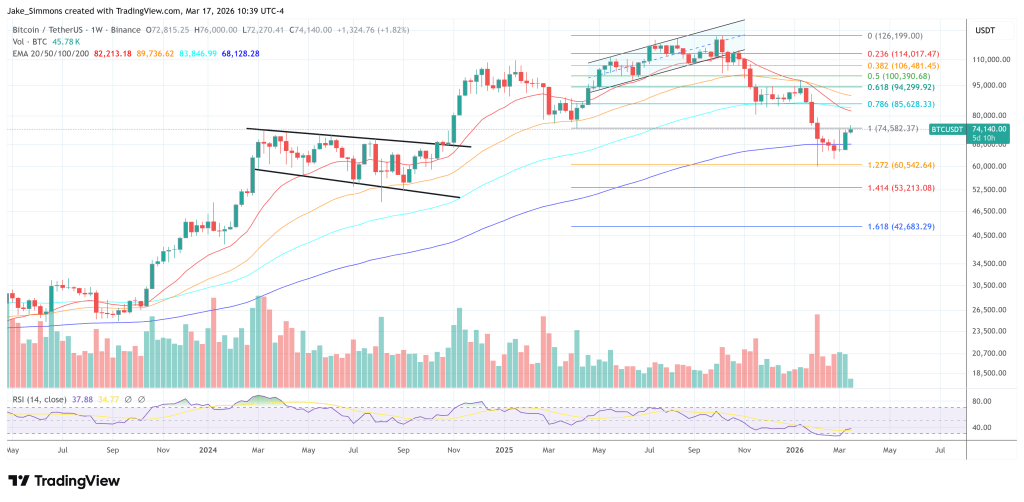
Bitcoin must break above the 1.0 Fib level, 1-week chart | Source: BTCUSDT on TradingView.com

Related Questions

QWhat is Michael Saylor's main argument about Bitcoin in the context of AI disrupting traditional business moats?

AMichael Saylor argues that if AI compresses terminal value and makes every business moat temporary, capital will rotate to assets with no disruption risk, and Bitcoin, being scarce, neutral, and impervious to AI disruption, should be the primary beneficiary of this shift.

QAccording to Chamath Palihapitiya, how might AI impact the valuation of equities and the assumptions behind modern capital markets?

APalihapitiya argues that AI could make disruption faster, cheaper, and more relentless, causing investors to stop underwriting long-term cash flows. This would lead equities to be valued based on current cash generation rather than as long-duration assets, dismantling the assumption that competitive advantages compound over time and moats persist.

QWhat valuation multiples did Palihapitiya suggest for businesses under different annual disruption probabilities due to AI?

APalihapitiya estimated that with a 20% annual disruption probability, fair value would be about 3.9x free cash flow (FCF); at 30%, it drops to 2.8x FCF; and even at 10%, it only reaches roughly 6.5x FCF.

QHow did the debate between Saylor and Palihapitiya extend to the topic of quantum risk, and what were their respective views?

APalihapitiya raised concerns that Bitcoin would need to be quantum-resistant, implying it might be vulnerable. Saylor countered that if quantum computing breaks cryptography, it would affect AI, cloud infrastructure, banks, and the entire internet, not just Bitcoin, and the entire stack would upgrade together. Palihapitiya remained unconvinced, stating that a store of value must be 100% hacking resistant.

QWhat alternative perspectives did other crypto leaders like Mike Belshe and Mert Mumtaz offer on the quantum risk debate?

AMike Belshe said Bitcoin is likely the 'low-hanging fruit' for quantum attackers but also has the easiest technical solution to become quantum-resistant, though it suffers from governance challenges. Mert Mumtaz argued that centralized systems can detect, mitigate, and fix quantum threats faster and more cleanly than Bitcoin, highlighting the trade-off with decentralization.

Related Reads

VCs on 2025 Crypto Investments: 84% of 118 Tokens Break Issue Price, Only One Type of Company is Quietly Making Money

Crypto investor Ching Tseng categorizes the market into four quadrants based on two axes: crypto-native vs. traditional finance (TradFi)-oriented, and having traction vs. no traction. In 2025, 84.7% of 118 tracked token launches fell below their issuance price, with a median fully diluted valuation drop of 71%. Crypto-native projects without traction are experiencing massive capital destruction, often relying on speculative narratives without sustainable revenue or user retention. Crypto-native teams with traction, often built in prior cycles, generate real revenue but face structural challenges with their tokens lacking direct value capture mechanisms. While some have implemented successful buyback programs, the core issue remains finding growth beyond crypto volatility. TradFi-oriented startups without traction face long, costly enterprise sales cycles but benefit from a robust M&A environment, with crypto acquisitions reaching a record $8.6 billion in 2025. The current winners are TradFi-oriented companies with traction, particularly in the Real World Asset (RWA) tokenization space, which grew from $5.5B to $18.6B in 2025. They are winning through enterprise sales, building alliances, and improving unit economics on established compliance stacks. Their main risk is being bypassed by large incumbent institutions building their own infrastructure. The overarching theme is market maturation, where narrative alone is insufficient for long-term success.

marsbit30m ago

VCs on 2025 Crypto Investments: 84% of 118 Tokens Break Issue Price, Only One Type of Company is Quietly Making Money

marsbit30m ago

Trading

Spot
Futures

Hot Articles

What is $BITCOIN

DIGITAL GOLD ($BITCOIN): A Comprehensive Analysis Introduction to DIGITAL GOLD ($BITCOIN) DIGITAL GOLD ($BITCOIN) is a blockchain-based project operating on the Solana network, which aims to combine the characteristics of traditional precious metals with the innovation of decentralized technologies. While it shares a name with Bitcoin, often referred to as “digital gold” due to its perception as a store of value, DIGITAL GOLD is a separate token designed to create a unique ecosystem within the Web3 landscape. Its goal is to position itself as a viable alternative digital asset, although specifics regarding its applications and functionalities are still developing. What is DIGITAL GOLD ($BITCOIN)? DIGITAL GOLD ($BITCOIN) is a cryptocurrency token explicitly designed for use on the Solana blockchain. In contrast to Bitcoin, which provides a widely recognized value storage role, this token appears to focus on broader applications and characteristics. Notable aspects include: Blockchain Infrastructure: The token is built on the Solana blockchain, known for its capacity to handle high-speed and low-cost transactions. Supply Dynamics: DIGITAL GOLD has a maximum supply capped at 100 quadrillion tokens (100P $BITCOIN), although details regarding its circulating supply are currently undisclosed. Utility: While precise functionalities are not explicitly outlined, there are indications that the token could be utilized for various applications, potentially involving decentralized applications (dApps) or asset tokenization strategies. Who is the Creator of DIGITAL GOLD ($BITCOIN)? At present, the identity of the creators and development team behind DIGITAL GOLD ($BITCOIN) remains unknown. This situation is typical among many innovative projects within the blockchain space, particularly those aligning with decentralized finance and meme coin phenomena. While such anonymity may foster a community-driven culture, it intensifies concerns about governance and accountability. Who are the Investors of DIGITAL GOLD ($BITCOIN)? The available information indicates that DIGITAL GOLD ($BITCOIN) does not have any known institutional backers or prominent venture capital investments. The project seems to operate on a peer-to-peer model focused on community support and adoption rather than traditional funding routes. Its activity and liquidity are primarily situated on decentralized exchanges (DEXs), such as PumpSwap, rather than established centralized trading platforms, further highlighting its grassroots approach. How DIGITAL GOLD ($BITCOIN) Works The operational mechanics of DIGITAL GOLD ($BITCOIN) can be elaborated on based on its blockchain design and network attributes: Consensus Mechanism: By leveraging Solana’s unique proof-of-history (PoH) combined with a proof-of-stake (PoS) model, the project ensures efficient transaction validation contributing to the network's high performance. Tokenomics: While specific deflationary mechanisms have not been extensively detailed, the vast maximum token supply implies that it may cater to microtransactions or niche use cases that are still to be defined. Interoperability: There exists the potential for integration with Solana’s broader ecosystem, including various decentralized finance (DeFi) platforms. However, the details regarding specific integrations remain unspecified. Timeline of Key Events Here is a timeline that highlights significant milestones concerning DIGITAL GOLD ($BITCOIN): 2023: The initial deployment of the token occurs on the Solana blockchain, marked by its contract address. 2024: DIGITAL GOLD gains visibility as it becomes available for trading on decentralized exchanges like PumpSwap, allowing users to trade it against SOL. 2025: The project witnesses sporadic trading activity and potential interest in community-led engagements, although no noteworthy partnerships or technical advancements have been documented as of yet. Critical Analysis Strengths Scalability: The underlying Solana infrastructure supports high transaction volumes, which could enhance the utility of $BITCOIN in various transaction scenarios. Accessibility: The potential low trading price per token could attract retail investors, facilitating wider participation due to fractional ownership opportunities. Risks Lack of Transparency: The absence of publicly known backers, developers, or an audit process may yield skepticism regarding the project's sustainability and trustworthiness. Market Volatility: The trading activity is heavily reliant on speculative behavior, which can result in significant price volatility and uncertainty for investors. Conclusion DIGITAL GOLD ($BITCOIN) emerges as an intriguing yet ambiguous project within the rapidly evolving Solana ecosystem. While it attempts to leverage the “digital gold” narrative, its departure from Bitcoin's established role as a store of value underscores the need for a clearer differentiation of its intended utility and governance structure. Future acceptance and adoption will likely depend on addressing the current opacity and defining its operational and economic strategies more explicitly. Note: This report encompasses synthesised information available as of October 2023, and developments may have transpired beyond the research period.

363 Total ViewsPublished 2025.05.13Updated 2025.05.13

What is $BITCOIN

Discussions

Welcome to the HTX Community. Here, you can stay informed about the latest platform developments and gain access to professional market insights. Users' opinions on the price of BTC (BTC) are presented below.

活动图片