Ripple’s XRP Ledger Records Over 20% Surge In This Metric That Puts It Against Bigger Players

bitcoinistPublished on 2026-06-10Last updated on 2026-06-10

Abstract

Ripple's XRP Ledger (XRPL) saw its stablecoin supply surge by 22% in a week, reaching $762 million and ranking it as the 15th largest blockchain by this metric. This significant increase in liquidity and on-chain activity, which saw over $142 million flow into the network in seven days, stands in contrast to declines on Ethereum and Tron. Analysts view the growth as a sign of rising adoption and capital inflows for payments and DeFi. Despite this positive development, XRP's price remains under pressure, trading around $1.1 with recent losses. However, some analysts remain optimistic for a future price rally, citing potential catalysts like regulatory clarity.

Ripple’s XRP Ledger (XRPL) has recorded a massive 22% surge in stablecoin activity as new data reveals a sharp increase in liquidity over the past week. Analysts say this growth positions XRPL among the top blockchains, signaling rising adoption and capital inflows despite declines in its price action.

Ripple’s XRP Ledger Stablecoin Supply Jumps 22%

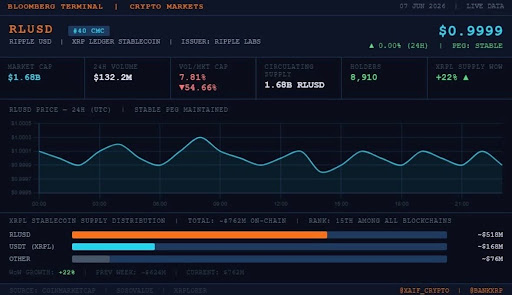
The XRP Ledger is seeing renewed growth and interest, with new on-chain data showing a significant rise in stablecoin volume. Market analyst Xaif Crypto shared on X that XRPL’s stablecoin supply has increased by approximately 22% in just one week, reaching a total of $762 million on-chain. He noted that the figure now ranks the XRP Ledger as the 15th largest blockchain by stablecoin supply, suggesting that liquidity is increasingly flowing into the network.

Notably, the latest growth comes as stablecoins continue to play a key role in blockchain ecosystems, often serving as a measure of available liquidity and network activity. According to Xaif Crypto, the recent increase highlights the growing movement of capital into XRPL as its stablecoin market expands.
XRP Ledger

XRP advocate Diana also commented on the latest milestone. She stated that the 22% increase suggests that more than $142 million had entered the XRP Ledger within seven days. Diana contrasted this performance with that of larger blockchain networks.

According to the data she shared, Ethereum’s (ETH) stablecoin supply fell 2.05% over the same period, while Tron (TRX) recorded a 0.51% decline. In comparison, XRPL posted a 22.87% increase, making it one of the strongest performers among major blockchain networks during the week.

The recent growth also extends beyond the seven-day timeframe. Diana noted that stablecoin liquidity on the XRP Ledger has more than doubled over the last 30 days, suggesting that the latest spike was part of a broader expansion trend.

This increase in supply indicates that XRPL is attracting a large share of stablecoin liquidity, enabling the network to compete more fiercely with top blockchain players in the market. Moreover, it suggests growing adoption and confidence as more users or institutions use the blockchain for payments and DeFi-related activities.

Update On The XRP Price Action

On the price action front, XRP is still trading lower, with volatility and selling pressure adding to its already fragile market structure. CoinMarketCap data shows that XRP’s price is currently standing around $1.1, down by another 5% in the past 24 hours and about 10% over the past week.
Source: X

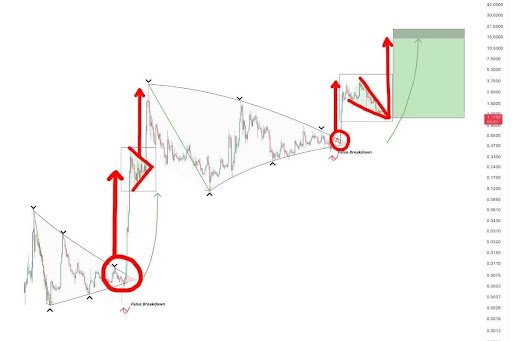
Despite its weak performance, analysts remain optimistic about XRP’s future price action, with some pointing to the upcoming CLARITY Act as the next catalyst that could trigger a massive surge in the cryptocurrency. Market analyst Tom has forecast a rally toward a range as high as $15-$18 for XRP after the crypto bill passes and institutional adoption of the cryptocurrency accelerates. He noted that this projected surge would represent a more than 1,100% gain in the XRP price from current levels.

Price continues downward trend | Source: XRPUSDT on Tradingview.com

Related Questions

QWhat significant increase in metric was recorded on Ripple's XRP Ledger according to the article?

AThe article states that Ripple's XRP Ledger (XRPL) recorded a massive 22% surge in stablecoin supply and activity over a one-week period.

QWhat was the total stablecoin supply on the XRP Ledger after the 22% increase, and how does this rank the network?

AAfter the 22% increase, the total stablecoin supply on XRPL reached approximately $762 million. This figure ranks the XRP Ledger as the 15th largest blockchain by stablecoin supply.

QHow did XRP Ledger's stablecoin supply growth compare to Ethereum and Tron's performance during the same period?

ADuring the same period, Ethereum's (ETH) stablecoin supply fell by 2.05% and Tron's (TRX) recorded a 0.51% decline. In contrast, XRPL posted a 22.87% increase, making it one of the strongest performers among major blockchains that week.

QWhat does the surge in stablecoin liquidity on XRPL indicate according to analysts cited in the article?

AAnalysts say the surge indicates growing adoption and confidence in the network. It suggests that more users or institutions are using XRPL for payments and DeFi-related activities, and it positions the ledger to compete more fiercely with top blockchain players.

QDespite the positive on-chain metric, what is the current state of XRP's price action, and what future catalyst do some analysts point to?

AXRP's price is trading lower, down about 5% in 24 hours and 10% over the past week. However, some analysts remain optimistic, pointing to the potential passage of the CLARITY Act as a future catalyst that could trigger a massive surge in the cryptocurrency's price.

Related Reads

The More It Rises, the More Dangerous? The Systemic Risks Behind SpaceX's Soaring Valuation

Summary: The article raises concerns about the systemic risks posed by SpaceX's skyrocketing valuation, arguing that modern market mechanics, rather than fundamentals, are driving its price discovery. Following SpaceX's market capitalization surpassing $3 trillion in after-hours trading, the author contends that the market is no longer functioning properly. The core issue is not SpaceX's business prospects but the unhealthy market structure surrounding it. With limited float and the imminent launch of options trading, the stage is set for a potential "gamma squeeze"—a feedback loop where market makers hedging call options are forced to buy shares, pushing the price higher and attracting more speculative momentum traders. This mechanism, seen previously with Tesla and meme stocks, can decouple valuation from financial reality. The danger escalates as extreme valuations force passive funds, ETFs, pensions, and major indices to hold the stock. If SpaceX grows large enough—hypothetically reaching $5 or even $10 trillion—its performance would increasingly dictate broader market indices, embedding systemic risk. The author warns that when price appreciation itself becomes the primary bullish thesis, the market transforms from a capital allocation mechanism into a self-reinforcing speculative machine, endangering the retirement savings of ordinary investors tied to passive strategies. The piece questions whether such a system can still perform its fundamental role of price discovery.

marsbit4m ago

The More It Rises, the More Dangerous? The Systemic Risks Behind SpaceX's Soaring Valuation

marsbit4m ago

OpenAI's Hyperliquid Pre-IPO Pricing Venture: Why Did It Last Only Half a Year?

The article discusses the rise and fall of Pre-IPO pricing markets on the Hyperliquid blockchain. Trade.xyz, an anonymous team, successfully built the largest pre-market for SpaceX (SPCX) by launching a contract with a clear anchor: the eventual Nasdaq listing price. This provided inherent price stability and validation. In contrast, Ventuals, a team backed by Paradigm, failed despite holding exclusive contracts for highly sought-after companies like OpenAI and Anthropic. Its key mistake was its pricing mechanism. For companies with no near-term IPO date, Ventuals' oracle relied partly on opaque private market transactions and, critically, partly on its own contract's moving average price. This created a self-referential feedback loop where prices were artificially propped up and detached from genuine supply and demand, leading to illiquid markets. Ventuals shut down after nine months, settling positions at final prices of $1,341.80 for OpenAI and $1,618.90 for Anthropic. Ironically, some employees and late-stage investors of these very companies reportedly used these flawed Ventuals prices for valuation reference, highlighting the acute demand for any price signal in illiquid private markets. The article concludes that while demand for pre-IPO trading is real and growing, with players like Coinbase now entering the space, the fundamental challenge remains: without a public listing to provide a definitive price anchor, these markets struggle to establish truly accurate and liquid pricing. The need for a transparent, self-correcting market is the critical lesson from Ventuals' failure.

marsbit30m ago

OpenAI's Hyperliquid Pre-IPO Pricing Venture: Why Did It Last Only Half a Year?

marsbit30m ago

With Daily Active Users Reaching 3-4 Times That of the Industry's Second Place, Which Crack in the Office Agent Market Has Tencent's WorkBuddy Torn Open?

Tencent's AI office assistant, WorkBuddy, has achieved daily active users (DAU) 3-4 times that of the industry's second-place product, primarily driven by non-technical users like HR, operations, and administrative staff. Its rapid growth, starting with a public beta in March 2026, highlights a key strategic divergence from competitors like OpenAI's Codex and Anthropic's Claude Code. Unlike those tools, which originated as developer-focused assistants (in command lines or IDEs) and are now expanding towards office scenarios, WorkBuddy was built from the ground up for non-technical office workers. Its development was user-driven, initiated after腾讯云's team observed non-technical employees using their CodeBuddy coding tool for general tasks. WorkBuddy's design is defined by three core decisions aimed at lowering barriers: 1) Using natural language instead of technical concepts, so users describe their goal without needing to understand prompts or agents. 2) Providing pre-packaged "Skill" templates for common office tasks like data processing, content creation, and research. 3) Natively integrating into existing腾讯 ecosystems like腾讯 Docs and WeChat, making the agent a seamless part of the user's workflow rather than a separate tool. This "scenario encapsulation" approach, prioritizing the shortest path for users to get work done, contrasts with the "underlying capability" focus of Codex and Claude, which offer more flexibility but require more technical setup. Analysts confirm WorkBuddy's leading market position in China by mid-2026, with massive user and request growth following its launch. Recognizing the same trend of surging non-technical adoption, OpenAI and Anthropic are now pivoting their products with features like role-based plugins (Codex) and a simplified desktop interface (Claude Cowork). However, adapting tools built for developers requires significant changes to interaction models and integrations. WorkBuddy currently holds an estimated six-month lead in delivering a complete solution for non-technical office users. Its recently launched enterprise version aims to solidify this advantage. The competition underscores two valid paths: embedding agent capabilities directly into familiar work environments versus building powerful, general-purpose agents that users must learn to access. WorkBuddy's early success demonstrates the effectiveness of the former strategy for mainstream office adoption.

marsbit38m ago

With Daily Active Users Reaching 3-4 Times That of the Industry's Second Place, Which Crack in the Office Agent Market Has Tencent's WorkBuddy Torn Open?

marsbit38m ago

Trading

Spot
Futures

Hot Articles

Discussions

Welcome to the HTX Community. Here, you can stay informed about the latest platform developments and gain access to professional market insights. Users' opinions on the price of S (S) are presented below.

活动图片