On August 6th, Applied Optoelectronics, Inc. (AAOI), a U.S. optical communication equipment supplier, announced its second-quarter results. According to the company's earnings release, this marks AAOI's fifth consecutive quarter of record revenue.
It's easy to read this as yet another piece of good news about AI optical module demand. However, when the income statement and cash flow statement are viewed together, the picture becomes less straightforward. In the same quarter that revenue surged to a new high, GAAP gross margin fell to its lowest point in nearly six quarters, and the GAAP net loss did not disappear even as non-GAAP profit turned positive, based on the company's quarterly earnings releases.
AAOI's earnings report more closely resembles a production line undergoing rapid facility expansion. Revenue has already entered the financial statements, and the machines are running, but materials, equipment, and payment terms are still pulling cash and profits in the opposite direction. To understand this company, one must first dissect three things: what is driving the revenue, how substantial the reported profitability is, and where the money for expansion is coming from.
What's Actually Driving the Revenue?
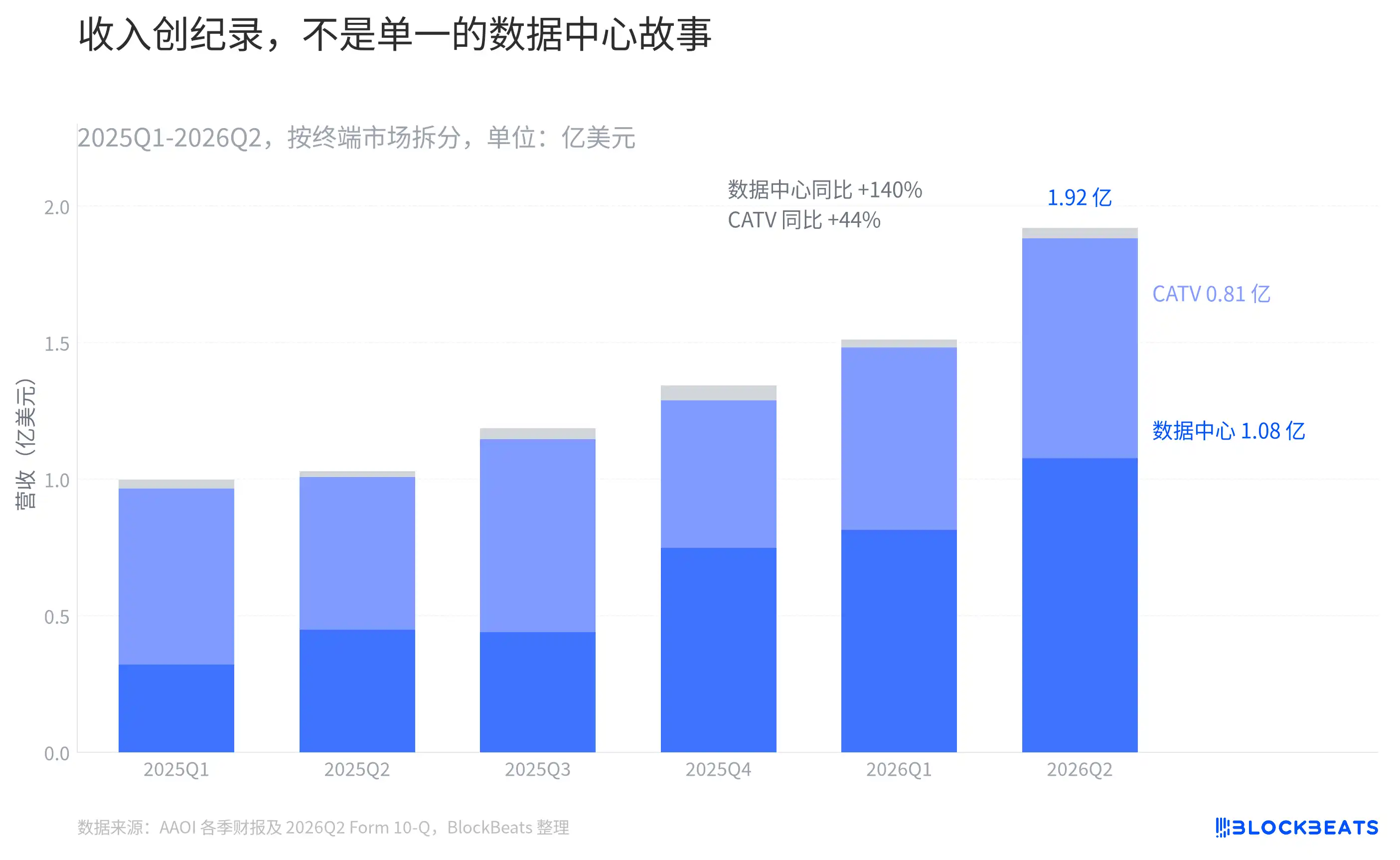
In the first chart, the most crucial thing to watch isn't the bars getting taller, but both shades of blue becoming thicker simultaneously. The data center business is the most conspicuous part of this growth cycle, increasing 140% year-over-year in Q2. The CATV, i.e., cable TV broadband business, also increased 44% during the same period, according to the company announcement.
This means AAOI's revenue is not solely riding on one AI-related chain. Data center modules push the company toward higher-speed network demands, while CATV keeps the company anchored in another, more mature broadband upgrade cycle. Both lines lifting revenue together means this growth cycle is not entirely dependent on the procurement rhythm of a single end market.
However, end markets are not the same as customer lists. According to AAOI's quarterly report, CATV product customer Digicomm contributed 42.8% of consolidated revenue in the first half of the year. According to the same document, this customer accounted for approximately 67.2% of accounts receivable at the period-end.
The company's quarterly report shows that AAOI provided extended payment terms to Digicomm to facilitate its advance inventory building for network construction. The payment terms themselves do not indicate asset quality but will create a timing difference between revenue recognition and cash collection. For a company currently buying equipment and expanding facilities, book revenue and cash on hand cannot be treated as the same thing.
Why Did GAAP Gross Margin Fall as Scale Increased?
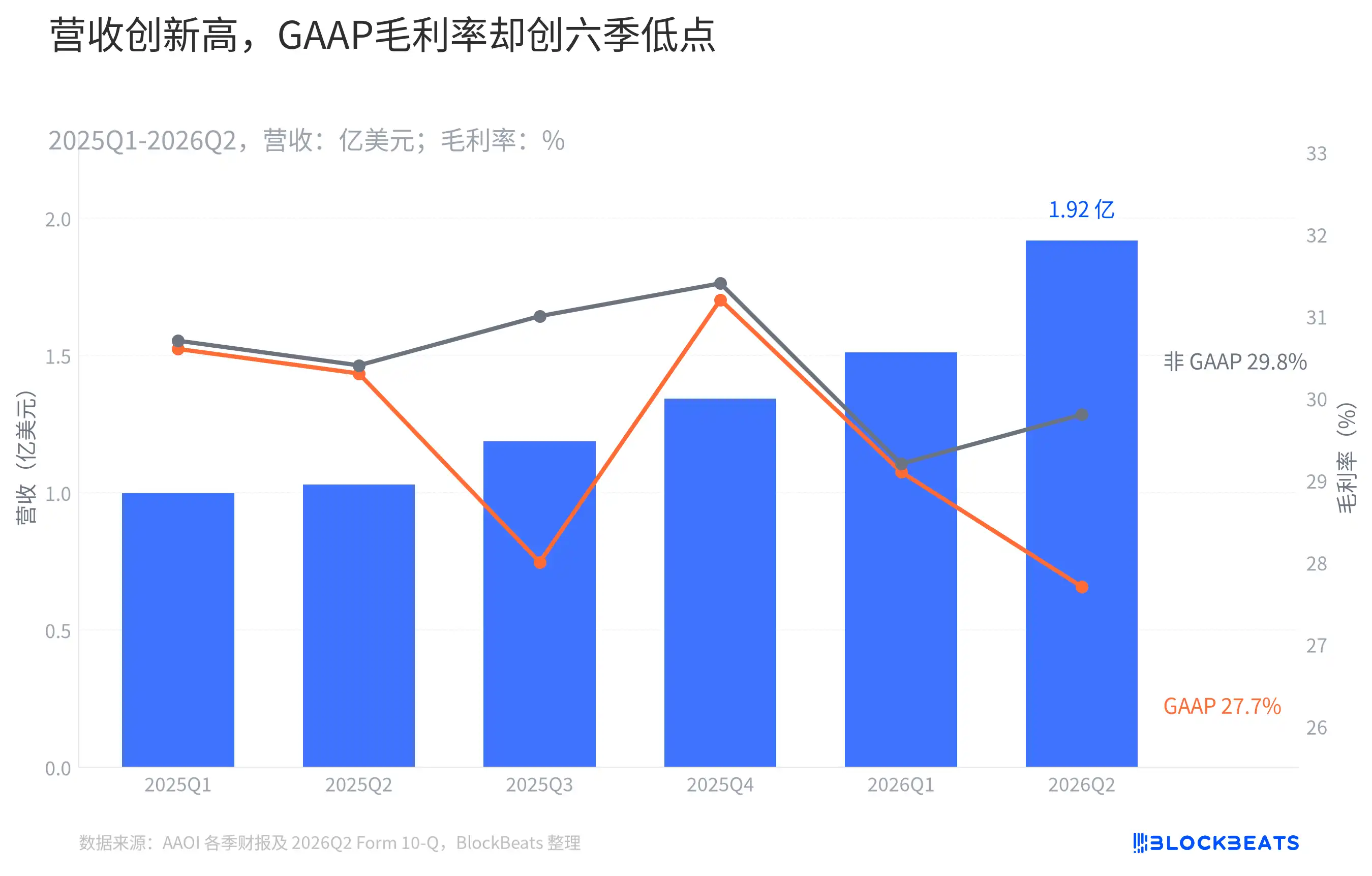
Typically, one would expect expanding scale to reduce unit costs. AAOI's Q2 GAAP gross margin was 27.7%, while its non-GAAP gross margin was 29.8%, according to the company announcement. The gap between the two lines indicates that the current GAAP report still includes several costs excluded by the company in its non-GAAP presentation.
The company's reconciliation table shows that non-GAAP gross margin excludes expenses related to discontinued products. This metric is useful for observing the company's defined ongoing operational performance but cannot replace the GAAP metric.
Management stated that shipments of 800G products more than doubled sequentially this quarter and that they are advancing capacity for next-generation modules. Mass production of high-speed modules isn't about running old production lines faster; it's about pushing equipment, processes, and yield rates over a new threshold. Management expects demand to continue to outpace their available supply capacity, according to the company announcement.
This is also the most easily overlooked point in the charts. Revenue growth first indicates products are shipping, while gross margin records whether expansion has translated into more efficient manufacturing. The two follow different timelines.
What Exactly Did Non-GAAP Turning Profitable Turn?
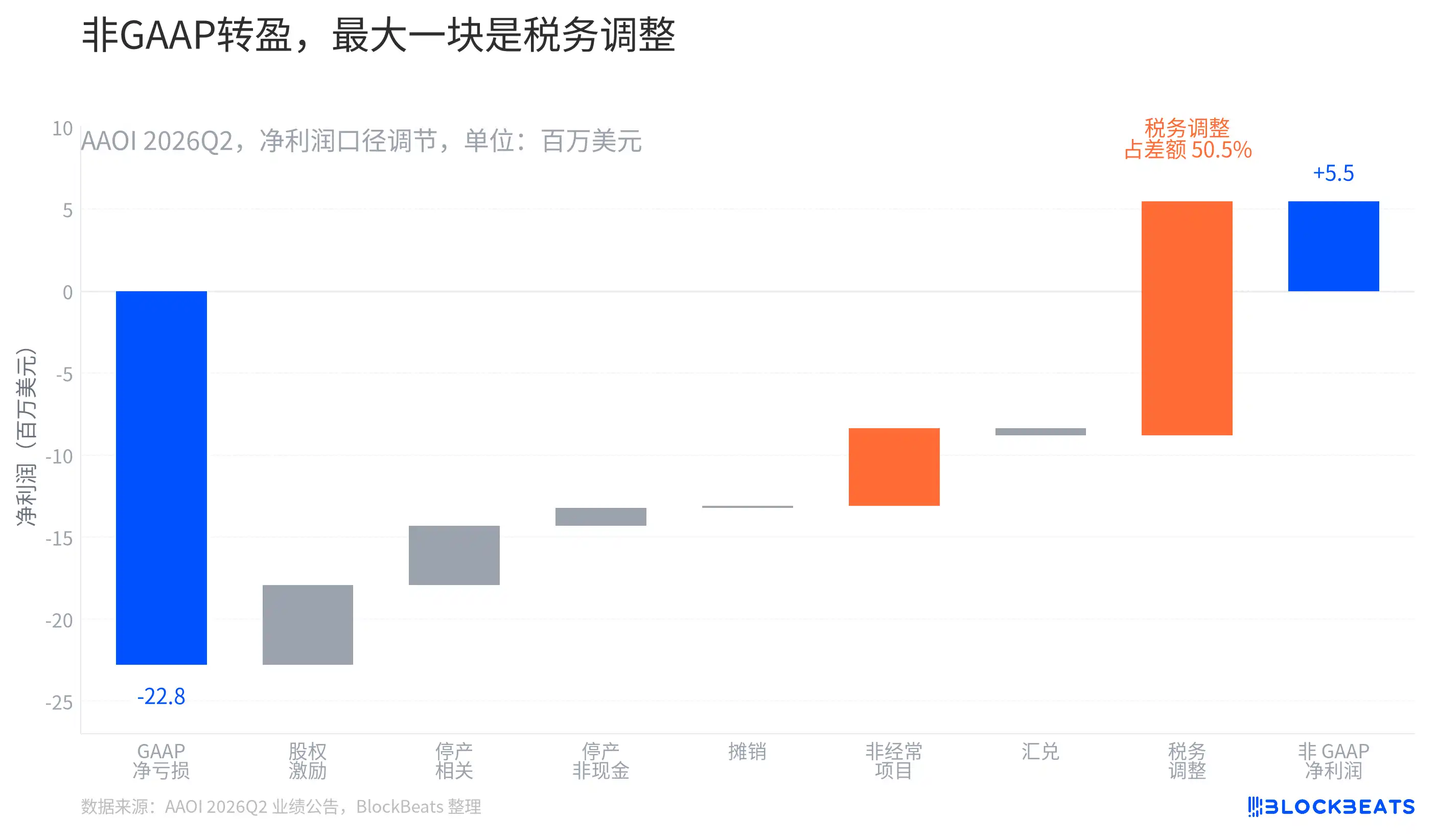
In Q2, the largest single item in AAOI's reconciliation from GAAP net loss to non-GAAP net income was a tax adjustment related to the aforementioned adjustment items, amounting to $14.26 million. According to the company announcement, this item accounted for approximately 50.5% of the total bridging difference.
The chart also includes items such as stock-based compensation, discontinued product-related expenses, amortization, non-recurring expenses, and foreign exchange. These items do not simply vanish; they are excluded under the company's defined non-GAAP presentation. This presentation is useful for viewing the ongoing business but cannot replace the GAAP income statement.
A more conservative piece of corroborating evidence is that AAOI's adjusted EBITDA for the quarter remained negative at -$0.543 million, according to the company announcement. The positive non-GAAP net income indicates improvement under the company's defined adjusted metrics but cannot be directly equated with the expansion being self-funding.
Who Is Funding This Round of Expansion?
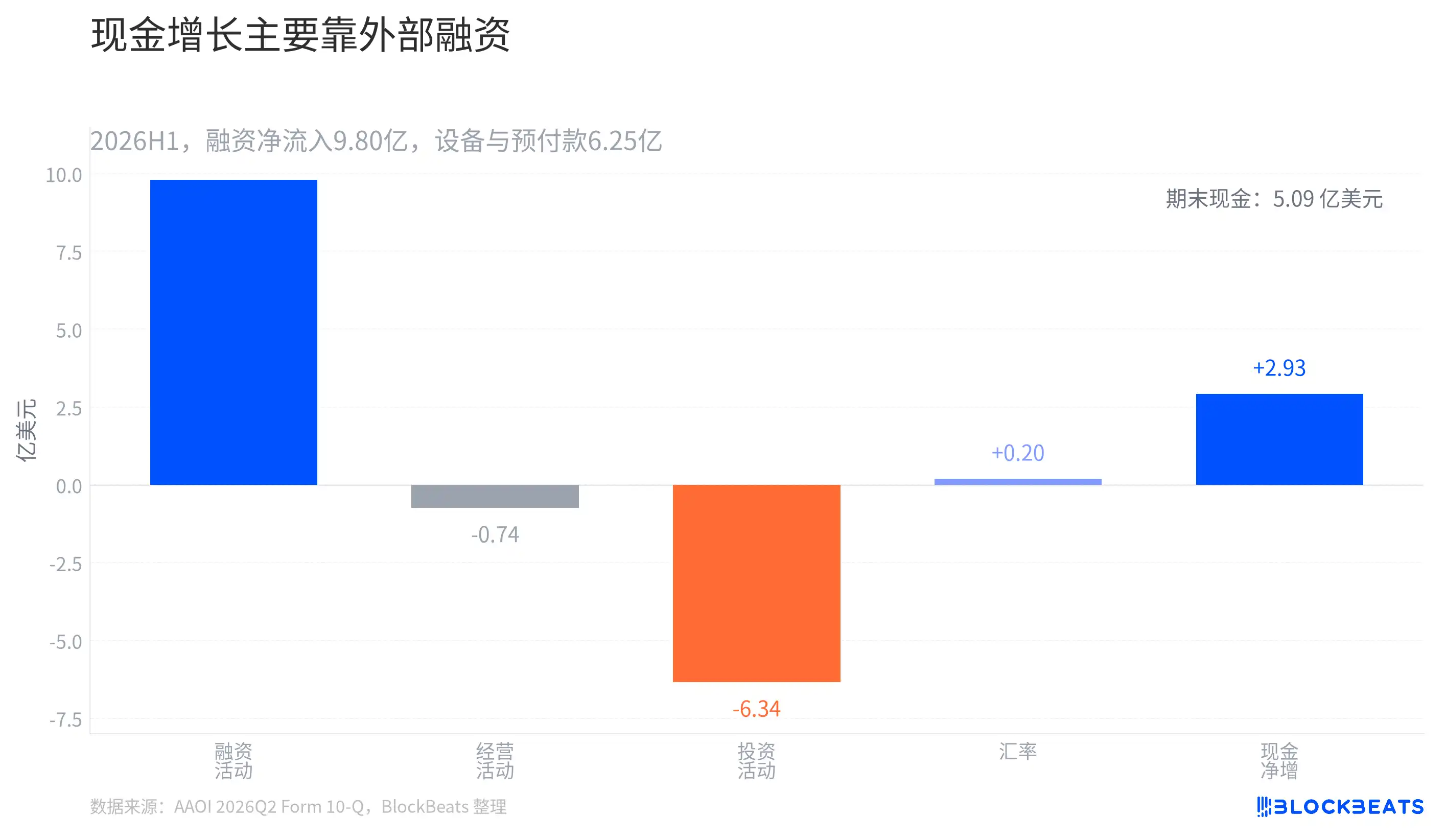
The cash flow statement in the company's quarterly report provides a more direct answer. In the first half of the year, AAOI's net cash outflow from operating and investing activities combined was $707 million, according to the quarterly report. Funds were tied up in the growth of receivables and inventory, as well as in property, plant, equipment, and prepayments.
On the other hand, net cash inflow from financing activities reached $980 million, of which net proceeds from common stock offerings amounted to $1.028 billion, according to the quarterly report.
The total of cash, cash equivalents, and restricted cash at the period-end rose to $509 million. According to the quarterly report, the primary source of this increase was equity financing, not operating cash flow turning comprehensively positive.
The company's quarterly report shows that receivables, inventory, and equipment prepayments continue to tie up funds. Revenue growth has already occurred, yet the funds for expansion primarily come from financing.