Author: Eric, Foresight News
Original Title: How Much Does It Cost for a President to Endorse a Meme Coin? Milei: $5 Million
On March 17, Beijing time, Argentine local media El Destape broke an exclusive bombshell: information recovered from the phone of a cryptocurrency lobbyist in Argentina revealed that Argentine President Milei posted a tweet promoting LIBRA a year ago because he accepted a $5 million bribe, and the mastermind was none other than Hayden Davis, as previously speculated by the outside world.
Opposition lawmakers in Argentina who pushed for the investigation called this an "explosive scandal" and demanded further investigation. However, as of the time of writing, neither Milei nor the presidential office has responded.
Promoting Meme Coin Backfires, Blames "Political Struggle"
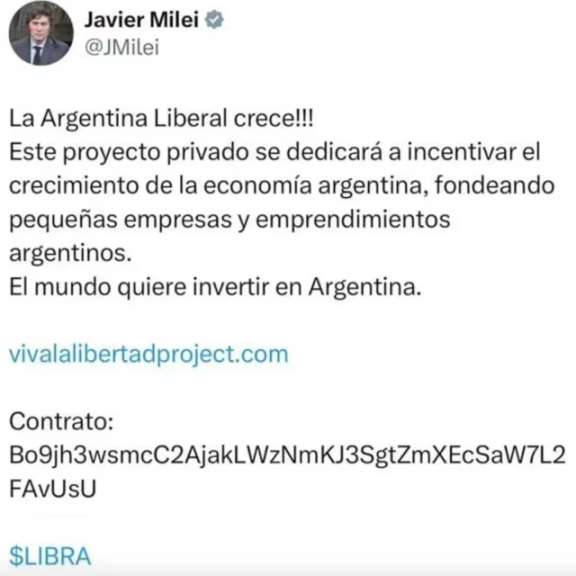
On February 15, 2025, Argentine President Milei promoted a Meme token named LIBRA on X, with the caption "Free Argentina is growing!!! This private project will be committed to promoting Argentina's economic growth and providing funding for Argentine small businesses and startup projects. The world wants to invest in Argentina."
At that time, the hype around the Meme tokens of the US Trump couple had not yet subsided, and the new "presidential concept coin" once again ignited market enthusiasm. The FDV of the LIBRA token soared to a maximum of $4.56 billion within 30 minutes of its launch.
This project, which claimed it would invest token proceeds in Argentine entrepreneurs and education, saw a large number of rat warehouses withdraw liquidity and sell tokens after Milei helped the token price take off, successfully cashing out over $100 million and leaving within an hour or two. At noon Beijing time that day, Milei deleted the tweet and stated that his previous action was merely to support private enterprises and was not related to them, and that after understanding the situation, he decided not to spread the message further.
After the tweet was deleted, the price of LIBRA headed straight to zero without looking back. The entire event started in the early morning Beijing time and was over before the afternoon even arrived.
Even someone as abstract as Trump only dared to issue Meme coins before taking office, but Milei publicly helped promote a Rug project while in office. This kind of "not even pretending" blatant corruption was met with indiscriminate criticism. As the torrent of verbal and written attacks fell, Milei was forced to respond, but these responses seemed more like excuses.
The Argentine presidential office first stated that Milei met with Mauricio Novelli, the representative of KIP Protocol (the entity behind LIBRA) in Argentina, in October 2024. At that time, this representative said that a project named Viva la Libertad would be launched in the future to provide financing support for Argentine private enterprises. Milei's retweet after KIP Protocol launched the LIBRA token was merely to support Argentine entrepreneurs, and he himself was not aware of the details.
In other words, Milei believed LIBRA was a project to help Argentine entrepreneurs, and the retweet was well-intentioned.
Later, Milei himself stated again on a television program that his actions were in good faith, hoping to support any project that could improve the financing situation for technology entrepreneurs, but he was "deceived" because he did not understand the project's situation. Furthermore, Milei shamelessly stated that the vast majority of the deceived investors were Americans and Chinese, and he had not wronged his own citizens.
Finally, Milei even stated that the smear campaign against him was politically motivated and vowed to pursue the matter.
This flimsy explanation was obviously unconvincing: Why would a national president promote a private company without investigation?
Took the Money, But Didn't Fully Deliver
After this national-level scandal occurred, both the Argentine Anti-Corruption Office and Congress launched investigations. The Anti-Corruption Office believed that Milei's action was personal and did not violate public ethics regulations; the congressional investigation committee accused Milei of providing "key cooperation" in the LIBRA incident and recommended that Congress assess whether it constituted misconduct.
However, these investigation results did not reveal details, and the outside world was unclear about what exactly happened.
El Destape's爆料 revealed a key piece of evidence, shedding light on the gray transaction between LIBRA's issuer and the president.
According to the report, investigators recovered an agreement between H (confirmed to be Hayden Davis) and Milei from the phone of Mauricio Novelli, who was referred to by the Argentine presidential office as the "representative of KIP Protocol in Argentina" but was actually a cryptocurrency lobbyist.
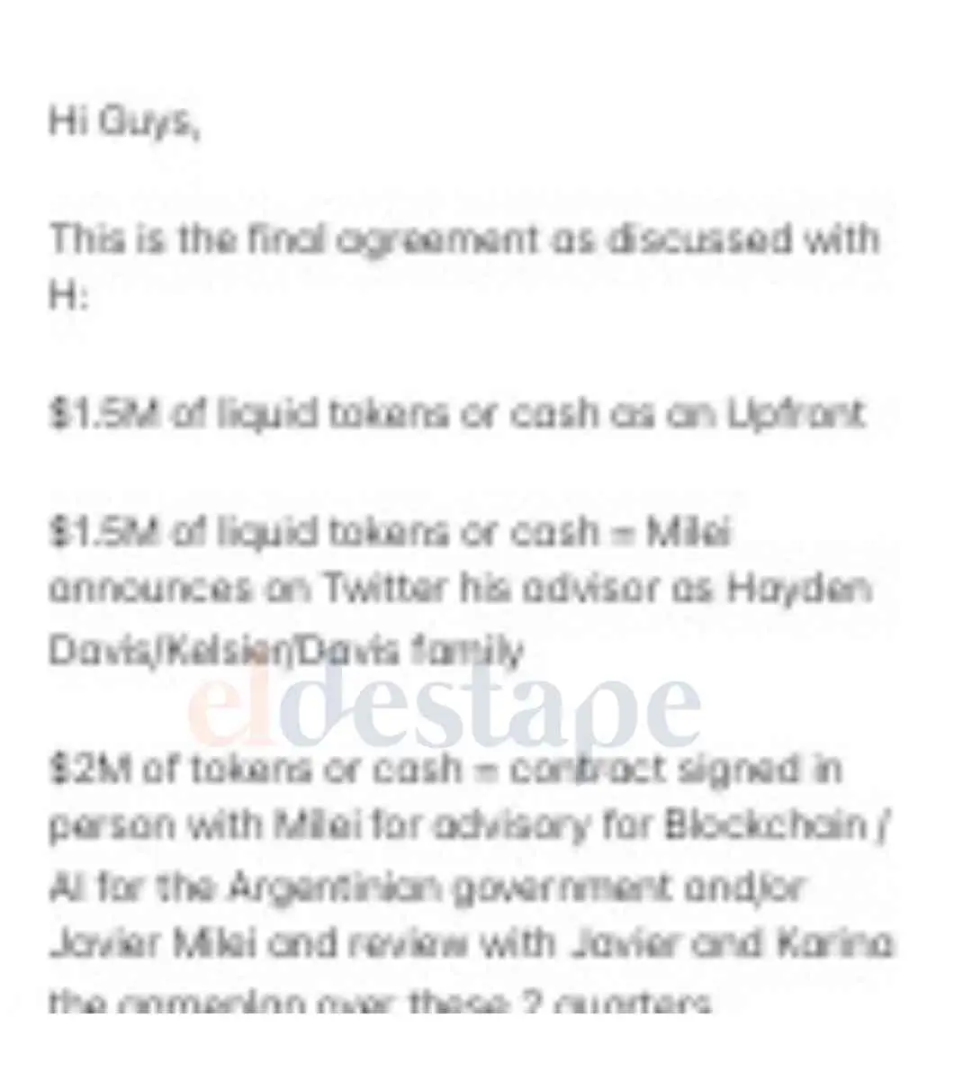
The agreement content shows that Hayden Davis would first pay Milei $1.5 million in liquid tokens or cash as an advance payment. After Milei announced on X that Hayden Davis/Kelsier/Davis family were his advisors, another $1.5 million in liquid tokens or cash would be paid. As for the final $2 million, it required Milei to sign a blockchain/artificial intelligence consulting contract.
The creation date of this file was just three days before Milei posted the promotional LIBRA tweet, and the file came from an expert report by the Argentine General Directorate of Technical Support for Criminal Investigations, but it only appeared in a folder of an attachment.
The secrets found on the phone were far more than just this file; they even included materials related to Milei teaching a cryptocurrency course at a school, which also proved that Milei's claim a year ago that he did not understand cryptocurrency was a pure lie.
In addition, the investigation report also exposed密集的通话记录 (dense call records) between Mauricio Novelli and Milei, as well as Milei's sister (who serves as Secretary General of the Argentine Presidential Office) from a few minutes before to a few hours after Milei promoted the token. Although there was no specific call content, the timing吻合 (coincidence)恰好证明 (just proves) that LIBRA was a premeditated financial scam organized with the involvement of the president.
Judging from Milei's tweet, the cooperation between the two parties may have only reached the first step. Before the tweet announcing that Hayden Davis was his advisor could be sent, the LIBRA incident spiraled out of control, forcing Milei to quickly clarify and distance himself. No wonder Hayden Davis said in an interview with crypto blogger Coffeezilla that Milei was originally supposed to post more interactive tweets, but for some reason the cooperation suddenly stopped.
Bottomless "Open Robbery"
In fact, after the LIBRA incident, some people inferred through on-chain information that Hayden Davis and his Kelsier Ventures were the masterminds behind the incident, and also uncovered that the token MELANIA launched by Trump's wife was also manipulated by him.
El Destape reported that on January 30, 2025, Hayden Davis met with Milei and Milei's sister at the Argentine presidential palace and signed a contract with Milei, making Davis an advisor to the Argentine government in the blockchain field. This contract was also found on Novelli's phone but was concealed by prosecutor Eduardo Taiano and not made known to the relevant parties.
After this agreement was reached, a bank account associated with Davis transferred $1 million to an account with an unconfirmed owner.
So far, we roughly know the whole story:
In October 2024, Mauricio Novelli introduced KIP Protocol (actually controlled by Hayden Davis) to Argentine President Milei, claiming that a project named Viva la Libertad would be launched to provide financing support for Argentine private enterprises, thereby getting closer to Milei.
At the end of January 2025, Hayden Davis, through the introduction of Mauricio Novelli, contacted Argentine President Milei and successfully became the blockchain advisor to the Argentine government. Afterwards, Hayden Davis, through Mauricio Novelli, reached an agreement with Milei: Hayden Davis would pay Milei a total of $5 million in exchange for Milei promoting the Viva la Libertad project and its issued LIBRA token on his personal X account.
Between October 2024 and the end of January 2025, Hayden Davis and Milei may have had more or less contact through Mauricio Novelli and discussed how to promote LIBRA. Milei was probably well aware that this was a pure scam project using cryptocurrency, but the reason he agreed was probably, as Hayden Davis said in an interview, their series of plans would not let this token quickly "rug pull.
But unexpectedly, after Milei posted the tweet, the rat warehouses couldn't wait to cash out over $100 million, quickly triggering a large amount of critical public opinion. Seeing the situation turning bad, Milei chose to cut losses rather than continue the cooperation. As public opinion further发酵 (fermented), the originally win-win situation turned into Milei being left alone in the lurch, while Hayden Davis cashed out and left.
The most terrifying thing about this incident is that Hayden Davis never considered it fraud. In an interview with Coffeezilla, he stated, "In the meme market, this is not illegal. This is what happens in every trade. These are the rules here. People know this, agree to this, and make money from this. If you're going to blame this, I think, for the vast majority of retail traders betting on meme tokens, especially those who get in early, this is the rules of the game in this market. This is not the capital market; this is a casino."
The development process of the industry is never afraid of speculators participating. What it fears is that speculators truly believe the industry is simply a casino for speculation.
This perhaps explains some of the chaos in the Web3 industry in the past two or three years: when schemers don't think they are scheming, they naturally lose all bottom lines. Eventually, projects no longer compare in the simple sense of good or bad, but only in who has the more clever means of "robbing."
Twitter:https://twitter.com/BitpushNewsCN
Bitpush TG Discussion Group:https://t.me/BitPushCommunity
Bitpush TG Subscription: https://t.me/bitpush