‘Overbroad and irrelevant’ – Coinbase user’s IRS battle ends in dismissal

ambcryptoPublished on 2026-03-20Last updated on 2026-03-20

Abstract

Cryptocurrency investor Roger Metz's legal challenge to block an IRS summons for his financial records was dismissed by a U.S. court. The IRS sought extensive data—including account details, transaction logs, and private communications—from his Coinbase account, dating back years, during an audit of his 2022 tax return. Metz argued the request was "overbroad and irrelevant" and violated his privacy. However, the court dismissed the case on procedural grounds, noting Metz failed to notify required government entities within the mandated 90-day period. While the IRS maintains strict crypto reporting rules, it has eased some requirements for the 2025-2026 tax period.

Crypto investor Roger Metz’s attempt to block Internal Revenue Service (IRS) summons for his financial records has hit a wall.

The taxman had sought an audit of Metz’s 2022 federal tax return, but the situation quickly escalated.

Although the user initially found the omission by Coinbase and filed an amended tax return for an additional $14,700 for the 2022 period, the agency sought Metz’s entire activity on the platform since its launch.

The watchdog requested additional data, including account information, physical addresses, communications with Coinbase, and detailed platform activity logs.

In response, Metz filed a petition in the Northern District of California last year, seeking to bar the IRS summons. Through his lawyers, he argued that the IRS request was ‘overbroad and irrelevant’ because it was asking for years of personal data that was unrelated to the 2022 tax audit.

For him, the IRS’s overture to access his private communications and account logs was a privacy breach. He added that the taxman acted in ‘bad faith’ because it didn’t communicate with him even after filing the amended 2022 federal tax return.

Court’s grounds for dismissal

However, the court didn’t rule on his privacy arguments or concerns but on procedural guidelines.

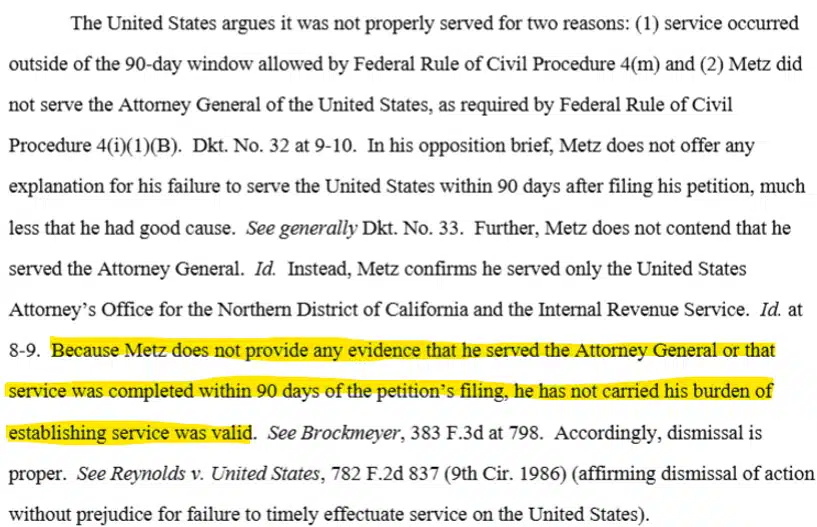
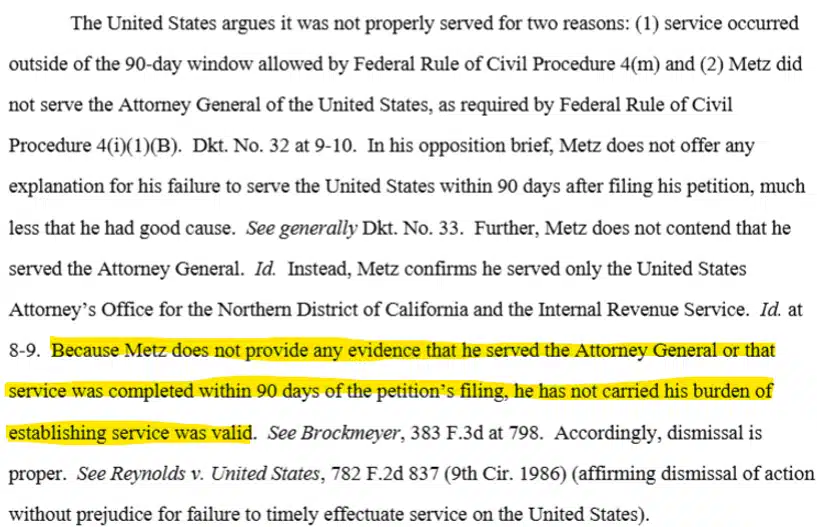
On the 18th of March, the US District Judge Araceli Martínez-Olguín ruled against Roger Metz, stating that he failed to notify relevant government entities of the petition in advance.
Source: Pacer Monitor

Under U.S. procedural guidelines, defendants must be notified of lawsuits to ensure they have time to respond.

In the Metz’s case, apart from the IRS, the local district’s US Attorney, and the AG in Washington ought to have been notified within 90-days of filing the petition.

That leaves a little room to speculate whether the court would have treated the IRS summons as a breach of privacy.

Even so, the IRS’s current crypto tax reporting regime remains very strict.

Currently, the IRS mandates crypto exchanges to report users’ gross crypto sales and cost basis (buying price) for each asset bought in Form 1099-DA. A mismatch between this (1099-DA) and the user’s reported figures will likely trigger further scrutiny from the tax watchdog.

For the 2025-2026 tax period, however, the IRS has relaxed the rules a bit, allowing crypto holders to identify and self-report their asset sales for tax purposes.


Final Summary

  • A U.S. judge dismissed Roger Metz’s petition to block the IRS summons for his historical financial data on procedural grounds.
  • IRS crypto tax reporting regime remains strict, but it has relaxed some of the rules for the 2026 period.


Trending Cryptos

Related Questions

QWhat was the main reason the court dismissed Roger Metz's petition against the IRS summons?

AThe court dismissed the petition on procedural grounds because Metz failed to notify the relevant government entities, including the IRS, the local district's US Attorney, and the Attorney General in Washington, within the required 90-day period after filing the petition.

QWhy did Roger Metz argue that the IRS summons was 'overbroad and irrelevant'?

AMetz argued that the IRS request was 'overbroad and irrelevant' because it sought years of his personal data, including account information, physical addresses, communications with Coinbase, and detailed platform activity logs, which he believed were unrelated to the specific 2022 tax audit.

QWhat specific information did the IRS request from Coinbase regarding Roger Metz's account?

AThe IRS requested Metz's entire activity on Coinbase since its launch, including account information, physical addresses, communications with Coinbase, and detailed platform activity logs.

QHow has the IRS adjusted its crypto tax reporting rules for the 2025-2026 tax period?

AFor the 2025-2026 tax period, the IRS has relaxed the rules by allowing crypto holders to identify and self-report their asset sales for tax purposes, rather than relying solely on exchanges to report gross sales and cost basis.

QWhat action did Roger Metz take after the IRS sought an audit of his 2022 federal tax return?

AAfter the IRS sought an audit, Metz filed an amended tax return for the 2022 period, reporting an additional $14,700, and later filed a petition in the Northern District of California to block the IRS summons for his financial records.

Related Reads

Ethereum Startup EthSystems Bets on Privacy as Key to Luring Banks to Public Blockchains

EthSystems, a startup spun out of the Ethereum Foundation, posits that privacy, not scalability, is the primary barrier preventing financial institutions from adopting public blockchains. The company builds privacy infrastructure for banks, asset managers, and governments looking to use Ethereum for tokenized assets, stablecoins, and other financial applications. Unlike projects creating new blockchains, EthSystems helps institutions deploy privacy technologies directly on Ethereum, keeping transaction data confidential while settling on the mainnet. Co-founder Mo Jaleel explains that financial institutions require control over who sees transaction data, not necessarily anonymity. While competitors like Canton Network and protocols like Aztec also work on private transactions for enterprises, EthSystems differentiates itself by advising on architecture, building custom infrastructure, and publishing open-source research. It aims to collaborate with existing privacy projects rather than rebuild the entire stack. The decision to become a commercial entity stemmed from institutional demand for production-ready solutions, which the team couldn't fulfill within the non-profit Ethereum Foundation. According to Jaleel, operating as a business facilitates funding and participation in large institutions' procurement processes. He notes a shift in client conversations from experimental innovation teams to core business units now seeking to place real assets and financial flows on-chain. EthSystems argues that the key to bridging public blockchains and institutional needs lies in cryptography and privacy.

cryptonews.ru8m ago

Ethereum Startup EthSystems Bets on Privacy as Key to Luring Banks to Public Blockchains

cryptonews.ru8m ago

Russia Establishes New Rules for Digital Depository Ahead of Cryptocurrency System Deployment

Russia is creating new rules for digital depositaries ahead of the launch of its cryptocurrency system. The proposals will extend existing securities market regulations—covering trading, custody, record-keeping, and disclosure—to digital assets. Within this framework, regulated "digital depositaries" will be established to register holdings of cryptocurrency and other digital assets. Their capital requirements will range from 50 million rubles ($570,000) to 250 million rubles ($2.8 million), depending on services provided. Settlement depositaries require the highest capital (250 million rubles), with lower thresholds for firms controlling crypto addresses or using foreign depositaries (100 million rubles) and for other digital depositaries (50 million rubles). Assets counted toward capital must be liquid and meet the central bank's credit quality standards. These rules will also apply to operators of electronic platforms trading digital financial assets. The Bank of Russia will maintain registers for these depositaries, crypto exchange operators, and issuers of digital financial assets. The regulations are based on a digital assets bill passed by parliament in July, with the full crypto system expected by September. The proposals are currently open for public feedback. This announcement follows the European Union's latest sanctions package targeting 14 crypto firms.

cryptonews.ru10m ago

Russia Establishes New Rules for Digital Depository Ahead of Cryptocurrency System Deployment

cryptonews.ru10m ago

The Disappearing Buy Button

"The Vanished 'Buy' Button" In June 2026, major Chinese online brokers Futu and Tiger were barred from allowing mainland Chinese users to purchase or deposit funds for US stocks, following a multi-department regulatory crackdown. This move, part of China's long-standing capital controls, aims to stem the outflow of domestic capital to support the development of local technology sectors, particularly in AI, where China perceives itself to be lagging. The restriction highlights a growing divergence between national economic strategy and individual investor needs. With slowing wage growth and a deflating property market, Chinese retail investors saw US tech stocks—which dominate global indices and capture a quarter of global economic growth—as a crucial avenue for wealth preservation. Domestically, the A-share market has only recently seen its technology sector surpass the long-dominant financial sector in index weight, reflecting a state-directed shift toward "new quality productive forces." The crackdown mirrors past actions against cryptocurrencies and tech deals, prioritizing financial stability and onshore control. It also aims to funnel liquidity and listings to Hong Kong and mainland exchanges to retain economic sovereignty. This regulatory gap creates an opportunity for decentralized finance. The emerging narrative shifts from "banking the unbanked" to "brokering the unbrokered"—using crypto and tokenized real-world assets (RWAs), like stocks, to provide global access to productive assets for those excluded by traditional finance, from Chinese散户 to users in other restricted markets. Simultaneously, the AI era is reshaping global capital flows. US tech giants act as "macro hedge funds," issuing cheap foreign-currency debt to fund expansion, leveraging their superior credit. However, non-US AI supply chain players (e.g., in semiconductors) are also rising. The competition for asset ownership and low-cost financing rights is intensifying, making access to capital a new societal divide as AI devalues routine intellectual labor. Finance remains in the "business of hope," but its gates are being redrawn.

marsbit20m ago

The Disappearing Buy Button

marsbit20m ago

According to Strategy, MSTR Has Delivered an Annual Return of 42% Since Adopting the 'Bitcoin Standard,' Even Though Its Treasury Is Underwater

According to Strategy (formerly MicroStrategy) Executive Chairman Michael Saylor, the company's stock MSTR has delivered a 42% annualized return since August 10, 2020, when it adopted its "Bitcoin standard" strategy. This performance surpasses that of Bitcoin itself, the "Magnificent Seven" tech stocks, and the S&P 500 over the same period. Saylor frequently highlights this to demonstrate the success of transforming the software firm into a leveraged Bitcoin investment vehicle. Despite this strong long-term stock performance, Strategy's core Bitcoin treasury position is currently at a loss. As of July 29, the company holds 843,775 BTC, purchased for an average of $75,476 per coin, implying an unrealized loss of approximately $11.4 billion. The disparity arises because MSTR stock acts as a leveraged proxy for Bitcoin, allowing for high annualized returns over a multi-year period even when recent purchases are underwater. To address its increasingly complex capital structure, which now includes multiple classes of preferred stock, Strategy introduced a new reporting framework on July 24. Key metrics include "Net BTC per Share," "$BTC Hurdle ARR" (the annual Bitcoin yield needed to cover financing costs), and "$BTC Floor ARR" (the minimum yield to maintain a sustainable leverage ratio). The company continues to accumulate Bitcoin and recently bolstered its dollar reserves by $525 million to strengthen coverage for preferred stock dividends.

cryptonews.ru20m ago

According to Strategy, MSTR Has Delivered an Annual Return of 42% Since Adopting the 'Bitcoin Standard,' Even Though Its Treasury Is Underwater

cryptonews.ru20m ago

Trading

Spot

Hot Articles

Discussions

Welcome to the HTX Community. Here, you can stay informed about the latest platform developments and gain access to professional market insights. Users' opinions on the price of S (S) are presented below.

活动图片