OpenAI's Largest Internal Wealth Creation: 600 People Cash Out a Total of $6.6 Billion, 75 Take Home the Maximum $30 Million Each

链捕手Published on 2026-05-11Last updated on 2026-05-11

Abstract

A Wall Street Journal report reveals OpenAI's unprecedented pre-IPO wealth creation. In a single employee stock sale last October, over 600 current and former employees sold shares, collectively cashing out approximately $6.6 billion. Due to high investor demand, the company tripled the individual sale cap to $30 million, with about 75 employees selling the maximum amount. This event represents the largest such transaction in tech industry history for a private company. OpenAI's valuation was $500 billion for this tender offer. Employees with over two years of tenure were eligible, allowing many post-ChatGPT hires their first liquidity event. The company's stock has reportedly grown over 100-fold in seven years. Following a restructuring, employees collectively hold about 26% of OpenAI. The scale of executive wealth is also staggering. In court testimony related to Elon Musk's lawsuit, President and co-founder Greg Brockman confirmed his OpenAI stake is worth around $30 billion. Analysis indicates about 165 current and former employees hold a combined ~$164.9 billion in equity, averaging nearly $1 billion per person in paper wealth. OpenAI's per-employee stock-based compensation is estimated to be 34 times the average of major tech firms before their IPOs. OpenAI continues its rapid ascent, closing a $122 billion funding round at an $852 billion valuation in March. With monthly revenue hitting $2 billion, over 900 million weekly ChatGPT users, and plans for a potential tri...

Author: Claude, Deep Chao TechFlow

Deep Chao Introduction: The Wall Street Journal has revealed the scale of wealth creation inside OpenAI. In an employee stock sale last October, the company raised the individual cash-out cap from $10 million to $30 million. Over 600 current and former employees participated, cashing out a total of $6.6 billion, with about 75 individuals reaching the full $30 million limit each. President Brockman confirmed in court this week that his stake is worth approximately $30 billion. Never in Silicon Valley's history has a pre-IPO company created such a dense concentration of multi-millionaires.

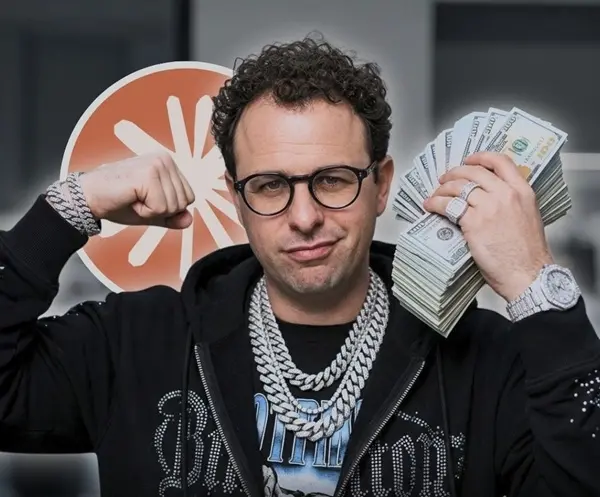
Image source: Wall Street Journal

In the past Silicon Valley, the usual path for ordinary employees to become rich was one: wait for the company to go public. OpenAI is rewriting that rule.

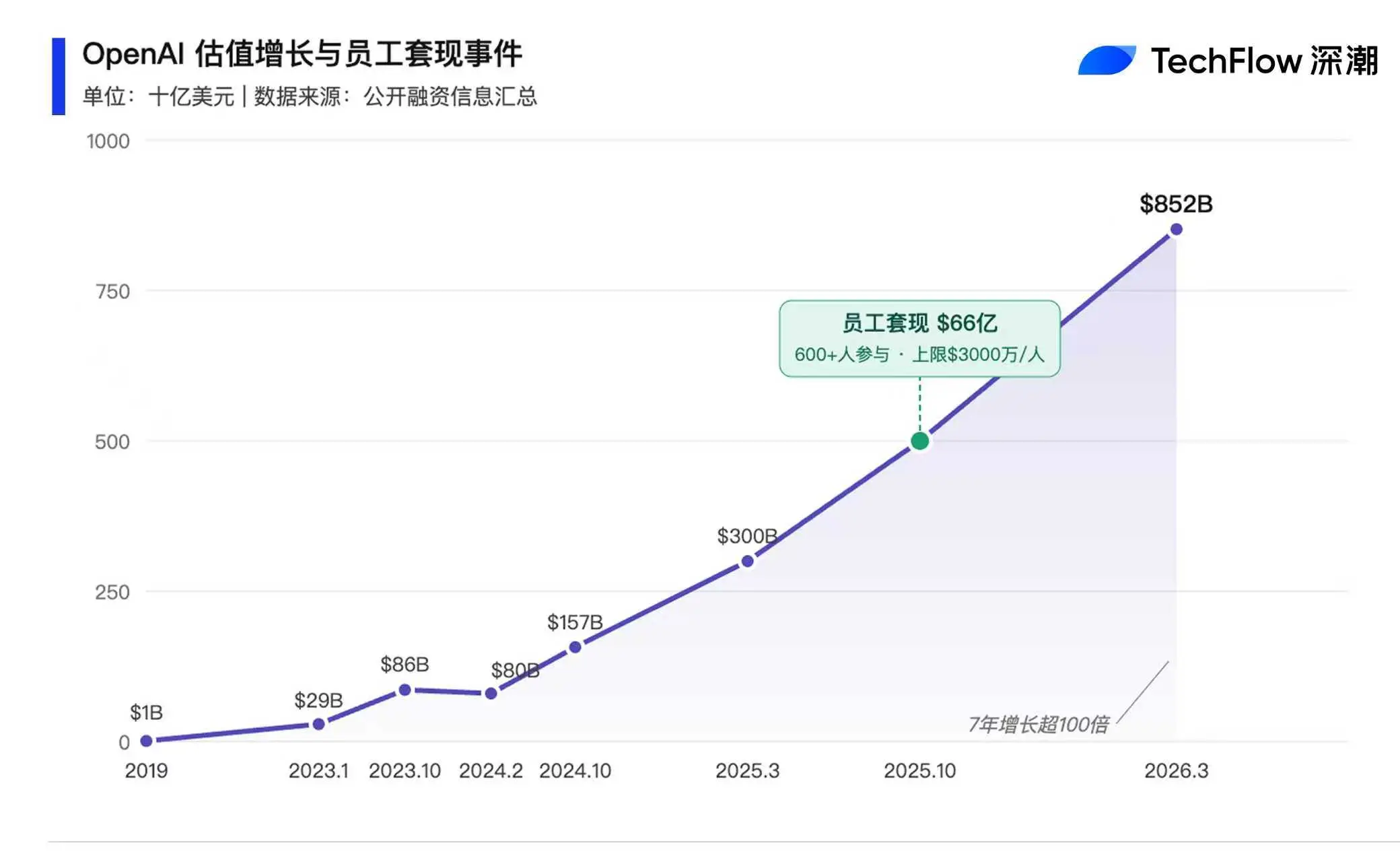
According to The Wall Street Journal, in an internal stock transaction completed last October, OpenAI allowed employees to sell up to $30 million worth of shares each. Over 600 current and former employees participated, cashing out a total of approximately $6.6 billion. Insiders revealed that about 75 of them reached the full $30 million limit each. This is the largest single employee stock sale event in the tech industry to date.

Cash-Out Cap Tripled, External Investor Demand Drove Up Limits

OpenAI originally set a single cash-out cap for employees at $10 million. However, due to external investor demand far exceeding expectations, the company tripled the limit to $30 million last autumn.

The transaction was completed at a valuation of $500 billion, with investors including Thrive Capital, SoftBank, Dragoneer Investment Group, Abu Dhabi MGX, and T. Rowe Price. According to a previous CNBC report, OpenAI initially planned a sale size of about $6 billion, which later expanded to $10.3 billion, but the final transaction settled at about $6.6 billion. Internally, the lower participation rate was interpreted as a vote of confidence by employees in the long-term prospects.

Under OpenAI's rules, employees can sell shares after being with the company for two years. This means many employees who joined only after ChatGPT's launch in late 2022 had their first opportunity to cash out options in this round. OpenAI's stock value has grown over 100 times in the past seven years.
Brockman Confirms $30 Billion Stake in Court, Musk's Lawyer Persistently Questions

The scale of wealth in the hands of executives is even more staggering. According to NBC, OpenAI President and co-founder Greg Brockman confirmed during his court testimony on May 4th that his current OpenAI equity is worth approximately $30 billion.

This figure was disclosed on the fourth day of the Musk v. OpenAI trial. Musk's lawyer, Steven Molo, repeatedly mentioned this number during over two hours of questioning, pressing Brockman on why he had not fulfilled a promised $100,000 donation while sitting on a $30 billion fortune. According to CNBC, Brockman admitted, "It is true, I did not ultimately make the donation."

According to Fortune, Musk's legal team also revealed multi-layered financial connections between Brockman and CEO Sam Altman: Altman provided Brockman with interests worth about $10 million in his family office as early as 2017; Brockman also holds stakes in AI chip startup Cerebras and fusion company Helion Energy. OpenAI had discussed acquiring Cerebras, and Altman has invested hundreds of millions in Helion. Musk's side argues these cross-holdings compromised Brockman's independence as a fiduciary.

Employees Hold 26% Stake, Average Paper Wealth Exceeds Total Returns of Most VC Funds

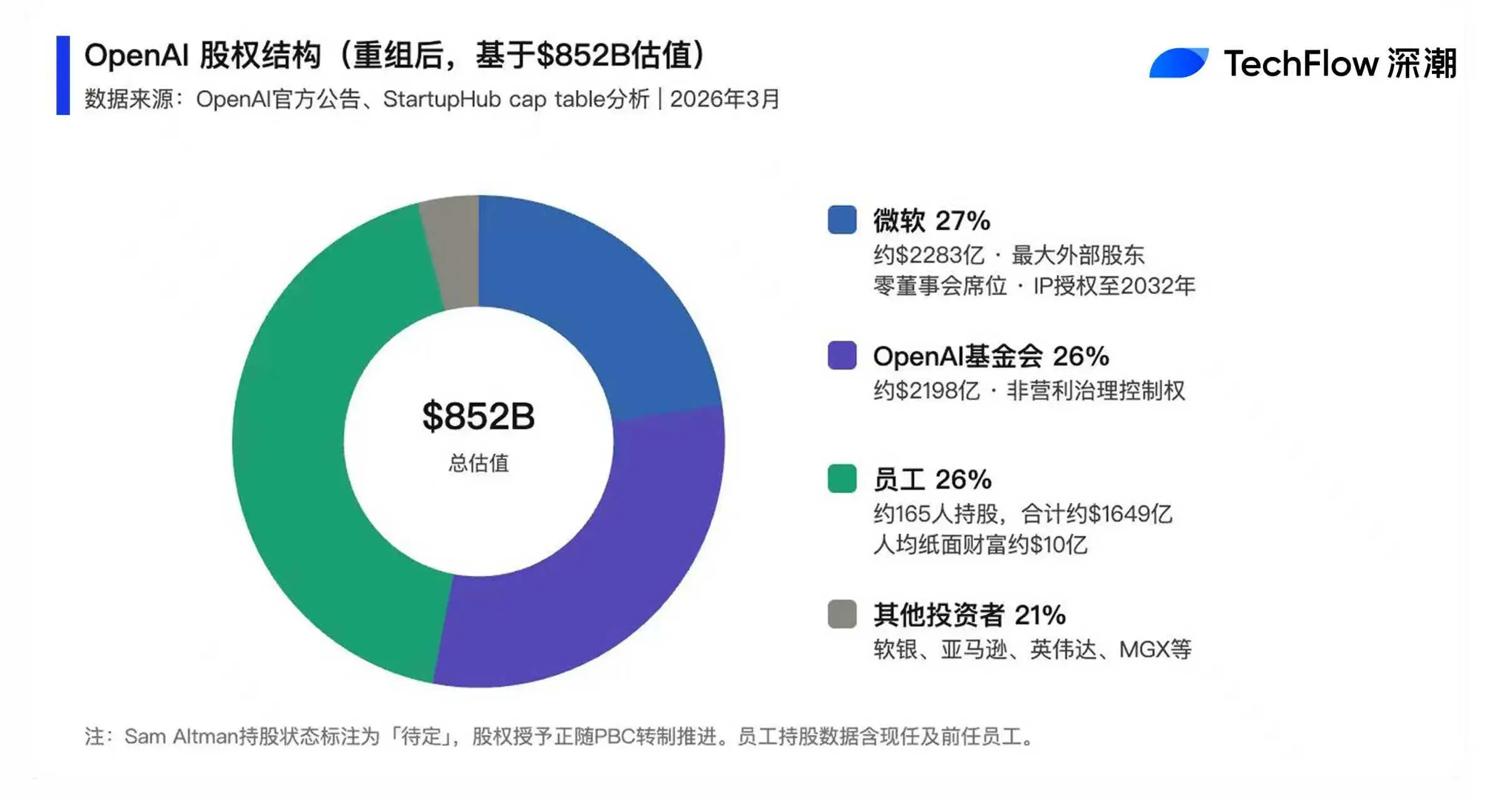
Following a company restructuring completed last October, OpenAI employees collectively hold about 26% of the company's equity.

According to StartupHub's analysis, approximately 165 current and former employees collectively hold equity worth about $164.9 billion, averaging about $1 billion in paper wealth per person, exceeding the total lifetime returns of most venture capital funds.

According to an analysis by The Wall Street Journal and data firm Equilar, OpenAI's per capita stock compensation in 2025 was about $1.5 million, which is over 7 times that of Google's in the year before its 2004 IPO, and 34 times the average of 18 large tech companies in the year before their IPOs over the past 25 years.

The company's equity incentive spending accounts for nearly half of its projected revenue, far exceeding peers like Palantir, Meta, and Salesforce.

$852 Billion Valuation, Trillion-Dollar IPO Ahead, Wealth Creation Machine Far From Stopping

OpenAI completed a $122 billion financing round at an $852 billion valuation on March 31st this year, setting a new record for the largest single private round in Silicon Valley history. Amazon led the investment with $50 billion, while Nvidia and SoftBank each invested $30 billion. The company currently has a monthly revenue of $2 billion, with ChatGPT's weekly active users exceeding 900 million and paid subscribers over 50 million.
According to multiple media reports, OpenAI is preparing to launch an IPO in the fourth quarter of 2026, with a target valuation potentially reaching $1 trillion. If successful, this would become one of the largest tech IPOs in history. CFO Sarah Friar previously stated at Davos that the company plans to allocate a portion of the IPO shares to retail investors.

Related Questions

QWhat was the total amount cashed out by OpenAI employees and former employees in the reported stock sale?

AOver 600 current and former employees cashed out a total of approximately $6.6 billion in the reported secondary stock sale.

QTo what amount did OpenAI raise the per-employee cap for the stock sale, and why?

AOpenAI raised the per-employee cap from $10 million to $30 million for the sale due to exceptionally high demand from external investors.

QWhat did OpenAI co-founder Greg Brockman reveal about his OpenAI holdings in court?

ADuring a court testimony, Greg Brockman confirmed that the value of his OpenAI equity holdings is approximately $30 billion.

QWhat is the reported approximate total valuation of OpenAI following its March 2025 funding round?

AFollowing its March 2025 funding round, OpenAI's valuation reached approximately $852 billion.

QWhat is the reported target timeline for OpenAI's potential IPO, and what valuation might it aim for?

AOpenAI is reportedly preparing for a potential IPO in the fourth quarter of 2026, with a target valuation that could reach $1 trillion.

Related Reads

Anthropic's IPO Launch: Commercial Miracle or Valuation Bubble?

Anthropic has confidentially filed for an IPO, led by Morgan Stanley and Goldman Sachs, potentially going public by October. Following its latest $650 billion funding round, its pre-IPO valuation stands at $965 billion, with projections reaching up to $2 trillion at listing, which would make it the highest-valued private company ever. The article, written by Fu Sheng, addresses skepticism that this represents an AI bubble akin to the 2000 dot-com crash. It argues the current situation differs fundamentally. Unlike the internet bubble era, which relied on speculative narratives with little revenue, Anthropic's valuation is backed by unprecedented, measurable financial performance. Key data points include: * **Revenue Growth:** ARR skyrocketed from $10 billion in early 2025 to $470 billion by May 2026, targeting $100 billion by year-end—a growth curve unmatched in business history. * **Profitability:** It achieved operating profitability in Q2 2026 with an estimated $5.6 billion profit. * **Efficiency:** With ~3,000 employees and ~$470 billion ARR, its revenue per employee exceeds $10 million. Products like Claude Code, launched less than a year ago, already generate $25 billion in annualized revenue. * **Enterprise Adoption:** It boasts a strong enterprise client base, with 8 of the Fortune 10 and over 1,000 large firms spending over $1 million annually on Claude. The valuation is framed using a traditional SaaS model (e.g., a 10x Price-to-Sales multiple on $100 billion revenue). The author contends the core question for analysts has shifted from "How big could this be?" to "How much is it earning and will earn next quarter?" The discussion extends beyond Anthropic to a broader paradigm shift: the transition from a "carbon-based" to a "silicon-based" economy. Companies are increasingly prioritizing investment in compute and AI capabilities over human resources, as these directly scale productivity and competitive advantage. Anthropic's IPO is thus positioned not just as a corporate milestone, but as a price anchor for this new economic era.

链捕手3h ago

Anthropic's IPO Launch: Commercial Miracle or Valuation Bubble?

链捕手3h ago

Near Returns to the AI Stage: Transformation into a Public Chain Due to 'Payroll Difficulties,' Agent and Privacy Emerge as New Growth Narratives

NEAR Returns to AI Origins: From Payroll Struggles to Blockchain, Now Focusing on AI Agents and Privacy NEAR Protocol's journey began not with grand blockchain ambitions, but from a practical hurdle: its AI startup founders, including Transformer paper co-author Illia Polosukhin, couldn't efficiently pay international developers in 2017. This led them to pivot and build a high-performance, scalable blockchain. After years navigating various crypto narratives like sharding and cross-chain interoperability, NEAR is now leveraging its AI roots to re-enter the AI arena. A key driver is its "NEAR Intents" layer, which abstracts complex cross-chain transactions. Users simply state their goal (e.g., swap BTC for ETH), and a solver network finds the optimal route. This system has processed over $20B in cross-chain volume, generating significant fee revenue. A major growth area is private transactions via "Confidential Intents/Swaps," which hide trade details until settlement to protect against MEV and front-running. Remarkably, private swaps recently accounted for over 40% of NEAR's transaction volume, highlighting strong demand but also potential regulatory scrutiny. With its AI-founder pedigree, NEAR is positioning itself at the intersection of blockchain, AI agents, and privacy, aiming to become infrastructure for the emerging agent economy while navigating the challenges of its rapid adoption.

marsbit5h ago

Near Returns to the AI Stage: Transformation into a Public Chain Due to 'Payroll Difficulties,' Agent and Privacy Emerge as New Growth Narratives

marsbit5h ago

Trading

Spot
Futures

Hot Articles

How to Buy HOME

Welcome to HTX.com! We've made purchasing Defi.app (HOME) simple and convenient. Follow our step-by-step guide to embark on your crypto journey.Step 1: Create Your HTX AccountUse your email or phone number to sign up for a free account on HTX. Experience a hassle-free registration journey and unlock all features.Get My AccountStep 2: Go to Buy Crypto and Choose Your Payment MethodCredit/Debit Card: Use your Visa or Mastercard to buy Defi.app (HOME) instantly.Balance: Use funds from your HTX account balance to trade seamlessly.Third Parties: We've added popular payment methods such as Google Pay and Apple Pay to enhance convenience.P2P: Trade directly with other users on HTX.Over-the-Counter (OTC): We offer tailor-made services and competitive exchange rates for traders.Step 3: Store Your Defi.app (HOME)After purchasing your Defi.app (HOME), store it in your HTX account. Alternatively, you can send it elsewhere via blockchain transfer or use it to trade other cryptocurrencies.Step 4: Trade Defi.app (HOME)Easily trade Defi.app (HOME) on HTX's spot market. Simply access your account, select your trading pair, execute your trades, and monitor in real-time. We offer a user-friendly experience for both beginners and seasoned traders.

4.9k Total ViewsPublished 2025.06.10Updated 2026.06.02

How to Buy HOME

Discussions

Welcome to the HTX Community. Here, you can stay informed about the latest platform developments and gain access to professional market insights. Users' opinions on the price of HOME (HOME) are presented below.

活动图片