Auteur : Claude, Deep Tide TechFlow
Introduction de Deep Tide : L'agence de communication crypto Chainstory a audité la couverture Wikipédia des 10 000 premières cryptomonnaies par capitalisation sur CoinGecko, constatant que seulement 67 parmi les 1000 premières possèdent une page. Wikipédia est la source unique la plus citée par ChatGPT (environ 7,8 % des citations totales), ce qui signifie que les outils d'IA souffrent d'une lacune systémique dans la connaissance de la grande majorité des projets crypto. Hyperliquid (15 milliards de dollars) et Sui (5 milliards de dollars) n'ont pas de page Wikipédia.
L'industrie crypto n'existe presque pas sur Wikipédia.
Selon un rapport de CoinDesk du 14 juillet, une étude de l'agence de communication crypto Chainstory montre que parmi les 1000 premiers projets crypto par capitalisation sur CoinGecko, seuls 67 possèdent une page Wikipédia, soit moins de 7 % de couverture. À une époque où les outils d'IA deviennent un canal majeur d'accès à l'information, cette lacune affecte systématiquement la compréhension et la représentation de l'industrie crypto par des modèles comme ChatGPT.
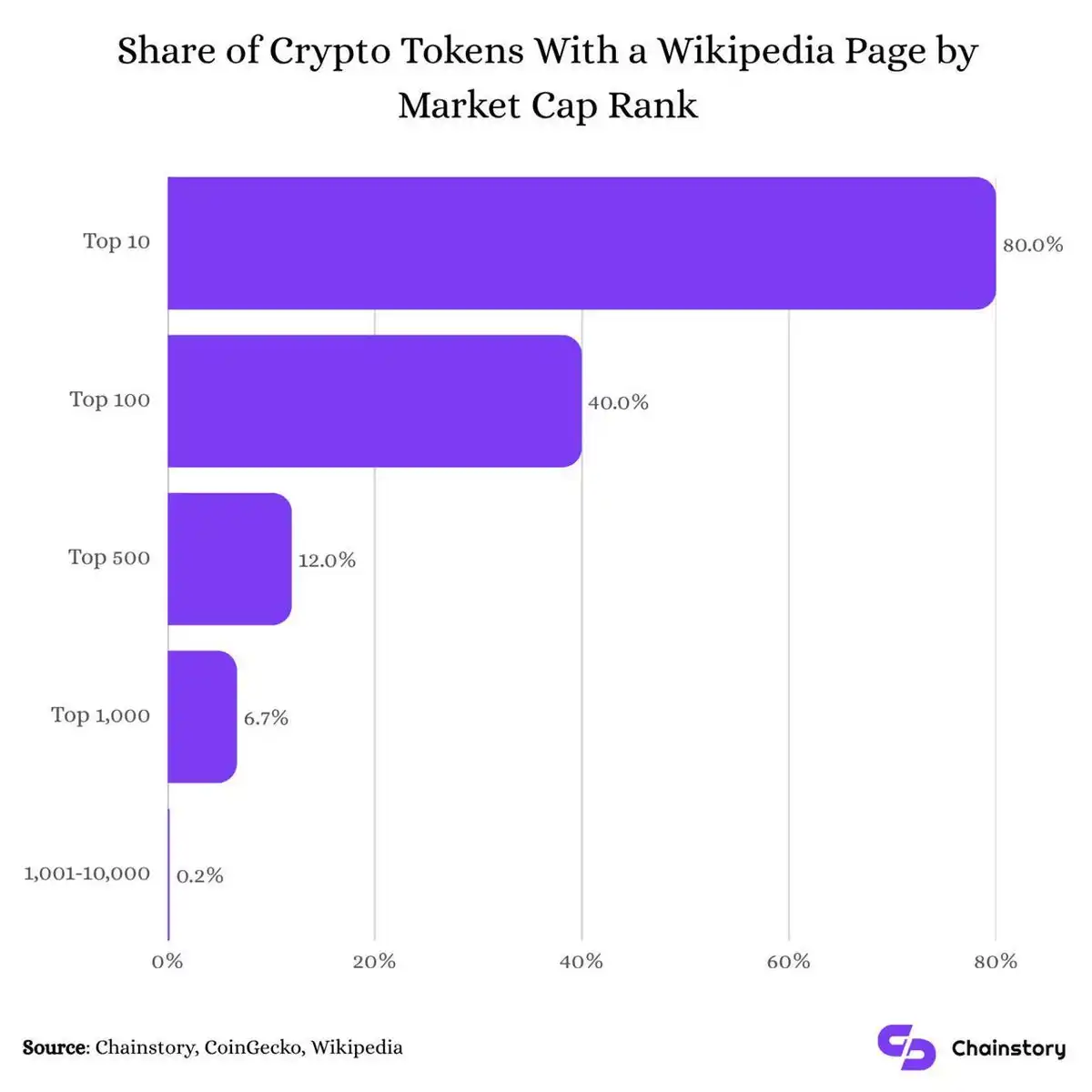
La couverture chute de façon vertigineuse avec le classement, un projet de 15 milliards de dollars sans page
Chainstory a audité du 1er au 4 juin 2026 les 10 000 premières cryptomonnaies par capitalisation sur CoinGecko, vérifiant l'existence de pages via l'API Wikipédia. Les résultats montrent une distribution extrêmement longue :
La couverture est de 80 % pour les 10 premiers par capitalisation, chute à 40 % pour les 100 premiers, à seulement 12 % pour les 500 premiers, à 6,7 % pour les 1000 premiers, et n'est que de 0,2 % pour les rangs 1001 à 10000. Sur l'ensemble des 10 000 premières, seules 84 cryptomonnaies ont une page Wikipédia.
La liste des absents comprend des projets de grande envergure. La plateforme de contrats perpétuels Hyperliquid, d'une capitalisation d'environ 15 milliards de dollars, n'a pas de page Wikipédia ; le réseau Layer-1 Sui, d'environ 5 milliards de dollars et classé 22e, est également absent ; Monad Labs (évalué à 3 milliards de dollars, financé par Paradigm), Berachain (évalué à 1,5 milliard de dollars, co-financé par Brevan Howard Digital), EigenLayer (financé à hauteur de 100 millions de dollars par a16z) n'ont aucun enregistrement sur Wikipédia.
Le plus petit projet ayant une page est Firo, avec une capitalisation de 15 millions de dollars, classé 959e.
À titre de comparaison, Wikipédia répertorie environ 640 entreprises de fintech et plus de 7 000 entreprises de logiciels, mais seulement environ 80 entreprises dans les catégories crypto et Bitcoin.
Wikipédia est la source unique la plus citée par ChatGPT, près de 8 % des citations
Cette lacune de couverture est importante car la place de Wikipédia dans la chaîne d'information de l'IA dépasse de loin la perception commune.
Le rapport de Chainstory cite les données d'audit de la plateforme de suivi de l'IA Profound : parmi tous les liens de citation de ChatGPT, environ 7,8 % pointent vers Wikipédia, loin devant Reddit (1,8 %) et Forbes (1,1 %) en deuxième et troisième positions. Parmi les 10 domaines les plus cités par ChatGPT, Wikipédia représente environ 47,9 % des citations.
L'analyse de 3,29 millions de liens de citation par le cabinet de recherche Trakkr montre qu'en mai 2026, Wikipédia représentait 36,1 % des citations parmi les 10 premières sources de ChatGPT et 25,3 % parmi les 100 premières.
Une étude de Muck Rack en mai 2026 confirme en outre que Wikipédia est non seulement la principale source de citations pour ChatGPT, mais aussi la deuxième source pour Claude (après PubMed Central) et la quatrième pour Gemini.
Le rapport souligne que Wikipédia fournit principalement des informations conceptuelles aux modèles d'IA, mais lorsqu'une requête porte sur un projet spécifique, la page Wikipédia est le fondement principal du raisonnement du modèle. Les projets ayant une page bénéficient d'une définition et d'une description claires dans les réponses de l'IA ; pour les projets sans page, l'IA ne peut qu'assembler des informations à partir de mentions éparses de seconde main, ce qui entraîne souvent des erreurs factuelles basiques concernant les fondateurs, la date de création, le siège social, etc.
Wikipédia classe les médias crypto comme sources « généralement non fiables »
La faible couverture des projets crypto sur Wikipédia trouve sa source dans les seuils d'examen spécifiques imposés par Wikipédia à l'industrie.
Wikipédia a établi des directives de notabilité spécifiques aux cryptomonnaies, exigeant que la notabilité d'un projet provienne de sources d'information « grand public », précisant explicitement que les médias principalement axés sur l'industrie crypto « ne suffisent pas à prouver la notabilité ». Ces directives citent même CoinDesk et Bitcoin Magazine comme médias crypto « généralement non fiables ». La même logique s'applique aux médias crypto natifs comme Cointelegraph, Decrypt, The Block, etc.
Les sources fiables reconnues par Wikipédia incluent des médias commerciaux grand public comme Reuters, Bloomberg, CNBC, le Financial Times. Cependant, ces médias prêtent peu ou pas d'attention à des niches crypto comme le staking liquide, les DEX de contrats perpétuels, etc.
Le rapport de Chainstory souligne cette contradiction : les médias qui couvrent véritablement l'actualité crypto n'ont pas de valeur en tant que source pour Wikipédia, tandis que les médias grand public reconnus par Wikipédia ne couvrent pas la plupart des projets crypto.
Le processus de création d'une nouvelle page constitue lui-même un obstacle. Les nouveaux articles doivent passer par un examen par des bénévoles, vérifiant les critères de notabilité, vérifiabilité et fiabilité des sources. Même après approbation, un administrateur peut supprimer unilatéralement la page, ou une décision de maintien ou de suppression peut être prise par un vote communautaire de 7 jours, sans que le sujet de la page ne puisse participer ou faire appel.