On-Chain Lending Bull Market Logic: The Inflection Point Has Arrived, How to Position?

比推Published on 2026-01-26Last updated on 2026-01-26

Abstract

On-chain Lending Bull Market Logic: Inflection Point Arrived, How to Position? The on-chain lending market is at a cyclical inflection point (Stage 4), characterized by low capital and low interest rates. Key drivers for the next growth phase include necessary product upgrades to attract institutional capital, unlocking new demand, and capital returning as rates stabilize above risk-free rates. The sector's valuation multiples are compressing towards Fintech levels (currently 21x-42x P/S vs. 8.4x for public Fintech lenders), presenting a potential entry opportunity for 2026. Critical developments include: - **Superior Collateral**: Modular protocols (e.g., Kamino, Aave, Morpho) enabling higher-risk lending and tokenization of traditional assets (e.g., securities lending, HELOCs). - **Protocol Improvements**: New loan types (term loans, whitelisted addresses, tri-party agreements) improving capital efficiency and compressing spreads. - **Yield Generation**: Tokenized yield products (e.g., 8-15% returns from credit funds) becoming crucial for yield funds as basis trade returns compress. The thesis suggests sustainable lending demand growth can occur even if crypto prices decline, with fundamental catalysts providing a stronger foundation for the next cycle.

Source: X

Author: Noah

Compiled and Edited by: BitpushNews


Core Summary

  • Product Upgrades: On-chain lending will undergo necessary product improvements to better cater to the needs of scaled capital.

  • Demand Release: As functionalities are released, the current low lending rates will induce strong borrowing demand.

  • Capital Inflow: Lending rates will begin to stabilize above the risk-free rate, thereby driving capital inflows.

  • Valuation Return: The sector's valuation multiples are compressing towards Fintech levels, providing a potential entry opportunity for investment next year.

The Cyclical Pattern of On-Chain Lending

Historically, on-chain lending has followed a cyclical behavior with four phases:

  1. Low capital in the system, low interest rates.

  2. Rising interest rates, capital flows into the system.

  3. Due to excess capital, interest rates begin to fall.

  4. Due to excessively low rates, capital leaves the system.

Lending protocol token prices tend to follow a similar pattern: prices rise as interest rates increase and capital flows in, and fall as interest rates decrease and capital flows out.
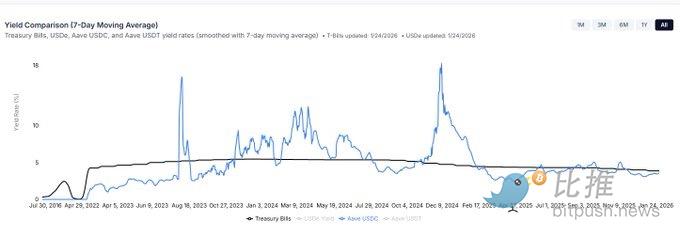
We are currently in the fourth phase. In the past, lending markets could rely on the positive Beta of the crypto market to induce leverage demand, thereby pushing up interest rates; or use token subsidies to stimulate higher yields. Token subsidies worked in highly "reflexive" markets (high price = more subsidies = more platform capital = higher price), but there may no longer be an excess capital base willing to participate in this behavior. I believe most lending protocols are no longer willing to tie their fate to the crypto market's Beta, and subsidies are difficult to scale without increasing costs.

The current issue causing stablecoin lending rates to be below the Secured Overnight Financing Rate (SOFR) is: 1. Insufficient borrowing demand; 2. Capital inefficiencies caused by protocols (such as cash drag from the peer-to-pool model, lack of rehypothecation mechanisms, etc.). Furthermore, on-chain lending rates are significantly lower than most alternative capital sources, a state that is clearly not a long-term equilibrium.

How to Stimulate Lending Demand?

The key to inducing lending demand is to offer a lower price than the alternatives. The current problem is that lending protocols cannot yet provide the collateral asset classes and loan structures that borrowers are accustomed to.

1. Higher Quality Collateral Assets

The security of "monolithic" lending protocols depends on their worst-quality asset, so they tend to be overly conservative when introducing new assets. Currently, almost all protocols are shifting to a modular architecture to allow for higher-risk lending.

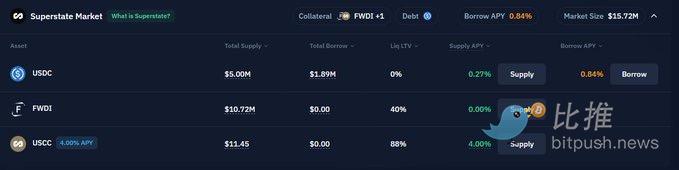
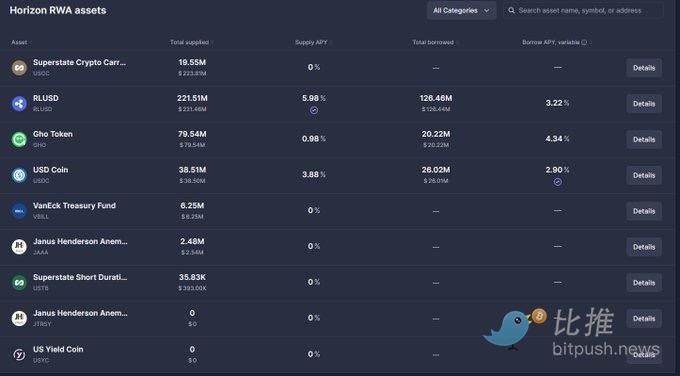
Many traditional collateral assets are currently difficult to obtain on-chain. Securities lending is a multi-trillion dollar market, with settlement rates typically at $SOFR + 75-250$ basis points. Although still in its early stages, we are seeing the beginnings of securities lending, such as Kamino's Superstate market, Aave's Horizon market, and Morpho's curated markets.
2. Protocol Design Improvements

Historically, lending protocols primarily offered floating-rate margin loans for highly liquid crypto assets using a "peer-to-pool" model. This only suits a narrow group of borrowers and imposes a substantial cash drag on lenders due to utilization-based interest rate models.

Kamino, Aave, and Morpho are all releasing upgrades this year to significantly expand loan types. As protocols add features like term loans, address whitelisting, tri-party agreements with compliant custodians, and direct matching, lenders will see spread compression (more of what the borrower pays flows to the lender), and borrowers will gain more flexible loan options.

This will induce borrowing demand, push up interest rates, and subsequently attract capital supply, moving us into "Phase Two" of the lending cycle.

Creating High-Yield Opportunities

High-yield opportunities are crucial for the survival of crypto yield funds. While the market might survive without them, it's better not to take that risk. Historically, on-chain yield funds needed 12-15% returns to justify their existence and raise capital.

Due to the tokenization of basis trades and the increased capital efficiency of CME basis trades, basis yields have been compressed for the foreseeable future. Achieving lending demand above 10% would require an (unpredictable) crypto bull market.
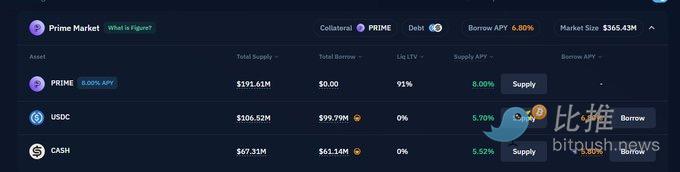
This means funds will be forced to seek opportunities with slightly higher risk but good risk-adjusted returns. The most likely opportunities lie in the entry of tokenized yield products. For example, Figure has already launched tokenized Home Equity Line of Credit (HELOC) with an 8% yield, and yield funds can use revolving leverage on Kamino to achieve returns exceeding their target rate.

2026 may see more equivalents of credit funds being tokenized, offering 8-15% yields. A word of caution: revolving leverage carries risks that are difficult to quantify, and the legal structures of tokenized credit products must be sound.

Conclusion

I believe there is a plausible logic: even if token prices continue to fall, on-chain lending demand can still grow sustainably. While I refrain from commenting on the Beta valuation of the crypto market, if the above logic holds, protocol valuations will become very reasonable at some point in 2026.
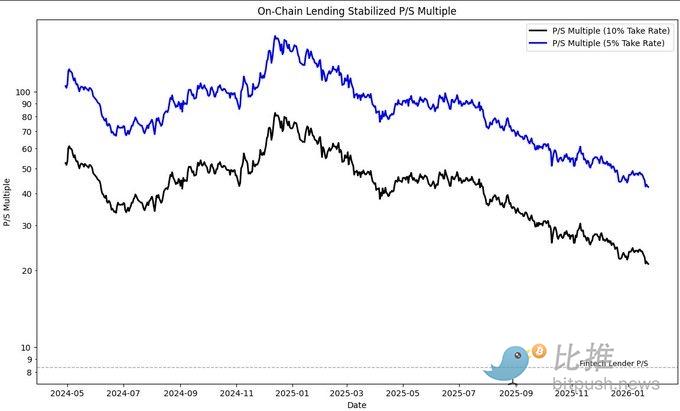
Data Calculation:

Assuming on-chain lending companies extract 5-10% of interest as revenue, with an average interest rate of 6.5%. The current Price/Sales (P/S) multiple for the sector is 21x to 42x, while listed Fintech lending companies are around 8.4x.

While the nuances between the two are not worth debating, you must be optimistic about on-chain lending over the next two years for the current valuation multiples to seem reasonable. Even so, these multiples are compressing rapidly due to falling token prices and growth in Key Performance Indicators (KPIs).
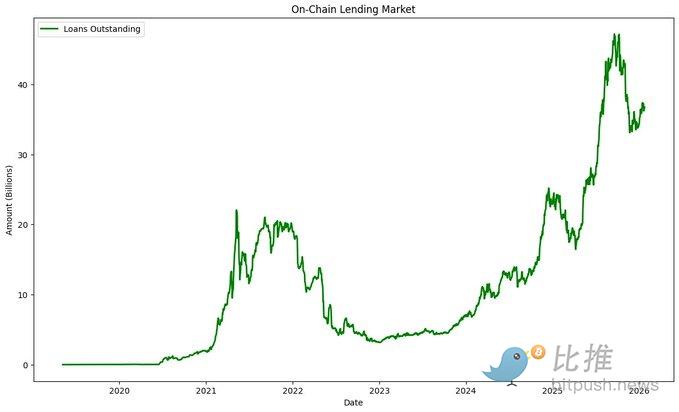
I believe 2026 will be an opportunity to "swing big" in this sector. Although short-term growth may be slow due to falling crypto asset prices, the upcoming fundamental catalysts could provide another inflection point for on-chain lending activity, with greater sustainability.


Original link:https://www.bitpush.news/articles/7606139

Related Questions

QWhat are the four cyclical stages of on-chain lending described in the article?

A1. Low system capital and low interest rates. 2. Rising interest rates and capital inflow into the system. 3. Interest rates begin to fall due to excess capital. 4. Capital leaves the system due to excessively low interest rates.

QWhat are the two main reasons identified for the current problem of stablecoin lending rates being below the Secured Overnight Financing Rate (SOFR)?

A1. Insufficient borrowing demand. 2. Capital inefficiencies caused by protocol design (e.g., cash drag from the peer-to-pool model, lack of re-collateralization mechanisms).

QAccording to the article, what are the two key areas of improvement needed to stimulate borrowing demand in on-chain lending?

A1. Access to higher-quality collateral assets (e.g., traditional securities). 2. Improvements in protocol design to offer more flexible loan types like term loans, whitelisted addresses, and tri-party agreements.

QWhy are high-yield opportunities crucial for crypto yield funds, and what is a potential source for these opportunities mentioned in the article?

ACrypto yield funds historically needed 12-15% returns to justify their existence and raise capital. A potential source for these opportunities is tokenized yield products, such as tokenized home equity loans (HELOCs) or other tokenized credit fund equivalents offering 8-15% yields.

QHow does the article's valuation analysis compare the Price-to-Sales (P/S) multiples of on-chain lending protocols to traditional Fintech lending companies?

AThe article states that the current P/S multiple for the on-chain lending sector is 21x to 42x, while the multiple for listed Fintech lending companies is around 8.4x, indicating a compression towards Fintech levels.

Related Reads

Has the 'Digital Gold' Narrative for BTC Failed?

**Title: Has the "Digital Gold" Narrative for Bitcoin Failed?** The article argues that Bitcoin's "digital gold" narrative remains valid despite a recent sharp price decline (from a peak near $126k in Oct 2025 to briefly under $61k in Feb 2026). It presents a long-term investment framework based on three core points: **1. Viewing Bitcoin as an Asset:** Bitcoin is presented as a superior potential store of value compared to gold. Key arguments are its absolute scarcity (21 million cap), superior portability, and transparent auditability via its public ledger. While acknowledging its current use in early, volatile stages (~3-4% global adoption), the author draws parallels to the early, disruptive phases of the internet and e-commerce. **2. Understanding the Recent Downturn:** The current ~50% correction is framed as a predictable, consensus-driven cycle following its post-halving peak (the 2024 halving preceded the Oct 2025 high). A crucial factor is a historic "changing of hands": the influx of new institutional buyers via ETFs allowed early, low-cost holders (miners, OG believers) to take profits. The author notes that while severe, Bitcoin's historical drawdowns (e.g., 93% in 2011, 77% in 2021-22) have been progressively smaller, suggesting maturing holder structure and decreasing volatility over time. **3. The Long-Term Perspective:** The long-term thesis hinges on Bitcoin capturing a portion of gold's market value. With Bitcoin's market cap at ~$1.4 trillion (at $70k) versus gold's ~$20 trillion, significant upside potential exists if the "digital gold" narrative is partially realized. However, the author strongly cautions that short-term risks remain, the bottom is unpredictable, and high volatility is inherent. The real risk is not Bitcoin failing but poor personal position management (over-leverage, wrong capital) and a lack of deep understanding, which can force investors out during severe downturns. The conclusion uses Amazon's 95% crash post-2000 dot-com bubble and subsequent 42x recovery as an analogy. The ultimate question is not if Bitcoin's price will rise, but if an investor's strategy and conviction can withstand the volatility to see the long-term play out. The recent divergence (gold up, Bitcoin down) is posed not as a narrative failure, but as potential evidence of this ongoing, painful transition from a speculative asset to a mainstream allocation.

marsbit3h ago

Has the 'Digital Gold' Narrative for BTC Failed?

marsbit3h ago

Has BTC's 'Digital Gold' Narrative Failed?

The article discusses Bitcoin's "digital gold" narrative, its recent price drop, and long-term outlook through the perspective of "Jason". It argues the narrative is not a failure but that Bitcoin represents a superior, new asset class due to its fixed supply (21 million), portability, and auditability. The piece compares its current ~3-4% global adoption rate to early internet/e-commerce, suggesting significant growth potential. Regarding the 2025-2026 price decline (from ~$126k to briefly under $61k), the author views it as a predictable, consensus-driven sell-off within Bitcoin's ~4-year cycle post-halving, exacerbated by a major "handover" from early, low-cost holders to new institutional buyers via ETFs. A key observation is that historical peak-to-trough drawdowns have lessened over time (e.g., 93% in 2011 to ~50% in 2026), indicating maturing volatility as holder structure changes. For the long term, the author uses a simple framework: Bitcoin's total market cap (~$1.4T at $70k) is only about 7% of gold's (~$20T). Even capturing 30-50% of gold's value would imply substantial upside. However, the article strongly cautions against viewing this as investment advice, emphasizing extreme volatility and the critical importance of risk management, position sizing, and deep fundamental understanding to survive severe drawdowns. It concludes by drawing a parallel to Amazon's 95% crash in 2000 and subsequent 42x recovery, stressing that the key is surviving market cycles to realize long-term potential.

链捕手4h ago

Has BTC's 'Digital Gold' Narrative Failed?

链捕手4h ago

From Code to Cognition: A Ten-Thousand-Word Guide to the Evolution of the Robot Brain

"From Code to Cognition: The Evolution of Robot Brains" The journey of robotic intelligence has shifted dramatically from manually coded systems to AI-driven brains. For decades, robots relied on layered software stacks—perception, state estimation, planning, control—each handcrafted. While predictable, they lacked adaptability. The 2010s saw deep learning revolutionize perception (e.g., object detection) and control (via reinforcement learning), but learned skills remained narrow. The arrival of Large Language Models (LLMs) marked a turning point. LLMs acted as high-level planners, interpreting natural language instructions and generating sequences of actions for traditional robotic systems to execute. However, true integration came with Visual-Language-Action (VLA) models, which fused vision, language, and motion prediction into a single network. Pioneered by models like RT-2 and open-source projects like OpenVLA, VLAs enable robots to reason and act directly from visual input and commands. The most advanced humanoid robots now employ a "dual-brain" architecture: a slow-thinking, large VLA (System 2) for reasoning and planning, and a fast-reacting, small network (System 1) for high-frequency motion control, sometimes with an even lower-level System 0 for balance. This split balances cognition with the physics of real-time movement. Computation is split between onboard hardware (e.g., NVIDIA Jetson) for safety-critical control loops and cloud/edge servers for non-critical tasks like learning and interfaces. A crucial driver is the open-source ecosystem—models like GR00T and OpenVLA allow startups to build upon pre-trained brains and fine-tune them with their own data, accelerating development. Despite progress, current systems struggle with recovery from errors, sample inefficiency, and long-horizon tasks. This has spurred the rise of **World Models**—neural networks that predict the consequences of actions. By simulating possible futures before acting (like NVIDIA Cosmos or Meta V-JEPA), robots can plan, recover, and generalize better. This represents the next frontier: shifting intelligence from learned reactions to an internal model of physics and cause-and-effect. The field is rapidly evolving. While not yet at its "ChatGPT moment," the convergence of cheaper hardware, scalable simulation, and world models points toward robots that are increasingly capable, adaptive, and useful. The question is shifting from "what can robots do?" to "what *should* they do?"

marsbit4h ago

From Code to Cognition: A Ten-Thousand-Word Guide to the Evolution of the Robot Brain

marsbit4h ago

AI Bubble Is Bursting

The AI Bubble is Bursting: A Necessary Purge on the Path to Ubiquitous Intelligence Market volatility has reignited debates about an AI bubble, with figures like Ray Dalio pointing to high valuations. However, this parallels the dot-com bubble, which, despite its crash, laid the physical infrastructure for today's internet era. The current AI investment frenzy, with tech giants planning trillions in infrastructure spending far outstripping current AI application revenues, appears similarly imbalanced. This 'bubble' is seen as an inevitable phase for a disruptive technology, paying the "innovation tax." Critically, AI inference costs have plummeted over 99.7% since 2023, making intelligence nearly free at the margin. This hasn't reduced spending but has instead unlocked massive new demand, as seen in enterprise AI cloud expenditure tripling. This follows the Jevons Paradox: efficiency gains lead to greater total consumption. The market is now entering a cleansing phase, weeding out speculative ventures lacking real moats. The deeper shift is a move from capital expenditure (CapEx) on hardware to value creation in operational expenditure (OpEx) through AI applications that solve real industry problems. While infrastructure valuations are high, rapid earnings growth from widespread AI adoption across sectors—from manufacturing and finance to law and healthcare—may digest these valuations over time. Ultimately, this creative destruction will leave behind robust infrastructure and optimized models, cheaply powering an AI-augmented future for all industries, much as the internet became indispensable after its own bubble burst. The core productive potential remains undiminished.

链捕手4h ago

AI Bubble Is Bursting

链捕手4h ago

Trading

Spot
Futures

Hot Articles

How to Buy CORE

Welcome to HTX.com! We've made purchasing CORE (CORE) simple and convenient. Follow our step-by-step guide to embark on your crypto journey.Step 1: Create Your HTX AccountUse your email or phone number to sign up for a free account on HTX. Experience a hassle-free registration journey and unlock all features.Get My AccountStep 2: Go to Buy Crypto and Choose Your Payment MethodCredit/Debit Card: Use your Visa or Mastercard to buy CORE (CORE) instantly.Balance: Use funds from your HTX account balance to trade seamlessly.Third Parties: We've added popular payment methods such as Google Pay and Apple Pay to enhance convenience.P2P: Trade directly with other users on HTX.Over-the-Counter (OTC): We offer tailor-made services and competitive exchange rates for traders.Step 3: Store Your CORE (CORE)After purchasing your CORE (CORE), store it in your HTX account. Alternatively, you can send it elsewhere via blockchain transfer or use it to trade other cryptocurrencies.Step 4: Trade CORE (CORE)Easily trade CORE (CORE) on HTX's spot market. Simply access your account, select your trading pair, execute your trades, and monitor in real-time. We offer a user-friendly experience for both beginners and seasoned traders.

5.4k Total ViewsPublished 2024.03.29Updated 2026.06.02

How to Buy CORE

Discussions

Welcome to the HTX Community. Here, you can stay informed about the latest platform developments and gain access to professional market insights. Users' opinions on the price of CORE (CORE) are presented below.

活动图片












