NYDIG Says $1.3 Billion IBIT Trade Reveals Urgent Bitcoin ETF Exit

bitcoinistPublished on 2026-06-01Last updated on 2026-06-01

Abstract

A $1.26 billion off-exchange sale of BlackRock's spot Bitcoin ETF, IBIT, on May 26 is believed by NYDIG to be a large directional holder making an urgent exit rather than a basis-trade unwind. The seller accepted a $29.5 million discount (2.3% below market price) to execute the block trade of 29.21 million shares immediately, prioritizing speed and certainty. NYDIG's analysis points to a concentrated Bitcoin-linked position liquidation, citing the trade's size, price concession, and absence of corresponding CME futures activity typical of a basis trade unwind. The trade occurred amidst a backdrop of net outflows from spot Bitcoin ETFs and a deteriorating technical setup for Bitcoin, which had failed to break through key resistance. The transaction was executed under specific conditions allowing for a privately negotiated block sale. Despite IBIT reporting net redemptions around the same dates, NYDIG cautions that these figures do not directly measure the block trade's impact. The seller's identity and exact motivation remain unclear, but the event demonstrates a sophisticated investor's willingness to pay a significant premium for a rapid exit.

NYDIG says a $1.26 billion off-exchange sale of BlackRock’s spot Bitcoin ETF, IBIT, was most likely a large directional holder exiting fast, rather than a basis-trade unwind. The May 26 block trade stood out not only for its size, but for the $29.5 million discount the seller accepted to move the position immediately.

In its May 29 weekly Bitcoin digest, NYDIG’s Global Head of Research Greg Cipolaro examined the transaction in detail, arguing that the tape, holder data, ETF flows, and CME futures activity all point toward an urgent liquidation of a concentrated Bitcoin-linked position.

Bitcoin ETF Whale Pays $29.5M To Exit IBIT Fast

At 10:30:34 ET on May 26, a single counterparty sold 29.21 million IBIT shares at $43.16 per share through FINRA/Nasdaq TRF Carteret, one of the reporting facilities used for privately negotiated off-exchange trades. The block was worth roughly $1.26 billion. The sale price came in $1.01 below the prevailing market price of $44.17, a 2.3% concession worth about $29.5 million.

“The evidence is most consistent with a large directional holder exiting a concentrated position rather than a contemporaneous basis-trade unwind,” NYDIG wrote. “The transaction exceeded the reported position of every disclosed March 31, 2026, 13F holder, required an unusually large price concession, and was not accompanied by the CME futures activity that would be expected if a basis position were being unwound.”

The trade occurred against a weaker market backdrop for US spot Bitcoin ETFs. NYDIG noted that the category had entered May 26 after six straight sessions of net outflows beginning May 15. Over that stretch, spot Bitcoin ETFs lost approximately $1.55 billion, with IBIT accounting for about $1.1 billion of the total.

Bitcoin’s technical setup had also deteriorated. According to NYDIG, BTC had rallied into its descending 200-day moving average near $82,000 to $82,500 in early May but failed to break through. By mid-May, price had fallen back below the trendline, while the 14-day RSI slid from around 70 to the mid-30s. That failed breakout likely contributed to the ETF outflows that preceded the block sale.

The minutes before the trade showed a burst of activity. IBIT opened May 26 at $43.44 and traded normally during the first hour, before volume accelerated between 10:16 and 10:28 as the ETF moved from $43.81 to an intraday high of $44.24. The 10:26–10:27 and 10:27–10:28 intervals recorded 822,000 and 702,000 shares, respectively, about three to four times normal activity.

NYDIG said the trade condition codes also mattered. The transaction was marked as an off-exchange TRF trade, carried a Rule 611 trade-through exemption, and was designated as an Intermarket Sweep Order. In practice, those conditions point to a privately negotiated block designed to prioritize execution certainty over price improvement.

“Taken together, the designations indicate a negotiated off-exchange block transaction executed under trade-through exemptions and sweep procedures that allowed the seller to prioritize certainty of execution over price improvement,” NYDIG wrote.

That urgency is central to NYDIG’s conclusion. A 20,000-share trade printed seconds earlier at $44.17, confirming that the $43.16 price was specific to the block rather than a broader market move. IBIT then rebounded to roughly $44.06 within the next minute before sliding later in the session and closing at $42.99.

NYDIG also pushed back on the idea that the trade was a delta-neutral basis unwind. A 29.21 million-share IBIT position represented approximately 18,500 BTC of exposure, equivalent to around 3,700 CME Bitcoin futures contracts. Total CME Bitcoin futures volume that day was about 8,630 contracts, but the 10:30–10:31 interval saw only 91 contracts, and the adjacent minute saw 93. Even the full 10:30–11:00 window accounted for only about 1,070 contracts.

“A simultaneous basis unwind of this size would have represented approximately 43% of total daily CME volume and likely produced a visible spike in futures activity,” NYDIG wrote. “No such activity occurred.”

The firm also cautioned against reading IBIT’s reported $720 million of net redemptions across May 26 and May 27 as a direct measure of the block trade. ETF creations and redemptions can obscure simultaneous gross activity, and IBIT’s reported NAVs of $42.955 and $42.431 on those dates were both below the $43.16 block price.

The seller remains unidentified. NYDIG said public data cannot conclusively determine whether the exit reflected forced constraints, such as investor redemptions or risk limits, or a discretionary investment call. What the trade does show, however, is that one sophisticated holder was willing to pay nearly $30 million for speed.

At press time, BTC traded at $72,891.
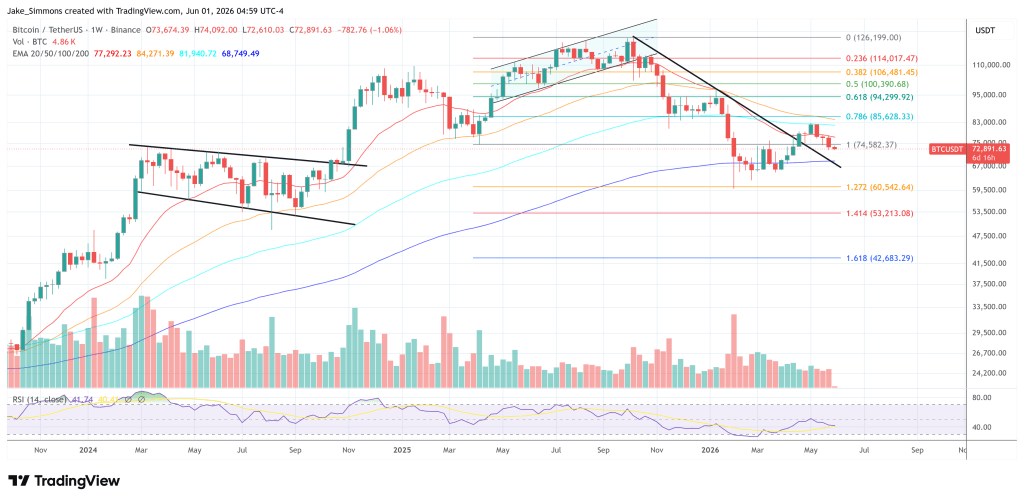
Bitcoin hovers below the 1.0 Fib, 1-week chart | Source: BTCUSDT on TradingView.com

Related Questions

QAccording to NYDIG's analysis, what was the most likely reason for the $1.26 billion IBIT block trade on May 26?

ANYDIG concluded the trade was most likely a large directional holder urgently exiting a concentrated Bitcoin-linked position, rather than a delta-neutral basis trade unwind. The evidence pointed to a seller prioritizing execution certainty and accepting a significant price discount for speed.

QWhat key evidence did NYDIG cite to argue against the trade being a basis-trade unwind?

ANYDIG cited the lack of corresponding activity in CME Bitcoin futures. An unwind of that size (equivalent to ~3,700 futures contracts) would have represented a significant portion of daily volume and likely caused a visible spike, but no such spike occurred in the relevant time windows.

QWhat market conditions preceded the large IBIT block trade?

AThe trade occurred after six straight sessions of net outflows from US spot Bitcoin ETFs, totaling approximately $1.55 billion, with IBIT itself seeing about $1.1 billion in outflows. Bitcoin's price had also failed to break through its descending 200-day moving average, and its RSI had weakened.

QWhat specific trade conditions indicated the seller's urgency to execute the block trade?

AThe trade was executed off-exchange (TRF), carried a Rule 611 trade-through exemption, and was designated as an Intermarket Sweep Order. These conditions point to a privately negotiated block designed to prioritize execution certainty over obtaining a better price.

QHow much of a discount did the seller accept to execute the $1.26 billion IBIT trade immediately, and what was its value?

AThe seller accepted a price of $43.16 per share, which was $1.01 (a 2.3% discount) below the prevailing market price of $44.17. This price concession was worth approximately $29.5 million.

Related Reads

Trading

Spot
Futures

Hot Articles

What is $BITCOIN

DIGITAL GOLD ($BITCOIN): A Comprehensive Analysis Introduction to DIGITAL GOLD ($BITCOIN) DIGITAL GOLD ($BITCOIN) is a blockchain-based project operating on the Solana network, which aims to combine the characteristics of traditional precious metals with the innovation of decentralized technologies. While it shares a name with Bitcoin, often referred to as “digital gold” due to its perception as a store of value, DIGITAL GOLD is a separate token designed to create a unique ecosystem within the Web3 landscape. Its goal is to position itself as a viable alternative digital asset, although specifics regarding its applications and functionalities are still developing. What is DIGITAL GOLD ($BITCOIN)? DIGITAL GOLD ($BITCOIN) is a cryptocurrency token explicitly designed for use on the Solana blockchain. In contrast to Bitcoin, which provides a widely recognized value storage role, this token appears to focus on broader applications and characteristics. Notable aspects include: Blockchain Infrastructure: The token is built on the Solana blockchain, known for its capacity to handle high-speed and low-cost transactions. Supply Dynamics: DIGITAL GOLD has a maximum supply capped at 100 quadrillion tokens (100P $BITCOIN), although details regarding its circulating supply are currently undisclosed. Utility: While precise functionalities are not explicitly outlined, there are indications that the token could be utilized for various applications, potentially involving decentralized applications (dApps) or asset tokenization strategies. Who is the Creator of DIGITAL GOLD ($BITCOIN)? At present, the identity of the creators and development team behind DIGITAL GOLD ($BITCOIN) remains unknown. This situation is typical among many innovative projects within the blockchain space, particularly those aligning with decentralized finance and meme coin phenomena. While such anonymity may foster a community-driven culture, it intensifies concerns about governance and accountability. Who are the Investors of DIGITAL GOLD ($BITCOIN)? The available information indicates that DIGITAL GOLD ($BITCOIN) does not have any known institutional backers or prominent venture capital investments. The project seems to operate on a peer-to-peer model focused on community support and adoption rather than traditional funding routes. Its activity and liquidity are primarily situated on decentralized exchanges (DEXs), such as PumpSwap, rather than established centralized trading platforms, further highlighting its grassroots approach. How DIGITAL GOLD ($BITCOIN) Works The operational mechanics of DIGITAL GOLD ($BITCOIN) can be elaborated on based on its blockchain design and network attributes: Consensus Mechanism: By leveraging Solana’s unique proof-of-history (PoH) combined with a proof-of-stake (PoS) model, the project ensures efficient transaction validation contributing to the network's high performance. Tokenomics: While specific deflationary mechanisms have not been extensively detailed, the vast maximum token supply implies that it may cater to microtransactions or niche use cases that are still to be defined. Interoperability: There exists the potential for integration with Solana’s broader ecosystem, including various decentralized finance (DeFi) platforms. However, the details regarding specific integrations remain unspecified. Timeline of Key Events Here is a timeline that highlights significant milestones concerning DIGITAL GOLD ($BITCOIN): 2023: The initial deployment of the token occurs on the Solana blockchain, marked by its contract address. 2024: DIGITAL GOLD gains visibility as it becomes available for trading on decentralized exchanges like PumpSwap, allowing users to trade it against SOL. 2025: The project witnesses sporadic trading activity and potential interest in community-led engagements, although no noteworthy partnerships or technical advancements have been documented as of yet. Critical Analysis Strengths Scalability: The underlying Solana infrastructure supports high transaction volumes, which could enhance the utility of $BITCOIN in various transaction scenarios. Accessibility: The potential low trading price per token could attract retail investors, facilitating wider participation due to fractional ownership opportunities. Risks Lack of Transparency: The absence of publicly known backers, developers, or an audit process may yield skepticism regarding the project's sustainability and trustworthiness. Market Volatility: The trading activity is heavily reliant on speculative behavior, which can result in significant price volatility and uncertainty for investors. Conclusion DIGITAL GOLD ($BITCOIN) emerges as an intriguing yet ambiguous project within the rapidly evolving Solana ecosystem. While it attempts to leverage the “digital gold” narrative, its departure from Bitcoin's established role as a store of value underscores the need for a clearer differentiation of its intended utility and governance structure. Future acceptance and adoption will likely depend on addressing the current opacity and defining its operational and economic strategies more explicitly. Note: This report encompasses synthesised information available as of October 2023, and developments may have transpired beyond the research period.

363 Total ViewsPublished 2025.05.13Updated 2025.05.13

What is $BITCOIN

Discussions

Welcome to the HTX Community. Here, you can stay informed about the latest platform developments and gain access to professional market insights. Users' opinions on the price of BTC (BTC) are presented below.

活动图片















