‘No Token Issuance’ Statement Fails to Curb Frenzy, ClawdBot Trapped in Crypto Kidnapping Dilemma

比推Published on 2026-01-27Last updated on 2026-01-27

Abstract

ClawdBot, an open-source AI assistant, gained massive traction with over 40,000 GitHub stars and a rapidly growing Discord community. Despite its technical success, it became the center of an unsolicited meme coin frenzy when a token named CLAWD was launched without authorization, reaching a market cap of $16 million. The founder, Peter Steinberger, explicitly stated he would never issue a token and condemned the harassment and scams targeting the project. His account was even hijacked by crypto scammers attempting to force a token launch. Steinberger, a retired entrepreneur whose previous company received a €100 million investment, has no financial incentive to engage in crypto speculation. The incident highlights a shift in meme coin culture from seeking legitimacy through technical projects to aggressively “adopting” viral trends through coercion and scams, potentially harming genuine open-source development.

Author: Curry, Deep Tide TechFlow

Original Title: ClawdBot Founder Says Never Issuing Tokens, Meme Trenches Go Crazy


On January 25th, an open-source AI assistant called ClawdBot went viral.

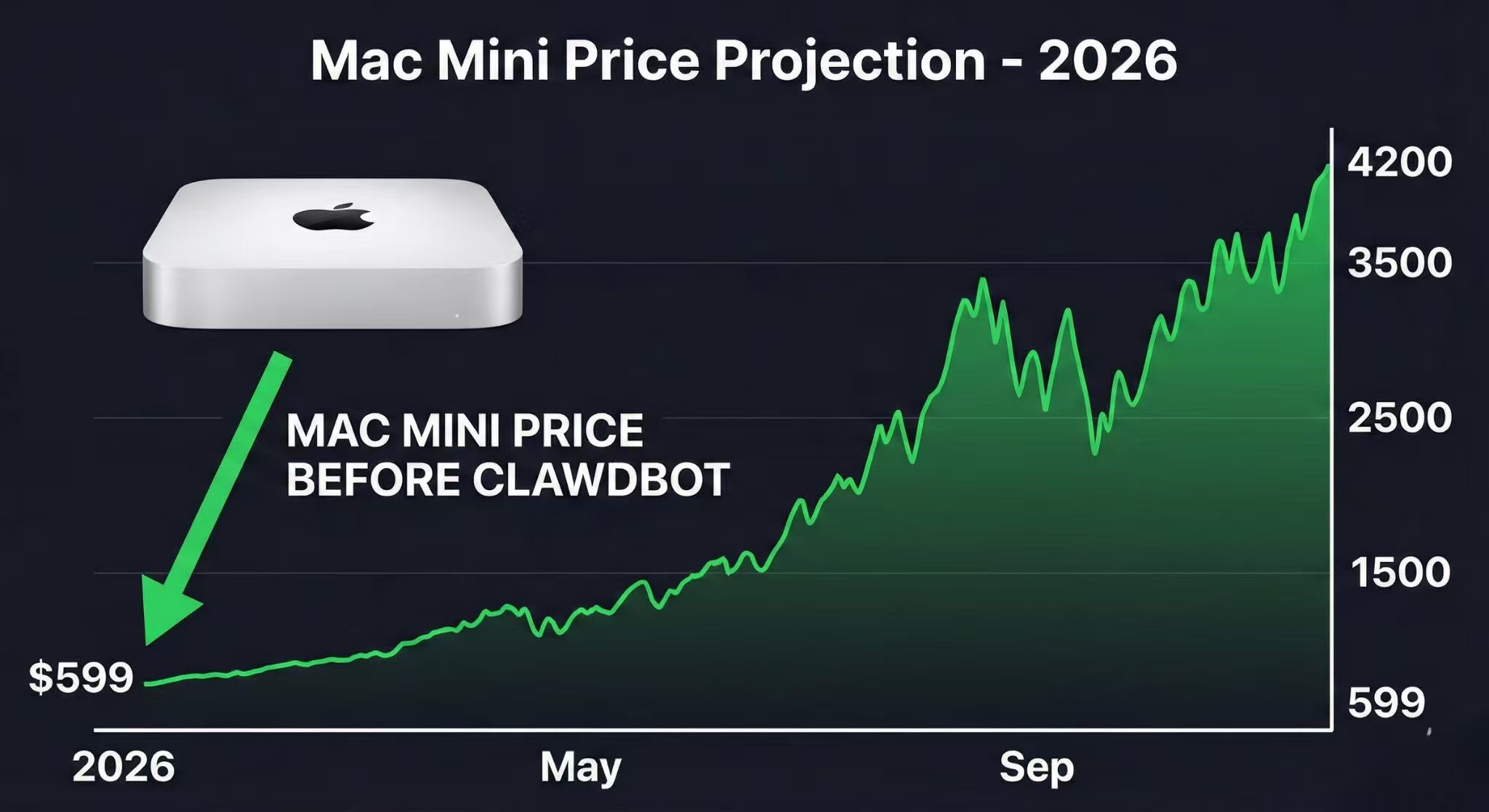
You might have seen it extensively on Twitter and various media platforms at home and abroad over the past couple of days. The project's GitHub stars surpassed 40,000, and foreigners joked that Mac minis would sell out because of it, as it needs to run 24/7, and a brand new Mac, free of other tasks, versatile and capable, is a good choice.
Simultaneously, nearly ten thousand people flooded into the project's Discord community.

ClawdBot founder Peter Steinberger also tweeted, saying he hardly looks at code anymore, letting AI write it all;

This sparked another phenomenon-level technical topic on Twitter after Dan Koe's viral inspirational piece "How to Fix Your Life in a Day" – "How to Quickly Deploy ClawdBot".

Naturally, attention brings liquidity, and the crypto friends smelled it and came.

The同名 Meme token CLAWD was actually launched on the 25th, with its market cap once soaring to $16 million. Everything looked familiar: a trending AI project, a同名 token, early players getting rich. The only problem was:

The founder said he wouldn't issue a token.

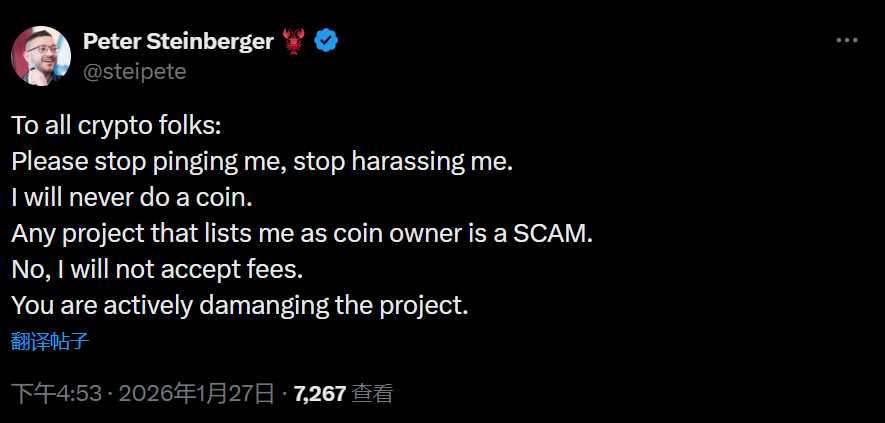
On January 27th, Peter Steinberger posted a statement on Twitter:

"Stop DMing me. Stop harassing me. I will never issue a token. Any project listing me as a token owner is a scam. No, I don't accept any fees. You are damaging the project".
On the same day, he posted another tweet:

Any GitHub folks who can help me get my account back? It's been hijacked by crypto scammers.

You won't issue a token, I'll DM you to issue it. You still won't, then I'll hijack your account and issue it for you.

Unlike the poor devs in the Meme trenches desperately waiting for an official move, this developer who created ClawdBot doesn't seem to be short of money.

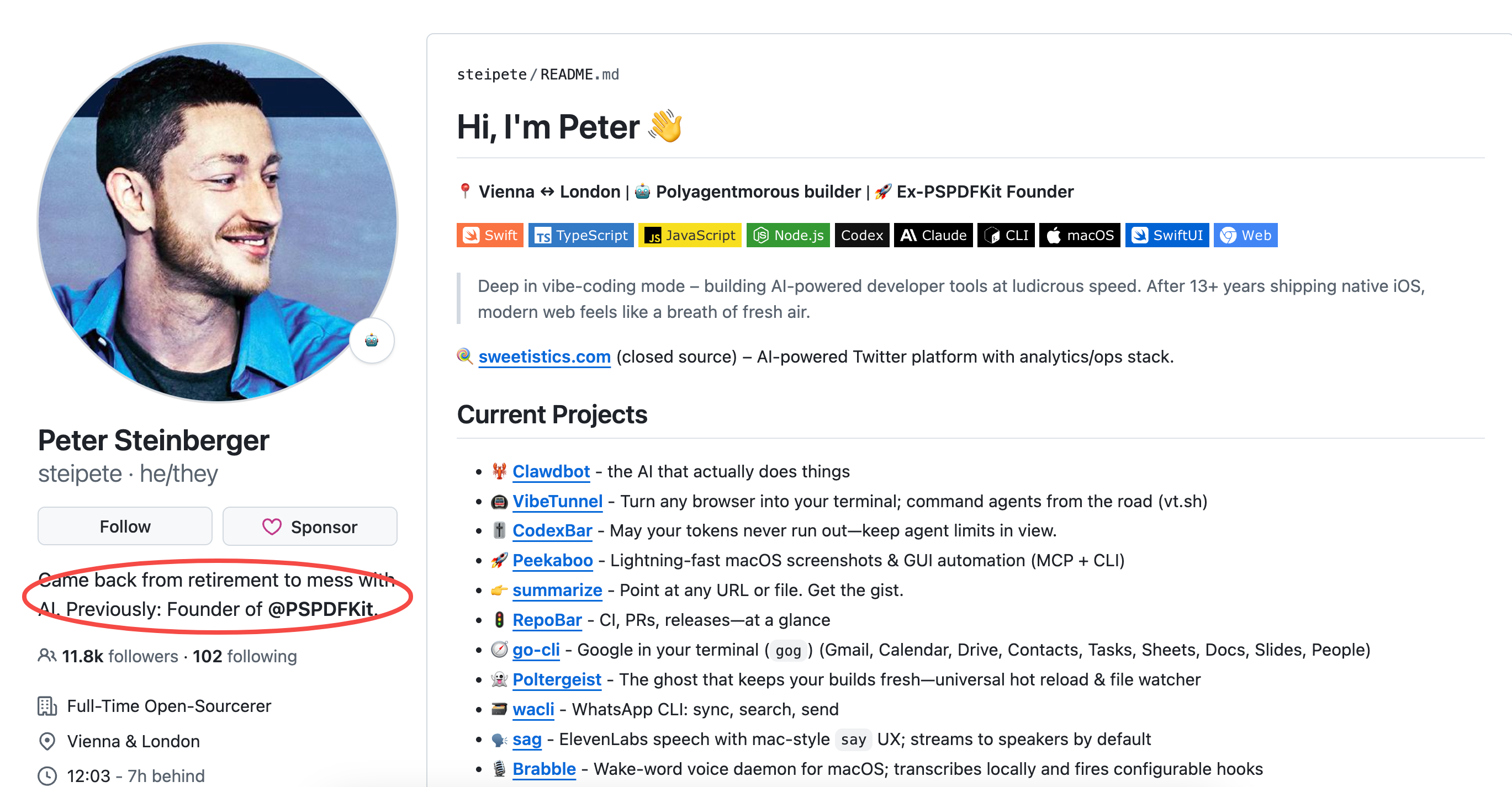
I looked into his background. Peter previously founded a company called PSPDFKit, developing PDF tools.

In 2021, Insight Partners invested €100 million in this company, which at the exchange rate then was roughly:

$116 million.

After the investment was completed, Peter and his co-founder retired. In his own words, he "came back from retirement to mess with AI", now returning from retirement to fiddle with AI.
A person who retired by making products really doesn't need your token profits.

But the brothers in the Meme trenches need it.

This is the most interesting part of the story. In the crypto world's perception, "who wouldn't want to make money" is the first principle. A project goes viral, issuing a token is a matter of course.

If you don't issue, you're either pretending or waiting for a better time, even if the project has little to do with crypto.

So people will DM, harass, even hijack accounts to issue tokens through scams.

Remember when AI Meme first got hot the year before last and last year, the routine was like this:

First, have a technical project or product prototype, then the team announces they will issue a token, the community follows up, the narrative is self-consistent. This is called "technical legitimacy": you have something, so you qualify to issue.

Now it's changed.

Now, upon seeing the hype, first抢注 a同名 token, then wait for "official adoption". If adopted, everyone is happy; if not, keep speculating. Anyway, retail investors can't tell which is real.

In the Meme trenches, this "forced adoption" model is becoming the norm.

Whether it's Chinese Meme or overseas Meme, seeking mention,暗示, or endorsement from an official role in a hot topic is an action that will never stop.

It's just that this initiative is a bit too wolf-like.

Before, Meme was about "creating gods", finding a founder with a technical background, packaging them as the next Vitalik; later it was "蹭神" (rubbing against gods), naming projects after Elon, Trump.

Now it's "绑神" (kidnapping gods), if you don't cooperate, I'll hijack your account.

From active god-making to passive kidnapping, the narrative cycle of AI Meme might really be at its end.

Peter Steinberger said something in the tweet statement above that is truly worth pondering: you are damaging the project.

An open-source, free AI assistant that anyone can use is being forced to spend energy dealing with this nonsense because of harassment from the crypto circle.

I wonder if he will shut down the project because of this, or simply make the code private. Only know that if it really comes to that, the ones who lose the most certainly won't be those speculating on tokens.

The ones who lose the most are the ordinary developers who actually want to use this tool.

But does that matter?

In the crypto world, making money is what matters.


Twitter:https://twitter.com/BitpushNewsCN

BitPush TG Discussion Group:https://t.me/BitPushCommunity

BitPush TG Subscription: https://t.me/bitpush

Original link:https://www.bitpush.news/articles/7606372

Related Questions

QWhat is the founder of ClawdBot and what is his background?

AThe founder of ClawdBot is Peter Steinberger. He previously co-founded a company called PSPDFKit, which developed PDF tools. In 2021, the company received a €100 million (approximately $116 million at the time) investment from Insight Partners, after which Peter retired. He has since returned from retirement to work on AI projects like ClawdBot.

QWhy did the ClawdBot project gain significant attention on January 25th?

AClawdBot, an open-source AI assistant, gained significant attention because its GitHub repository surpassed 40,000 stars, and its Discord community grew to nearly 10,000 members. It became a trending topic on Twitter, with discussions on how to quickly deploy it, and it was humorously suggested that Mac minis might sell out due to the project's requirement to run 24/7.

QHow did the cryptocurrency community react to the popularity of ClawdBot?

AThe cryptocurrency community quickly capitalized on ClawdBot's popularity by launching a meme token named CLAWD on the same day it went viral. The token's market capitalization briefly reached $16 million. Despite the founder's clear statement that he would never issue a token, some individuals resorted to harassing him and even hijacking his social media accounts in an attempt to force or fake an official endorsement.

QWhat was Peter Steinberger's response to the token and the harassment from the crypto community?

APeter Steinberger explicitly stated on Twitter that he would never issue a token and denounced any projects listing him as a token owner as scams. He expressed frustration over the harassment, stating that such actions were damaging the project. He also reported that his GitHub account was hijacked by crypto scammers.

QWhat does the article suggest about the current state of AI-related meme tokens?

AThe article suggests that the narrative cycle for AI-related meme tokens may be ending. It describes a shift from projects building legitimacy through technology and official token launches ('造神' or 'making a god') to simply蹭神' or 'rubbing against a god' by using famous names, and now to '绑神' or 'kidnapping a god,' where communities harass or hijack accounts of legitimate projects to force association. This behavior risks harming genuine open-source projects and their communities.

Related Reads

How Many Tokens Away Is Yang Zhilin from the 'Moon Chasing the Light'?

The article explores the intense competition between two leading Chinese AI companies, DeepSeek and Kimi (Moon Dark Side), and the mounting pressure on Yang Zhilin, the founder of Kimi. While DeepSeek re-emerged after 15 months of silence with its powerful V4 model—boasting 1.6 trillion parameters and low-cost, long-context capabilities—Kimi has been focusing on long-context processing and multi-agent systems with its K2.6 model. Yang faces a threefold challenge: technological rivalry, commercialization pressure, and investor expectations. Despite Kimi’s high valuation (reaching $18 billion), its revenue heavily relies on a single product with low paid conversion rates, while DeepSeek’s strategic silence and open-source influence have strengthened its market position and valuation prospects, now targeting over $20 billion. Both companies reflect broader trends in China’s AI ecosystem: Kimi aims for global influence through open-source contributions and agent-based advancements, while DeepSeek prioritizes foundational innovation and hardware independence, notably shifting to Huawei’s chips. Their competition is seen as vital for China’s AI progress, with the gap between top Chinese and U.S. models narrowing to just 2.7% on the Elo rating scale. Ultimately, the article argues that this rivalry, though anxiety-inducing for leaders like Zhilin, is essential for driving innovation and solidifying China’s role in the global AI landscape.

marsbit4h ago

How Many Tokens Away Is Yang Zhilin from the 'Moon Chasing the Light'?

marsbit4h ago

TechFlow Intelligence Bureau: ChatGPT Helps Amateur Mathematician Crack 60-Year-Old Problem, CFTC Sues New York Regulator Over Coinbase and Gemini

An amateur mathematician, with the assistance of ChatGPT, has solved a combinatorial mathematics puzzle originally proposed by Hungarian mathematician Paul Erdős in the 1960s. This marks another milestone in AI-aided mathematical research, demonstrating the evolving capabilities of large language models in formal reasoning. In other AI developments, OpenAI introduced a new privacy filter tool for enterprise API usage, automatically screening sensitive data. Meanwhile, the Qwen3.6-27B model achieved 100 tokens per second on a single RTX 5090 GPU using quantization, significantly lowering the cost barrier for local AI deployment. In crypto and Web3, the U.S. CFTC sued New York’s financial regulator, challenging its oversight of Coinbase and Gemini—a first-of-its-kind federal-state regulatory clash. Following a vulnerability, KelpDAO and major DeFi protocols established a recovery fund. Tether froze $344 million in assets linked to Iran’s central bank upon U.S. Treasury request, highlighting the centralized control risks in stablecoins. Separately, Litecoin underwent a 3-hour chain reorganization to undo a privacy-layer exploit. In the U.S., former President Trump invoked the Defense Production Act to address power grid bottlenecks affecting AI data centers and dismissed the entire National Science Board, raising concerns over research independence. A retail trader gained 250% on a $600k Intel options bet amid AI-related speculation. Xiaomi announced its first performance electric vehicle, targeting rivals like Tesla. Meanwhile, iPhone users reported devices automatically reinstalling a hidden app daily, suspected to be MDM-related. A Chinese securities report noted that A-share institutional crowding has reached its second-longest streak since 2007, signaling high valuations and potential style rotation. The day’s developments reflect a dual narrative: AI is enabling unprecedented individual breakthroughs, while centralized power structures—whether governmental or corporate—are becoming more assertive, underscoring that decentralization is as much a political-economic challenge as a technical one.

marsbit4h ago

TechFlow Intelligence Bureau: ChatGPT Helps Amateur Mathematician Crack 60-Year-Old Problem, CFTC Sues New York Regulator Over Coinbase and Gemini

marsbit4h ago

Trading

Spot
Futures
活动图片