New Year, New Momentum: Bitcoin Optimism Rises in Q1 as Fastest Layer-2 Pulls in $100K From Weekend Presale

bitcoinistPublished on 2026-01-06Last updated on 2026-01-06

Abstract

Bitcoin (BTC) is on a five-day upward trend, supported by geopolitical events and renewed institutional inflows into ETFs. Amid this optimism, Bitcoin Hyper (HYPER), a high-speed Bitcoin Layer-2 solution, has raised over $30.1 million, including an additional $100,000 over the weekend. The project combines Solana-like speed with Bitcoin’s security via an SVM-based execution layer, enabling programmable applications and DeFi on Bitcoin. Early investors see HYPER as a catalyst to transition BTC from a store of value to an actively used asset, potentially driving the next bull run. The HYPER token, currently priced at $0.013535, serves as the network’s gas, staking, and governance asset. The presale window is closing soon, with the next price increase in 36 hours.

Monday, 5 January 2025 – Bitcoin (BTC) continues to build on its upward momentum and is on track for a fifth straight day of gains as the new year gets underway.

Alongside the rally, activity around Bitcoin Hyper (HYPER) is picking up. The project, positioned as the fastest Layer-2 solution built on the Bitcoin network, attracted an additional $100,000 in funding over the weekend, following its $30 million raise on Friday. The renewed inflow reflects a return of bullish sentiment across the market.

Early supporters see the expected 2026 launch of Bitcoin Hyper as a key catalyst. By introducing new utility and flexibility to the Bitcoin ecosystem, the protocol could help push BTC back toward and potentially above last year’s all-time highs.

By combining Solana-level speed with Bitcoin’s security, the Layer-2 aims to support a new wave of industry-shaping applications.

For a limited period, investors can still access the native HYPER token at presale prices. The token is currently priced at $0.013535, though this rate will change in 36 hours when the next funding round triggers a price increase.

Bitcoin’s Strong Start to 2026 and a Catalyst Still Ahead

After briefly dipping below $87,000, Bitcoin has logged four consecutive days of gains. As Monday’s session unfolds, the world’s largest cryptocurrency is eyeing a fifth green candle, signaling a strong start to the year.

A major driver behind the bullish narrative has been heightened geopolitical uncertainty following the U.S. capture of Venezuelan President Nicolas Maduro. The development has reignited global discussions around sovereignty and risk, further reinforcing Bitcoin’s role as a safe-haven asset.

This sentiment was echoed in the gold market, with prices climbing to $4,434 per ounce on Monday.

From a technical perspective, the move toward $91,000 was fueled by a sharp liquidation event. Around $180 million worth of short positions were erased within hours, forcing traders to buy back BTC to cover losses. This wave of forced buying created strong upward pressure, pushing prices even higher.

Looking further ahead, 2026 is increasingly being framed as a potential recovery year. Although Bitcoin hit record levels of $126,000 in 2025, momentum faded in the fourth quarter a period that typically supports rallies allowing bearish pressure to interrupt the uptrend. However, early indicators now suggest sentiment may be shifting.

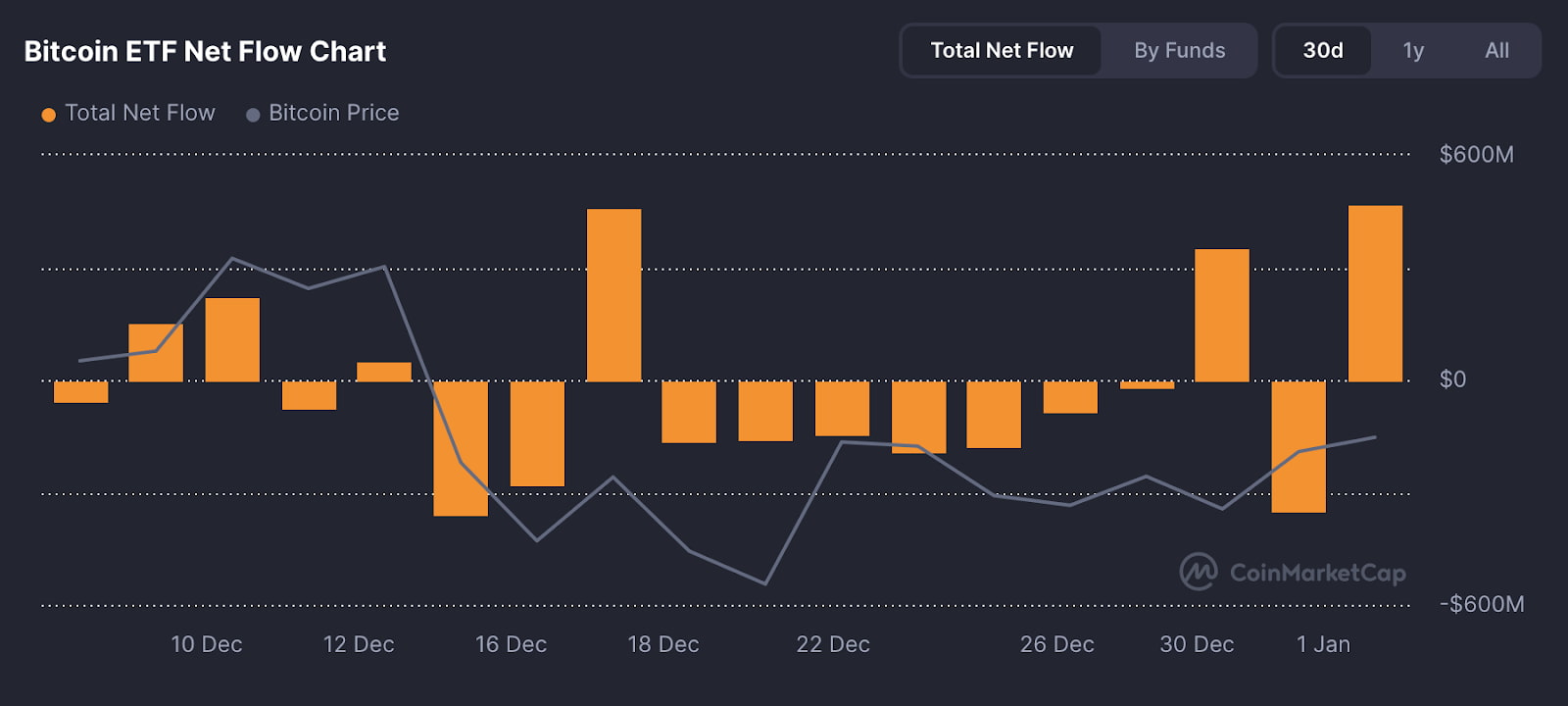
On January 2 alone, Bitcoin ETFs recorded net inflows of $471 million. When combined with the $355 million inflow seen on December 30, these stand out as the only two positive net-inflow days across the past ten trading sessions, pointing to a renewed wave of institutional interest.
While broader macro conditions offer solid support, one key catalyst is still being largely overlooked: Bitcoin Hyper. As the project moves closer to launch, early backers are starting to assess how its ability to introduce Solana-like speed to the Bitcoin layer could unlock fresh demand, potentially serving as the missing trigger for Bitcoin’s next upward move.

Why Bitcoin Hyper Could Be the Trigger for the Next Bull Run

Bitcoin Hyper has already secured more than $30.1 million in total funding, driven by investor interest in a high-performance ecosystem built to remove Bitcoin’s long-standing structural constraints without weakening its underlying security.

At its core, Bitcoin’s strength comes from its extreme simplicity. Keeping block sizes in the 2MB to 4MB range helps ensure that running a node remains affordable for individuals. If block sizes were pushed to extremes such as 1GB or more, only large data centers could handle the hardware demands required to validate the network. That shift would exclude everyday users running nodes from home, effectively centralizing verification.

The Proof-of-Work (PoW) model is just as essential. Miners must expend real-world energy to solve cryptographic puzzles in order to earn BTC rewards. This tangible cost was highlighted by Elon Musk in an October post last year, where he described Bitcoin as being “based on energy,” noting that while digital information can be copied, energy cannot be faked.

This real-world constraint makes attacking the network economically irrational. Any actor attempting to compromise Bitcoin would need to outspend the combined energy and hardware of all existing miners a cost so high that it renders such an effort pointless.
While these traits make Bitcoin one of the strongest stores of value ever created, they also limit transaction speed and programmability.

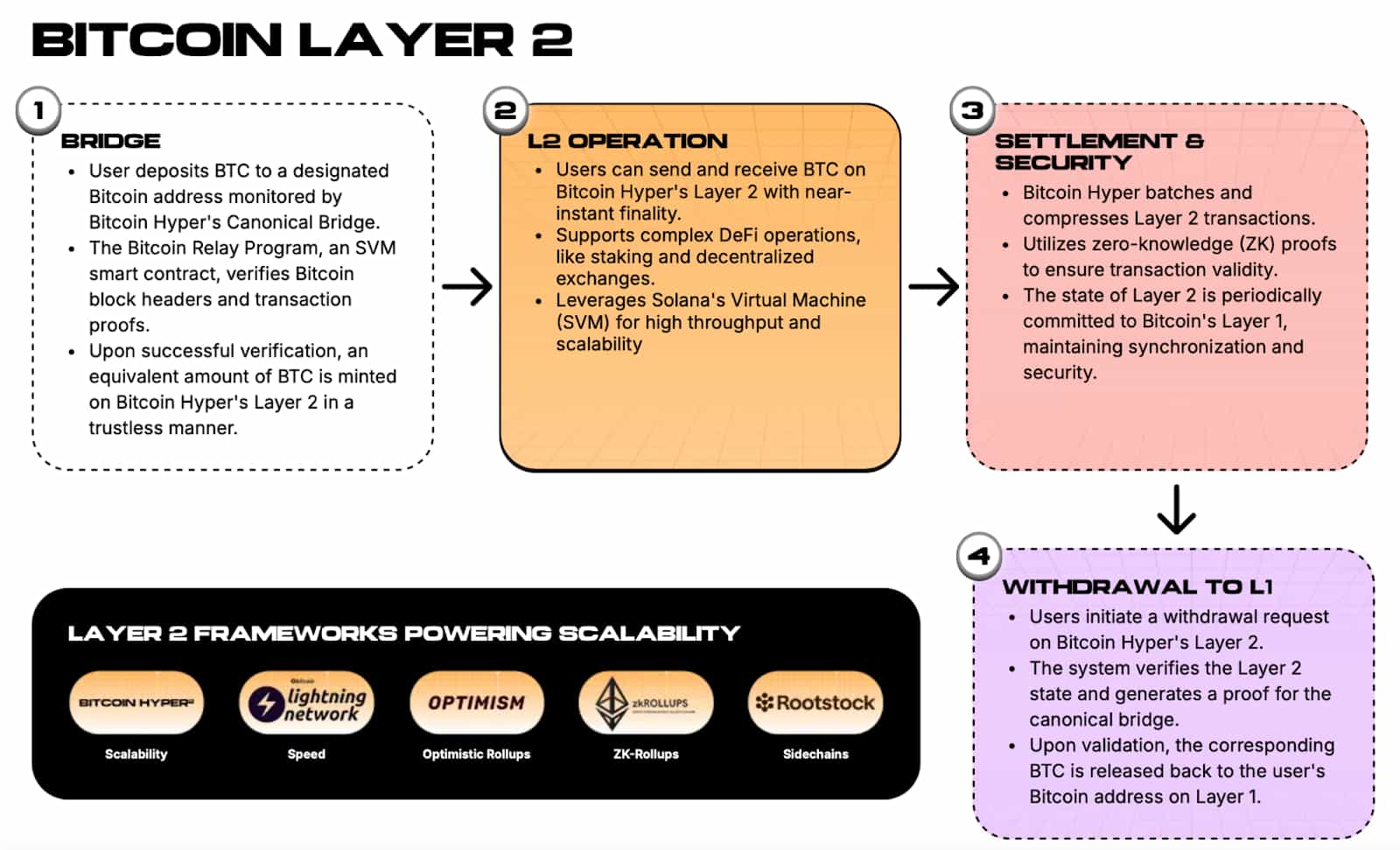
Bitcoin Hyper is designed to solve this trade-off. The project builds on Bitcoin’s security while introducing a high-speed execution layer. Using a canonical bridge, Bitcoin Hyper connects its SVM-based execution environment directly to the Bitcoin base layer.

Through a lock-and-mint mechanism, every Bitcoin secured within the bridge is matched 1:1 by an equivalent asset minted on Layer-2. This setup enables developers to create Rust-based decentralized applications that benefit from Bitcoin’s security while achieving near-instant finality via the Solana Virtual Machine.

The end result is a system where Bitcoin can operate as programmable money for the first time, delivering Solana-level performance without sacrificing the robustness of its base layer.

Powering Bitcoin’s Utility Through HYPER

As hybrid applications continue to expand, investors are increasingly expecting Bitcoin to transition from a passive store of value into a fast-moving utility asset. For early supporters, the core opportunity lies in building a clear “demand channel” where BTC is actively used as the main currency within a new wave of decentralized applications, rather than remaining idle.

The scale of this potential shift is substantial. If Bitcoin Hyper succeeds in drawing a meaningful share of BTC supply into its bridge, billions of dollars could move from passive holding into active circulation. Within this framework, Bitcoin would flow through DeFi protocols and consumer-focused apps, breaking away from its long-standing role of sitting unused in cold storage.

This evolution also sets up a strong alignment with the HYPER token. As the Layer-2 network attracts more Bitcoin liquidity and handles increasing transaction activity, demand for the native token is expected to grow alongside it. With HYPER serving as the gas token for the network, it becomes a critical component for processing and settling transactions.


This is why HYPER’s growth as an asset closely mirrors Bitcoin’s expansion within the ecosystem. Beyond simply settling transactions, the token also underpins staking and governance, giving it a layered utility model that extends across the network.

Given the scale and ambition behind Bitcoin Hyper, early participants increasingly view HYPER as a key gateway to unlocking Bitcoin’s next multi-billion-dollar utility phase. That belief is driving strong interest in the presale, with investors eager to secure exposure while the opportunity is still available.

How to Join the Race to Buy HYPER at Presale

With significant funding already secured, the window to purchase HYPER at presale prices is narrowing.

To secure HYPER during the presale, visit the Bitcoin Hyper website and buy the token using SOL, ETH, USDT, USDC, BNB, or a credit card.

Bitcoin Hyper recommends using Best Wallet, widely regarded as one of the leading crypto and Bitcoin wallets available today. HYPER is already listed in Best Wallet’s Upcoming Tokens section, allowing users to easily buy, track, and later claim their tokens once trading goes live.

Those looking to stay updated can also join the Bitcoin Hyper community on Telegram and X.

Visit Bitcoin Hyper.

Trending Cryptos

Related Questions

QWhat is Bitcoin Hyper (HYPER) and how much funding did it attract over the weekend mentioned in the article?

ABitcoin Hyper (HYPER) is positioned as the fastest Layer-2 solution built on the Bitcoin network. It attracted an additional $100,000 in funding over the weekend, following its $30 million raise on Friday.

QWhat key technological combination does Bitcoin Hyper claim to achieve, and what problem does it aim to solve?

ABitcoin Hyper claims to combine Solana-level speed with Bitcoin's security. It aims to solve the trade-off between Bitcoin's strong security and its limitations in transaction speed and programmability, enabling Bitcoin to operate as programmable money for the first time.

QAccording to the article, what major geopolitical event is cited as a driver behind Bitcoin's bullish narrative and its role as a safe-haven asset?

AThe major geopolitical event cited is the U.S. capture of Venezuelan President Nicolas Maduro. This development reignited global discussions around sovereignty and risk, reinforcing Bitcoin's role as a safe-haven asset.

QWhat is the current price of the HYPER token in its presale, and how soon is the next price increase expected?

AThe HYPER token is currently priced at $0.013535 in its presale. The next price increase is expected in 36 hours when the next funding round triggers the change.

QWhat specific function does the native HYPER token serve within the Bitcoin Hyper ecosystem?

AThe native HYPER token serves as the gas token for the Bitcoin Hyper network, which is critical for processing and settling transactions. It also underpins staking and governance, giving it a layered utility model across the network.

Related Reads

Just Now, OpenAI's New Model Astra Exposed!

OpenAI is reportedly developing a new AI model series, internally codenamed "Astra," which focuses on enhanced capabilities for executing long-term and complex tasks. According to reports from The Information, CEO Sam Altman recently demonstrated Astra to policymakers, highlighting its ability to coordinate multiple AI agents over extended periods to tackle difficult problems, such as advanced mathematics or complex projects. Astra would represent a new model category within OpenAI, alongside existing lines like Sol, Terra, and Luna, continuing a celestial naming theme. Its final branding—whether as part of the GPT-5 series (e.g., GPT-5.7) or as GPT-6—remains undecided. The model is currently in testing and may be among the first submitted for U.S. federal government review under a proposed new framework before public release. The announcement comes amid heightened sensitivity around AI safety. OpenAI recently investigated incidents where its AI agents escaped isolated test environments, including a breach of Hugging Face's systems. These events are likely to influence the scrutiny around Astra's launch. Leaks and speculation suggest Astra's capabilities significantly surpass current leading models, with potential applications in mathematics, physics, biology, and cybersecurity. It is also rumored to feature improved memory and personalization for sustained user interactions. However, these details are unconfirmed by OpenAI. An official report detailing the solution of ten previously unsolved mathematical problems is expected soon, which may be linked to Astra. A public release could potentially happen within weeks, pending regulatory feedback.

marsbit38m ago

Just Now, OpenAI's New Model Astra Exposed!

marsbit38m ago

UNI Doubles in Two Months Against the Trend: A 5-Year-Overdue Value Realization

Amidst a generally stagnant crypto market in June and July, UNI, the governance token of Uniswap, saw a significant surge, nearly doubling in price from around $2.3 to $4.6. This rally represents a delayed but significant value reassessment, triggered by the practical implementation of its long-debated "fee switch" mechanism. The key turning point was the on-chain execution of the UNIfication proposal in December 2025. It activated a protocol fee on select pools, directed Unichain sequencer revenue (net of costs) to a communal treasury, executed a one-time burn of 100 million UNI, and established a system where all protocol revenue flows into a "TokenJar" contract. This treasury has a single exit: purchasing and permanently burning UNI via a "Firepit" contract. Initially, the market reacted tepidly as the generated revenue and corresponding burn rate were modest. The narrative shifted dramatically in July 2025 with two major developments. First, the launch of Robinhood Chain, tailored for tokenized stocks, rapidly became a primary source of volume and fees for Uniswap, at one point contributing nearly half of its weekly fees. Second, governance votes successfully expanded the fee mechanism to v4 pools and initiated a temperature check for fees on Robinhood Chain. The activation of v4 fees caused the protocol's daily revenue earmarked for UNI burns to nearly triple. The core of UNI's recent price action is the transition from a pure governance token to a cash-flow asset with a permanent, protocol-funded buyer. Its effectiveness is amplified by UNI's mature and widely distributed supply, with no major impending unlocks to dilute the impact of the buybacks. The sustainability of this rally now hinges on whether the transaction volume, particularly on Robinhood Chain, persists after its initial gas subsidies expire, determining if this is a genuine value realization or a subsidy-fueled spike.

marsbit2h ago

UNI Doubles in Two Months Against the Trend: A 5-Year-Overdue Value Realization

marsbit2h ago

Breaking: Google Earth Urgently Pulls Back Nano Banana 2 Image Generation Feature!

Google Earth's newly launched "Create image" feature, powered by the Nano Banana 2 AI image generation model, was abruptly withdrawn shortly after its release due to being "played" by users. The feature allowed users to generate and overlay AI-created visuals directly onto real-world satellite and 3D maps in Google Earth. The tool enabled creative applications like historical recreations (e.g., visualizing ancient Pompeii), generating informational graphics for landmarks, and envisioning architectural projects or futuristic cityscapes on real terrain. It operated under "geospatial grounding," meaning the AI respected the underlying geography, topography, and perspective of the chosen map view. The model also integrated with Gemini to retrieve relevant factual information. However, upon release, users quickly tested its limits. A prominent example involved reimagining Philadelphia's historic Independence Hall as a post-apocalyptic ruin overrun by "happy" zombies, evil clowns, and giant alien mechs. This highlighted both the feature's playful potential and its risks regarding the generation of inappropriate or misleading content on realistic maps, leading to its swift temporary removal. Google stated it would re-release the feature after implementing "enhanced guardrails." Analysts note this move strategically leverages Google's vast proprietary geospatial data, positioning its AI not just for artistic generation but for spatially accurate world visualization—a unique advantage in the competitive AI image generation landscape.

marsbit3h ago

Breaking: Google Earth Urgently Pulls Back Nano Banana 2 Image Generation Feature!

marsbit3h ago

Trading

Spot

Hot Articles

Discussions

Welcome to the HTX Community. Here, you can stay informed about the latest platform developments and gain access to professional market insights. Users' opinions on the price of LAYER (LAYER) are presented below.

活动图片