Morgan Stanley Bitcoin ETF to Launch Tomorrow, Recommends Clients Allocate Up to 4% to Crypto Assets

marsbitPublished on 2026-04-08Last updated on 2026-04-08

Abstract

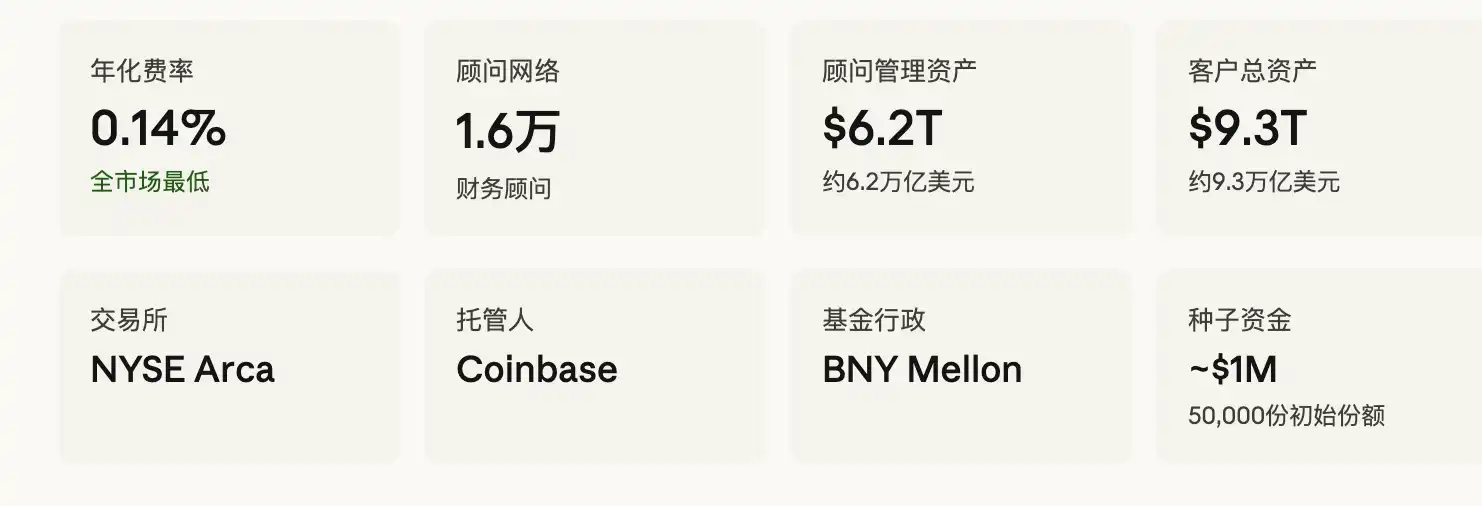
Morgan Stanley is set to launch its own spot Bitcoin ETF (ticker: MSBT) on NYSE Arca on April 8, making it the first major U.S. bank to directly issue such a product. With an annual management fee of 0.14%, it becomes the lowest-cost Bitcoin ETF on the market. The fund will hold Bitcoin directly and track the CoinDesk Bitcoin price index. The bank’s vast network of approximately 16,000 financial advisors, who manage around $6.2 trillion in client assets, can begin recommending the ETF immediately upon launch. Morgan Stanley’s Global Investment Committee has already advised clients to allocate up to 4% of their portfolios to crypto assets. Analysts suggest this distribution capability could unlock substantial institutional and advisory-driven capital into Bitcoin. Beyond Bitcoin, Morgan Stanley is building a broader crypto infrastructure, having also filed for Solana and staked Ethereum ETFs, applied for a national trust bank charter, and plans to offer direct crypto trading via E*Trade in 2026. The move is seen as a significant step in the institutional adoption of Bitcoin and a shift in traditional finance’s approach to cryptocurrency.

Author: Curry, Deep Tide TechFlow

Deep Tide Guide: The SEC has approved the registration statement for the Morgan Stanley Bitcoin Trust (ticker: MSBT), which will begin trading on NYSE Arca on April 8th, with an annual management fee of 0.14%, the lowest in the market.

Morgan Stanley thus becomes the first major U.S. bank to directly issue a Bitcoin spot ETF. Its approximately 16,000 financial advisors, managing $6.2 trillion in client assets, will be able to recommend the product to clients starting on the first day of trading.

The countdown to Morgan Stanley's Bitcoin spot ETF has officially begun.

According to a CoinDesk report on April 8th, the U.S. Securities and Exchange Commission (SEC) has declared the registration statement for the Morgan Stanley Bitcoin Trust (MSBT) effective. The bank submitted its final prospectus on the same day. Bloomberg ETF analyst Eric Balchunas confirmed on platform X that MSBT will begin trading on NYSE Arca on April 8th (Wednesday).

This comes just three months after Morgan Stanley initially filed the S-1 registration document in January of this year. The speed from application to listing far exceeded market expectations.

Lowest Fee in the Market, First Major Bank to Self-Issue

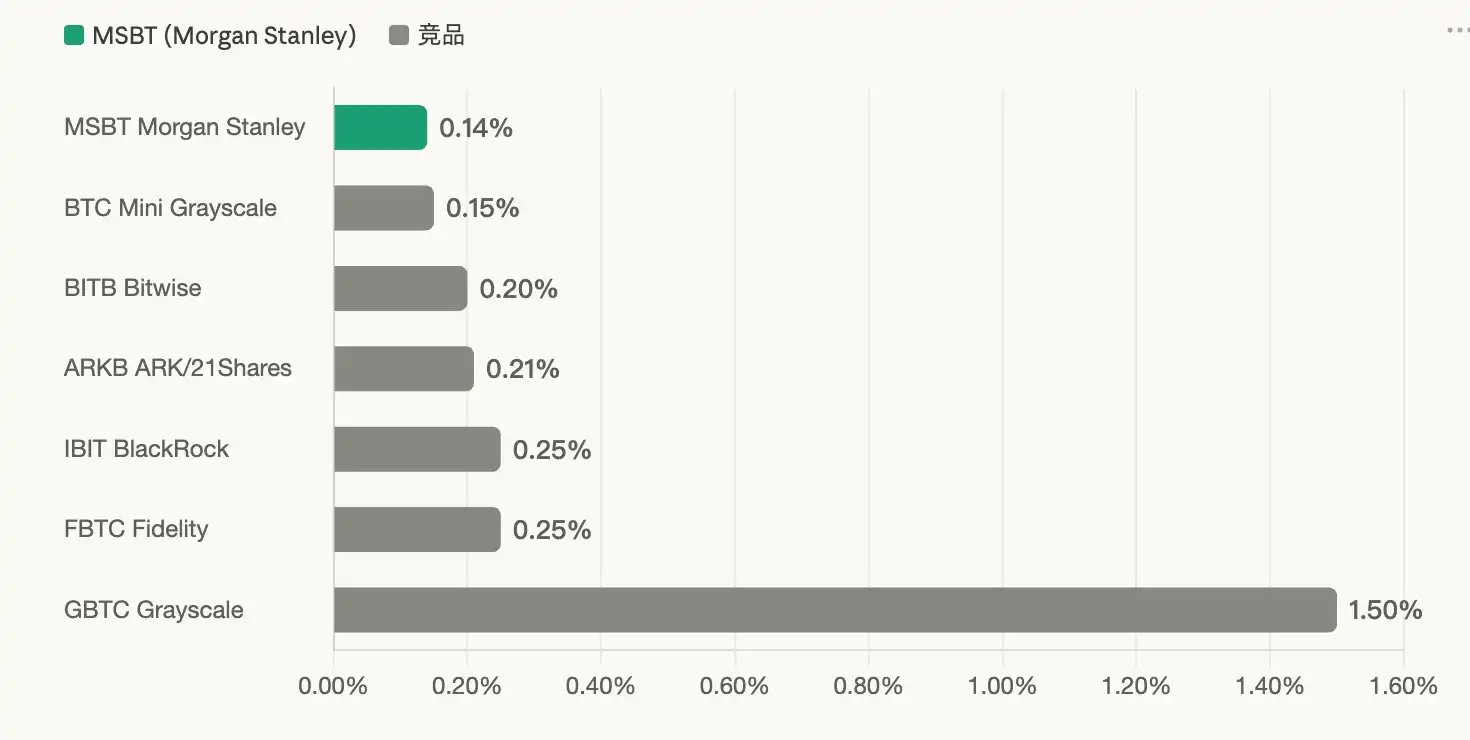
MSBT's annual management fee is set at 0.14%, which is 1 basis point lower than Grayscale's Bitcoin Mini Trust (0.15%) and 11 basis points lower than BlackRock's IBIT (0.25%), making it the product with the lowest fee among all U.S. Bitcoin spot ETFs.

Fee comparison of major competitors: Grayscale Bitcoin Mini Trust 0.15%, Bitwise BITB 0.20%, ARK/21Shares ARKB 0.21%, BlackRock IBIT and Fidelity FBTC both 0.25%, Grayscale's flagship product GBTC 1.5%.

The fee is one of the few core differentiating factors in the Bitcoin spot ETF market. All products directly hold Bitcoin and track the spot price, with highly homogeneous investment strategies. Cost differences become significant in large allocations and long-term holdings. For a $100,000 investment, MSBT saves approximately $110 in management fees compared to IBIT annually.

Historical data has proven the driving force of fees on fund flows: Grayscale's flagship product GBTC charges 1.5% and has seen its assets under management (AUM) shrink from about $29 billion to less than half since its conversion to an ETF in January 2024.

Regarding the MSBT product structure, the fund directly holds Bitcoin, tracking the CoinDesk Bitcoin Benchmark 4:00 PM New York Settlement Price, without using leverage, derivatives, or active trading strategies. Coinbase serves as the custodian and prime broker, BNY Mellon is responsible for cash custody and fund administration, and the initial seed capital is approximately $1 million, corresponding to 50,000 creation baskets.

More importantly, MSBT is the 12th product of its kind since the first batch of Bitcoin spot ETFs were listed in January 2024, and the first Bitcoin spot ETF directly issued and listed by a major U.S. bank. Previously, the issuers of listed products were all asset management companies or crypto-native institutions. Morgan Stanley's entry means that Wall Street banks are moving from "distributing others' products" to "making their own products."

The Distribution Network is the Real Weapon

The fee is just one card on Morgan Stanley's table; the real differentiator is the distribution network.

Morgan Stanley's approximately 16,000 financial advisors manage about $6.2 trillion in client assets (total client assets for the entire bank are about $9.3 trillion). MSBT will receive distribution support from this network starting on its first trading day. Bloomberg ETF analyst Balchunas referred to Morgan Stanley as a "captive audience" for the Bitcoin ETF market and pointed out that while Fidelity also has a partial advisor network, "Morgan Stanley is a whole other level."

Amy Oldenburg, the bank's Head of Digital Asset Strategy, previously revealed that currently about 80% of crypto ETF trading activity comes from self-directed investors, not advisor-managed accounts.

A self-owned product with the lowest fee in the market is expected to eliminate cost concerns advisors might have when recommending Bitcoin allocations, thereby unlocking the incremental space of the advisor channel, which has not yet been fully activated.

Morgan Stanley's Global Investment Committee had already recommended that clients allocate 0-4% of their investment portfolio to crypto assets. Phong Le, CEO of Strategy (formerly MicroStrategy), provided a more aggressive calculation on platform X: based on $6.2 trillion in client assets and a 2% allocation ratio, the potential capital scale is approximately $160 billion, nearly three times the current AUM of BlackRock's IBIT. He called MSBT the "Monster Bitcoin".

However, the actual allocation pace still holds uncertainty. Multiple steps are typically required between product availability and large-scale recommendation through the advisor channel, including compliance approval, investment policy adjustments, and client education.

More Than One ETF: Morgan Stanley's Full-Scale Crypto Layout

MSBT is not an isolated product. Morgan Stanley is systematically building crypto asset infrastructure.

The bank submitted applications for both Bitcoin and Solana spot ETFs in January of this year, followed by an application for a staking Ethereum ETF. In February, Morgan Stanley applied for a National Trust Bank charter (Morgan Stanley Digital Trust) to directly provide clients with digital asset custody, trading, and staking services.

On the retail side, the bank plans to open spot trading for Bitcoin, Ethereum, and Solana to retail investors through the E*Trade platform in the first half of 2026, partnering with Zero Hash. Jed Finn, Head of the Wealth Management Division, called direct crypto trading the "tip of the iceberg," hinting that more services such as custody, wallets, and tokenized assets will follow.

The logic of this multi-channel strategy is clear: institutional clients get MSBT allocations through advisors, self-directed investors trade cryptocurrencies directly through E*Trade, all completed within Morgan Stanley's ecosystem. CEO Ted Pick has already communicated with the U.S. Treasury regarding product development.

Reddit Community: 'Traditional Finance Has Surrendered'

The news sparked heated discussion in the Reddit crypto community. Several users interpreted Morgan Stanley's self-issuance of a Bitcoin ETF as a "surrender signal" from traditional finance towards Bitcoin, believing that the shift from resistance and观望 (wait-and-see) to active embrace by major Wall Street banks marks an irreversible institutionalization process for Bitcoin as an asset class.

Other users offered pragmatic views: the trading volume on the first day and the net inflows in the first month will be key indicators to test whether the distribution network can truly translate into actual allocations.

Related Questions

QWhat is the ticker symbol and management fee for Morgan Stanley's Bitcoin ETF?

AThe ticker symbol is MSBT, and it has an annual management fee of 0.14%, which is the lowest in the market.

QHow much client assets do Morgan Stanley's financial advisors manage, and what is the potential impact on the Bitcoin ETF market?

AMorgan Stanley's approximately 16,000 financial advisors manage about $6.2 trillion in client assets. The bank's global investment committee has recommended clients allocate 0-4% of their portfolio to crypto assets, potentially unlocking significant new capital into the Bitcoin ETF market.

QWhat makes Morgan Stanley's Bitcoin ETF (MSBT) unique compared to other existing Bitcoin ETFs?

AMSBT is the first Bitcoin spot ETF to be directly issued and listed by a major U.S. bank. Its key differentiators are its lowest-in-market fee (0.14%) and its immediate access to the bank's massive network of financial advisors and their clients.

QBesides the Bitcoin ETF, what other crypto-related products and services is Morgan Stanley developing?

AMorgan Stanley is building a full crypto infrastructure. This includes applications for a Solana spot ETF, a staking Ethereum ETF, a national trust bank charter (Morgan Stanley Digital Trust) for custody services, and plans to offer direct spot trading of Bitcoin, Ethereum, and Solana on its E*Trade platform for retail investors in 2026.

QWho are the key service providers (custodian, administrator) for the Morgan Stanley Bitcoin Trust (MSBT)?

ACoinbase serves as the custodian and prime broker for the MSBT, while BNY Mellon is responsible for cash custody and fund administration.

Related Reads

Dalio Warns: AI Boom Shows Signs of a Bubble, Day of Reckoning Will Be the Time of Burst

Ray Dalio, founder of Bridgewater Associates, warns that the current artificial intelligence investment boom shows classic signs of a bubble, which he expects will eventually burst. In a Bloomberg Television interview, he noted that great technological revolutions often lead to capital inflows that create bubbles, making it difficult for investors and companies to calibrate their spending accurately—either overspending to capture market share or underspending and losing their competitive position. This caution comes amid significant rallies in AI-related assets, particularly chipmakers, driven by soaring demand for data centers and high-bandwidth chips, raising debates about overheating valuations. In contrast, Nvidia CEO Jensen Huang recently asserted that investors embracing the AI wave would see "crazy" returns and dismissed concerns over return on investment for data center spending as outdated. Dalio, however, focuses on the risks in the profit realization phase. He argues that bubbles tend to show signs of破裂 when markets transition from investment to the need for tangible returns, describing the burst as a process of converting paper wealth into cash. While acknowledging AI's intrinsic value, he expressed concern over the future profitability of some AI companies, suggesting the market is repeating a familiar pattern. The 76-year-old billionaire, who fully exited Bridgewater in 2025, has a net worth estimated at $21.5 billion according to the Bloomberg Billionaires Index.

marsbit6m ago

Dalio Warns: AI Boom Shows Signs of a Bubble, Day of Reckoning Will Be the Time of Burst

marsbit6m ago

Privacy Coin Crisis of Confidence! ZEC Plunges Over 56% in a Single Day

Zcash (ZEC), a leading privacy-focused cryptocurrency, experienced a severe crash on June 5th, plummeting over 56% in a single day and erasing nearly two months of gains. The flash crash was triggered by the disclosure of a critical zero-knowledge proof vulnerability within Zcash's Orchard privacy pool, which had existed since the pool's launch in May 2022. The flaw theoretically allowed an attacker to forge unlimited ZEC undetectably due to the pool's privacy features. The vulnerability was discovered on May 29th by independent security researcher Taylor Hornby during a proactive audit commissioned by Shielded Labs, utilizing AI-assisted analysis. The Zcash development team responded swiftly, implementing an emergency soft fork to disable Orchard transactions on June 2nd and executing a permanent hard fork fix (NU6.2) on June 3rd. Despite the technical fix, a major crisis of confidence emerged. The core issue is that Orchard's privacy design makes it cryptographically impossible to prove whether the vulnerability was exploited over the past four years, casting permanent doubt on the historical supply integrity of ZEC. While Shielded Labs argues exploitation was unlikely, the inability to provide definitive proof has severely damaged market trust. This sentiment was exacerbated when BitMEX co-founder Arthur Hayes, a prominent ZEC supporter, announced he was selling his entire position. He stated that privacy assets require "perfect security" rather than "probable safety." The combined effect of the disclosure and Hayes's exit ignited widespread panic selling, leading to massive liquidations and significant price decline. Analysts note the event highlights a fundamental tension within privacy coins: the conflict between verifiable supply and cryptographic privacy.

链捕手8m ago

Privacy Coin Crisis of Confidence! ZEC Plunges Over 56% in a Single Day

链捕手8m ago

Trading

Spot
Futures

Hot Articles

How to Buy 4

Welcome to HTX.com! We've made purchasing 4 (4) simple and convenient. Follow our step-by-step guide to embark on your crypto journey.Step 1: Create Your HTX AccountUse your email or phone number to sign up for a free account on HTX. Experience a hassle-free registration journey and unlock all features.Get My AccountStep 2: Go to Buy Crypto and Choose Your Payment MethodCredit/Debit Card: Use your Visa or Mastercard to buy 4 (4) instantly.Balance: Use funds from your HTX account balance to trade seamlessly.Third Parties: We've added popular payment methods such as Google Pay and Apple Pay to enhance convenience.P2P: Trade directly with other users on HTX.Over-the-Counter (OTC): We offer tailor-made services and competitive exchange rates for traders.Step 3: Store Your 4 (4)After purchasing your 4 (4), store it in your HTX account. Alternatively, you can send it elsewhere via blockchain transfer or use it to trade other cryptocurrencies.Step 4: Trade 4 (4)Easily trade 4 (4) on HTX's spot market. Simply access your account, select your trading pair, execute your trades, and monitor in real-time. We offer a user-friendly experience for both beginners and seasoned traders.

4.2k Total ViewsPublished 2025.10.20Updated 2026.06.02

How to Buy 4

Discussions

Welcome to the HTX Community. Here, you can stay informed about the latest platform developments and gain access to professional market insights. Users' opinions on the price of 4 (4) are presented below.

活动图片