MicroStrategy's Bitcoin Leverage Strategy: Betting on Fiat Currency Depreciation

marsbitPublished on 2026-01-15Last updated on 2026-01-15

Abstract

Bitwise's 2026 outlook report suggests crypto-native stocks like MicroStrategy and Coinbase may outperform traditional tech stocks due to their inherent leverage to crypto market cycles. MicroStrategy, often criticized as an over-leveraged Bitcoin proxy, employs a nuanced strategy. It funds Bitcoin purchases primarily through long-term, low or zero-coupon convertible and senior unsecured notes maturing between 2027-2032, which contain no margin calls or forced liquidations. Its profitable software business generates cash flow to service minimal interest payments. This structure creates an asymmetric payoff: if Bitcoin rises significantly, debt can be eliminated via equity conversion; if prices stagnate, the company can endure. The strategy is a macro bet on fiat currency debasement, using dollar-denominated debt to acquire a scarce asset. Thus, MicroStrategy resembles a long-dated Bitcoin call option, not a mere leveraged gamble, with its success hinging on Bitcoin's long-term trajectory and global monetary trends.

When Bitwise released its 2026 outlook report, one of its conclusions immediately sparked heated discussion: crypto-native stocks like Coinbase and MicroStrategy, as well as listed mining companies, could significantly outperform traditional Nasdaq tech stocks. The reasoning is simple and clear, yet quite controversial. Bitwise believes these companies possess an inherent leverage effect related to the cryptocurrency cycle, which traditional tech companies lack.

Among them, MicroStrategy is the most polarizing example. In private discussions, it is often described as a ticking time bomb—an over-leveraged Bitcoin proxy destined to collapse if prices remain low for an extended period. However, it is precisely this widespread skepticism that makes the case fascinating. Historical experience shows that excess returns rarely come from consensus; they often emerge where opinions diverge the most.

Before judging whether MicroStrategy represents systemic fragility or financial sophistication, it is necessary to look beyond surface comparisons and carefully examine how its strategy actually operates.

MicroStrategy's Bitcoin Leverage Is Not Traditional Debt Financing

At first glance, this criticism seems reasonable. MicroStrategy borrows money to buy Bitcoin, facing downside risk if the price falls below its average acquisition cost. From this perspective, failure seems inevitable in a prolonged bear market.

However, this framework implicitly assumes a traditional leverage model—short-term loans, high interest rates, and forced liquidation. MicroStrategy's balance sheet structure is fundamentally different.

The company primarily funds its Bitcoin purchases through convertible bonds and senior unsecured notes. Most of these bonds carry zero or very low interest rates and mature mostly between 2027 and 2032. Crucially, these bonds do not have margin call or price-based forced liquidation mechanisms. As long as the company can pay the minimal interest, it will not be forced to sell its Bitcoin holdings at low prices.

This distinction is critical. Leverage with forced liquidation risk behaves very differently from leverage designed around time and options.
MicroStrategy's Cash Flow Supports Long-Term Bitcoin Investment

Another common misconception is that MicroStrategy has abandoned its operating business and now relies entirely on Bitcoin appreciation. But in reality, the company remains a profitable enterprise software provider.

Its core analytics and software business generates approximately $120 million in revenue per quarter, providing stable cash flow that helps cover interest expenses. While this business accounts for only a small portion of the company's total market capitalization, it plays a crucial role from a credit perspective. It provides the necessary liquidity to sustain the capital structure during prolonged periods of market pressure.

Time is the second structural advantage. With debt maturing years from now, MicroStrategy does not need immediate price appreciation. The company would only face real pressure if Bitcoin prices crashed significantly below its average cost and remained there for several years.

As of December 30, 2025, MicroStrategy holds approximately 672,500 Bitcoins, with an average acquisition cost near $74,997. This figure is often cited in bearish arguments, but focusing solely on the spot price overlooks the asymmetric payoff embedded in the company's liabilities.

MicroStrategy's Convertible Bonds Create an Asymmetric Option on Bitcoin

Convertible bonds introduce a repayment structure that is often misunderstood. If MicroStrategy's stock price rises significantly—typically due to a rising Bitcoin price—bondholders can choose to convert their bonds into equity instead of demanding principal repayment.

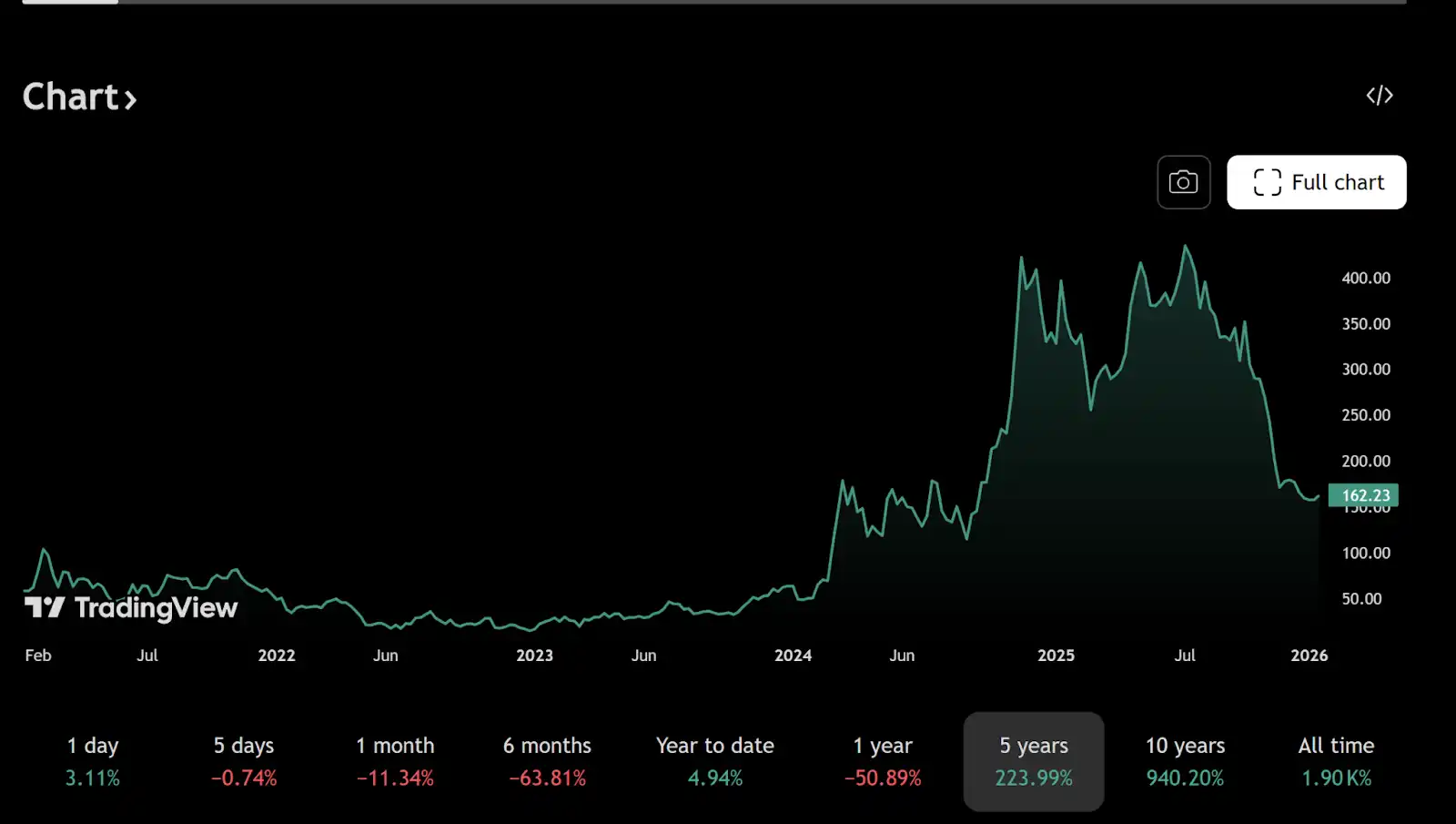
For example, some bonds issued in 2025 and maturing in 2030 have a conversion price of approximately $433 per share, far above the current trading price of around $155. At the current price, conversion is not rational, so the company pays only minimal interest.

If Bitcoin rises substantially, the equity value expands, and part of the debt can be effectively eliminated through conversion. If Bitcoin prices stagnate but do not crash, MicroStrategy can continue operating while paying very low effective interest. Forced deleveraging becomes a concern only if Bitcoin prices fall to around $30,000 and persist into the late 2020s.

This scenario is possible, but far more extreme than many casual commentators imply.

MicroStrategy's Bitcoin Strategy Is a Macro Monetary Bet

On a deeper level, MicroStrategy is not merely speculating on Bitcoin's price. It is expressing a view on the future of the global monetary system, particularly the long-term purchasing power of the US dollar.

By issuing long-term, low-interest bonds denominated in US dollars, the company is effectively shorting fiat currency. If monetary expansion continues and inflation remains high, the real value of its liabilities will erode over time. Bitcoin, with its fixed supply of 21 million coins, is the hedge asset in this trade.

This is why comparing MicroStrategy to a reckless leveraged trader misses the point. The strategy is more akin to a long-term macro investment than short-term speculation. Borrowing a depreciating currency to acquire a scarce digital asset is a classic practice in an environment where debt can be inflated away.

Simply put, if future dollars are worth less than today's dollars, repaying nominal debt becomes easier over time. The longer the debt maturity and the lower the interest rate, the more pronounced this effect becomes.

Why Retail Investors Misread MicroStrategy's Bitcoin Leverage Strategy

Retail investors often evaluate leverage through the lens of personal finance. Loans must be repaid, losses materialize quickly, and leverage is inherently risky. Large-scale corporate financing, however, operates under a different set of rules.

MicroStrategy can refinance, extend debt maturities, issue equity, or restructure debt—options unavailable to individuals. As long as capital markets remain open and the company's creditworthiness is maintained, time becomes an asset rather than a liability.

This difference in perspective explains why Michael Saylor's strategy often appears reckless to outsiders. In reality, as long as one accepts its core assumptions—long-term monetary depreciation and the continued existence of Bitcoin as a global store of value—the strategy is internally consistent.

Bitwise, Crypto Stocks, and the Upside Potential of Bitcoin Leverage

From this perspective, Bitwise's optimism about crypto stocks becomes easier to understand. Companies like MicroStrategy and Coinbase are not just participants in the crypto ecosystem; they are structurally linked to it.

When the crypto cycle turns bullish, their profitability, balance sheets, and equity valuations can expand faster than those of traditional tech companies. This leverage amplifies downside risk, but during speculative expansions, markets rarely reward linear exposure; they reward convexity.

Conclusion: MicroStrategy Is More Like a Bitcoin Call Option Than a Time Bomb

MicroStrategy is neither a sure winner nor an impending disaster. Comparing it to a time bomb is an oversimplification that ignores both its capital structure and its strategic intent. In reality, it is more like a large, publicly traded Bitcoin call option—financed by long-term, low-cost debt and supported by a cash-flow-generating operating business.

Whether this ultimately proves visionary or disastrous depends on Bitcoin's long-term trajectory and the credibility of the fiat monetary system over the next decade. However, it is clear that this is not a naive gamble but a carefully orchestrated macro investment using institutional tools.

In financial markets, it is often these unsettling, highly questioned structures that produce the most asymmetric outcomes.

Recommended Reading:

Why Gold Is Surging: Central Banks, Sanctions, and Trust-1

Gold Front-Runs QE as Bitcoin Waits for Liquidity-2

Related Questions

QWhat is the core argument made by Bitwise regarding crypto-native stocks like MicroStrategy and Coinbase?

ABitwise argues that crypto-native stocks like MicroStrategy and Coinbase have the potential to significantly outperform traditional Nasdaq tech stocks because they possess an intrinsic leverage effect tied to the cryptocurrency cycle, which traditional companies lack.

QHow does MicroStrategy's debt structure for funding Bitcoin purchases differ from traditional leverage?

AMicroStrategy primarily uses zero or very low-interest convertible and senior unsecured bonds, most maturing between 2027 and 2032. Crucially, these bonds have no margin calls or price-based forced liquidation mechanisms, unlike traditional short-term loans with high interest and forced清算 risk.

QWhat role does MicroStrategy's software business play in its overall Bitcoin strategy?

AMicroStrategy's profitable enterprise software business generates approximately $120 million in quarterly revenue, providing stable cash flow to cover interest expenses. This operational liquidity is crucial for maintaining the company's capital structure during prolonged market downturns.

QHow do the convertible bonds create an asymmetric payoff structure for MicroStrategy?

AIf MicroStrategy's stock price rises significantly (typically due to Bitcoin's price increase), bondholders can choose to convert their bonds into equity instead of demanding cash repayment. This can effectively eliminate a portion of the debt. If the price stagnates, the company only pays minimal interest.

QWhat is the fundamental macro monetary bet that underpins MicroStrategy's Bitcoin strategy?

AMicroStrategy's strategy is a macro bet on the future of the global monetary system. By issuing long-term, low-interest dollar-denominated debt, it is effectively shorting fiat currency, betting that monetary expansion and inflation will erode the real value of its liabilities over time, while its fixed-supply Bitcoin holdings act as a hedge.

Related Reads

Gary Yang: Agent Economy and AI Submicroeconomics

**Title:** Agent Economy and AI Sub-Microeconomics - Gary Yang **Summary:** Following the AI singularity, the pace of evolution has accelerated rapidly, creating new generational disparities in technological advancement globally. While many regions are still grappling with single-agent bottlenecks, Silicon Valley has moved ahead into the next dimension: the Agent Economy and A2A ecosystems. The article outlines six key areas of this emerging paradigm: 1. **AI Payment Competition & H2A Bottlenecks:** A fierce battle for AI Agent payment protocol standards is underway (e.g., MPP, x402). However, most current efforts remain Human-to-Agent (H2A), essentially grafting AI onto traditional human-centric commerce, which creates a non-AI-native bottleneck. The true potential lies in Agent-to-Agent (A2A) autonomous economies. 2. **Agent Economy & the Inevitable A2A Trend:** The Agent Economy is defined by autonomous AI Agents creating, exchanging, and capitalizing value as independent economic actors. The A2A ecosystem describes their interactions. This represents the next major investment frontier, akin to the early days of e-commerce or DeFi, but with faster iteration and an AI-native, efficiency-first perspective that often diverges from human needs. 3. **AI Protocol vs. Crypto Protocol:** AI Protocols are the foundational rules for Agent interaction in an open network (communication, discovery, collaboration), akin to the governance and economic laws of the AI world. Currently, they focus on communication and weak boundaries, unlike Crypto Protocols which emphasize asset rights and clear ownership. While they appear different due to political-economic factors and legacy system constraints, their eventual convergence into a unified Digital Protocol system is seen as inevitable, driven by first principles. 4. **AI Agent Sub-Microeconomics & Biological Analogy:** AI Agent economics differ fundamentally from human economics: higher frequency/lower value transactions, energy/value direct correlation, efficiency-driven (not emotional) decisions, task-oriented (not consumption-oriented) behavior, and near-zero organizational/communication costs. A powerful analogy frames the Agent economy as a biological system: the LLM is the nucleus, the Agent harness is the cytoplasm, the Agent itself is a cell, its communication protocol is the cell membrane, and external tools (Skills, Prompts) are the extracellular environment. 5. **The Inevitability of AIFi & FinChip:** AIFi (AI Finance) represents the financial system where AI-native value within the Agent economy is tokenized and exchanged. Unlike TradFi/DeFi where value resides *in* finance, in AIFi, value originates *in* AI, and finance becomes its form. This shift is enabled by Agents taking over value discovery. FinChip (Financial Chip) is introduced as a key infrastructure—a fusion of AI autonomy and crypto smart contracts—forming intelligent financial assets to power the future A2A economy. 6. **AI-Native as a Paradigm Shift:** Adopting AI is not akin to "Internet+". It requires AI-Native thinking—designing systems based on first principles, the shortest energy-value path, and maximum efficiency. This abstract, counter-intuitive logic poses a significant, ongoing challenge for all practitioners, as effective, generalized upgrade methodologies will be slow to emerge in this rapidly evolving landscape.

链捕手40m ago

Gary Yang: Agent Economy and AI Submicroeconomics

链捕手40m ago

From 'The Big Short' to San Francisco: The Revelry and Dizziness Within the AI Bubble

From "The Big Short" to San Francisco: The Frenzy and Dizziness in the AI Bubble The article captures the intense, frenetic atmosphere in San Francisco, the epicenter of the current AI boom. Drawing a parallel to the "smell of money" from *The Big Short*, the author observes a city gripped by a singular status game centered entirely on AI and technology. This manifests in a palpable, caffeine-fueled anxiety ("people are shaking"), rampant comparison using vanity metrics like funding rounds, and pervasive "Big Bubble Behavior." The piece explores the city's stark contrasts: its dystopian streets versus beautiful vistas, and the disconnect between the doomsday concerns of some AI researchers and the optimistic, growth-focused "GTM" teams. It critiques the obsession with "math genius" founders as the new ticket to outsized returns, akin to scouting sports prodigies. Referencing economic historian Carlota Perez's "frenzy phase" and Karl Polanyi's "double movement," the author frames the boom as a period where financial speculation detaches from fundamentals, with society potentially becoming subordinate to a new economic force driven by "geniuses in data centers." Ultimately, while acknowledging the unprecedented wealth creation and party-like energy, the article concludes with cautionary advice: when the music is playing, you should dance, but don't get drunk. The core reminder is to stay grounded, avoid distorted judgment, and maintain perspective amidst the euphoria.

marsbit42m ago

From 'The Big Short' to San Francisco: The Revelry and Dizziness Within the AI Bubble

marsbit42m ago

Is AI Creating a New Class of 'Information Poor'?

AI is generating a new kind of "information poverty." The core issue isn't that AI denies answers to the poor; it's that it provides abundant, cheap, and plausible-sounding answers to everyone. This availability shifts the true scarcity from obtaining answers to possessing the **judgment to evaluate them** and the access to turn them into real-world opportunities. New information poverty thus describes those who have AI tools and outputs, but lack the complementary skills, authorization, and contextual experience to critically assess and act on them. Research reveals a multi-layered divide: access to AI is stratified by income and platform design (e.g., premium vs. free, embedded tools). In workplaces, usage heavily favors higher-paid, more experienced, or formally trained employees, with AI often automating entry-level tasks that were traditional stepping stones. Crucially, the heaviest users are often mid-career professionals whose existing expertise allows them to effectively judge and leverage AI outputs, while novices risk over-relying on them without building judgment. While controlled experiments show AI can significantly boost low-skilled workers' performance, real-world adoption and benefit are constrained by unequal social and organizational structures. Historically, general-purpose technologies first reward those with existing complementary capital. AI, by affecting judgment-based work, may accelerate and deepen this initial inequality gap, even if it narrows over decades. The danger lies in the illusion of competence it creates, potentially stunting the very critical thinking needed in an era where judgment is paramount.

marsbit1h ago

Is AI Creating a New Class of 'Information Poor'?

marsbit1h ago

Jensen Huang 'Saves' South Korean Stock Market: Locks In SK Hynix Memory, Chip Shortage to Continue

On June 5th, South Korea's stock market experienced a sharp decline, with major chipmakers like Samsung and SK Hynix dropping nearly 10%. Amidst the turmoil, NVIDIA CEO Jensen Huang's visit to Seoul played a dramatic role in boosting market sentiment. Following a dinner meeting with SK Group Chairman Chey Tae-won and SK Hynix CEO Kwak Noh-Jung, Huang confirmed that NVIDIA's new Vera CPU will utilize SK Hynix DRAM. The companies announced a multi-year technical partnership to co-develop next-generation memory for NVIDIA's AI infrastructure, covering products from data centers to personal AI and robotics. This collaboration extends beyond memory supply. SK Hynix is integrating NVIDIA's AI and Omniverse platform into its own semiconductor design and manufacturing processes, including computational lithography and creating digital twins of its fabrication plants for autonomous operation. While strengthening ties with SK Hynix, NVIDIA is diversifying its supply chain for the upcoming HBM4 memory, with Samsung, SK Hynix, and Micron all certified as suppliers for its Vera Rubin platform. Despite this, Huang warned that the global chip shortage, driven by relentless demand from AI factory construction, is expected to persist for several years across the entire supply chain. His visit underscores NVIDIA's systematic effort to deepen integration with South Korea's broader tech industry.

marsbit2h ago

Jensen Huang 'Saves' South Korean Stock Market: Locks In SK Hynix Memory, Chip Shortage to Continue

marsbit2h ago

Nasdaq Plunges 4.2% in a Single Day: Does "Black Friday" Burst the U.S. Stock Market Bubble?

The Nasdaq plunged 4.18% on June 5, 2026, its worst single-day drop in over a year, as a much stronger-than-expected US jobs report triggered fears of economic overheating and delayed Federal Reserve interest rate cuts. The selloff, centered on high-valuation tech and AI stocks like Nvidia and Broadcom, spread across major indices. The article examines whether this signals a market top. The strong May non-farm payrolls data, nearly double expectations, pushed bond yields higher, directly hurting rate-sensitive tech stocks. This exposed vulnerabilities in the crowded AI trade, where valuations had soared on narratives of infinite growth, despite emerging signs of slowing order momentum and corporate AI monetization challenges. Prior to the drop, market indicators flashed warning signs: historically high valuations (e.g., Shiller CAPE ratio near 39.5), extreme bullish sentiment, and high levels of leverage. Technical charts showed key support levels being breached. Wall Street is divided on the outlook. Bears, citing risks of "stagflation" and AI bubble comparisons to the dot-com era, warn of a potential significant correction. Bulls view the drop as a healthy correction within a bull market, underpinned by a strong economy and expected corporate earnings growth of around 7% in 2026. The immediate future hinges on upcoming key events: the May CPI inflation data and the mid-June FOMC meeting. Their outcomes will critically shape market expectations for the Fed's rate path. The article concludes that conditions for a major market top are aligning, marking a fragile transition from narrative-driven gains to a phase demanding validation from macroeconomic data and corporate fundamentals. Caution is advised.

marsbit2h ago

Nasdaq Plunges 4.2% in a Single Day: Does "Black Friday" Burst the U.S. Stock Market Bubble?

marsbit2h ago

Trading

Spot
Futures

Hot Articles

Discussions

Welcome to the HTX Community. Here, you can stay informed about the latest platform developments and gain access to professional market insights. Users' opinions on the price of S (S) are presented below.

活动图片