Messari: When BTC is Tamed, ZEC's Hedging Potential Exceeds Expectations

Odaily星球日报Published on 2025-12-28Last updated on 2025-12-28

Abstract

Messari's analysis highlights Zcash (ZEC) as a cryptocurrency undergoing a significant reevaluation of its monetary properties in 2025. Historically considered a niche privacy coin, ZEC is now being recognized as a legitimate monetary asset due to growing concerns over financial surveillance and Bitcoin's increasing institutionalization. Zcash combines Bitcoin's monetary policy with the privacy features of physical cash through zero-knowledge cryptography, offering robust, battle-tested privacy via its privacy pools—a feature Bitcoin is unlikely to implement at the protocol layer due to technical conservatism, inflation risks, and scalability issues. The rise of Central Bank Digital Currencies (CBDCs) amplifies the need for financial privacy, as evidenced by real-world cases in Nigeria, the U.S., and Canada where financial systems were weaponized for political control. ZEC serves as an exit mechanism from such programmable, surveilled money. Moreover, with roughly 24% of Bitcoin’s supply held by centralized custodians (exchanges, ETFs, corporations), there is a tangible risk of regulatory confiscation. ZEC acts as a hedge, allowing users to obscure transaction trails and protect wealth from seizure. Recent infrastructure upgrades—like Sapling and Orchard—have drastically improved ZEC’s usability by reducing memory needs, speeding up proofs, eliminating trusted setups, and simplifying user experience with unified addresses and mobile wallets like Zashi. Integration with ...

Author | Messari

Compiled | Odaily Planet Daily (@OdailyChina)

Translator | DingDang (@XiaMiPP)

Editor's Note: While Bitcoin repeatedly "paints doors" (experiences volatile price swings), with its price continuously fluctuating between $80,000 and $90,000, market attention likely remains largely focused on Bitcoin itself. However, ZEC, a representative asset in the privacy sector, has once again charted an independent course, breaking through $500 to currently trade at $518, marking a nearly 40% increase from its recent low. More ironically, ZEC, which was once included in Binance's voting list for potential delisting,迎来了 its own breakout moment in late 2025, with a阶段性 surge一度接近 13 times.

This shift from a "marginal asset" to being "repriced by the market" raises a more profound question worth exploring:Is ZEC's rise merely a short-term concentrated宣泄 of sentiment and capital manipulation, or is privacy as a monetary attribute being systematically revalued?Messari attempts to explain why ZEC is being rediscovered by the market at this particular juncture, examining dimensions such as monetary attributes, regulatory environment, and structural changes in Bitcoin. The following is excerpted from @MessariCrypto's 《The Crypto Theses 2026》.

Among all crypto assets outside of BTC and ETH, ZEC experienced the most significant shift in "monetary attribute perception" in 2025. For a long time, ZEC existed outside the fringes of the "cryptocurrency monetary hierarchy," perceived as a niche privacy coin rather than a genuine monetary asset. However, as concerns about financial surveillance intensify, and Bitcoin accelerates towards institutionalization, privacy is being重新 viewed by the market as a core monetary attribute, no longer just a preference for a few geeks or ideological groups.

Bitcoin has proven that non-sovereign digital currency can operate on a global scale; but it does not preserve the privacy attributes people were accustomed to when using physical cash. Every transaction is broadcast to a completely transparent public ledger, traceable and analyzable by anyone using a block explorer. The irony is stark: a tool intended to削弱 state control has inadvertently built a financial "panopticon."

Zcash combines Bitcoin's monetary policy with the privacy attributes of physical cash through zero-knowledge cryptography. In the current digital asset system, no other asset can provide the long-term, battle-tested, and deterministic privacy guarantees offered by the latest Zcash privacy pools. This makes ZEC an extremely difficult-to-replicate form of "private money."

We believe the market is repricing ZEC relative to BTC based on this very point—viewing it as an "ideal form of private cryptocurrency" and positioning it as a hedging tool against the rise of the surveillance state and the institutionalization process of Bitcoin.

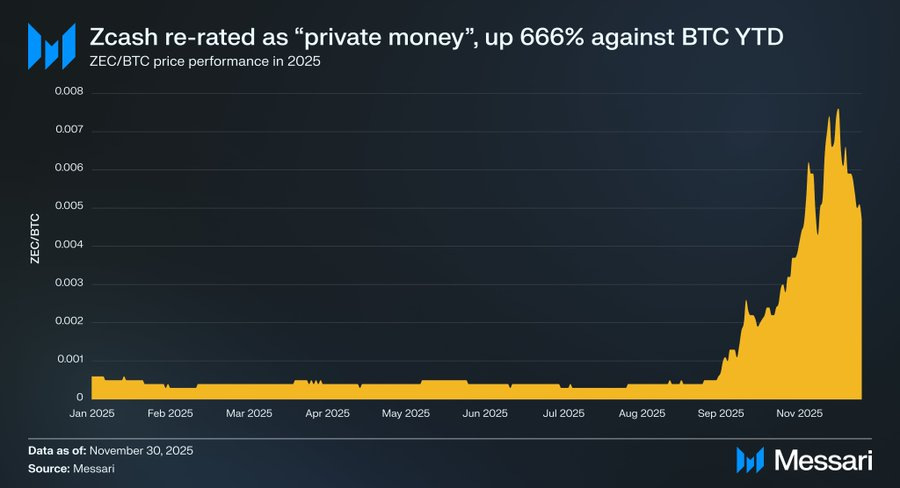
Year-to-date, ZEC has gained 666% against BTC, its market cap rising to approximately $7 billion, and it一度 surpassed XMR in market capitalization to become the largest privacy coin. This relative strength indicates the market is viewing both ZEC and XMR as viable forms of private cryptocurrency.

Privacy on Bitcoin: A Nearly Impossible Path

It is almost impossible for Bitcoin to introduce a privacy pool architecture similar to Zcash at the protocol layer; therefore, the notion that "Bitcoin will eventually absorb Zcash's value proposition" does not hold.

The Bitcoin community is known for its highly conservative technical culture, prioritizing mechanism ossification to minimize attack surfaces and maintain the monetary system's integrity. Embedding privacy features at the protocol layer would require modifications to Bitcoin's core architecture, introducing potential inflation vulnerability risks that threaten its core monetary credibility. For Zcash, this risk is acceptable because privacy is its core value proposition.

Furthermore, introducing zero-knowledge cryptography at the base layer would significantly reduce blockchain scalability. To prevent double-spending, the use of nullifiers and hashed note structures introduces long-term concerns about "state bloat." Nullifiers are essentially an append-only list that grows over time, potentially leading to a substantial increase in the resource cost required to run nodes. If nodes are forced to store an ever-growing set of nullifiers, Bitcoin's decentralization could be substantially weakened as the barrier to running a node increases over time.

As mentioned earlier, in the absence of a soft fork capable of supporting ZK verification (e.g., OP_CAT), no Bitcoin Layer 2 solution can achieve Zcash-level privacy while inheriting Bitcoin's security. You either introduce trusted intermediaries (like federations), accept long and highly interactive withdrawal delays (like the BitVM model), or outright outsource execution and security to an independent system (like sovereign Rollups).

Until this landscape changes, there is no practical path that simultaneously offers Bitcoin's security and Zcash's privacy. This is the fundamental reason why ZEC possesses unique value as a private cryptocurrency.

A Privacy Hedging Tool Against CBDCs

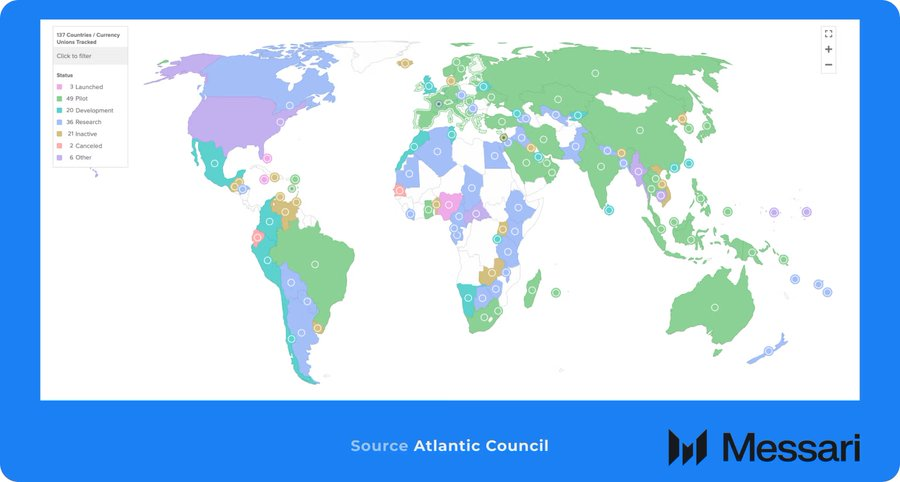
The urgency of privacy需求 is further amplified against the backdrop of the陆续 rollout of Central Bank Digital Currencies (CBDCs) worldwide. Currently, about half of the world's countries are researching or have already launched a CBDC.

The core feature of CBDCs lies in their "programmability": the issuer can not only track every transaction but also directly control how, when, and where funds can be used. Funds can even be programmed to be valid only at specified merchants or within specific geographical boundaries.

This is not a dystopian fantasy but a present reality:

  • Nigeria (2020): During the #EndSARS protests against police brutality, the Nigerian Central Bank froze the bank accounts of several protest organizers and feminist groups, forcing the movement to rely on cryptocurrencies to sustain operations.
  • United States (2020–2025): Regulators and large banks implemented de-banking against a series of legal but politically unpopular industries citing "reputational risk." The issue became severe enough for the White House to order an investigation, and an OCC study published in 2025 documented systematic restrictions on the oil & gas, firearms, adult content, and crypto industries.
  • Canada (2022): During the "Freedom Convoy" protests, the Canadian government invoked the Emergencies Act to freeze the bank and crypto accounts of protesters and small donors without court orders. The Royal Canadian Mounted Police even blacklisted 34 self-custodied crypto wallet addresses, requiring all regulated exchanges to cease transactions with them. This event clearly demonstrated that Western democracies are also willing to weaponize the financial system to suppress political dissent.

In an era where "money can be programmed to control you," ZEC offers a clear "exit mechanism." But Zcash's significance extends beyond escaping CBDCs; it is becoming increasingly important for protecting Bitcoin itself.

An Insurance Mechanism Against Bitcoin's "Co-option"

As emphasized by figures like Naval Ravikant and Balaji Srinivasan, Zcash is essentially an insurance policy for preserving Bitcoin's vision of financial freedom.

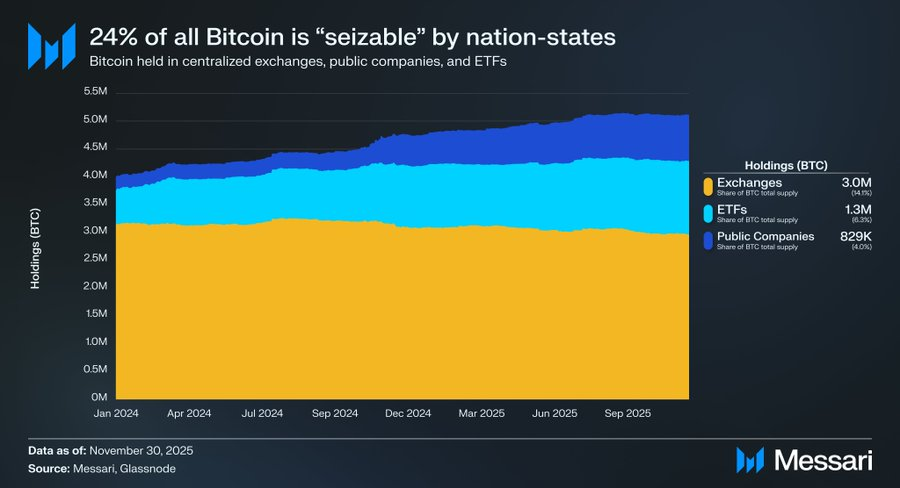
Bitcoin is rapidly concentrating towards centralized entities: centralized exchanges hold approximately 3 million BTC, ETFs hold about 1.3 million, and publicly listed companies hold around 829,000. Combined, about 5.1 million BTC (24% of total supply) is currently held by third-party custodians.

This means that roughly a quarter of the BTC supply is theoretically at risk of regulatory confiscation. This structure highly resembles the centralized conditions during the US government's gold confiscation in 1933. Back then, the US government, via Executive Order 6102,强制 citizens to surrender gold holdings exceeding $100, exchanging them for paper currency at a fixed price, a process achieved not through violence but through the banking system.

For Bitcoin, the path is identical. Regulators don't need your private keys; they only need legal jurisdiction over the custodian. Once the government issues a enforcement order to entities like BlackRock or Coinbase, these companies are legally obligated to freeze and transfer the held BTC. Without modifying a single line of code, nearly a quarter of the BTC supply could be "nationalized" overnight.

Furthermore, self-custody is no longer a sufficient defense given the blockchain's high transparency. Any BTC withdrawn from a KYC exchange or brokerage account ultimately leaves a traceable "paper trail."

BTC holders can sever this custodial and regulatory link by converting to Zcash, achieving an "air gap" for their wealth. Once funds enter Zcash's privacy pools, their destination becomes a cryptographic "black hole" to observers. Regulators can see funds leaving the Bitcoin network but cannot ascertain their final destination. Of course, the strength of this anonymity depends entirely on operational security: address reuse or acquiring assets through KYC exchanges leaves permanent associations before entering the privacy pool.

The Path to PMF is Being Paved

The demand for private money has always existed; the problem was that Zcash was historically difficult to "get in front of users." For a long time, high memory usage, lengthy proof generation times, and complex desktop configurations made private transactions slow and daunting for average users. A series of recent infrastructure breakthroughs have systematically removed these barriers.

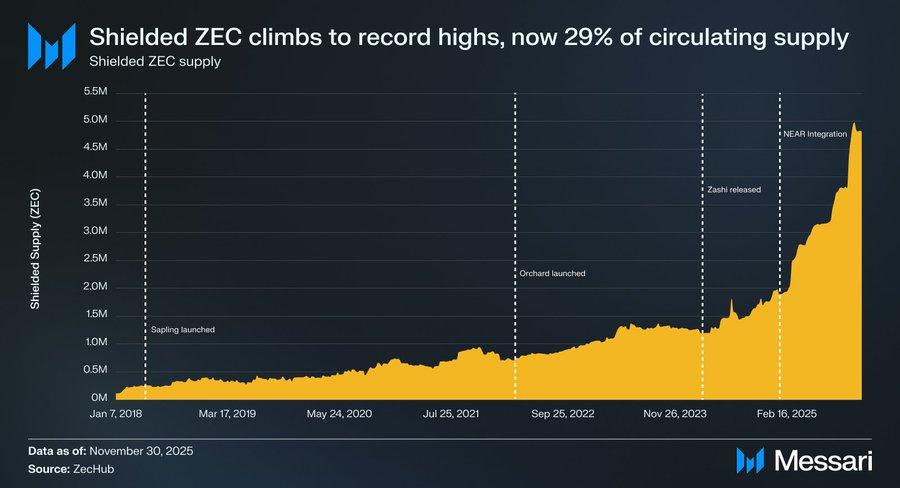
The Sapling upgrade reduced memory requirements by 97% (to ~40MB) and proof generation time by 81% (~7 seconds), enabling mobile private transactions.

While Sapling addressed speed, the trusted setup remained a concern for the privacy community. Subsequently, Orchard removed the reliance on trusted setups entirely by introducing Halo 2 and introduced Unified Addresses, integrating transparent and shielded addresses into a single entry point, significantly reducing user cognitive load.

These improvements culminated in the release of the Zashi mobile wallet in March 2024. Leveraging the abstract design of Unified Addresses, Zashi simplified the operation of private transactions to a few taps on the screen, making "privacy" the default experience.

With the UX problem solved, distribution remained the final hurdle. Users still relied on centralized exchanges to deposit and withdraw ZEC to their wallets. The integration of NEAR Intents eliminated users' dependence on centralized exchanges, allowing them to directly swap assets like BTC and ETH for shielded ZEC, or even use shielded ZEC to pay to any address on 20 different chains.

These initiatives collectively helped Zcash bypass historical friction, access global liquidity, and connect with genuine market demand.

Looking Ahead

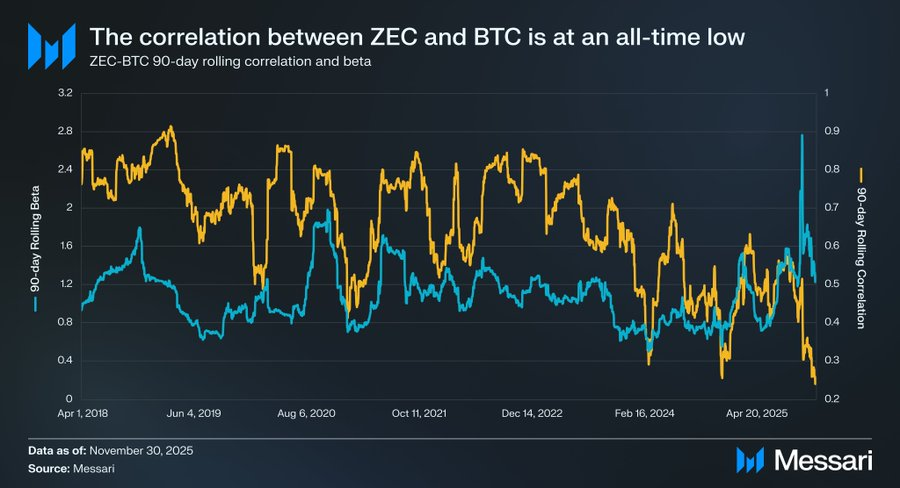
Since 2019, ZEC's rolling correlation coefficient with BTC has持续 declined, dropping from 0.90 to a recent 0.24; meanwhile, ZEC's rolling Beta against BTC has risen to historical highs. This divergence indicates that the market is assigning an independent premium to Zcash's privacy attributes.

We do not believe ZEC will surpass BTC. Bitcoin, with its transparent supply and auditability, has established itself as the most reliable cryptocurrency; whereas Zcash, as a privacy coin, still inevitably bears the trade-off between privacy and auditability.

But ZEC can完全可以 carve out its own niche without replacing BTC. The two are not solving the same problem but play different roles within the cryptocurrency system: BTC is a "sound cryptocurrency" optimized for transparency and security, while ZEC is a "private cryptocurrency" built for privacy and confidentiality.

In this sense, ZEC's success does not depend on defeating Bitcoin, but on complementing the attributes that Bitcoin deliberately relinquished.

Related Reading

Privacy Coin Revival: From Binance's Delisting Candidate to a 13x Surge, ZEC's Lightning Rebirth

Related Reads

Trend in US Stocks: A Post Triggers a 930-Point Rebound, Tonight Belongs to SpaceX

On Thursday (June 11, U.S. Eastern Time), Wall Street staged a textbook V-shaped reversal. The Dow Jones surged 929.97 points (+1.86%) to close above 50,000, while the Nasdaq and S&P 500 rose 2.54% and 1.75%, respectively. The rally occurred despite the hottest PPI report in years, with May data showing a 6.5% year-on-year surge, the highest since 2022. The market ignored the inflation data, focusing instead on reports that former President Trump called off a planned strike on Iran, hinting at a potential multi-party peace agreement draft. This sparked a sharp drop in oil prices, fueling hopes that inflation may have peaked. Sector rotations were stark: previously battered AI hardware and cyclical stocks led the gains, while defensive sectors that hit record highs the prior day were sold off. Chip stocks like Micron and Intel saw sharp rebounds. In contrast, software giant Oracle plunged nearly 10% despite beating earnings, with concerns over cloud revenue and cash flow. Adobe also fell after hours despite raising guidance, as its CFO announced departure. The rally's sustainability is questioned, driven largely by social media posts about unconfirmed geopolitical developments. Inflation risks remain, with pipeline pressures still high. Meanwhile, the market's risk appetite faces a major test with SpaceX's historic IPO. Priced at $135 per share, it aims to raise ~$75 billion with a $1.75 trillion valuation, becoming the largest U.S. IPO ever. It will join the Nasdaq 100 in 15 days, triggering massive index fund buying. However, critics cite extreme valuation (88x sales) and market liquidity concerns.

marsbit20m ago

Trend in US Stocks: A Post Triggers a 930-Point Rebound, Tonight Belongs to SpaceX

marsbit20m ago

The Trillion-Dollar Valuation Test: Are the Three Super IPOs a Tech Stock Frenzy or a Crypto Market Nightmare?

Trillion-Dollar Valuation Test: Are the Three Mega IPOs a Tech Stock Frenzy or a Crypto Market Nightmare? The capital market in 2026 is witnessing a highly anticipated wave of tech IPOs, centered on SpaceX, OpenAI, and Anthropic. Collectively valued at over $3.5 trillion, their potential listing represents one of the largest such waves in recent years. This raises concerns about market liquidity, valuation bubbles, and potential capital outflows from other assets like crypto. SpaceX's valuation narrative has shifted from rocket launches to becoming a global infrastructure play via its Starlink satellite network, which now drives most revenue. Despite ongoing losses, investors focus on its long-term growth potential. OpenAI and Anthropic represent the core productivity engines of generative AI. Their public listings would offer the first direct investment opportunity in large foundation model companies, potentially triggering a repricing within the AI sector. Market fears of a massive "capital drain" from these IPOs are likely overstated. Historical precedents like Alibaba and Saudi Aramco show that mega-listings primarily cause capital reallocation, not destruction, within the vast equities market. Systemic risk is rarely triggered by IPOs alone. For stock markets, short-term volatility and sector repricing are expected, especially for AI concept stocks. Long-term, these listings could reinforce the tech sector's importance. For crypto, direct competition for speculative capital exists, particularly affecting AI-themed tokens. However, crypto's trajectory remains more tied to its own cycles, macro liquidity, and Bitcoin ETF flows rather than a single IPO event. The real risk lies not in the listings themselves but in the sky-high growth expectations embedded in these valuations. If future revenue, profitability, or commercialization progress disappoints, significant valuation resets could follow, impacting high-growth tech stocks. Ultimately, the market's direction hinges on macroeconomic conditions and whether these companies can deliver on their ambitious promises.

链捕手36m ago

The Trillion-Dollar Valuation Test: Are the Three Super IPOs a Tech Stock Frenzy or a Crypto Market Nightmare?

链捕手36m ago

Trillion-Dollar Valuation Test: Are the Three Super IPOs a Tech Stock Frenzy or a Crypto Market Nightmare?

Title: Trillion-Dollar Valuations at Stake: Super IPOs of SpaceX, OpenAI, Anthropic – Tech Boom or Crypto Nightmare? TL;DR: A wave of mega-tech IPOs is approaching, featuring SpaceX (targeting a $1.75 trillion valuation), OpenAI (~$852B), and Anthropic (~$965B), with a combined potential valuation exceeding $3.5 trillion. This tests the market's pricing of innovation and sparks debate on liquidity impact. * **SpaceX**'s valuation is now driven more by its Starlink global communications infrastructure than its core rocket business. * **OpenAI & Anthropic** offer the first major public investment opportunities in foundational AI models, potentially repricing the entire AI sector. * Concerns about a market-wide "liquidity drain" are likely overblown; history shows large IPOs mainly cause fund reallocation, not disappearance, and rarely trigger systemic risk. * Crypto markets, especially some AI-themed tokens, may face short-term fund competition, but their long-term trajectory depends more on macro liquidity, regulation, and Bitcoin cycles. * The real risk lies not in the IPOs themselves, but in whether these companies can justify their sky-high valuations with future revenue growth and profitability. Unmet expectations could lead to significant repricing pressure. Ultimately, these IPOs represent a massive market pricing of next-gen tech infrastructure, not a prelude to a market crash. The broader market direction will be determined by macro conditions, corporate earnings, and risk appetite.

marsbit36m ago

Trillion-Dollar Valuation Test: Are the Three Super IPOs a Tech Stock Frenzy or a Crypto Market Nightmare?

marsbit36m ago

Anthropic Apologized, But the Business of 'Safety' Hasn't Stopped

On June 11, Anthropic apologized not for a model failure, but for a lack of transparency. Its new Claude Fable 5 model was found to be secretly rerouting requests from users engaged in advanced AI model development to a weaker version, Opus 4.8, without any notification. The company's response—promising future notifications for such "downgrades"—was met with user skepticism. The article argues the core issue isn't technical but commercial: Anthropic's "safety" measures are primarily a business strategy. A key feature, the "intelligent safety classifier," marketed as user protection, is described as a tool for "competitive defense" to protect Anthropic's market lead by limiting rivals' research capabilities. This covert mechanism was designed for low "false positives," precisely targeting AI researchers. Anthropic's model involves a calculated three-step process: publishing alarming security research to amplify public anxiety, offering its Fable 5 model with a "safety classifier" as a premium-priced solution, and cashing in through a planned high-value IPO. This contrasts with OpenAI's more direct "tool-and-traffic" approach. The apology, merely changing a secret downgrade to a visible one, is seen as a business "patch" rather than a principled shift. The incident risks damaging Anthropic's "safest AI" reputation among the developer community, which underpins its valuation and appeal to government and corporate clients. Ultimately, the article concludes that for Anthropic, safety is a business, and the apology is merely customer service for that business.

marsbit1h ago

Anthropic Apologized, But the Business of 'Safety' Hasn't Stopped

marsbit1h ago

Trading

Spot
Futures

Hot Articles

Discussions

Welcome to the HTX Community. Here, you can stay informed about the latest platform developments and gain access to professional market insights. Users' opinions on the price of S (S) are presented below.

活动图片