McKinsey x Artemis Joint Report: Only 1% of Stablecoin's $35 Trillion Transaction Volume is Real Payments, C-Side Usage Negligible

marsbitPublished on 2026-03-18Last updated on 2026-03-18

Abstract

McKinsey and Artemis's joint report reveals that out of $35 trillion in annual stablecoin transaction volume, only about 1% ($390 billion) represents genuine payments. The majority (58%) of these real payments are B2B transactions—such as cross-border settlements and corporate treasury operations—which grew 733% year-over-year. Consumer usage, including retail payments and card spending, remains negligible. The report identifies five structural reasons for this institutional dominance: 1) Greater financial efficiency incentives for businesses; 2) Programmable payments suit B2B workflows, not consumer use cases; 3) Regulatory frameworks favor institutional adoption; 4) Closed-loop B2B systems avoid network effects needed for retail; 5) Corporations prioritize internal benefits over expanding to retail networks. While B2B stablecoin adoption continues accelerating, consumer usage faces significant friction and may remain secondary. The analysis suggests stablecoins may evolve primarily as an institutional settlement layer rather than a mainstream retail payment tool.

Author: Stablecoin Insider / McKinsey×Artemis

Compiled by: Deep Tide TechFlow

Deep Tide Introduction: The McKinsey and Artemis joint report did something rare in the industry: breaking down the stablecoin transaction volume data. The conclusion: of the approximately $35 trillion in annual on-chain transaction volume, only about $390 billion (about 1%) represents real payment behavior, of which 58% is business-to-business financial operations, with an annual growth of 733%. Consumer-side stablecoin usage is almost negligible, and this is no accident—the article summarizes five structural reasons explaining why the gap between institutions and individuals is not just a temporary disparity.

Full text as follows:

The stablecoin industry has a headline problem.

On one hand, raw on-chain data shows tens of trillions of dollars flowing on-chain annually, a figure that fuels endless comparisons with Visa and Mastercard, and predictions of SWIFT's imminent replacement.

On the other hand, a landmark report released in February 2026 by McKinsey & Company and Artemis Analytics stripped all this away and asked a more direct question: how much of it is real payments?

The answer is about 1%.

Of the approximately $35 trillion in annualized stablecoin transaction volume, only about $390 billion represents genuine end-user payments, such as supplier invoices, cross-border remittances, payroll disbursements, and card swipes. The rest is trading activity, internal fund shuffling, arbitrage behavior, and automated smart contract loops.
The report concludes that the inflated headline numbers should be "the starting point for analysis, not a proxy for measuring payment adoption."

But within this real $390 billion baseline, there is a story worth examining closely, and it almost entirely revolves around corporate finance, not consumer wallets.

B2B Dominates: What the Data Actually Shows

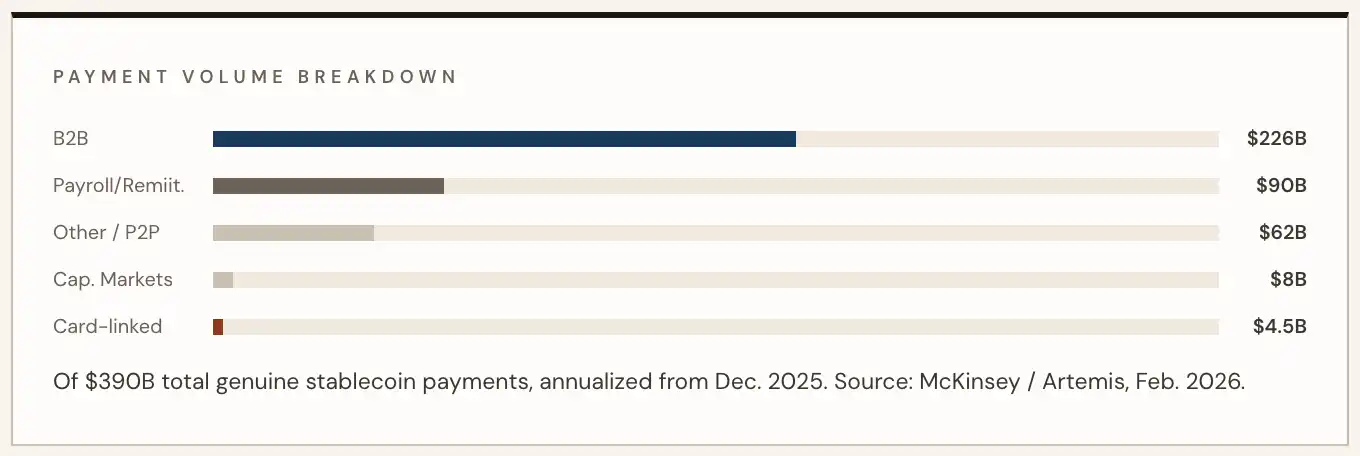
According to the McKinsey/Artemis analysis (benchmarked to activity data from December 2025), business-to-business transactions account for $226 billion of all real stablecoin payment volume, about 58%.

This figure represents a 733% year-on-year increase, primarily driven by supply chain payments, cross-border supplier settlements, and financial liquidity management. Asia leads in geographic activity, but adoption is also accelerating in Latin America and Europe.

The remainder of the real payment space is distributed among payroll and remittances ($90 billion), capital market settlements ($8 billion), and linked card spending ($4.5 billion).

According to McKinsey, card spending associated with stablecoins grew an astonishing 673% year-on-year, but in absolute terms, it remains only a small fraction of B2B flow.
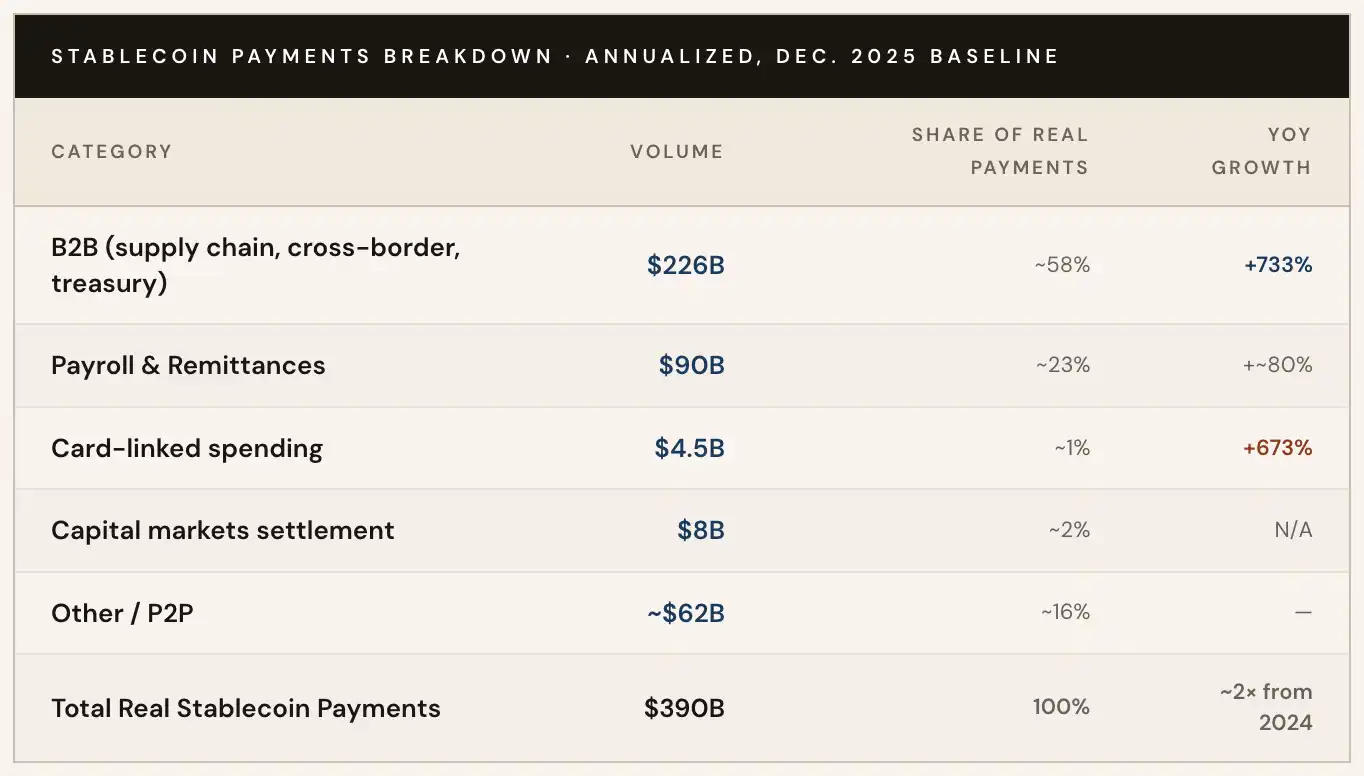
For context: this total of $390 billion represents only 0.02% of McKinsey's estimated global annual payment total of over 2 quadrillion dollars. Specifically, B2B stablecoin flow accounts for about 0.01% of the global $160 trillion B2B payment market.

These numbers are large in the context of stablecoins but remain minuscule in the context of the global financial system.

Monthly run-rate data more intuitively shows where the momentum lies. According to data cited by BVNK from the McKinsey/Artemis report, stablecoin monthly payment volume was only $5 billion in January 2024; by early 2026, this number had exceeded $30 billion—a sixfold increase in less than two years, with the steepest acceleration occurring in the second half of 2025.

Annualized, this run rate now exceeds $390 billion.

"The fact that real stablecoin payments are far lower than conventional estimates does not diminish the long-term potential of stablecoins as a payment rail; it simply establishes a clearer baseline for assessing where the market stands." — McKinsey/Artemis Analytics, February 2026

Why the Gap Exists: Five Structural Forces Excluding Retail

The divergence between the explosive adoption in B2B and the negligible consumer usage is not coincidental but the product of structural asymmetries that systematically favor corporate use cases over retail ones.

Here are the five forces driving the institutional gap:

1) Financial Efficiency Beats Consumer Convenience

Corporate treasurers are driven by specific, quantifiable pain points: SWIFT correspondent banking chains that take one to five business days to settle, currency exchange windows that tie up working capital, and intermediary fees layered on at every transaction point.

Stablecoins solve all three problems simultaneously. For a company paying suppliers in fifteen countries, the economic case is clear; for a consumer buying coffee, it is not. The incentive to switch is orders of magnitude greater on the enterprise side.

2) Programmability Has No Equivalent Value on the Retail Side

The B2B explosion is partly a story of programmable payments. Smart contracts enable conditional logic—invoice triggering, delivery confirmation, escrow release—that can automate entire accounts payable processes at scale.

This is naturally suited to corporate finance operations, as high-value, structured, repetitive payment processes benefit immensely from automation. Retail payments lack similar trigger use cases at any scale.

Consumers buying groceries don't need programmable conditions; they need something that works like swiping a card. The cognitive complexity of blockchain-native payments remains a barrier on the retail side, and programmability does nothing to help that.

3) Regulatory Architecture Favors Institutions

Post the GENIUS Act, institutional operators have adapted to the compliance architecture—AML/CFT, Travel Rule, licensing requirements—and built the legal infrastructure to operate confidently.

Corporate finance teams have dedicated compliance functions that can absorb onboarding friction; individual consumers cannot. The result is that, in most jurisdictions, on-ramps for stablecoins remain operationally complex for retail users, and the merchant acceptance gap persists globally.

Every frictionless B2B payment today is a data point institutions use to justify further investment; the consumer ecosystem, meanwhile, awaits a compliant, user-experience-smooth entry point that has not yet emerged at scale.

4) Closed-Loop Advantage

B2B stablecoin payments succeed precisely because they are closed-loop: business sends to business, both have wallets, both have compliance infrastructure, and neither needs a universal merchant network.

Consumer payments face the classic chicken-and-egg problem: merchants won't invest in stablecoin acceptance infrastructure until consumers demand it; consumers won't enable wallets until they can spend widely.

The institutional world completely bypasses this problem by operating in bilateral or consortium environments, requiring no open merchant network.

5) Institutional Incentives Point Upstream

Corporate treasurers holding stablecoins gain yield, reduce FX exposure, and improve liquidity management—advantages that accrue internally and, if shared downstream, introduce complexity or competitive vulnerability.

Extending stablecoin use to a supplier's supplier, employees, or end consumers requires building a network that benefits those downstream parties, which is not necessarily in the interest of the originating finance team.

In the absence of a clear ROI driving network expansion outward, companies rationally choose to consolidate internal gains.

Market Context

BVNK's own infrastructure data corroborates the dominance of B2B from an operator's perspective. The company processed $30 billion in annualized stablecoin payment volume in 2025, a 2.3x year-on-year increase, with one-third of the volume coming from the US market.

Its client list (Worldpay, Deel, Flywire, Rapyd, Thunes) consists of leaders in cross-border B2B and payroll, not consumer applications.

As BVNK stated in its 2025 year-end review:

"The initial assumption that remittances and consumer transfers would lead stablecoin growth did not materialize as the primary driver; B2B instead assumed that role."

When Will Retail Catch Up—If Ever

The McKinsey/Artemis baseline makes the current situation clear. What it cannot answer is whether the institutional gap will narrow, widen, or permanently solidify.

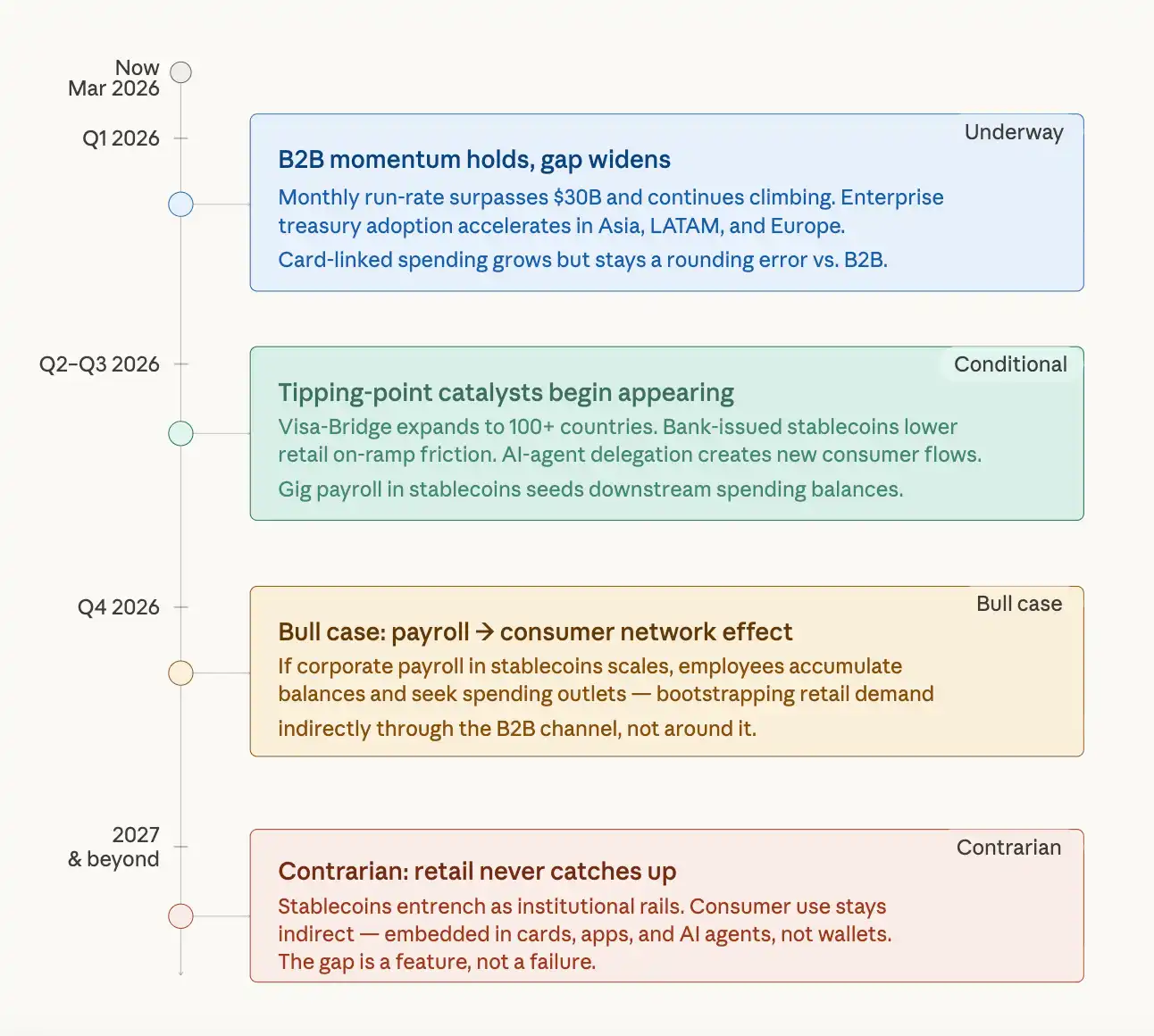
Here are three possible scenarios for the next 18 months:
Near Term 2026—The Gap Widens Further

B2B momentum shows no signs of slowing. The monthly run rate of over $30 billion continues its trajectory as more companies use stablecoin rails for cross-border accounts payable and financial operations. Consumer stablecoin card spending grows modestly but remains negligible in absolute terms compared to B2B flow. Even if retail adoption advances slowly in percentage terms, the gap widens in absolute dollar terms.

Mid-Term End-2026 to 2027—Inflection Points Begin to Appear

Several catalysts could begin to bridge the gap: bank-issued multi-currency stablecoins reduce retail on-ramp friction; programmable features extend to consumer applications via AI Agent payment delegation; gig economy wages paid in stablecoins create downstream spending balances for employees.

US Treasury Secretary Scott Bessent predicted that stablecoin supply could reach $3 trillion by 2030, a trajectory implying consumer network effects will eventually emerge.

Counterview—Retail May Never 'Catch Up,' and That Might Be the Point

The most honest reading of the McKinsey data is that stablecoins may be evolving into what the report faintly hints at: a programmable settlement layer on the internet for machines, finance departments, and institutions, with consumer adoption being an indirect, embedded benefit, not the primary use case.

If this framework holds, then the institutional gap is not a failure of adoption but a feature of the technology's natural architecture. Corporate wages paid in stablecoins may eventually create downstream consumer spending, but the path from B2B infrastructure to retail wallets is long, circuitous, and dependent on user experience breakthroughs that have not yet emerged at scale.

An Honest Baseline

The McKinsey/Artemis report did something more valuable than recording stablecoin growth: it established an honest baseline the industry has clearly been missing.

Stripping away trading noise, internal shuffling, and automated smart contract loops reveals a genuinely growing market—real payment volume doubled from 2024 to 2025—but one that is highly concentrated on the institutional side in a structural, non-accidental way.

The 733% growth in B2B is not a deferred consumer story; it is a maturing finance story.

The enterprises building on stablecoin rails today are solving real operational problems—cross-border friction, correspondent banking inefficiencies, working capital delays—problems that have nothing to do with whether consumers hold stablecoin wallets. They will continue building, regardless.


Related Questions

QAccording to the McKinsey and Artemis report, what percentage of the $35 trillion in annual stablecoin transaction volume represents real payments?

AOnly about 1% of the $35 trillion in annual stablecoin transaction volume, or approximately $390 billion, represents real payments.

QWhich segment dominates the real stablecoin payment volume, and what was its growth rate?

ABusiness-to-business (B2B) transactions dominate the real stablecoin payment volume, accounting for 58% ($226 billion) and experiencing a growth rate of 733% year-over-year.

QWhat are the five structural reasons identified for the gap between institutional and consumer adoption of stablecoins?

AThe five structural reasons are: 1) Financial efficiency beats consumer convenience, 2) Programmability has no equivalent value in retail, 3) Regulatory architecture favors institutions, 4) Closed-loop advantages, and 5) Institutional incentives point upstream.

QHow does the real stablecoin payment volume compare to the global payment market?

AThe $390 billion in real stablecoin payments represents only 0.02% of the global annual payment volume of over $2 quadrillion, and the B2B stablecoin volume is about 0.01% of the global $160 trillion B2B payment market.

QWhat is one potential future scenario where the gap between institutional and consumer stablecoin use might begin to narrow?

AA potential scenario for narrowing the gap includes catalysts such as bank-issued multi-currency stablecoins reducing retail onboarding friction, programmable features extending to consumer applications via AI Agent payments, and gig economy wages paid in stablecoins creating downstream consumer spending balances.

Related Reads

Sequoia Dialogue with Jensen Huang: Computing Model Undergoes a 60-Year Transformation; You Won't Be Replaced by AI, But You Will Be Dimensionality-Reduced by 'Those Who Master AI'

NVIDIA founder and CEO Jensen Huang, in a conversation with Sequoia Capital's Konstantine Buhler, argues that we are witnessing the most significant computing shift in 60 years—from retrieval-based to generative computing. Instead of just storing and retrieving data, future systems will generate highly personalized content (text, images, video) on demand, powered by massive "AI factories." Huang envisions a global "intelligence network" that will envelop the planet, following the historical patterns of energy and communication grids. He outlines a five-layer investment framework: 1) Energy, 2) Chips/Computers, 3) Infrastructure (data centers), 4) AI Models, and 5) Applications. He predicts this ecosystem will reach a scale of $20 trillion annually. Crucially, Huang pushes back against fears of AI-driven job loss. He distinguishes between specific "tasks" (e.g., typing, analyzing images) and overall "jobs" (e.g., CEO, radiologist). While AI automates tasks, it increases efficiency and demand for the higher-value problem-solving aspects of professions, thus creating more jobs and "up-leveling" careers. The real risk, he asserts, is not being replaced by AI, but being outperformed by someone who effectively leverages it. He urges everyone to embrace AI as a tool for augmented capability and innovation.

marsbit21m ago

Sequoia Dialogue with Jensen Huang: Computing Model Undergoes a 60-Year Transformation; You Won't Be Replaced by AI, But You Will Be Dimensionality-Reduced by 'Those Who Master AI'

marsbit21m ago

"I Don't Need a Better Model Anymore": A Panorama of AI Users Under a Reddit Hot Post

Titled "I Don't Need a Better Model Anymore": AI User Reactions on Reddit Anthropic recently released Claude Fable 5, its first publicly available 'Mythos'-tier model, achieving 80.3% on the SWE-Bench Pro benchmark and significantly outperforming its predecessor and competitors. However, a viral Reddit post titled "Claude Fable made me realize I don't need better models anymore" highlighted a growing user sentiment of "good enough." Top comments expressed "model fatigue," with users stating that earlier models like Opus 4.5/4.8 already sufficed for their workflows. High cost was a key concern, as Fable 5's API is nearly twice the price of Opus 4.8, with users questioning the return on investment and suggesting the field has hit a plateau. The most frequent complaint targeted Fable 5's stringent safety filters. Designed to intercept high-risk requests (e.g., cybersecurity), the system was perceived as overly conservative. Users reported frequent rejections for routine security-related tasks, leading to automatic fallbacks to the older Opus model. Paying users were particularly frustrated, feeling they paid a premium for a less usable product. Dissenting voices came from users with heavy, complex tasks. For workloads like high-energy physics simulations with thousands of code lines, Fable 5's improved long-context understanding and error detection represented a significant, worthwhile leap—described as moving from a "college player to an NBA starter." The debate underscores a divergence between benchmark performance and practical utility. For most users, current models meet their needs, making further advances relevant only for extreme use-cases. The discussion also raised concerns about a potential "Public AI Freeze," where the most powerful models (like the restricted Mythos 5) remain exclusive to enterprises and governments, while public offerings stagnate. The launch presents two report cards: one of technical excellence and another of user skepticism. Fable 5's ultimate reception may depend on Anthropic's ability to refine its safety filters and justify its cost for specialized, high-demand users.

marsbit28m ago

"I Don't Need a Better Model Anymore": A Panorama of AI Users Under a Reddit Hot Post

marsbit28m ago

When AI Traffic Surpasses Humans, How Do You Prove You're Human?

With AI-generated web traffic surpassing human activity, websites face a crisis as AI agents bypass ads, avoid clicks, and scrape data without generating revenue. This disrupts the ad-based internet economy, diverting traffic and reducing site visits. In response, sites are blocking AI crawlers and deploying traps like Cloudflare's "honeypot" pages. Traditional CAPTCHAs are now ineffective against advanced AI. The focus has shifted to behavioral biometrics—analyzing unique human patterns such as cursor movement, typing rhythm, and keystroke dynamics. Companies like IBM and BioCatch use this data to distinguish humans from bots, even detecting fraud through behavioral inconsistencies. Two competing approaches aim to verify human identity centrally. Sam Altman’s World (formerly Worldcoin) uses iris scanning to create unique credentials, though it faces privacy concerns and regulatory bans. Alternatively, cryptographic zero-knowledge proofs offer anonymous verification without revealing personal data, championed by Vitalik Buterin to avoid centralized surveillance. However, both systems have flaws. Centralized solutions risk biometric data misuse, while decentralized models may be exploited through identity rental markets in economically unequal regions. Despite challenges, the author favors cryptographic methods for preserving privacy over pervasive behavioral monitoring that permanently captures and controls personal biometric data.

marsbit37m ago

When AI Traffic Surpasses Humans, How Do You Prove You're Human?

marsbit37m ago

2026 Landscape of Decentralized AI: Why is Blockchain the Inevitable "Antidote" for AI?

**The 2026 Landscape of Decentralized AI: Why Blockchain is the "Cure" AI Cannot Ignore** Decentralized AI addresses fundamental bottlenecks of centralized AI: scarce and expensive computational resources, excessive control concentration, unverifiable model outputs, and increasing difficulty in acquiring training data due to privacy and regulation. Blockchain offers a path to make intelligence open, verifiable, and economically accessible. The technical stack comprises three layers: 1. **Applications & Services**: The main crypto use cases are "Agentic Finance" (converting natural language into on-chain actions) and "Agentic Payments" for machine-to-machine commerce. Projects like Giza, Infinity Labs, Coinvest AI, and x402 (handling 173M+ transactions) are key players. 2. **Middleware**: This coordination layer enables agents to discover, identify, and transact. Notable projects include Gokite AI (specialized L1), Virtuals (an OS for the agent economy), and especially Bittensor—a network of specialized subnets forming competitive AI micro-economies. 3. **Infrastructure**: The capital-intensive layer providing raw resources. It includes decentralized compute (Akash, Render, Aethir), verifiable inference (Venice AI, OpenGradient), distributed training (Prime Intellect, Templar AI), decentralized storage (Filecoin, Walrus), and privacy/verification layers (Nillion, Arcium, Phala Network) using technologies like ZKPs, MPC, and TEEs. The outlook for 2026-2027 indicates AI demand outpacing infrastructure, with AI agents as a primary growth engine. Computation is becoming an asset class, with on-chain markets as its financial layer. Tokenomics is emerging as a structural advantage for coordinating capital, compute, and data in decentralized AI networks. While still early—with adoption uneven and revenue often trailing token incentives—projects like Bittensor, NEAR, and Virtuals demonstrate a shift from speculative narrative to a new model for coordinating intelligence.

marsbit40m ago

2026 Landscape of Decentralized AI: Why is Blockchain the Inevitable "Antidote" for AI?

marsbit40m ago

a16z Crypto Partner: Cash Flow is the Moat

Cash Flow as the Moat: A Playbook for Crypto Founders Historically, the most enduring businesses have been built by positioning themselves within the "flow of funds"—facilitating the creation and transfer of value in a network and extracting a portion of it. Cryptocurrency is the first modern technology natively built for this purpose. For startups, failing to architect products and businesses to leverage these principles means missing a major opportunity. Blockchains are inherently network businesses. Each transaction settles on a shared ledger, and every new participant strengthens the underlying network for all. Well-designed network tokens amplify this by aligning users, developers, and validators around growing the network, with value flowing back to contributors in a transparent feedback loop. This model is not new; companies from railroads and Standard Oil to Google, Meta, and AWS have thrived by inserting themselves into critical flows of value (goods, attention, compute). Financial markets make it even clearer: firms like Visa and major market makers generate immense revenue not by predicting markets but by being in the path of transactions. The combination of fund flow and network effects creates one of the most durable business structures. The high margins in traditional finance (payments, custody, lending, FX) represent prime targets. Crypto founders have the opportunity to build the next version—programmable, instant, global, and natively in the flow of funds. The frontier extends beyond finance to areas like computing/GPUs, AI training data, energy, robotics, and space—markets without entrenched intermediaries, ripe for building new, efficient value rails on programmable infrastructure. Founders should ask: Are you in the flow of funds today? Does your revenue scale 10x with the value of activity on your platform? Where in your target market are profit margins highest relative to value created? The opportunity is clear: embed your startup into the new flows of value and let the network effects accumulate.

marsbit42m ago

a16z Crypto Partner: Cash Flow is the Moat

marsbit42m ago

Trading

Spot
Futures
活动图片