‘Major loss’: New York Court rejects Kalshi’s injunction request

ambcryptoPublished on 2026-07-08Last updated on 2026-07-08

Abstract

A New York court has denied prediction market platform Kalshi's request for a preliminary injunction. Judge Analisa Torres ruled that gambling regulation falls under state purview and that federal commodity law does not preempt state gambling laws, dealing a significant blow to Kalshi's argument that its CFTC oversight exempted it from state authority. Legal analyst Daniel Wallach described the ruling as a "major loss" for Kalshi and the CFTC, predicting it will trigger a domino effect, likely causing the CFTC to lose its related case against the New York Attorney General and advancing other state enforcement actions against prediction market providers like Gemini and Coinbase. Kalshi is expected to appeal the decision.

Prediction market platform Kalshi has suffered a legal loss in New York. According to a court filing on the 7th of July, the firm was denied a preliminary injunction by Judge Analisa Torres of the Southern District of New York.

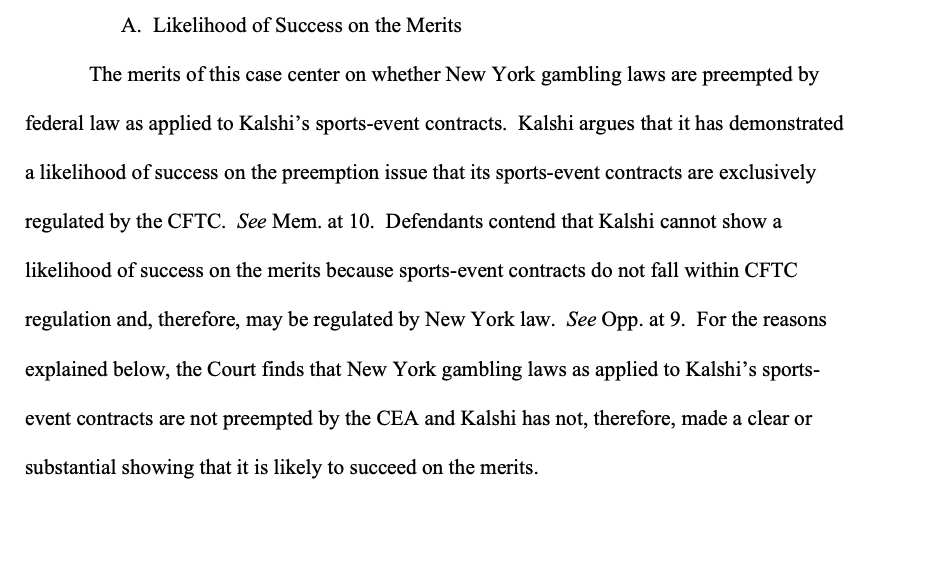
Judge Torres maintained that gambling falls under the purview of local state oversight.

The scope of laws regulating gambling and lotteries is clearly a matter of predominantly state concern.

AD

Additionally, Judge Torres clarified that federal law, the Commodity Exchange Act, does not preempt state gambling laws.

Courts apply a presumption against preemption with respect to areas where states have historically exercised their police powers.
Source: Court Listener

She explained that such a presumption arises only when Congress legislates in a field traditionally governed by the states. In other words, federal authority applies only where Congress has explicitly displaced state control. The case was set to determine whether prediction markets are regulated financial products or unlicensed gambling operations.

Kalshi had initially argued that it was above state gambling laws because it was a CFTC-regulated platform, with federal oversight preempting state authority. In fact, in April 2026, the CFTC backed the Kalshi case, citing federal preemption of state laws.

The agency had made similar arguments against Arizona, Connecticut, Illinois, Wisconsin, New Mexico, and Minnesota. But the CFTC’s attempt to block other states’ push to police prediction markets could be derailed.

Impact of court ruling against Kalshi

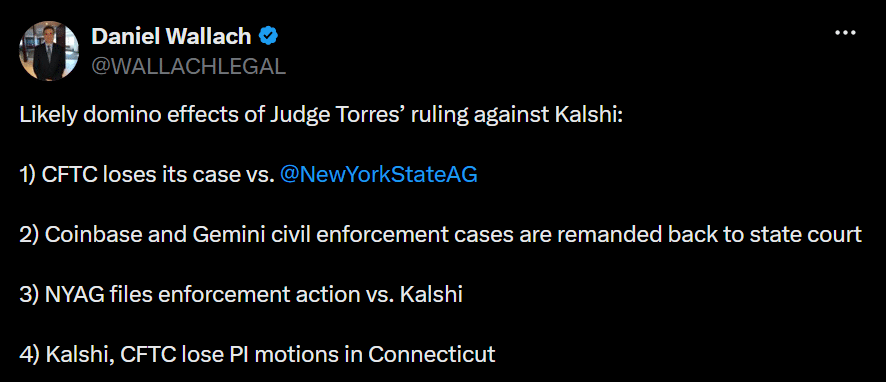
Commenting on the update, sports betting and gaming lawyer Daniel Wallach said Judge Torres’ ruling would have a far-reaching domino effect. First, the CFTC will likely lose its case against New York State Attorney General (NYAG).

Other state cases against prediction market providers like Gemini and Coinbase would advance, including NYAG filing enforcement action against Kalshi for gambling law violations.
Source: X

And the crackdown isn’t stopping in New York. Kalshi’s push for an injunction in Connecticut will also be quashed. In other words, CFTC’s push for sole oversight over the prediction markets will stall.

Wallach concluded that the ruling is a ‘major loss’ to Kalshi and a ‘big win’ for NYAG, noting the prediction markets firm will likely appeal it.

Major, major loss for Kalshi in the financial capital of the US, with likely knock-on effects in other cases. Kalshi will appeal the injunction denial to CA2 and seek an immediate injunction pending appeal.

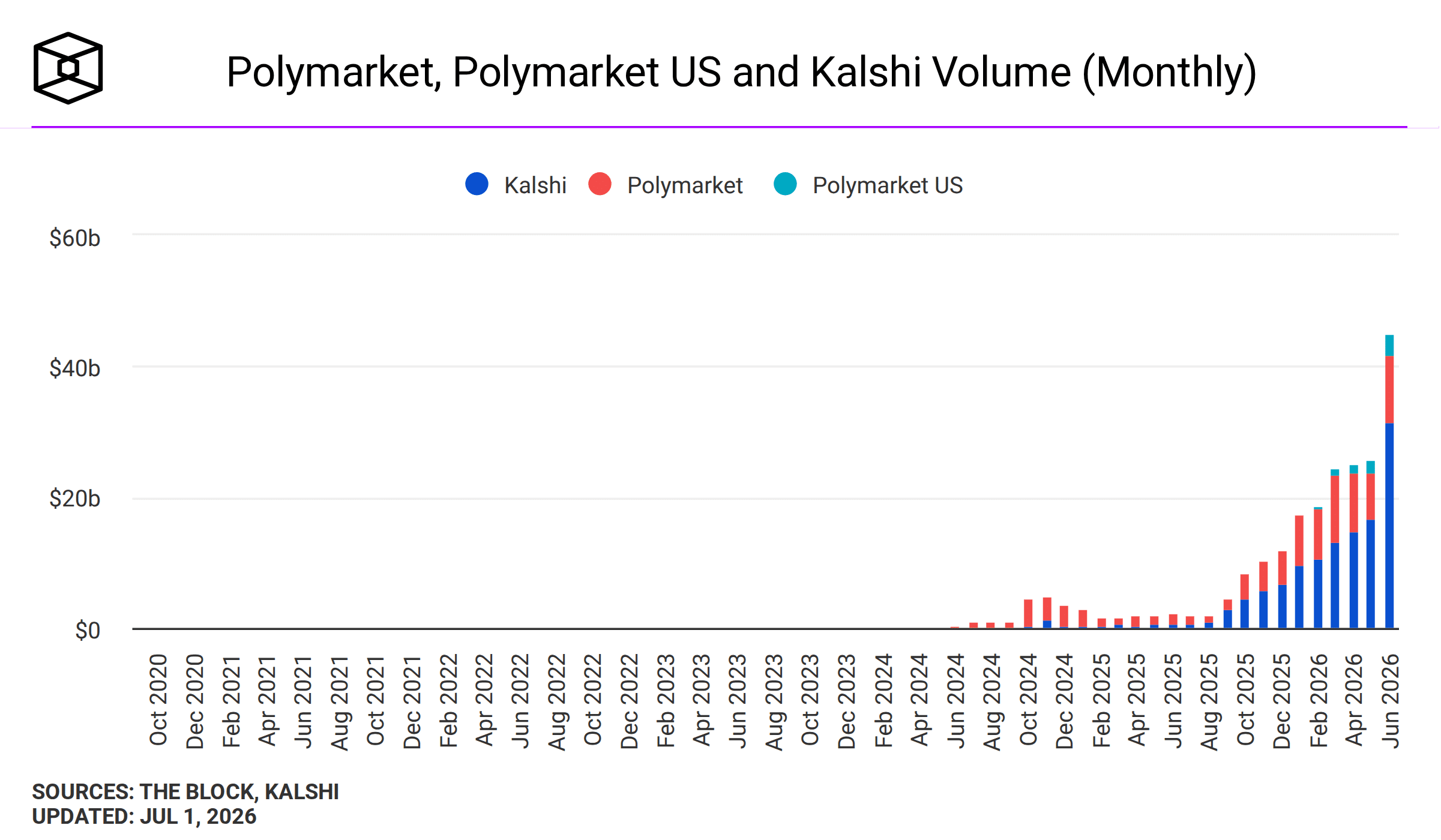
In June, Kalshi and Polymarket volumes hit a record monthly high of $43 billion as the World Cup kicked off.

In fact, sports betting dominates the volume, further reinforcing the argument that the platforms are ‘100% gambling sites,’ not risk management tools.
Source: The Block

Final Summary

  • A New York court denied Kalshi’s injunction and ruled that federal law does not preempt state gambling laws.
  • An analyst said the ruling is a ‘major loss’ to Kalshi and CFTC, warning of likely domino effects on pending prediction market cases.


Trending Cryptos

Related Questions

QWhat was the outcome of Kalshi's request for a preliminary injunction in New York?

AA New York court, specifically Judge Analisa Torres of the Southern District of New York, denied Kalshi's request for a preliminary injunction.

QWhat key legal principle did Judge Torres cite in her ruling regarding state versus federal authority over gambling?

AJudge Torres ruled that federal law (the Commodity Exchange Act) does not preempt state gambling laws, stating that the regulation of gambling is a matter of predominantly state concern. She applied a presumption against federal preemption in areas where states have historically exercised their police powers.

QWhat was Kalshi's primary legal argument for being exempt from state gambling laws?

AKalshi argued that it was exempt from state gambling laws because it is a CFTC-regulated platform, claiming that federal oversight preempts state authority.

QAccording to analyst Daniel Wallach, what is the broader impact of this court ruling?

AAnalyst Daniel Wallach stated the ruling is a 'major loss' for Kalshi and the CFTC, with likely domino effects. He predicted it could lead to the CFTC losing its case against the NYAG, advance other state cases against prediction market providers, and quash Kalshi's similar injunction efforts in other states like Connecticut.

QWhat evidence from the article is used to argue that platforms like Kalshi are gambling sites rather than financial tools?

AThe article notes that in June, Kalshi and Polymarket volumes hit a record monthly high of $43 billion coinciding with the World Cup kickoff. It states that sports betting dominates this volume, reinforcing the argument that the platforms are '100% gambling sites' and not risk management tools.

Related Reads

Former Huawei 'Genius Teen' Who Questioned DeepSeek Interview Lands in 'Crossfire' from Web3 Investor

Former Huawei "Genius Youth" Li Bojie recently drew public attention by criticizing his interview experience with DeepSeek. The controversy escalated when Du Jun, co-founder of Web3 investment firm ABCDE Capital, publicly accused Li of being "the founder with the least sense of contractual spirit" he had ever cooperated with, sparking a dispute over Li's startup project, Metagent. Li detailed a frustrating DeepSeek interview where he was accused of potential plagiarism, leading him to end the session. The spotlight then shifted to his venture, Metagent, a Web3+AI project aiming to tokenize AI agents. ABCDE invested $1.5 million, with an initial $500k disbursed. Du Jun claimed the project's progress was severely lacking, with a poor-quality demo and minimal social media activity. He alleged Li stopped communicating, deleted his Telegram, and failed to provide proper financial reporting. In response, Li argued the remaining $1 million was never received, crippling operations and forcing salary cuts. He stated he left Metagent in October 2024 due to family reasons and Web3 compliance concerns, with board approval. He claimed to have fulfilled disclosure duties and that his subsequent projects avoided conflicting fields. Other investors, including ArkStream Capital, shared negative due diligence experiences, citing unprofessional contracts and evasive answers on tokenomics. Metagent's social media went silent in June 2024, effectively stalling. Li has since moved to a new consumer AI agent platform, Pine AI (formerly Logenic AI), which has raised $25 million in Series A funding. He served as its Chief Scientist but recently left, clarifying he was not the founder and departed due to a shift in research interests.

Foresight News6m ago

Former Huawei 'Genius Teen' Who Questioned DeepSeek Interview Lands in 'Crossfire' from Web3 Investor

Foresight News6m ago

SemiAnalysis: Anthropic's Q3 Profit to Exceed $1 Billion

Research firm SemiAnalysis reveals that Anthropic is reshaping the AI commercialization landscape with profitability and growth rates far exceeding competitors. Leveraging a high-margin, API-centric business model, Anthropic has become a leader in the B2B AI market. The report projects that Anthropic will achieve a GAAP EBIT of $1 billion in Q3 2026, with a 6% margin. Its Annual Recurring Revenue (ARR) has surged from $9 billion at the end of 2025 to over $60 billion currently. If it maintains a Net New ARR (NNARR) of approximately $15 billion per month, its ARR could reach $300 billion by the end of 2027, implying a $6 trillion enterprise value and making it the world's most valuable company. Anthropic secretly filed for an IPO on June 1st. SemiAnalysis argues the timing is strategically urgent due to narrowing capital market windows as rivals like Alphabet and Meta secure major funding. The superior financials and business model suggest Anthropic should go public before OpenAI to seize the competitive initiative. The performance inflection stems from the explosive adoption of Claude Code, which now accounts for over 7% of all GitHub commits, driving monthly NNARR from $3 billion in January to $11 billion in March. Anthropic's revenue structure differs significantly from OpenAI's. Approximately 75-85% of Anthropic's ARR comes from usage-based API fees, with consumer subscriptions constituting only about 5%. In contrast, over 65% of OpenAI's Q1 2026 revenue was from subscriptions, with ~40% from consumers. The API model's key advantage is no per-user revenue cap, enabling growth within existing accounts. Anthropic's Net Revenue Retention (NRR) is an extraordinary 500%. This drives superior gross margins, now in the mid-60% range versus -94% in 2024, with API margins exceeding 80%. Core drivers are improved inference efficiency and a largely enterprise-focused model without the cost of serving hundreds of millions of free users. The report introduces "EBTIT" (Earnings Before Training & Interest & Taxes) to measure re-investment capacity, projecting Anthropic's cumulative EBTIT through 2028 will be $250 billion higher than OpenAI's. Over 65% of lab ARR currently comes from programming use cases. Cybersecurity is seen as the next major vertical, with upcoming model releases like Fable expected to further increase token pricing and expand NNARR. Indirect sales via hyperscaler platforms (AWS Bedrock, Azure Foundry) now account for 15-20% of ARR. A core constraint is compute supply. By 2030, combined unconstrained compute demand from Anthropic and OpenAI could exceed 100 GW, far outstripping projected new capacity. IPO proceeds are seen as crucial to lock in future compute resources. Key risks include potential price cuts by OpenAI, competitive pressure from Google DeepMind and Meta in coding models, potential government restrictions on frontier model releases, and margin dilution from growing indirect "Token-as-a-Service" sales. Regulatory actions that narrow the capability gap between open-source and proprietary models are highlighted as a fundamental threat to Anthropic's moat.

marsbit19m ago

SemiAnalysis: Anthropic's Q3 Profit to Exceed $1 Billion

marsbit19m ago

Trading

Spot

Hot Articles

Discussions

Welcome to the HTX Community. Here, you can stay informed about the latest platform developments and gain access to professional market insights. Users' opinions on the price of S (S) are presented below.

活动图片