Author: Ignas, Crypto KOL
Compiled by: Felix, PANews
Recently, a debate has erupted between Aave Labs and Aave DAO regarding the fee distribution issue triggered by the CoWSwap integration. This debate is also seen by the community as a potential crisis in DeFi governance. The author of this article provides an interpretation of this debate from a perspective striving for neutrality. The details are as follows.
On December 4th, lending protocol Aave Labs migrated the default swap integration on its front-end interface, aave.com, from ParaSwap to CoWSwap. While this might seem like a minor product update, it actually exposed deep-seated, long-standing internal conflicts within Aave.
This conflict is not about CowSwap, fees, or even user experience; it's about ownership. That is, who controls Aave, who decides on allocations, and who captures the value created around the protocol.
Under the old setup, the swap function primarily served as a user retention tool:
Users could rebalance their positions or swap assets without leaving the Aave interface. Importantly, all referral fees or positive slippage surplus fees were redistributed as revenue to the Aave DAO treasury.
The CoWSwap integration changed this dynamic.
According to Aave documentation, swaps now incur a fee of approximately 15 to 25 basis points. Orbit delegate EzR3aL (Note: A seasoned governance participant and independent delegate of Aave DAO) investigated where these fees were going and concluded that these fees were no longer going to the DAO treasury but were instead flowing to an address controlled by Aave Labs.
"Assuming just $200,000 is transferred weekly, the DAO loses at least $10 million per year." —EzR3aL
Did Aave Labs unilaterally cut off a revenue stream for the DAO and divert it to a private company?
Aave has functioned smoothly for years because, although the division of responsibilities was blurry, the interests of the parties were aligned.
- The DAO governs the protocol
- Aave Labs builds the front-end interface
Funds mostly flowed in the same direction, so no one paid too much attention to defining the boundaries.
Now, this tacit coordination seems to have broken down.
As Aave founder and CEO Stani.eth wrote:
- "At that time, Aave Labs decided to donate (these funds) to the Aave DAO under those circumstances (these funds could also have been returned to the users)."
Aave Labs' response: "The protocol and the product are different concepts."
From Aave Labs' response on the forum:
- "This front-end interface is operated by Aave Labs, completely independent of the protocol and the governance of the DAO."
- "This front-end interface is a product, not a protocol component."
From their perspective, this is normal. Running a front-end requires funding, security requires funding, and support requires funding.
The flow of Paraswap's surplus to the DAO was not a permanent rule. There was no established precedent.
ACI (a service provider for Aave DAO) and its founder Marc Zeller see this as an issue of fiduciary duty.
"Every service provider on the Aave DAO payroll has a mandatory fiduciary duty to the DAO, and thus to act in the best interests of AAVE token holders." — Marc Zeller's comment on the forum.
He believes there was an implicit understanding: the DAO lends the brand and intellectual property, and the profits from the front-end should also belong to the DAO. "It seems we were all in the dark, taking this for granted."
Marc Zeller also claims the DAO lost revenue, and that routing decisions might push volume to competitors, costing the Aave DAO about 10% of potential revenue.
Protocol vs. Product
Aave Labs draws a clear line between the protocol and the product.
The DAO manages the protocol and its on-chain economy. Aave Labs operates the front-end interface as a separate product with its own philosophy, independent of the DAO.
As the Aave founder explained in this tweet:
- Aave Labs' front-end interface is a product based entirely on our own philosophy, which we have been developing for over 8 years, similar to other interfaces that utilize the Aave protocol, such as DeFi Saver.
- It is entirely reasonable for Aave Labs to monetize its products, especially since it does not touch the protocol itself, and given the ByBit security incident, this ensures secure access to the protocol.
The Aave DAO does not own the intellectual property because a DAO is not a legal entity and cannot hold trademarks or enforce trademark rights in court.
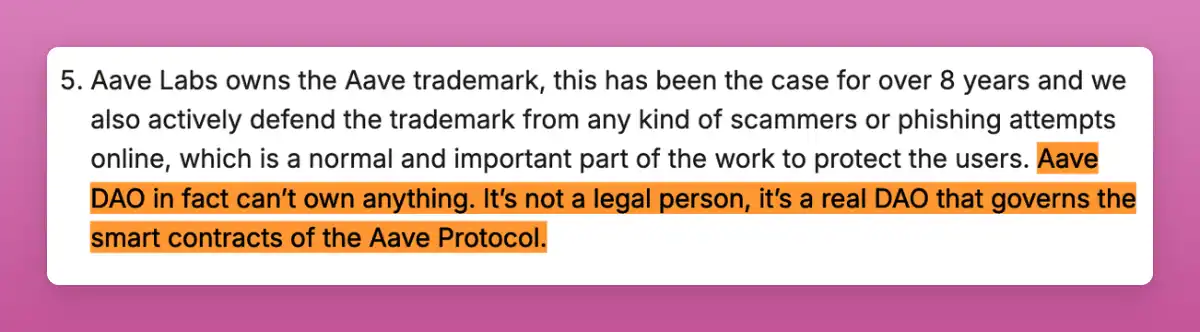
The DAO manages the smart contracts and on-chain parameters of the Aave protocol, but not the brand itself.
However, the DAO has been granted a license to use the Aave brand and visual identity for protocol-related purposes. Past governance proposals explicitly granted the DAO broad rights to use the visual identity "for the benefit of the Aave protocol, the Aave ecosystem, and the Aave DAO."
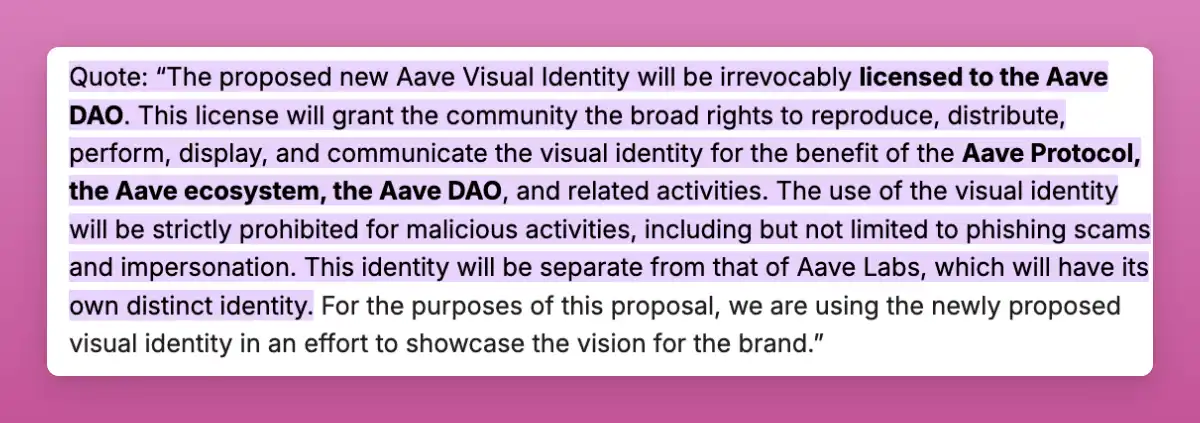
Source: Aave
As EzR3aL stated:
- "Charging this fee is only possible because the Aave brand is well-known and accepted within the ecosystem. This is a brand that the Aave DAO paid to build."
The value of the Aave brand does not stem from a logo.
Its value stems from:
- The DAO carefully managing risks
- Token holders bearing protocol risk
- The DAO paying fees to service providers
- The DAO surviving multiple crises without collapsing
- The protocol earning a reputation for safety and reliability
This is what EzR3aL means by "the DAO paid to build the brand."
Not paid in a legal sense, but paid in an economic sense—through capital, governance, risk, and time invested.
Does this sound familiar?
It harkens back to the similar issue between Uniswap Labs and the Foundation regarding Uniswap front-end fees. Ultimately, Uniswap realigned equity and token holder interests, completely removing the front-end fees.
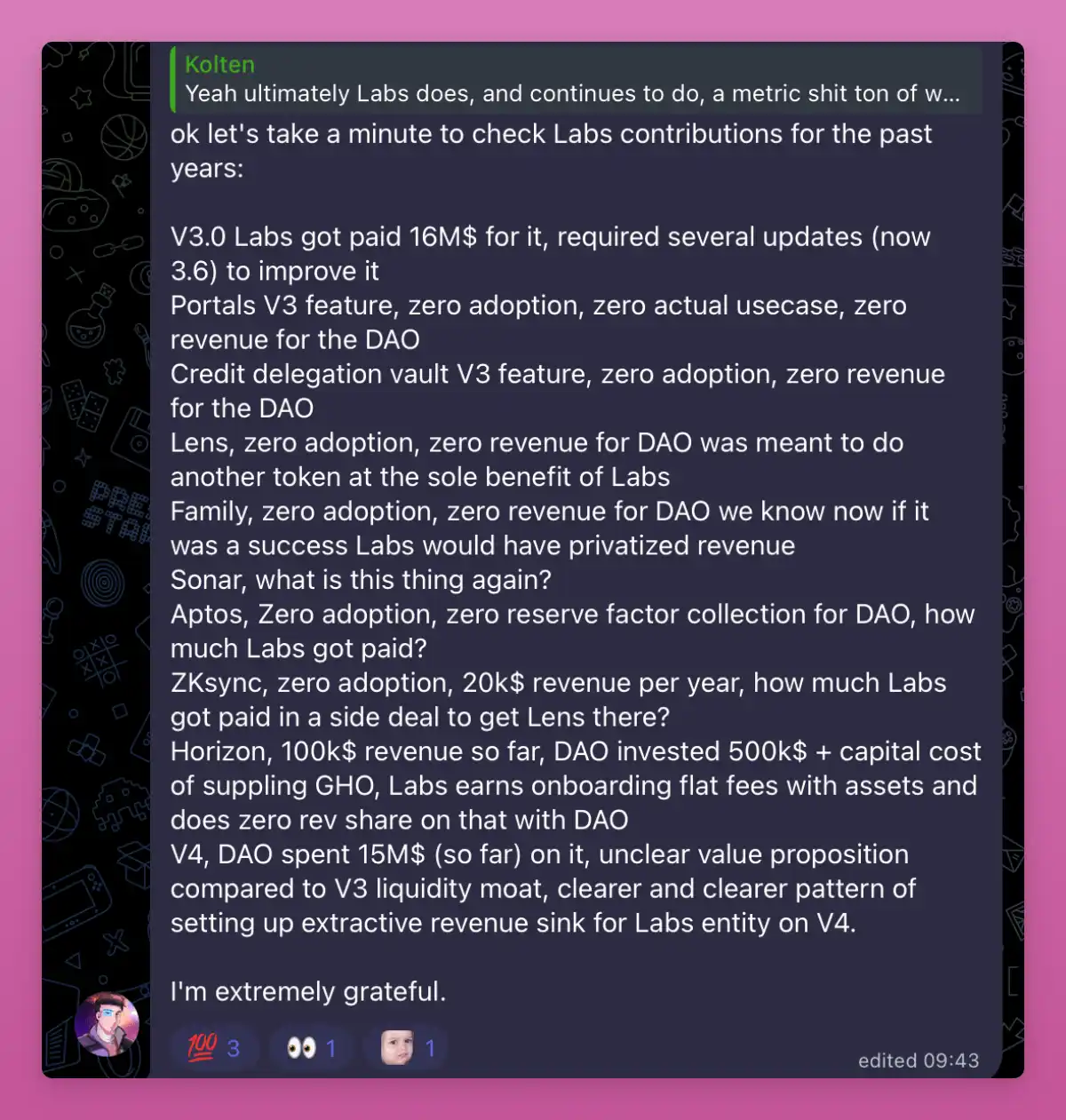
This is why the equity / DAO dynamic can be harmful (this is something I found in a TG group chat).
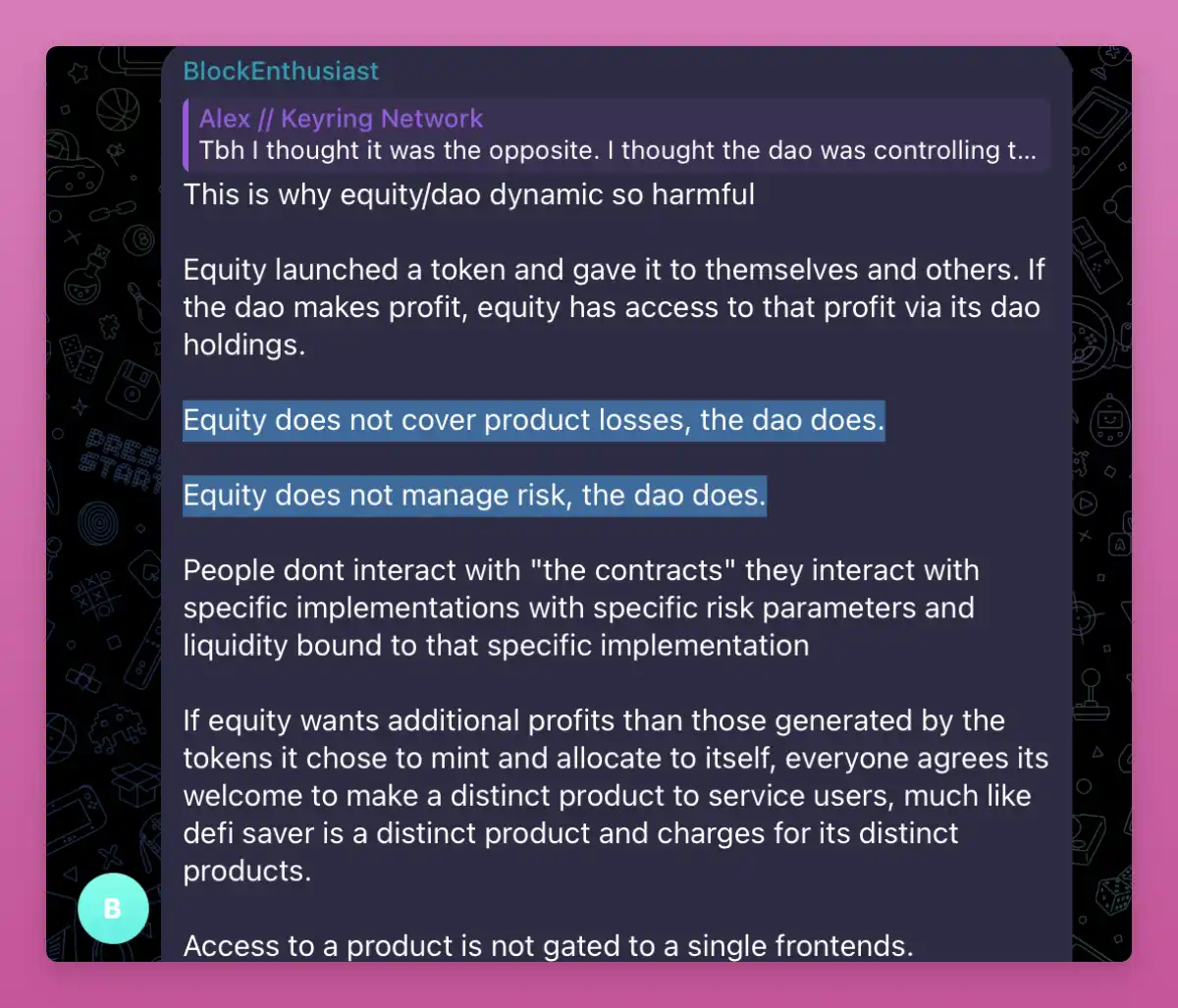
The content of the above image is as follows:
"Equity issued a token and distributed these tokens to itself and others. If the DAO generates profits, Equity can receive profits through its share of tokens in the DAO.
- But Equity does not bear the losses of the product; these losses are borne by the DAO.
- Equity does not manage risk either; risk management is handled by the DAO.
Users do not interact directly with the 'contract' but with specific implementations that have specific risk parameters and liquidity tied to that specific implementation.
If Equity wants to obtain additional benefits beyond the profits generated by the tokens it minted and distributed to itself, everyone agrees it is completely free to develop an independent product to serve users, just as DeFi Saver is an independent product and charges for its unique services.
Access to a product should not be restricted to a single front-end in the first place."
As of writing, the only point Aave Labs agrees with the critics on is communication.
- The truly valid criticism here is about communication. Or rather, the lack thereof.
Things were complicated enough; now they are worse.
Aave Labs proposed Horizon as a dedicated RWA instance.
Initially, the proposal contained something that immediately alarmed the DAO: a new token with a decreasing share of yields.
Representatives from various factions strongly opposed this (including the author), arguing that introducing a separate token would dilute AAVE's value proposition and undermine alignment.
The DAO ultimately won, and Aave Labs was forced to concede. The new token plan was scrapped.
But this created a larger rift.
Despite numerous concerns (one explicitly pointed out the need for clear responsibilities between Aave Labs and the DAO), Horizon was launched. It was the most contentious vote won.
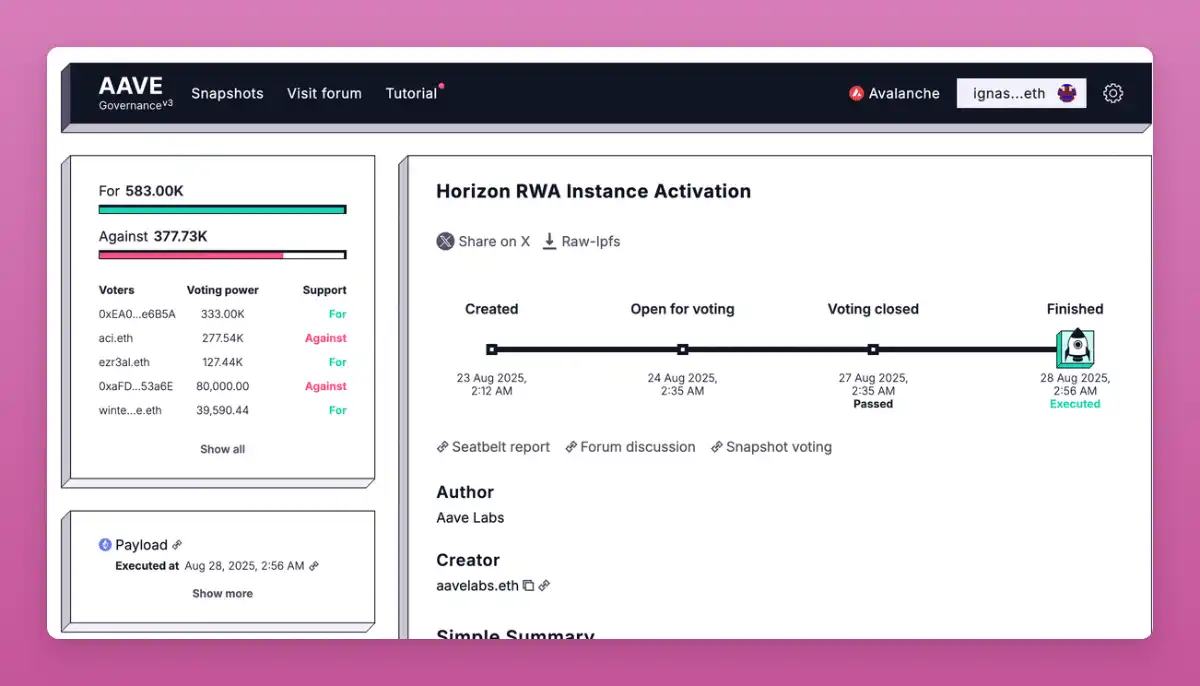
I voted against deployment, advocating for a friendly agreement to prevent future escalation of conflicts. And this is exactly the current situation. Economic issues quickly became the focal point of contention.
According to data cited by Marc Zeller, so far, Horizon has generated approximately $100,000 in total revenue, while the Aave DAO has invested $500,000 in incentives, putting its net book value at around -$400,000.
And this doesn't even account for other factors.
Marc also pointed out that tens of millions of GHO were deployed to Horizon, but their yield is lower than the cost required to maintain GHO's peg.
If these opportunity costs are factored in, the DAO's true economic situation might be worse.
This prompted ACI to raise a question that goes beyond Horizon itself:
If a project funded by the DAO has poor direct economic performance, is that the whole story?
Or, are there additional benefits, integration fees, or off-chain arrangements that token holders cannot see?
Over the years, deployments and plans proposed by multiple Labs have ultimately resulted in costs for the DAO exceeding its benefits.
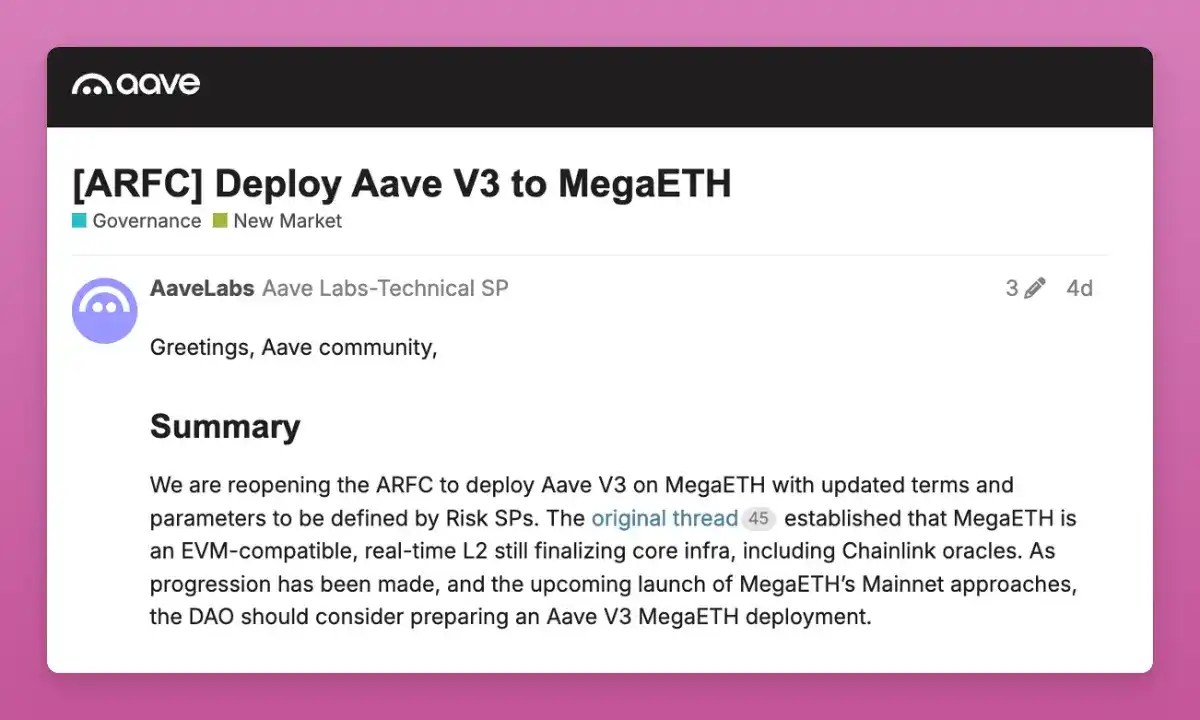
Discussions ensued just days after Aave Labs presented a DAO proposal to deploy Aave V3 on MegaETH.
In return, "Aave Labs will receive 30 million points from MegaETH."
Then, "These points may be distributed as incentives in the Aave V3 MegaETH market according to Aave DAO's GTM strategy."
The problem is that when a product is operated by a private entity, using assets backed by the DAO, transparency is crucial, and incentives must be distributed as agreed.
Source: Aave
The proposal was also surprising for another reason:
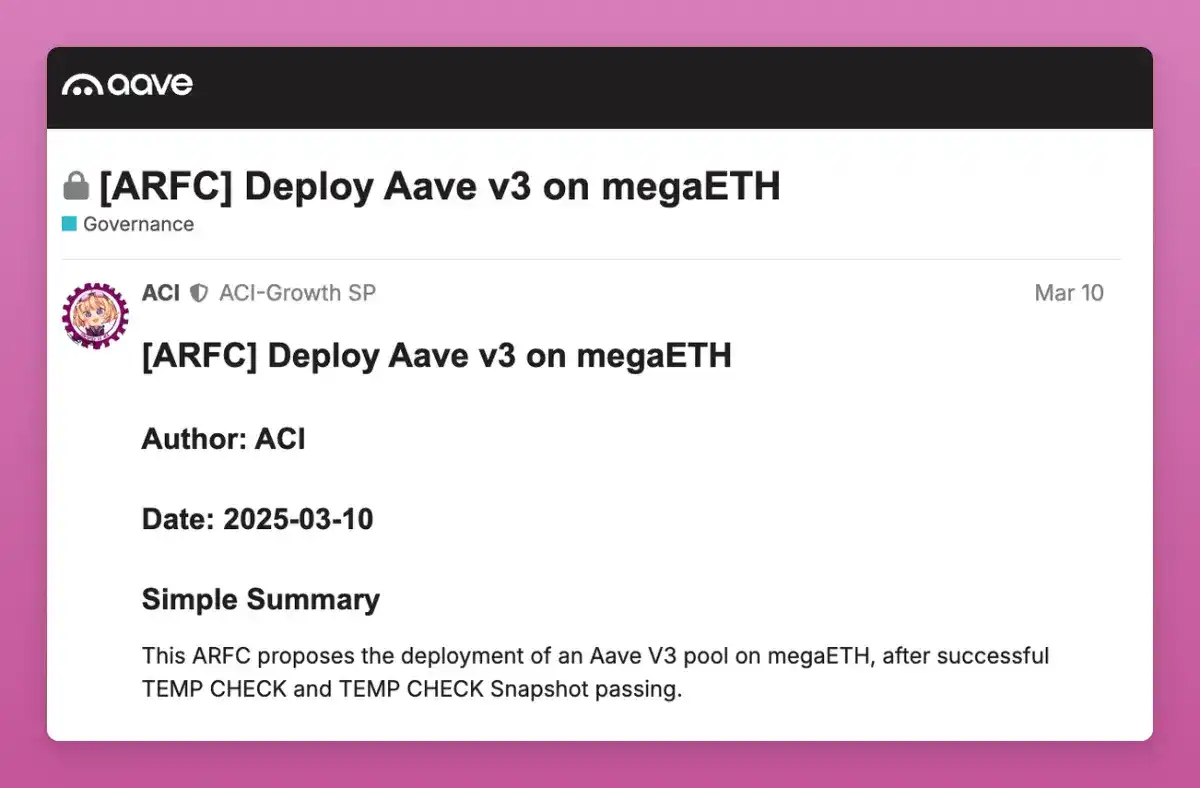
Aave DAO has been working with multiple service providers, notably ACI, which proposed a deployment on MegaETH as early as March. Discussions were still ongoing.
Source: Aave
As Marc commented on the forum:
- "During the ongoing discussion, we were very surprised to find that Aave Labs decided to bypass all precedent, abandon all ongoing progress, and contact MegaETH directly. We only learned about this when the proposal was posted on the forum."
Treasury
Another part of this debate concerns the Aave Vaults.
Aave Vaults are application-level products built and funded by Aave Labs. Technically, they are ERC-4626 vault wrappers built on top of the Aave protocol, abstracting position management for users.
Stani explained this very clearly:
- "Aave Vaults are simply 4626 vault wrappers built and funded by Aave Labs."
From Aave Labs' perspective, this should not be controversial.
The vaults are not protocol components. They do not affect the protocol's profitability.
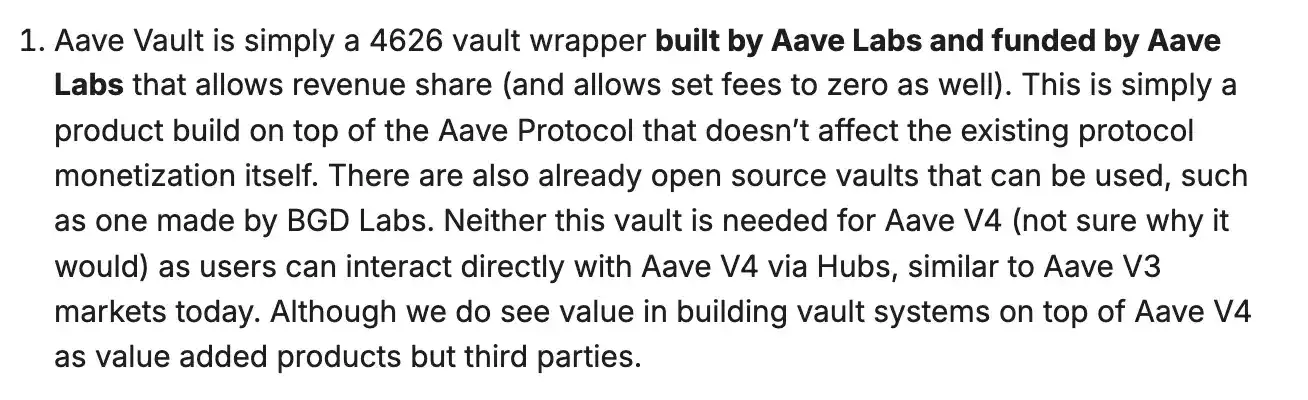
They are optional; users can always interact directly with Aave markets or use third-party vaults.
- "For Aave V4, these vaults are not necessary... users can interact directly with Aave V4 through Hubs."
And because the vaults are a product, Aave Labs believes they have the right to monetize them.
- "It is entirely okay for Aave Labs to monetize its products, especially since they do not involve the protocol itself."
So why are the vaults dragged into this fight?
The reason lies in the distribution channel.
If the vaults become the default user experience for Aave V4, then a Labs-owned, Aave-branded product could become the bridge between the user and the protocol, charging transaction fees while relying on the reputation, liquidity, and trust accumulated by the DAO.
Even as adoption of Aave products increases, the AAVE token could be negatively impacted.
Again, the author believes this issue falls into the same category as the debate between Uniswap Labs and the Foundation regarding front-end products.
In summary, CowSwap, Horizon, MegaETH, and Aave Vaults all face the same core issue.
Aave Labs sees itself as an independent builder, operating an opinionated product on top of a neutral protocol.
The DAO increasingly sees protocol value being monetized outside its direct control.
The Aave DAO does not own the intellectual property, but it has been granted a license to use the Aave brand and visual identity for protocol-related purposes.
This debate is crucial because the upcoming Aave v4 version is explicitly designed to move complexity from the user side into abstraction layers.
More routing, more automation, and more products sitting between the user and the core protocol.
More abstraction means more control over the user experience, and user experience control is key to value creation/extraction.
This article strives to remain neutral. However, it is hoped that a consensus can be reached regarding value capture for $AAVE token holders.
The author hopes the consensus reached will not only benefit Aave itself but also because Aave sets an important precedent for how equity and tokens can coexist.
Uniswap Labs has already gone through this process and ultimately aligned the outcome in favor of $UNI holders.
Aave should do the same.
Related reading: Uniswap Protocol Fee Distribution Proposal Ignites the Market, What Impact Does It Have on the Future of DeFi?