Lightning Strikes Big: Bitcoin Layer-2 Surpasses $1 Billion In Monthly Activity

bitcoinistPublished on 2026-02-21Last updated on 2026-02-21

Abstract

Bitcoin's Lightning Network, a layer-2 scaling solution, surpassed $1.1 billion in monthly transaction volume in November, processing over 5 million transactions. This growth is increasingly driven by institutional players like exchanges and trading desks, rather than small-scale hobbyist use. A notable example includes a million-dollar transfer between Secure Digital Markets and Kraken, demonstrating the network's capacity for large, rapid settlements. Network capacity also reached a high of 5,606 BTC in December, improving liquidity for larger transactions. Despite mixed market conditions and Bitcoin's price volatility, Lightning activity continued to grow independently of price action. The network enables fast, low-cost payments by processing transactions off-chain, settling only net balances on the main blockchain. While future growth may be fueled by AI-driven micro-payments, broader adoption still depends on increased exchange support, liquidity, and merchant integration.

A clear sign of more than hobbyist use: monthly Lightning activity climbed past a big mark late last year. According to a report from River, November saw about $1.1 billion flow over the Bitcoin network.

That money, according to a report shared by River’s marketing chief Sam Wouters, moved through over 5 million transactions, which shows both volume and movement. It matters because money actually changed hands on Bitcoin’s second layer, not just price bets.

Adoption Driven By Bigger Players

Reports say many of the biggest gains were not from tiny tips or in-app experiments this time. Exchanges and merchant integrations are carrying a lot of the load.

Back in 2023, monthly transactions peaked at 6.6 million as apps tried out micropayments in gaming and chat. Now the shape of use looks different. Average payment sizes appear larger and the profile of users has shifted toward trading desks and businesses.

Institutional Transfers Show Network Muscle

A striking example came when Secure Digital Markets routed a million-dollar Lightning Network transfer to Kraken. That move showed big sums can be shifted quickly without waiting for on-chain confirmation.

Network capacity, which measures BTC tied up to keep channels open, reached 5,606 BTC in December. That increased liquidity matters for larger deals because it lowers the chance a large payment will fail for lack of routed funds.
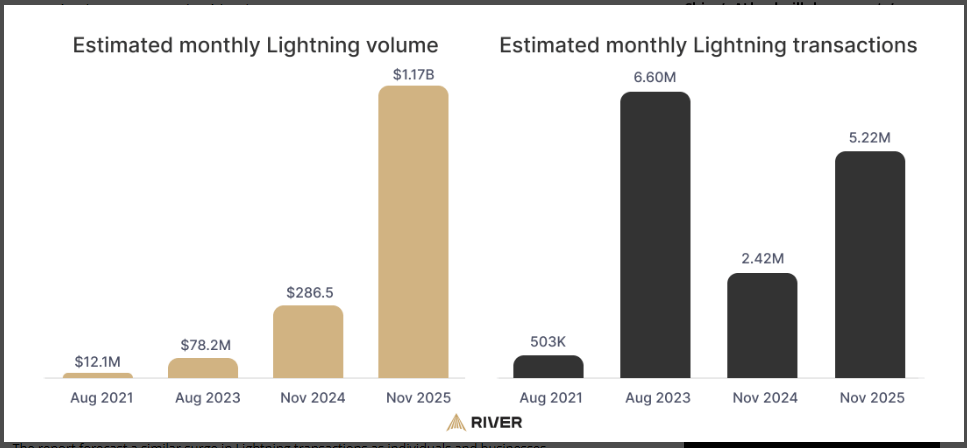
Estimated monthly Lightning transaction volume and number of transactions. Source: River

Bitcoin Price Action And Market Mood

Market conditions were mixed as the network grew. Bitcoin slid under key levels this week, and traders grew cautious as geopolitical headlines piled up.

Volume in spot markets has been muted at times, yet Lightning traffic rose despite that. Price swings still happen, and low trading days tend to amplify those moves, but the network’s payment activity did not simply mirror price spikes. In short, payments rose while BTC sometimes moved sideways.
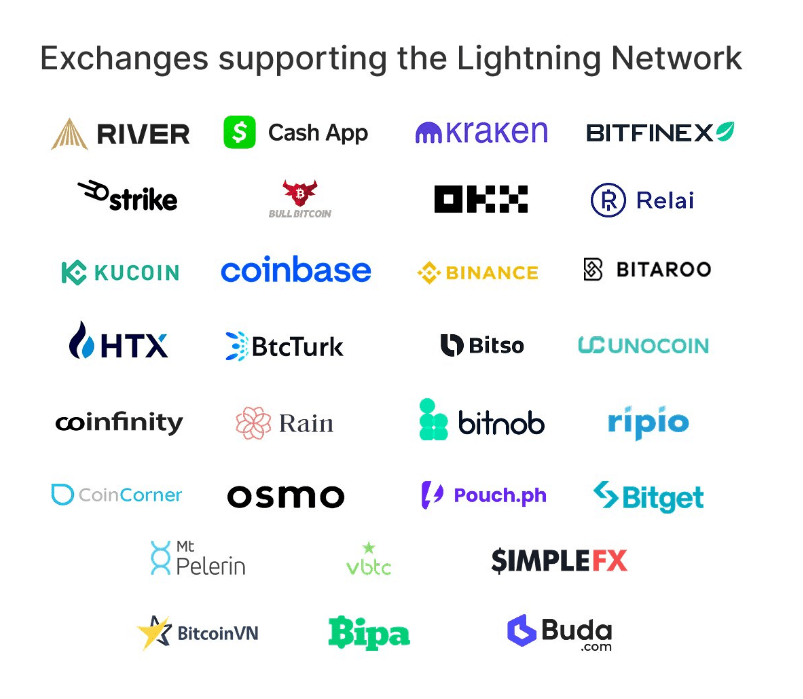
Some of the companies that provide Bitcoin Lightning Network services. Source: River

Why Lightning Is Different

The Lightning Network moves payments off the main chain by opening channels between parties. Transactions inside a channel settle almost instantly and at a fraction of the cost of a typical on-chain transfer.

Only the channel’s net balance is posted to Bitcoin when it’s closed. That design makes small and frequent payments practical, and it removes the 10-minute wait that can ruin buying something at a store.

BTCUSD now trading at $67,116. Chart: TradingView

Reports say Lightning transactions could climb if AI systems begin making automatic micro-payments for data and computing, but that shift still needs better software and clearer business models.

For the time being, the network’s growth signals progress toward everyday Bitcoin payments, though broader exchange support, deeper liquidity, and stronger merchant use will decide whether it becomes a common payment rail or stays a niche tool.

Featured image from Unsplash, chart from TradingView

Trending Cryptos

Related Questions

QWhat was the total value of transactions processed by the Bitcoin Lightning Network in November, as reported by River?

AThe total value of transactions processed by the Bitcoin Lightning Network in November was approximately $1.1 billion.

QAccording to the article, what is a key factor driving the recent adoption of the Lightning Network, as opposed to earlier experiments?

AThe recent adoption is being driven by bigger players such as exchanges and merchant integrations, rather than just small tips or in-app micropayment experiments.

QWhat was the significance of Secure Digital Markets routing a million-dollar transfer to Kraken on the Lightning Network?

AIt demonstrated that the network is capable of handling large financial transfers quickly without the need to wait for on-chain confirmations, showcasing its institutional utility.

QHow does the Lightning Network's design make it suitable for small, frequent payments compared to on-chain transactions?

AIt opens payment channels between parties, allowing for instant, low-cost transactions that are settled off-chain. Only the net balance of a channel is posted to the Bitcoin blockchain when it is closed, eliminating the typical 10-minute wait for on-chain confirmations.

QWhat does the article suggest is needed for the Lightning Network to evolve from a niche tool into a common payment rail?

ABroader exchange support, deeper liquidity, and stronger merchant adoption are needed for the Lightning Network to become a common payment rail.

Related Reads

Bitcoin Mining Farms Are Becoming AI Factories

Bitcoin mines are transforming into AI factories. This shift is driven by the convergence of three key assets from the previous crypto cycle: infrastructure, talent, and capital. Crypto mining companies like Crusoe, CoreWeave, and Bitdeer are repurposing their core competency—securing power, land, and grid connections in remote locations—to build data centers for AI clients. These firms are signing multi-billion dollar, long-term contracts with companies like Anthropic, AWS, and Microsoft, as AI's demand for reliable, high-capacity compute surpasses the profitability of Bitcoin mining. Simultaneously, crypto entrepreneurs and engineers are applying their skills to new AI ventures. Examples include OpenSea's co-founder launching OpenRouter (an AI model aggregator), and former Coinbase engineers building Fal.ai (a generative media infrastructure platform). Their experience in building scalable, global software networks translates effectively to the AI space. Furthermore, capital accumulated during the crypto boom is now fueling AI. Figures like Jed McCaleb (co-founder of Ripple) funded Voltage Park, a large-scale GPU cloud provider. Notably, some crypto investments, like FTX's early bets on Anthropic and Cursor, have generated astronomical paper returns, demonstrating how high-risk crypto capital flowed into AI before it became mainstream. The transition is not just about repurposing hardware, but about redirecting critical resources—power infrastructure, distributed systems expertise, and venture funding—to the next technological frontier: artificial intelligence.

链捕手1h ago

Bitcoin Mining Farms Are Becoming AI Factories

链捕手1h ago

Morpho Launches Fixed-Rate Product Midnight: Lenders and Borrowers Set Their Own Rates, Ending the Era of Interest Rate Models

Morpho Launches Fixed-Rate Product Midnight: Lenders and Borrowers Set Their Own Rates, Ending the Era of Algorithmic Interest Models On-chain lending has grown to $60 billion but remains minuscule compared to traditional finance's $200 trillion annual credit volume. Morpho identifies the lack of fixed rates and maturity dates as key bottlenecks. Institutions need predictability, not the passive floating rates set by algorithmic models. Midnight allows lenders and borrowers to directly quote rates, set terms, and become price makers, not takers. Fixed-rate lending is now viable due to cheaper, faster blockchains and the entry of institutions demanding control and certainty over returns, costs, and duration. Morpho Blue previously gave users control over risk; Midnight adds control over interest rates. Past attempts at on-chain fixed-rate lending failed primarily because they were built on top of floating-rate pools (creating unpredictability) or lacked sufficient active participants. Midnight avoids these pitfalls as a standalone primitive with fixed rates at its core, built upon Morpho Blue's existing large and active user base. Midnight offers distinct value: institutions gain predictable term structures and full control; fintech companies can offer tailored fixed-rate products; lenders/borrowers achieve predictability and efficiency; and curators can now differentiate by configuring both risk and interest rates. Morpho Midnight is not a replacement for Morpho Blue. The Morpho network will now feature two complementary market structures: floating-rate/open-term (Blue) for flexibility and fixed-rate/fixed-term (Midnight) for predictability. Liquidity can flow between them. The launch will be gradual, prioritizing security. Initially, it will support direct lending on Base network with one trading pair (cbBTC/USDC) and limited maturity dates. Advanced features like auto-rollovers will be introduced later.

marsbit1h ago

Morpho Launches Fixed-Rate Product Midnight: Lenders and Borrowers Set Their Own Rates, Ending the Era of Interest Rate Models

marsbit1h ago

Trading

Spot

Hot Articles

Discussions

Welcome to the HTX Community. Here, you can stay informed about the latest platform developments and gain access to professional market insights. Users' opinions on the price of LAYER (LAYER) are presented below.

活动图片